

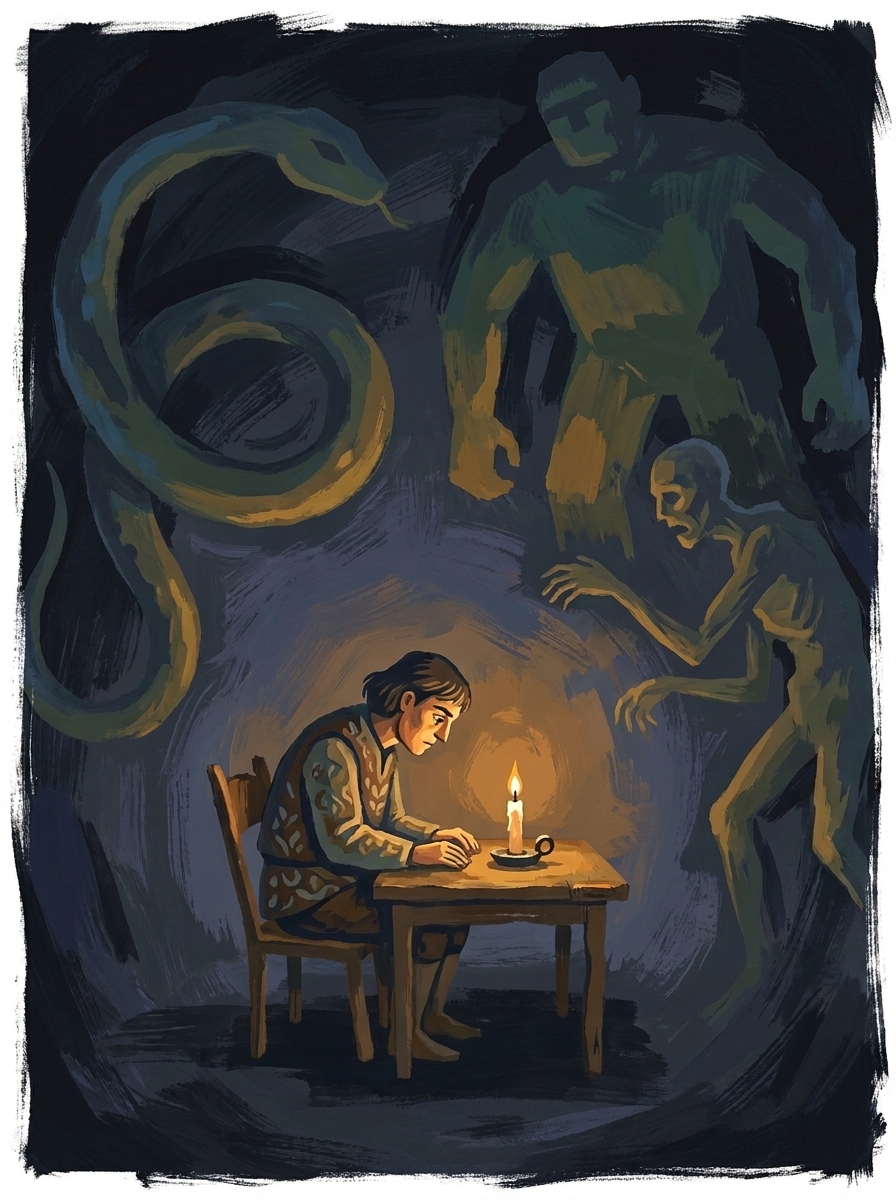
Turn the lights off. Not for a moment — for a minute. Long enough for the afterimage of the room to dissolve, for the visual cortex to run out of input, for the brain to face the absence of signal. Something happens in that silence that we tend to describe as imagination but that operates closer to compulsion. The dark fills. It fills itself. And what it fills with — the shapes, the presences, the figures at the edge of the bed — is not random. It is not you, not exactly. It is something older than you, running a program you did not write.
Every human culture that has left a record has populated its darkness with the same figures. Not the same names, not the same costumes, not the same narrative traditions — but the same categories, recurring with a regularity that demands explanation. The ghost. The shapeshifter. The walking corpse. The charming parasite. The neighbor who poisons from within. The giant who eats children. The trickster who weaponizes language. The beautiful thing that drowns you. The cosmic adversary. The serpent coiled beneath the world. Ten figures. Ten thousand regional skins. One species, filling the dark the same way for as long as it has had the cognitive equipment to do so.
This is a book about why the monsters are always the same.
The standard answers are not wrong, but they are shallow. You will hear that monsters reflect cultural anxieties — that the vampire is about sex, the zombie about consumerism, the werewolf about repressed masculinity. These readings are real as far as they go. A culture does dress its anxieties in monstrous clothing, and the clothing changes as the anxiety does. But the readings explain the surface and miss the substrate. They explain why the vampire became Byronic in the nineteenth century but not why the blood-drinking dead appear in Romania, West Africa, Southeast Asia, and Mesoamerica, in cultures that never exchanged a word. They explain why the zombie movie flourished in the 1970s but not why the revenant — the corpse that will not stay buried — has haunted every known civilization since the earliest funerary practices.
The cultural-anxiety reading treats the monster as a mirror. I want to treat it as a fossil. Not a reflection of what a society fears at a given moment, but a trace of what the human mind does when its perceptual systems fire without supervision.
Here is the argument in its simplest form: no cognitive system evolved for ghosts. No neural circuit was selected because it helped our ancestors detect werewolves. But several systems that did evolve for other purposes — agency detection, theory of mind, contamination avoidance, predator recognition, kin discrimination, threshold sensitivity — produce monsters as a byproduct when they run in the dark, in grief, in isolation, in the space between sleep and waking. The ghost is what happens when the person-tracking system cannot accept that the body has stopped. The shapeshifter is what happens when the recognition system discovers that the face it trusted belongs to something else. The revenant is the body stripped of its mind, triggering the contamination circuits that make corpses sticky and dangerous. The vampire is the predator who learned our manners.
Each of these figures traces to a specific collision between a cognitive mechanism and an ancient anxiety. The mechanism is species-wide. The anxiety is species-wide. The figure is therefore species-wide — not because cultures copied each other, but because they were all running the same hardware.
I want to be careful with that metaphor, because it risks sounding like the kind of evolutionary psychology that got sloppy in the 1990s — the kind that saw an adaptive module behind every human behavior and treated the Pleistocene like a user manual for the modern mind. I am not claiming that monster-belief is adaptive, that there is a ghost module in the brain, or that any of these figures is hardwired in the way hunger or thirst is hardwired. The claim is narrower and, I think, stronger: these figures are byproducts, not adaptations. They are what the mind produces when genuinely adaptive systems — the ones that detect predators, track agents, monitor social belonging, flag contamination — collide with conditions those systems were not designed for. The dark bedroom. The three-day vigil beside a body. The stranger who speaks your language but does not share your gods. The crossing at the river where the water moves faster than you can swim. In each of these conditions, a system that evolved for good reasons fires in a context that produces a specific kind of false positive. And the false positive has a shape. It has the same shape every time.
This is why the serial killer does not belong on the list. Or the mad scientist. Or the terrorist, the cult leader, the corporate villain, the rogue AI. These are real-world threat categories, minted by the world as it changes shape. The serial killer in his modern form is roughly fifty years old — a product of the FBI's Behavioral Science Unit, the Bundy and Gacy media cycle, the true-crime paperback shelf at the airport. He works in fiction precisely because he borrows from the older bestiary. Strip Hannibal Lecter to his moving parts and you find the demon's articulate menace, the witch's intimate cunning, the ogre's appetite for human flesh, the trickster's fluency with language. He is a costume rack of the deep figures, not a new entry among them.
The same is true of aliens. The Grey with the abduction beam reproduces the hag, the changeling, and the demon almost feature for feature: the paralyzed sleeper, the stolen child, the creature that enters uninvited from a dimension the human cannot reach. The body-snatcher is the doppelgänger crossed with the revenant. The benevolent visitor is the ancestor spirit or the angel, dressed in chrome instead of light. Strip the technology and the seams underneath are the same ten. Aliens are not an embarrassment to this thesis. They are its cleanest proof — evidence that the cognitive substrate keeps generating the figures regardless of what the surrounding cosmology allows us to call them.
Now, the honest objection. A cognitive-byproduct account risks explaining too much — collapsing every monster into neuroscience and leaving no room for the thing that makes monsters actually matter, which is the cultural work they do. If the ghost is just a misfiring person-tracker, why do ghost stories carry moral weight? If the dragon is just an upscaled predator schema, why does nearly every culture that has one also worships it, or at least treats it as a figure worthy of awe rather than mere fear? The byproduct account explains the recurrence but not the persistence. A genuine byproduct — a cognitive hiccup, a perceptual error — should be correctable. We should be able to educate it away, the way we educate away the intuition that heavier objects fall faster. But the figures do not go away. They change their clothes and keep arriving.
This is where the argument turns. The figures persist not because the mind cannot stop producing them — though it cannot — but because the production turns out to be useful. Not useful in the narrow evolutionary sense of keeping you alive long enough to reproduce. Useful in the broader sense of encoding truths the species needs to carry but cannot carry in propositional form. The ghost encodes the truth that love does not end when the body does, and that the labor of grief is real labor with real obligations. The shapeshifter encodes the truth that the person you trust may not be what you think — and may not be what they think. The ogre encodes the truth that authority can become predatory, that the figure charged with protecting children can be the one that consumes them. These are not pleasant truths. They are not truths that survive well in direct argument, because direct argument invites direct rebuttal, and the rebuttal is always the same: surely not, surely that is too dark, surely the system works, surely the adults in the room can be trusted. The monster bypasses the rebuttal. It delivers the warning below the threshold of rational objection, where it lodges and does its work for decades.
This is what I mean when I say the monsters carry information that direct argument cannot. They are not illustrations of ideas that could be stated more clearly in prose. They are a delivery system for knowledge that prose would reject. You cannot tell a child that some adults will harm them and expect the warning to land with the force it needs. But you can tell them about the ogre, and the ogre will operate beneath conscious thought for forty years, firing every time the child — now grown — encounters the pattern the figure was built to detect.
Which brings us to the betrayal.
When the figures are hollowed out — when the Disney witch carries no warning, when the Marvel demon flatters its audience with the aesthetic of evil stripped of its moral weight, when the romantic vampire is rebuilt as a marketing exercise for adolescent desire, its parasitism scrubbed clean — the protection vanishes with the figure. The shell remains. The costume is still recognizable. But the information the figure was built to carry has been removed, and what is left is a product that looks like a monster in the same way a stuffed animal looks like a predator. The shape is there. The teeth are there. The thing it was for is gone.
This is not a stylistic choice. It is not a neutral act of modernization, the kind of updating a culture does to keep its stories fresh. It is a specific loss, and it leaves the species less equipped to recognize what the figures were built to flag. The species kept these figures dangerous for forty thousand years. In cave paintings and funerary rites, in oral traditions that survived the death of the languages that carried them, in the bedtime stories parents told children to teach them what the world contains — the figures endured because they did a job. To hollow them for product is not creative license. It is a cultural lobotomy performed in the name of palatability.
I am not arguing for superstition. I am not arguing that we should believe in ghosts or avoid crossroads after dark or refuse to cross moving water without a prayer. I am arguing that the figures themselves — the shapes the mind makes when it fills the dark — are not junk. They are not errors to be corrected, childish fears to be outgrown, or quaint survivals to be preserved under glass in the folklore wing of the university. They are the visible output of a system that does real cognitive and cultural work, and understanding that work — naming the seams, tracing the figures, reading the fill — is the business of this book.
The ten essays that follow move inside-out, tracking how the darkness fills the mind from the body outward to the cosmos. We begin in the room with the dead — the ghost, the figure closest to the self, the one the person-tracker will not release. We move to the mirror and the shapeshifter, the face that is and is not yours. To the floor and the revenant, the body that refuses its function. To the table and the vampire, the predator who sits where the guest should be. To the edge of the village and the witch, the harm that comes from within. To the wall and the ogre, the hunger that exceeds the boundary. To the crossroads and the trickster, the stranger who weaponizes the exchange. To the water and the drowner, the lure at the threshold you cannot fight on. To the adversary behind the world and the demon, the figure that gives evil an ontological address. And finally to the coil at the world's root — the dragon, the only monster on this list that can also be a god, the fear that swallowed worship.
A closing essay returns to ask what, exactly, the monsters protect — and what it costs us when we let them stop.
The dark is still being filled. Every night, in every bedroom, in every culture, the perceptual systems go quiet and the deeper machinery takes the stage. The figures that arrive are the ones that have always arrived. The question this book asks is not whether they will keep coming. They will. The question is whether we will read them — whether we will trace the seam or seal it over, listen to what the fill is telling us about the architecture underneath, or sand it down to a silhouette and sell it on a lunchbox.
The first essay begins with the person who is gone and the mind that will not stop tracking them.
Turn the lights off. Wait a full minute. The dark doesn't stay empty. Your brain fills it — with shapes, with presences, with the feeling that something is standing just past what you can see.
Here's the strange part: every human culture fills it with the same things.
The Same Monsters, Everywhere
Ghost. Shapeshifter. Walking corpse. Vampire. Witch. Giant that eats children. Trickster who twists your words. Beautiful thing that drowns you. Demon. Dragon. Ten figures. They show up in cultures on every continent, in societies that never had contact with each other. The names change. The costumes change. The creatures underneath don't.
The usual answer is that monsters reflect what a culture is afraid of. The vampire is about sex. The zombie is about consumerism. The werewolf is about repressed anger. These readings aren't wrong, but they're shallow. They explain why the vampire got a cape in the 1800s. They don't explain why blood-drinking dead people show up in Romania, West Africa, Malaysia, and Mexico, in cultures that never exchanged a word.
This book treats monsters as fossils, not mirrors. Not reflections of what a culture fears right now, but traces of what the human mind does when its systems fire in the dark.
Your Brain Makes These
No part of your brain evolved to detect ghosts. No circuit was built for werewolves. But several systems that did evolve for real purposes — spotting predators, tracking faces, detecting cheaters, flagging contamination — produce monsters as a side effect when they run without real input.
Your agent-detector is jumpy on purpose. It's cheaper to flinch at a shadow than to miss a real threat. Your mind tracks bodies and minds through two separate systems, and those systems don't always agree — which is why the mind can "persist" after the body dies. Your disgust system treats dead things as dangerously contaminated, far past any actual risk. Your face-reading system sounds an alarm when a face doesn't match what it should be.
Put these systems in the dark. In grief. In isolation. In the silence of a house that used to hold someone who's gone. The systems fire, the corrections don't come, and the output has a shape. The same shape. Every time.
Why Serial Killers Don't Count
You might wonder: why these ten and not, say, the serial killer? Or the evil AI? Or the alien?
Because those are threat categories invented by the modern world. The serial killer is about fifty years old. Hannibal Lecter works in fiction because he borrows from the older list — the demon's intelligence, the witch's intimacy, the ogre's appetite. He's a costume rack, not a new creature.
Aliens are even more telling. The Grey with the abduction beam is the hag, the changeling, and the demon dressed in chrome. Strip the technology and the same ten figures are underneath. Aliens don't disprove the thesis. They're the strongest evidence for it.
What the Monsters Carry
Here's where it gets important. These figures aren't junk. They're not errors to outgrow. They carry information.
The ghost carries the truth that grief takes real time and real labor. The shapeshifter carries the warning that the person you trust might not be what they seem. The vampire carries suspicion of deals that feel like desire but are actually extraction. The ogre carries the hardest truth of all — that authority can turn predatory, that the figure built to protect the child can be the one that eats it.
These aren't truths that survive well in direct argument. Tell a child "some adults will hurt you" and the warning slides off. Tell them about the ogre and the warning sticks for forty years, running beneath conscious thought, firing every time the pattern shows up in real life.
Monsters smuggle knowledge past the part of your brain that would reject it if it were stated plainly.
The Betrayal
When the monsters are hollowed out — when the Disney witch carries no warning, when the Marvel demon is just a cool action villain, when the romantic vampire has its parasitism scrubbed clean — the information disappears with the figure. The shape is still there. The teeth are still there. But the thing it was for is gone.
The species kept these figures dangerous for forty thousand years. In cave paintings. In bedtime stories. In rituals that survived the death of the languages that carried them. They lasted because they did a job. Hollowing them for product isn't creative freedom. It's removing a warning system and calling it entertainment.
What Comes Next
This book follows the darkness as it fills — from the body outward to the cosmos. We start in the room, with the dead. We end at the root of the world, with the dragon. Between them, the fill expands, and the figures grow with it.
The dark is still being filled. The same systems are still running. The same shapes are still arriving.
The only question is whether we'll let them mean something.