

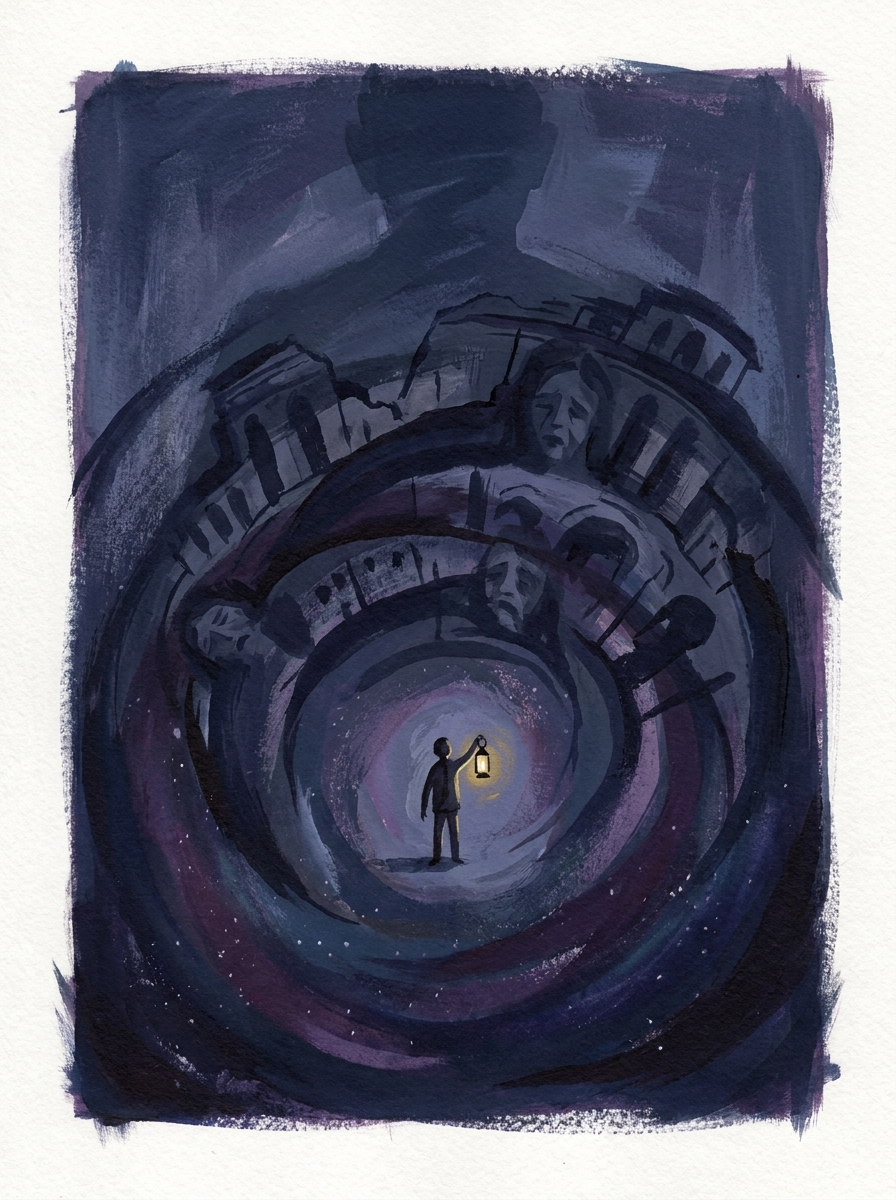
Somewhere around the sixth century BCE, a priest or a poet or a prophet — the historical record does not distinguish cleanly among these roles in ancient Persia — made a move that changed the architecture of the human imagination. Zoroaster, or the tradition that carries his name, divided the cosmos into two opposed forces: Ahura Mazda, the lord of truth and order, and Angra Mainyu, the destructive spirit, the adversary. The innovation was not that evil existed. Every culture before Zoroaster knew that. The innovation was that evil had a mind. That it had intention. That behind the suffering and cruelty and entropy of the world stood not blind mechanics but an agent — a personality who opposed the good, who worked against it with intelligence and purpose, who could be named and therefore, at least in theory, opposed.
This is the demon's founding act: giving evil an ontological address. Not evil as behavior — humans behaving badly, predators doing what predators do — but evil as a force with its own agency, its own strategy, its own stake in the outcome of the human story. The demon is the figure that answers the question every moral consciousness eventually asks: why is the world like this? And the answer it provides — because something is making it this way, on purpose — is the most psychologically satisfying answer the species has found, which is why the figure has survived every attempt to retire it.
The cognitive substrate is the in-group calibration system scaled to the cosmos.
At the local level, in-group calibration sorts the world into us and them — allies and enemies, the trusted and the suspect. At the village level, it produces the witch and the shapeshifter: figures of hidden threat within the community. At the national level, it produces the barbarian, the invader, the enemy civilization whose values oppose your own. The demon is what happens when the system scales all the way up — when the in-group becomes not a tribe or a nation but a moral universe, and the out-group becomes not a neighboring people but a cosmic adversary whose opposition to everything you value is total, personal, and permanent.
This scaling requires a second system: what I have been calling cosmic agency throughout this series. It is the extension of the agency-detection apparatus — the same system that finds watchers in empty rooms and presences behind closed doors — to the structure of the universe itself. The agent-detector, running at cosmic scale, does not merely find a presence in the dark of the bedroom. It finds a presence behind the dark of the world. It finds a mind in the pattern of suffering. It finds a will in the arrangement of misfortune. The demon is the output of the agent-detector aimed at existence itself: the answer to "why do bad things happen?" that says bad things happen because something wants them to.
Jonathan Haidt's work on moral foundations helps explain why the figure persists with such tenacity. Haidt identified five (later six) foundational moral intuitions that appear across cultures: care/harm, fairness/cheating, loyalty/betrayal, authority/subversion, and sanctity/degradation. The demon engages all of them simultaneously. It harms. It cheats — it offers false bargains, inverts the terms of exchange. It betrays — it was, in many mythologies, once an ally of the good who turned. It subverts authority — the demon operates precisely by undermining legitimate order. And it degrades the sacred — the demon's signature move, across nearly every tradition, is the inversion of the holy, the corruption of what was pure. No other figure on this list activates the full spectrum of moral intuition. The ghost engages care. The shapeshifter engages loyalty. The vampire engages fairness. The demon engages everything.
This is why the demon requires a moralized cosmos. In a universe where good and evil are behavioral descriptions rather than ontological categories — where "evil" means "doing things that cause suffering" and nothing more — the demon has nowhere to stand. It becomes a metaphor, and metaphors are weaker than presences. The demon bites hardest in cosmologies where the universe has a moral structure, where good and evil are not just descriptions of behavior but forces that exist independently of human action, where the fact that children suffer and good people fail and cruelty prospers is not an accident but an assault.
The Mesopotamian demon is the oldest documented version. Pazuzu — later made famous by The Exorcist, but ancient long before William Peter Blatty borrowed him — is a wind demon, a bringer of drought and famine, a figure associated with the southwest wind that blew from the desert and killed crops. But Pazuzu is not merely a weather event with a face. He is a personality. He has intentions. The Mesopotamian pantheon is full of demons with specific portfolios — Lamashtu who kills infants, the utukku who haunt the wilderness, the edimmu who are the unburied dead — and each of them operates not as a random force but as an agent with motives. The suffering they cause is not meaningless. It is personal.
The Christian Devil synthesized several of these strands into a single figure of extraordinary narrative power. The Hebrew śāṭān — "the adversary" — begins in the book of Job not as God's enemy but as a member of the divine court, a prosecutor whose role is to test human faithfulness. By the New Testament, the figure has been promoted: he is the prince of this world, the tempter in the wilderness, the ruler of a kingdom of fallen angels. By the medieval period, he has acquired a biography — the Lucifer myth, the brightest angel who fell through pride — and a visual identity, and a portfolio that encompasses every form of evil the human mind can produce. The Christian Devil is the demon perfected: a single adversarial intelligence behind all the world's suffering, powerful enough to challenge God, personal enough to tempt individuals, and narratively satisfying in a way that abstract explanations of evil never are.
Buddhist Mara operates on a different mechanism but engages the same seam. Mara does not rule a kingdom of fallen angels. Mara is the tempter at the threshold of enlightenment — the figure who appears to the Buddha on the night of his awakening and deploys every weapon available to prevent the crossing: desire, fear, doubt, the attachment to the self that enlightenment requires the practitioner to release. Mara is not evil in the cosmic-warfare sense. Mara is the name for everything in the mind that resists liberation. The demon here is not external. It is the internal adversary — the cognitive resistance to the surrender of the ego. But the structure is the same: an agent behind the suffering, a mind opposing the good, a figure that makes the obstacle personal.
The Japanese oni — the horned, club-carrying demons of Japanese folklore and Buddhist cosmology — range from terrifying to comic, from figures of cosmic punishment to figures of seasonal festival. The oni of the setsubun ritual, chased from the house with thrown soybeans, is the demon domesticated — reduced to a nuisance the household can manage. The oni of Buddhist hell paintings is something else entirely: a torturer of the damned, a figure of moral consequence operating in a cosmology where action and suffering are linked by karmic law. The distance between the festival oni and the hell oni is a measure of the distance the demon travels as the moral cosmos expands and contracts around it.
The Egyptian Apophis — the chaos serpent who attacks Ra's solar barge each night as it passes through the underworld — is the demon at its most cosmological. Apophis does not tempt. He does not bargain. He does not offer the seductions that the Christian Devil or Mara deploy. He simply opposes. He is the force that tries to prevent the sun from rising, and every night the gods must fight him, and every morning the sun rises because the fight was won. Apophis is the demon as pure opposition — the adversary who exists not because he wants something but because creation itself requires an opponent. Without Apophis, the sun does not rise. Without the daily battle, the cosmos does not renew. The demon here is not a flaw in the system. It is a structural feature, and the horror is that the fight never ends.
The honest counterargument is the Enlightenment one, and it is powerful: the demon is a category error. Evil is not a force. It is a description of human behavior under specific conditions — poverty, trauma, ideology, institutional failure, the ordinary operation of self-interest in systems that do not constrain it. To personify evil is to misdiagnose it. To name an adversary behind the world is to look for a villain when you should be looking for a structure. The demon distracts from the real causes of suffering by offering a satisfying but fictitious explanation: someone is doing this to you. When in fact, often, no one is. The system is doing it. The incentives are doing it. The indifference of physics is doing it. There is no mind behind the pattern.
I think this argument is largely correct about causes. Structural analysis of suffering is better than demonology for the purposes of intervention. If you want to reduce suffering, study systems, not spirits. But the argument is wrong about phenomenology. It is wrong about what evil feels like from the inside — not as an analyst but as a person who has encountered it. Because some acts do not feel structural. Some acts feel personal. The torturer who enjoys the work. The policy designed to inflict suffering on a specific population. The lie told by the institution that knows the truth and chooses to conceal it because the concealment is profitable. These are not random. They are not weather. They have the quality of intention behind them, and the mind's insistence on finding that intention — on naming the adversary — is not merely a cognitive error. It is a recognition that some forms of suffering carry the fingerprint of a will.
The demon protects this recognition. It holds the line between suffering that is unfortunate and suffering that is anti-human. The modern collapse of evil into preference difference — the sophisticated shrug that says "who are we to judge," the relativist's insistence that moral categories are cultural constructions and no act can be called evil without committing an act of intellectual imperialism — is the specific erasure the demon exists to resist. Not because the demon's metaphysics are correct. They are probably not. But because the moral intuition the demon carries — that some acts are not merely harmful but aimed, not merely destructive but opposed to everything the species has built — is worth protecting even if the metaphysical framework that houses it is imperfect.
For the writer, the demon requires a moralized cosmos, and the writer must choose how moralized the cosmos is. In a fully moralized world — where good and evil are ontological forces — the demon has maximum weight. It is the adversary, the anti-god, the intelligence behind the suffering. In a partially moralized world — where moral structure exists but is ambiguous, contested, uncertain — the demon becomes more interesting and more dangerous, because the reader cannot be sure whether the moral structure is real or projected. In a fully secular world — where evil is reduced to behavior and the cosmos has no moral opinion — the demon flattens. It becomes a costume. It becomes a special effect. It loses the weight the figure was built to carry.
The choice is the writer's, but the choice is not free. A story that invokes the demon and then refuses to moralize the cosmos in which it operates has not made a bold artistic choice. It has produced an incoherent story — a figure of cosmic evil in a cosmos that does not believe in evil, a weight-bearing column in a building that has no floor.
The demon protects the line under evil. It insists that the line exists. It insists that some acts are not merely harmful but actively, intentionally opposed to the conditions under which human life can flourish. To lose this figure — to reduce it to a Halloween costume, a comic villain, a monster-of-the-week in a franchise that treats the cosmic adversary as an action-movie boss fight — is to lose the species' oldest insistence that evil is real, that it has a direction, and that it must be opposed not merely managed.
The adversary is behind the world. It may not have a face. It may not have a name. But the intuition that it is there — that the suffering is not random, that something in the structure of things pushes against the good — is the demon's inheritance, and it is older than any theology that tried to house it.
The question is not whether the adversary exists. The question is what you lose when you stop believing it might.
Around 2,500 years ago, someone in ancient Persia made a move that changed how humans imagine evil. Zoroaster — or the tradition carrying his name — divided the cosmos into two opposing forces: one that stood for truth and order, one that stood for destruction.
The innovation wasn't that evil existed. Every culture already knew that. The innovation was that evil had a mind. That behind the suffering and cruelty of the world stood not random chance but an agent — a personality working against the good on purpose.
The demon is the figure that gives evil an address.
Why Your Brain Wants a Villain
Your brain has a threat-detection system that sorts the world into us and them — allies and enemies, safe and dangerous. At the village level, this produces the witch and the shapeshifter. At the national level, it produces the enemy civilization.
The demon is what happens when this system scales all the way up. The in-group becomes the entire moral universe. The out-group becomes a cosmic adversary whose opposition to everything you value is total, personal, and permanent.
Your brain also runs agency detection at every scale. The same system that finds watchers in empty rooms can find a mind behind the pattern of the world's suffering. Bad things don't just happen. Someone is doing this. On purpose.
Combine these — the us-vs-them system at cosmic scale, plus agency detection aimed at the universe itself — and you get the demon. A personal intelligence behind the world's evil. The answer to "why do bad things happen?" that says: because something wants them to.
The Same Figure, Different Pantheons
Mesopotamian demons had specific portfolios — one for drought, one for infant death, one for the unburied dead. Each operated with intentions, not just effects.
The Christian Devil started as "the adversary" in the book of Job — basically a prosecutor testing human faith. By the medieval period, he'd become the prince of a fallen kingdom, complete with a biography and an army.
Buddhist Mara is different in kind: the tempter at the edge of enlightenment, every desire and fear that prevents the practitioner from letting go. Mara isn't a cosmic warlord. Mara is the name for everything in the mind that resists liberation.
The Japanese oni range from terrifying hell-guardians to seasonal nuisances chased away with soybeans. The Egyptian Apophis is pure opposition — the chaos serpent that tries to swallow the sun every night and must be fought so dawn can arrive.
Different cosmologies. Same seam: an agent behind the suffering, a mind opposing the good, a will that makes evil feel personal.
The Strongest Counterargument
The Enlightenment answer is powerful: the demon is a category error. Evil isn't a force. It's a description of behavior under specific conditions — poverty, trauma, bad incentives, institutional failure. To personify evil is to misdiagnose it. Look for systems, not spirits.
I think this is mostly right about causes. If you want to reduce suffering, study structures, not demons.
But it's wrong about what evil feels like from the inside. Some acts don't feel structural. The torturer who enjoys the work. The policy designed to inflict suffering on a specific group. The institution that knows the truth and hides it because silence is profitable. These carry the fingerprint of a will. The mind's insistence on finding that will — on naming the adversary — isn't just a cognitive error. It's a recognition that some suffering has a direction.
What the Demon Protects
The demon holds the line between "unfortunate" and "anti-human." The modern tendency to collapse evil into preference difference — the shrug that says "who are we to judge?" — is the specific erasure this figure exists to resist.
Not because the demon's metaphysics are right. They're probably not. But because the moral instinct the demon carries — that some acts aren't merely harmful but aimed, not merely destructive but opposed to the conditions under which human life can flourish — is worth protecting.
A story that invokes the demon but refuses to moralize the cosmos it operates in has produced an incoherent story. The demon needs a universe where good and evil are real forces, not just descriptions. Without that, it's just a costume.
The question isn't whether the adversary exists. The question is what you lose when you stop believing it might.