

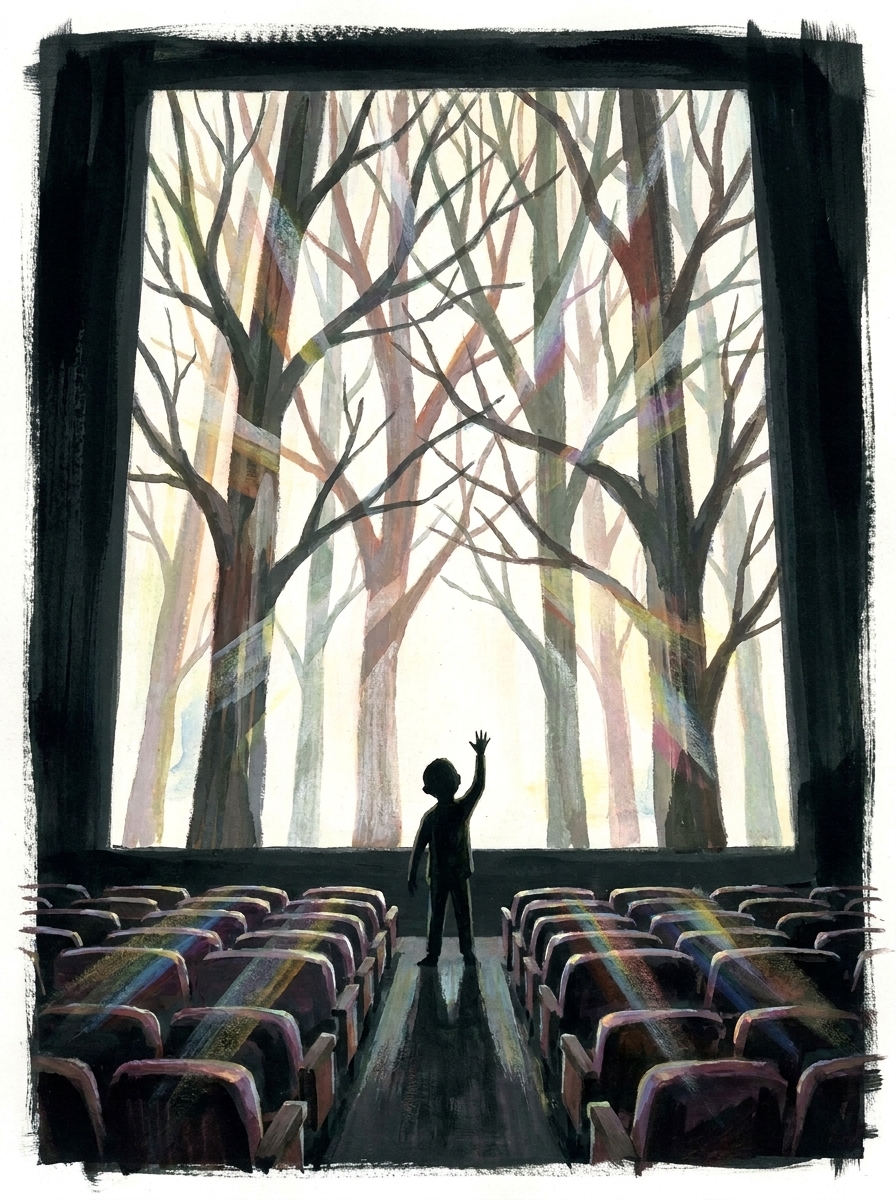
In May 2025, Netflix removed its last interactive title from the platform. The company had spent eight years experimenting with choose-your-own-adventure storytelling — Bandersnatch, a handful of children's series, a scattering of romantic and horror experiments — and it pulled every one of them. A spokesperson offered the kind of corporate epitaph that sounds like a compliment: the technology had served its purpose, but was now limiting. What Netflix actually learned was simpler and more interesting. Filming six versions of a scene costs six times as much and delivers about one-sixth the narrative payoff. The branches multiplied; the meaning did not.
This was not the failure of interactive narrative as a concept. It was the failure of a specific architecture — pre-authored branching paths grafted onto a linear spine. But the distinction matters less than you might think. Because the deeper problem Netflix encountered was not a production bottleneck. It was an audience telling the most data-rich entertainment company on Earth, through the only feedback mechanism that counts — whether they kept watching — that they did not want to make the choices an author is supposed to make for them.
I keep returning to that signal as I try to think clearly about the claim that artificial intelligence will transform storytelling from something we receive into something we co-create. The claim is everywhere right now. Inference costs for large language models have fallen at a pace that makes Moore's Law look leisurely — roughly fifty-fold per year by some benchmarks, two hundred-fold since January 2024, according to Epoch AI's tracking. Performance that cost twenty dollars per million tokens in late 2022 runs at forty cents today. NVIDIA ships autonomous character engines in commercial games. Startups like Hidden Door let you wander through Pride and Prejudice or Call of Cthulhu with an AI that improvises around your choices. The RPG market — the genre with the closest structural resemblance to responsive narrative — is growing at ten percent annually, with more than half of developers integrating AI-driven characters into their NPC systems. A fourteen-year-old today has never lived without Roblox, returns to AI companion platforms sixteen times a month, and belongs to a generation where only thirty percent prefer watching movies or shows as their primary entertainment. Her grandparents' cohort lands at fifty-five percent.
The numbers are real. The trajectory is real. And I think the conclusion most people are drawing from them is wrong.
The strongest version of the case for displacement — not mere coexistence, but responsive narrative actually supplanting authored storytelling as the dominant form — rests on three pillars that deserve to be taken seriously, because dismissing them would mean ignoring genuine forces reshaping how human beings relate to narrative.
The first pillar is cognitive. Karl Friston's predictive processing model, which Nature Reviews Neuroscience has called arguably the most ambitious theory of the brain available today, holds that we engage with the world by generating predictions and updating them when reality diverges. Stories grip us precisely through prediction errors — violations of expectation that force our mental models to reorganize. The case for responsive narrative extends this logic: if the system reacts to your choices, the prediction errors become personalized, self-referential, and therefore more cognitively potent than those engineered for a general audience. Layer in Michael Tomasello's research on shared intentionality — the capacity for collaborative activity with shared goals, observable in children as young as eighteen months — and Alison Gopnik's work showing that counterfactual reasoning through pretend play improves working memory and cognitive flexibility, and you have a respectable neuroscientific argument that interactive narrative activates the brain's deepest engagement circuits more fully than passive reception.
The second pillar is economic. The cost of generating AI narrative content is collapsing on a curve that even conservative projections find staggering. If inference costs continue declining at even one-and-a-half-fold per year after 2027 — a dramatic deceleration from current rates — the cumulative reduction over twenty years exceeds three thousand-fold. That is enough to absorb the far higher token volume that interactive experiences require compared to streaming a pre-authored film. The a16z framework calls this LLMflation: inference cost deflation with no obvious floor. When a prestige television episode costs fifteen million dollars and a AAA game title runs past two hundred million, the crossover point where AI-generated narrative becomes cheaper per hour of entertainment is not science fiction. It is arithmetic.
The third pillar is demographic. The generation entering peak entertainment spending in the 2040s and 2050s — Gen Alpha — treats interactive formats as default. They build worlds in Minecraft, roleplay in character-creation engines, and express themselves through game systems rather than passive consumption. The preference data is already measured, not hypothesized. And demographic transitions, as social scientists will tell you, are among the most reliable predictors we have. The cohort that grew up with television stayed television-dominant. The cohort that grew up with smartphones became mobile-first. There is no historical precedent for a generation abandoning the entertainment format it was raised on.
These are not trivial arguments. They describe real forces, supported by real data, operating on a real timeline. And yet I think they are insufficient to produce displacement, for reasons that cut deeper than technology or economics.
Start with what I think is the most important and least discussed dimension of this question. Authored narrative draws its power not from giving audiences what they want but from denying it. The great novel, the great film, the great season of television — these work because someone who is not you decided what you needed to encounter. They subverted your expectations. They forced you to sit with discomfort you would never have chosen. They withheld information you wanted and revealed information you did not, in a sequence so precise it felt, in the best cases, inevitable. The author's control over sequencing — what happens, in what order, for what duration, beside what silence — is not a limitation of the medium. It is the mechanism by which narrative achieves its deepest effects.
Responsive narrative, by definition, cedes this control. Even in its most sophisticated form — where a designer builds the world, the characters, the thematic architecture, and the AI manages moment-to-moment execution within those constraints — the sequencing of experience passes to the audience. Advocates call this redistribution. I think the more precise word is abdication, and the distinction matters. Consider: every prior media transition that displaced a dominant narrative form moved authorial precision to a different register without handing sequencing power to the audience. Film did not give viewers control over the story. It gave directors control over framing, editing, and visual rhythm that stage directors never had. Television gave showrunners serialized authority over character arcs across dozens of hours. Even the transition from studio-era Hollywood to the New Wave auteurs was a story of authorial power concentrating, not dispersing. Responsive narrative proposes the first transition in the history of narrative that moves in the opposite direction — toward the audience, away from the author.
This matters because the forms that have dominated human narrative for three thousand years share one structural feature: a singular human intelligence deciding what the audience will experience. The epic poem, the tragedy, the novel, the film. We can argue endlessly about which forms are higher or lower, which audiences are more or less sophisticated. But the throughline is authorial control. And the claim that a form which structurally weakens that control will displace the forms that preserve it is a claim without precedent. Not because no one has tried — they have, for thirty years — but because the precedent runs the other way.
Now, you might think the thirty-year failure record is just a technology problem. Chris Crawford spent three decades building interactive storytelling systems and concluded his Storytron had fallen into what he called a nether zone between techies and arties that neither community could bridge. Michael Mateas and Andrew Stern spent five years on Facade and achieved, by their own assessment, thirty percent of what they originally envisioned — and the project spawned no commercial successors in two decades. AI Dungeon peaked at around 1.5 million monthly active users, then collapsed under content-filter controversies, database instability, and the dismal experience of characters who forgot everything that had happened three scenes earlier. Its concurrent player count on Steam fell to twenty-six. Not twenty-six thousand.
And you would not be wrong to point out that these failures each had specific technological causes. Crawford's symbolic language systems could not scale; LLMs obviously solve this. Facade's two-person team could not hand-author enough content; generative AI removes the bottleneck. AI Dungeon's GPT-2 and early GPT-3 could not maintain coherence over long interactions; context windows have expanded fifty-fold since, from four thousand to over two hundred thousand tokens. Each diagnosis is accurate. But diagnosing individual causes does not make the pattern disappear. What the pattern reveals is not one obstacle but a cascade: authoring, coherence, cost, audience effort, content moderation — each of which must be solved simultaneously, not sequentially, and each of which presents a different kind of difficulty. Some are engineering problems amenable to scaling. Others are not.
The coherence problem, for instance, is more stubborn than the cost curve suggests. Large language models generate text token by token without a global narrative plan. They can hold vast amounts of prior context in their window, but holding context is not the same as having intention. A two-hundred-thousand-token context window full of prior story text gives the model a retrieval buffer, not a narrative architecture. Academic frameworks for structured narrative generation — knowledge-graph-guided systems, the SCORE framework for plot coherence — are promising, but none has been validated in a consumer product serving millions of users. The evidence we do have is not encouraging: AI-generated narrative scores fifty-eight percent lower in emotional resonance than human-authored work of comparable quality, according to Adobe's Digital Trends survey. Content identified as AI-generated receives twenty to thirty-five percent lower engagement rates. And the broader trend in consumer sentiment is moving in the wrong direction for the displacement thesis — enthusiasm for AI-generated content dropped from sixty percent to twenty-six percent between 2023 and 2025.
I am less certain about this next claim, but I think it is worth sitting with: the coherence problem may not be primarily technical. It may be philosophical. What makes a long narrative cohere is not just consistency — characters remembering names, plots avoiding contradiction — but purpose. An authored story coheres because every element serves a vision. The pacing of a chapter, the placement of a reveal, the decision to spend three pages on a character's childhood and one sentence on their death — these are not information-management problems. They are acts of meaning. An AI can be instructed to maintain consistency. I am not convinced it can be instructed to mean something by the choices it makes about structure. And without that, coherence in the deepest sense — the kind that makes a reader feel, at the end of a great novel, that nothing could have been otherwise — may remain out of reach.
The market data here is less ambiguous than the philosophy. The global books market stands at over one hundred fifty-six billion dollars, projected to reach roughly two hundred fifteen billion by 2033, with print retaining more than three-quarters of market share. The global box office is on pace to surpass thirty-five billion dollars in 2026. Streaming subscribers exceed 1.1 billion worldwide, consuming overwhelmingly linear content. The combined linear-storytelling ecosystem runs past four hundred billion dollars and continues to grow. Against this, the AI-generated interactive-narrative market was valued at 1.7 billion in 2024 and projected, at an optimistic compound annual growth rate of 34.3 percent, to reach 31.1 billion by 2034.
Run the arithmetic. Even if you grant the optimistic growth rate for interactive narrative and assume it decelerates to twenty percent annually after 2030, the market reaches approximately one hundred sixty billion dollars by 2049. That sounds enormous until you notice that the book market alone, growing at its current 4.1 percent, reaches roughly three hundred fifty billion by the same date. Books. One segment of one medium. Add film, television, and streaming — all growing — and authored linear storytelling commands something well north of half a trillion dollars against interactive narrative's one hundred sixty billion. That is not displacement. That is coexistence at a ratio that does not remotely approach dominance.
The analogy I keep hearing — that responsive narrative will do to linear storytelling what the automobile did to the horse — is instructive, but not in the way its proponents intend. The automobile offered a functional advantage horses could not structurally match. Speed, range, reliability in adverse conditions. The structural advantage was categorical: no amount of horse breeding would close the gap. Responsive narrative does not have an equivalent advantage over authored storytelling. It has a different value proposition — agency, personalization, participatory engagement — that appeals to some people in some contexts. But it carries a structural disadvantage in the dimension that has historically determined which narrative forms dominate: the capacity of a single human intelligence to craft an experience more precisely, more surprisingly, and more meaningfully than any audience member could choose for themselves. A faster horse is still slower than a car. A more responsive story is not more powerful than an authored one. It is differently powerful, and in the dimension that matters most, less so.
There is, however, a version of this story that I find more honest and more interesting than either triumphalist prediction or nostalgic denial. Responsive narrative will grow. It will become a commercially significant, culturally visible medium. The cost curves ensure this; the demographic shifts accelerate it. Gen Alpha will carry interactive preferences into adulthood, and the entertainment industry will build for those preferences, and some of what they build will be extraordinary in ways we cannot currently imagine. The technology stack is converging across too many independent vectors — language generation, character animation, voice synthesis, real-time inference — for this not to matter.
But the most probable outcome is not displacement. It is addition. Radio did not displace books. Television did not displace cinema. Gaming did not displace television. Each new medium became a layer in an ever-thickening media ecosystem, and each prior medium retained its audience, its cultural function, and — critically — its dominance in the specific register of experience it serves best. Books remained dominant for the kind of deep, sustained, interior narrative that no other medium replicates. Cinema remained dominant for the kind of collective visual spectacle that no screen at home can match. Television became dominant for serialized, character-driven storytelling that demands dozens of hours of committed attention. Each form found its register and held it.
Responsive narrative will find its register too. It will be the medium of personalized exploration, of collaborative world-building, of social play that shades into story. It will serve the cognitive needs that the neuroscience correctly identifies — agency, shared intentionality, counterfactual reasoning — and it will serve them brilliantly for the audiences that seek them. But it will not displace the form whose power derives from the one thing it cannot replicate: a human being who decided, before you arrived, exactly what you needed to encounter, and in what order, and would not let you look away.
The fourteen-year-old who has never known a world without Roblox will grow into an adult who adds AI-driven narrative experiences to a media diet that still includes novels and films and prestige television. She will do this for the same reason her parents added streaming to a diet that still included cinema, and her grandparents added television to a diet that still included books. Not because the new form is weaker than the old. Because the old form does something the new one cannot. The author's monopoly on sequenced meaning is not a market position to be disrupted. It is a human capacity — the capacity to know what you need before you know it yourself — and the history of narrative art is the history of audiences seeking out the people who possess it.
What falls away, in the end, is not the author. It is the assumption that technological capability translates automatically into cultural dominance. Sometimes the better technology wins. Sometimes the existing form persists because it is not a technology at all, but a relationship — between a mind that shapes and a mind that surrenders to being shaped — and no amount of computational power can replace the willingness to be told something you did not ask to hear.
What If Stories Could Talk Back?
You know that show you love — the one where the twist at the end made you gasp? What if, instead of watching it, you got to be in it? What if the characters knew your name, reacted to your choices, and the story changed every time you played?
That's the promise of AI-driven storytelling. And a lot of smart people think it's about to take over. They might be wrong.
The tech is real. The cost of running AI has dropped by about fifty times per year. A response that cost twenty bucks in 2022 costs less than a dollar now. NVIDIA ships tools that let game characters hold real conversations. Startups let you wander through classic novels with an AI that makes things up as you go. And if you're fourteen, you've probably never known a world without Roblox. Only thirty percent of your generation picks watching a movie as their go-to entertainment. For your grandparents, it was more like fifty-five.
So the trends look clear. But I think the conclusion most people are drawing is wrong.
The Case For a Takeover
The strongest argument comes in three parts, and each one deserves respect.
First, our brains crave surprise. We're wired to predict what happens next, and we light up when we're wrong. That's why good stories grip us — they break our guesses. An AI that reacts to your choices can make those surprises personal. In theory, that's even more gripping than a story aimed at everyone.
Second, the money works. Making a prestige TV episode costs fifteen million dollars. A big video game can run past two hundred million. AI storytelling gets cheaper every year, on a curve that shows no sign of stopping. Give it two decades, and the math tips hard in AI's favor.
Third, the kids are already there. The generation that will dominate spending in the 2040s grew up building worlds in Minecraft and talking to AI companions. They treat play as self-expression. They don't sit and watch — they jump in.
These aren't weak arguments. They describe real forces.
But Here's What They Miss
Think about the last story that really hit you. A book that wrecked you. A movie scene you still think about. What made it work?
It wasn't that you got to choose what happened. It was that someone else chose — and they chose better than you would have. They knew what you needed to see before you knew it yourself. They held back the big reveal until exactly the right moment. They forced you to sit with something uncomfortable you never would have picked on your own.
That's what authors do. They control the order. They decide what you experience and when. And that control isn't a flaw in the system. It's the whole point.
AI stories, by their nature, hand that control to you. Even in the best version — where a designer builds the world and the AI fills in the details — you're steering. Fans of the tech call this sharing the creative power. I'd call it giving away the thing that makes stories matter most.
Here's what's strange: every time one form of storytelling replaced another as the big one — theater gave way to film, film gave way to TV — the author actually gained more control, not less. Film gave directors power over every frame. TV gave showrunners dozens of hours to build characters. AI storytelling is the first time anyone has proposed going the other direction. Toward the audience. Away from the author.
There's no precedent for that working.
The Track Record Is Rough
People have tried this for thirty years. It hasn't gone well.
One game designer spent three decades building an interactive story system. It never found an audience. Two researchers spent five years on a project called Facade and hit about thirty percent of what they wanted. AI Dungeon — the app that was supposed to prove AI could finally do it — peaked at about 1.5 million users, then crashed. Its live player count on Steam dropped to twenty-six. Not twenty-six thousand.
And then there's Netflix. The biggest streaming company on Earth spent eight years on choose-your-own-adventure shows. Bandersnatch was a hit. But Netflix pulled every single interactive title by 2025. Filming six versions of a scene costs six times as much and tells about one-sixth the story.
You can blame each failure on old tech. And you'd be partly right. But the pattern is hard to ignore.
So What Actually Happens?
AI storytelling will grow. The cost curves guarantee it. The kids demand it. Some of what gets built will be amazing in ways we can't picture yet.
But it won't replace the old stuff. It'll sit next to it.
Radio didn't kill books. TV didn't kill movies. Video games didn't kill TV. Each new thing became a new layer. And each old form kept doing the one thing it does best. Books stayed the best way to live inside someone's head for hours. Movies stayed the best way to share a huge visual moment with a crowd. TV became the best place for slow, deep character work.
AI storytelling will find its own lane. It'll be the place for personal adventures, for building worlds with friends, for stories that know you. And it'll be great at that.
But it won't replace what an author does. Because what an author does is decide — before you show up — exactly what you need, in exactly the right order. That's not a tech problem waiting to be solved. It's a human gift. And we've been seeking out the people who have it for three thousand years.
The fourteen-year-old who grew up on Roblox will add AI stories to her life. She'll also read novels. She'll watch great shows. She'll go to movies. Not because the new thing is weak — but because the old thing does something the new thing can't.
Sometimes the better tech wins. Sometimes the old form sticks around because it was never really a technology at all. It was a relationship — between someone who shapes the story and someone willing to be shaped by it. No amount of computing power can replace the choice to be told something you didn't ask to hear.