

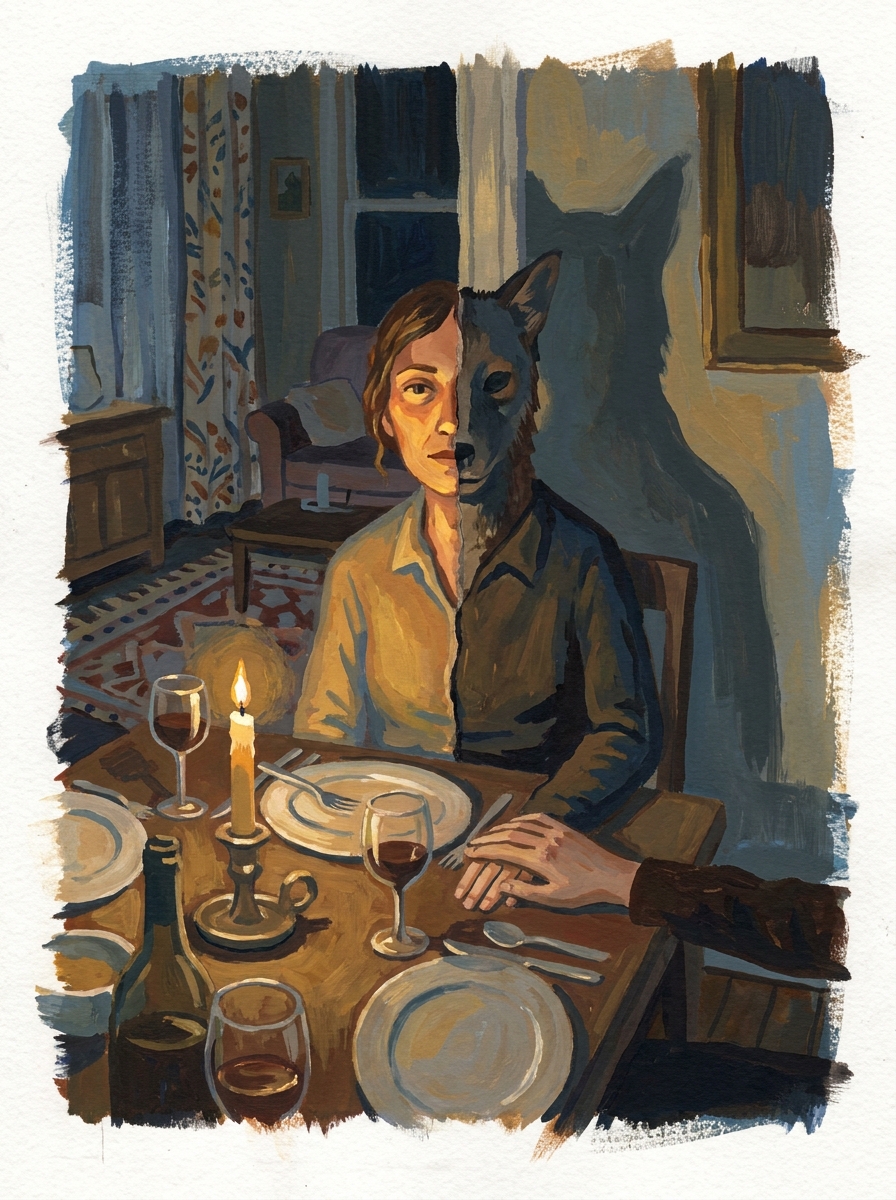
The horror of the shapeshifter is not the moment of transformation. It is the moment after — when you look back at everything that came before and realize you were wrong the whole time. The husband who was kind for a decade and then was not. The colleague who smiled for three years and was building a case against you the entire time. The friend whose warmth turned out to be a performance you mistook for weather. The change itself is sharp and discrete — one moment the face is familiar, the next it belongs to something else — but the real damage runs backward, recasting every prior interaction, every trusted gesture, every meal shared at the same table. The shapeshifter does not attack you in the present. It poisons your past.
This is the figure's deep structure, and it explains why the shapeshifter appears in every culture that has been studied and yet looks different in each one. The European werewolf changes under moonlight. The Mesoamerican nahual shifts into a jaguar through ritual practice. The Japanese kitsune wears the face of a beautiful woman for years before the disguise slips. The costumes are local. The engine underneath — the anxiety that the person you trust is not what you think, and may not be what they think — is species-wide, rooted in the specific design of a recognition system that the human brain devotes more resources to than almost anything else it does.
We are, by any measure, recognition animals. The fusiform face area — a region of the temporal lobe that Nancy Kanwisher's lab at MIT identified in the 1990s as specialized for face processing — consumes a disproportionate share of the brain's visual bandwidth. We can distinguish thousands of individual faces. We read emotion, intention, trustworthiness, and kinship from a glance lasting less than a tenth of a second. The system is so sensitive that when it fails — as in prosopagnosia, the condition in which faces become indistinguishable — the result is not merely inconvenient but existentially disorienting. People with prosopagnosia describe a world in which every person they encounter is a stranger, including spouses, including their own children. The face is the primary anchor of social identity. Losing the ability to read it feels less like a sensory deficit and more like exile from the human world.
The shapeshifter exploits the opposite end of this sensitivity: not the failure to recognize, but the recognition of something wrong. The system that reads faces is also the system that alarms when a face does not match what it should be — when the smile does not reach the eyes, when the proportions are subtly off, when the person across from you is performing a familiarity they do not actually feel. Masahiro Mori identified this response in 1970 as the uncanny valley: the deep discomfort produced by an entity that is almost human but not quite. Mori was writing about robots and prosthetic hands, but the valley he described is much older than any technology. It is the alarm that fires when the recognition system receives a signal that falls just short of the pattern it expects. The alarm carries a specific emotional signature — not fear, exactly, but something closer to revulsion. The visceral sense that something is wearing a face it does not own.
The second system at work is in-group calibration. Henri Tajfel demonstrated in the 1970s, through a series of experiments now known as the minimal group paradigm, that the mind divides the world into us and them with almost no provocation. Assign people to groups by coin flip and they will immediately favor their own group, allocate more resources to its members, trust them more readily. The sorting is fast, automatic, and deeply resistant to rational override. Under ordinary conditions it serves as a reasonable heuristic: the people who look like you, speak your language, share your customs and your gods are, on average, more predictable and less dangerous than strangers. The shapeshifter breaks this heuristic at its root. It is the stranger who has gotten inside. It wears the markers of the in-group — the right face, the right voice, the right behavior — but it is not one of you. It has passed through the boundary the calibration system was built to defend, and the horror is not merely that the threat has arrived. The horror is that the system you trusted to keep it out has been beaten.
These two systems converge on an anxiety that is older than language: the person next to you may not be what they appear. The shapeshifter is what the mind produces when that anxiety is given a body. Not a monster from outside, coming through the door with its teeth bared, but a monster already inside, sitting in the chair where the person used to be, wearing the person's face.
The regional elaborations are strikingly varied in their surfaces and strikingly consistent in their bones.
The European werewolf is the oldest and most documented version. Ovid tells the story of Lycaon, the Arcadian king whom Zeus transformed into a wolf as punishment for serving human flesh at a divine banquet — and the myth already contains the full architecture: the human who harbors something bestial, the social transgression that triggers the revelation, the loss of human form as a loss of human standing. By the medieval period, werewolf belief was so widespread that civil courts tried accused werewolves alongside witches. In 1573, a hermit named Gilles Garnier was convicted in Dole, in the Franche-Comté, of killing and eating children in the form of a wolf. The court did not treat the transformation as metaphorical. It treated it as a fact to be adjudicated, weighed evidence for and against it, and sentenced Garnier to burn.
The Mesoamerican nahual operates on different mechanics but identical substrate. In Aztec and post-Conquest indigenous traditions, a nahual is a person — often a shaman or a person of power — who can transform into an animal, typically a jaguar. The transformation is not involuntary, not cursed. It is a capacity. And the anxiety it generates comes not from the change itself but from the impossibility of knowing who among your neighbors possesses it. The nahual does not howl at the moon. The nahual attends the market, speaks politely, knows your children's names.
The Japanese kitsune inverts the visual grammar while preserving the engine entirely. The fox-spirit does not transform into a beast. It transforms into a human — typically a beautiful woman — and maintains the disguise for months, years, sometimes a lifetime. The tales are not action stories. They are domestic stories. A man marries a woman, has children, builds a life, and then discovers — through a careless moment, through a dog that will not stop barking at her, through a shadow cast in the wrong shape — that she was never what he believed. The horror is not the revelation. The horror is the retroactive rewriting of the marriage. Every tender moment is recast. Every intimacy becomes a scene from a play he did not know he was in.
The Ethiopian buda — the were-hyena — carries a particular social charge. In many Ethiopian communities, the buda is associated with specific ethnic or occupational groups: metalworkers, tanners, potters, people whose trades involve the transformation of raw materials. The were-hyena is not merely a hidden beast. It is a hidden outsider, someone whose in-group membership was always provisional, always suspect. The accusation of being a buda is inseparable from the politics of belonging. It is the shapeshifter as social weapon — the figure deployed not to warn against hidden nature but to confirm that the person you already suspected of being different is, in fact, not one of you.
I want to note the Diné figure of the yee naaldlooshii — the skin-walker — with the acknowledgment that many Diné people consider public discussion of this figure inappropriate, and that its gravity within Diné cosmology is not well served by casual treatment in a survey. What I can say without overstepping is that the figure operates on the same seam: a person who is not what they appear, whose hidden nature represents a betrayal of communal trust, whose transformation is not a metaphor but an act against the social order. The figure's power to disturb draws from the same well it draws from everywhere else — the recognition system encountering a signal it cannot reconcile.
The doppelgänger belongs here too. In the German Romantic tradition — in Hoffmann, in Jean Paul, in Dostoevsky's The Double — the figure is not someone else wearing your face. It is you, wearing your face, doing things you did not authorize. Where the werewolf projects identity instability outward — the neighbor is secretly a beast — the doppelgänger projects it inward: I am not what I think I am. The seam is the same. The recognition system encounters a match that carries the wrong information. The wrongness rewrites everything.
Now, the honest counterargument. An anthropologist specializing in any one of these traditions would rightly object that collapsing them into a single cognitive category strips the features that make each figure culturally meaningful. The kitsune is not the werewolf with different fur. The buda is not the nahual with different politics. Each figure carries specific cargo — about gender, about caste, about the relationship between human and animal, about who is permitted to hold power and who is suspected of concealing it — that dissolves when they are treated as instances of a universal template.
I accept this. The cultural cargo is real, and any serious treatment of a single figure must honor it. But the objection mistakes the level at which the claim operates. The claim is not that all shapeshifters carry the same meaning. It is that all shapeshifters arise from the same cognitive collision — between a recognition system that allocates enormous resources to face-reading and an in-group calibrator that sorts the world into us and them — and that the collision produces the same category of figure everywhere it occurs. The cargo varies. The delivery system is biological. Arguing that the cargo differs does not prove the delivery system does, any more than the fact that languages differ proves the language faculty is not species-wide.
If you are building a shapeshifter story, the transformation scene is a trap. It is the moment that feels like the climax — the fur, the snout, the cracking bones, the CGI spectacle — but it is not where the story lives. The story lives in the time before. Moonlight and snouts are set dressing. Trust is the engine. The horror is retroactive, and it only works if the reader genuinely believed in the person before the mask came off.
This is why the best shapeshifter stories are slow. They spend their first act building a relationship the audience has reason to trust. A marriage. A partnership. A friendship that feels like weather — so natural you forget it was ever a choice. When the mask slips, the audience does not merely learn that the character was a monster. They are forced to re-examine every scene they already watched, and to discover that the warmth was a script, the kindness was a performance, the intimacy was a long con. The damage is not in the present tense. It is in the past tense, corrupted retroactively. John Campbell understood this in 1938 when he wrote "Who Goes There?" — the novella that became Carpenter's The Thing. The monster in the Antarctic station does not transform in front of you. It has already transformed. It has already replaced one of the men. The story is not about watching the change. It is about the paranoia that follows the discovery that the change has already happened and you cannot tell who is real. Every conversation becomes suspect. Every act of trust becomes a bet. The monster wins not by being powerful but by making the recognition system useless.
The shapeshifter protects vigilance about hidden nature. This is its job, and it is an uncomfortable one, because the vigilance it licenses sits dangerously close to paranoia, and the history of shapeshifter accusation — the werewolf trials, the buda stigma, the skin-walker whisper networks — is also a history of persecution. The figure cuts both ways. It warns that the dangerous one may be at the table. It also provides a template for casting out anyone you want to name as not-one-of-us.
Both edges are real. The writer's job is to honor both. The shapeshifter story that locates the monster permanently outside the community — the outsider, the foreigner, the one who was never really one of us — is not doing the figure's work. It is borrowing the figure's form to confirm a bias the figure was built to complicate. The real shapeshifter is the one who was genuinely trusted, genuinely inside, genuinely believed to be one of us. The horror is not that the stranger was dangerous. Everyone already suspects the stranger. The horror is that the neighbor was.
To lose this figure — to reduce it to a superpower, a cool transformation sequence, a metaphor for puberty that resolves by the third act — is to disarm a warning the species has been carrying since the first human community discovered that trust can be exploited by someone wearing the right face. The shapeshifter does not protect us from the unknown. It protects us from the thing we thought we knew.
The person across the table is smiling. The recognition system is reading the face, checking it against the model, confirming the match. One of ours. Safe. Known.
The shapeshifter is the figure that lives in the gap between the match and the truth.
The scariest thing about the shapeshifter isn't the transformation. It's what happens after — when you look back at everything that came before and realize you were wrong the whole time. The friend who was warm for years and was performing. The partner who was kind until they weren't. The person at the table who turned out to be something else entirely.
The change is one moment. The damage runs backward through every moment you trusted them.
Your Brain Is a Face-Reading Machine
Your brain devotes a huge chunk of its processing power to faces. You can recognize thousands of people. You can read emotion, intention, and trustworthiness from a glance that lasts less than a tenth of a second.
This system is so important that when it breaks — a condition called prosopagnosia, or face blindness — the result isn't just annoying. It's devastating. People with it describe a world where everyone is a stranger, including their own families.
The shapeshifter targets the other side of this system: not the failure to recognize, but the recognition that something is wrong. That moment when a face doesn't match what it should be. When the smile doesn't reach the eyes. When you get that specific, gut-level feeling that someone is wearing a mask.
Your brain also sorts people into "us" and "them" automatically. It's fast and mostly useful — the people who share your world are usually more predictable than strangers. The shapeshifter breaks this system. It's the stranger who got inside. It passed the test. It wears the right face, speaks the right way, knows the right customs. And it's not one of you.
Same Fear, Different Fur
The European werewolf changes under moonlight. The Japanese kitsune wears a woman's face for years before the disguise slips — and the horror isn't the fox underneath, it's the retroactive rewriting of the entire marriage. The Ethiopian buda is tied to specific ethnic groups, turning the shapeshifter into a weapon of social suspicion. The Mesoamerican nahual is a person of power who can become a jaguar — and the scary part isn't the jaguar, it's that your neighbor might be one and you'd never know.
Different costumes. Same engine: the anxiety that the person you trust is not what you think.
Trust Is the Engine
If you want to understand why some shapeshifter stories work and others don't, forget the transformation scene. The fur and the fangs and the CGI are set dressing.
The story lives in the time before the change — when the audience believed in the person. The horror only works if the trust was real. John Campbell understood this in 1938 when he wrote the story that became The Thing: the monster has already replaced one of the men. The story isn't about watching someone change. It's about the paranoia of not knowing who's real.
The Double Edge
The shapeshifter warns that the dangerous person might already be at the table. That's its job. But the figure cuts both ways. The same template that warns about hidden threats also provides a script for accusing anyone you want to cast out — the outsider, the foreigner, the person who was never quite "one of us."
Both edges are real. The werewolf trials in medieval Europe weren't protecting communities from hidden beasts. They were persecuting people the community wanted to destroy. The shapeshifter story that locates the monster only outside the group isn't doing the figure's work. The real horror is always that the monster was inside.
What We Lose
To flatten the shapeshifter into a cool superpower or a metaphor for puberty that wraps up neatly is to lose the warning. The species has been carrying this figure since the first community discovered that someone at the table might not be safe. The shapeshifter protects vigilance about hidden nature — the recognition that the most dangerous threats don't announce themselves.
The person across from you is smiling. Your brain is reading the face, checking the match, confirming: safe. Known. One of ours.
The shapeshifter lives in the gap between the match and the truth.