

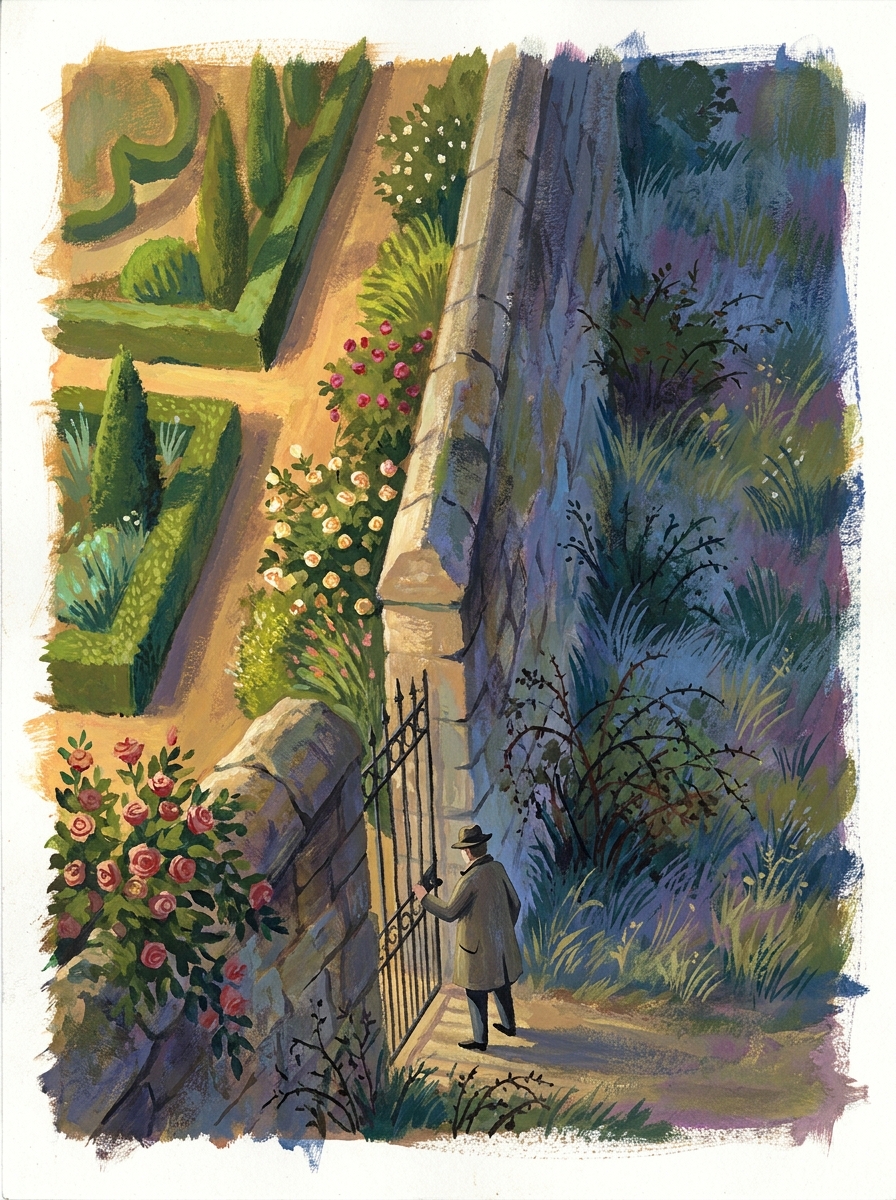
The first thing a garden requires is a wall. Not a literal wall, necessarily, though most of the gardens the species remembers best have had them. But a boundary. An edge where the garden ends and the not-garden begins. Without the edge, you have a field. With the edge, you have an argument: that nature can be ordered, that the ordering is good, and that the person who does the ordering has the right to decide what grows and what doesn't.
The garden is the ninth place in the series, the first of the two human-made places that close the walk. The hearth began with fire. The garden begins with soil. Both are places where the species shapes the raw material of the world into something intentional, and both carry the politics of the shaping embedded in the shape.
The Substrate
Cultivation cognition is the foundation, and it is recent relative to the other substrates in this series. The brain's place-machinery is hundreds of thousands of years old. Cultivation, the deliberate management of plant growth, is roughly twelve thousand years old. But the cultivation instinct, once it arrived, recruited older systems with remarkable efficiency. The pleasure of making something grow in a controlled space, the satisfaction of seeing order emerge from disorder, the aesthetic response to a well-tended plot: these are older cognitive rewards applied to a newer domain.
Boundary perception provides the structural logic. The garden's edge is a cognitive threshold, the same system that makes rivers feel like borders and cave mouths feel like entrances. The garden's wall separates the cultivated from the wild, the deliberate from the accidental, the owned from the common. The boundary is not incidental to the garden. The boundary is the garden's defining feature. Without it, the cultivation disperses into the general landscape and loses its identity as a distinct place.
The prospect-refuge dynamic operates in the garden at miniature scale. The garden provides prospect (the ability to survey the space from within) and refuge (the sense of enclosure and protection the boundary provides). The combination is the same one that makes the hearth feel safe and the mountain summit feel exhilarating, reduced to the domestic register. The garden is the landscape's safety features concentrated into a space small enough to maintain.
Order-from-disorder satisfaction provides the emotional engine. The garden is the visible result of deliberate action: weeds removed, plants arranged, paths laid, water channeled. The brain rewards the perception of imposed order with the same circuits that reward the resolution of a puzzle or the completion of a pattern. The satisfaction is aesthetic and cognitive simultaneously, and the conjunction is part of why gardens produce the specific kind of pleasure they do: the pleasure of looking at something that was made to be looked at, by someone who decided what should grow there.
The Exemplars
Eden is the garden that the species lost. The biblical narrative places the first humans in a garden of perfection, a place where every need is met, where the boundary holds, where the relationship between the cultivated and the wild is settled in favor of the cultivated. The expulsion from Eden is the loss of the garden, and the loss carries the weight of the first and most permanent exile. The garden that was given is taken away, and every garden made after it is, in the biblical tradition's logic, an attempt to rebuild what was forfeited.
The Persian paradeisos gives us the word "paradise," and the etymology is the argument. The Persian royal garden was an enclosed space, walled and irrigated, that contained trees, flowers, watercourses, and game animals. The garden was a demonstration of royal power: the ability to impose order on a landscape that, beyond the walls, was arid and difficult. The paradise was the proof that the king could make the desert bloom, and the proof was political as much as it was botanical.
The Japanese tea garden, the roji, operates in a different cognitive register. The roji is not a display of abundance. It is a display of restraint. The path to the teahouse is deliberately simple. The plants are understated. The stones are placed to create a sense of passage from the ordinary world to the contemplative world of the tea ceremony. The garden here is a transition, a threshold between states of mind, and the cultivation is aimed not at abundance but at reduction. The tea garden is the garden as subtraction.
The Mughal char bagh, the four-part garden, is the garden as cosmological diagram. The space is divided by water channels into four quadrants, representing the four rivers of paradise in Islamic tradition. The geometry is precise, the planting is symmetrical, and the overall effect is of a mathematical argument expressed in plant material. The Taj Mahal's gardens are the most famous example. The garden here is not an imitation of nature. It is a correction of nature, an assertion that the true order of the world is geometric and that the garden is the place where the geometry is made visible.
The English landscape garden of the eighteenth century is the garden that pretended not to be one. Capability Brown and his contemporaries removed the walls, eliminated the geometry, and designed landscapes that looked natural while being entirely artificial. The "natural" look required enormous labor: hills were moved, lakes were dug, trees were planted in compositions that mimicked the paintings of Claude Lorrain. The English garden is the garden that conceals its own gardening, and the concealment is itself a cultural statement. The culture wanted nature, but it wanted nature designed by the culture, and the paradox was the style.
The Variations
The paradise garden and the contemplation garden are different answers to the question of what the garden is for. The paradise garden says: abundance, beauty, the fulfillment of desire. The contemplation garden says: simplicity, attention, the discipline of looking closely. Both are gardens. Both are bounded. Both are cultivated. The difference is in what the cultivation aims to produce in the person inside the garden.
The productive garden, the kitchen garden, the orchard, the market garden, is the garden as food. The productive garden is the oldest form and the one most directly connected to the substrate of cultivation: the deliberate growing of food in a managed space. The productive garden is rarely beautiful in the display-garden sense, but it carries its own aesthetic, the aesthetic of function, of rows, of the visible evidence of labor that produces nourishment. The productive garden is the garden most honest about what it is.
The botanical garden is the garden as colonial project. Kew Gardens in London was partly an instrument of empire: a collection of plants from the colonies, catalogued and studied for their economic potential, grown in artificial conditions that replicated their native climates. The botanical garden is the garden as extraction, the world's plant wealth gathered into a single bounded space under the authority of a single institution. The knowledge the botanical garden produces is real. The power the botanical garden represents is also real, and the two are not separable.
The Honest Account
Gardens have always been class statements. This is the figure's shadow, and it is as old as the figure itself.
The English landscape garden was made by displacing tenant farmers. The enclosure movement, which converted common agricultural land to private estates, provided the raw material for the landscape designs of Brown and Repton. The aesthetic of the "natural" garden was purchased with the eviction of the people who had been working the land. The beauty required the displacement, and the displacement was hidden by the beauty.
The paradise garden's boundary is not merely aesthetic. It is exclusionary. The wall that separates the garden from the not-garden is also the wall that separates the people inside from the people outside. The garden as gated community, the garden as private estate, the garden as country club: these are the modern versions of the paradise boundary, and the boundary's function has not changed. The garden says: this is cultivated, this is beautiful, this is ordered. The wall says: and it is not for you.
The botanical garden's colonial dimension is equally direct. Kew was an instrument of imperial resource management. The rubber plant was smuggled from Brazil to Kew, grown, and then distributed to British colonies in Southeast Asia, destroying Brazil's rubber monopoly and creating the plantation economies of Malaya and Ceylon. The garden was the laboratory. The empire was the beneficiary. The displaced were the peoples whose plant knowledge was collected and whose economies were restructured.
The romantic garden, the garden as escape from the industrial world, carries its own form of dishonesty. The country garden that the city dweller retreats to on weekends is the garden as consumer product, the bounded green as lifestyle brand. The retreat from the real is not the garden's original function. The garden's original function was to make the real more ordered, more productive, more legible. The garden as escape is the garden with its purpose inverted.
The Craft Turn
The garden works in story as the place where order has been chosen and is therefore vulnerable. This is the structural principle. The garden is deliberate, and deliberate things can be undone.
The fall in Eden is a garden story. The storm that destroys the cultivated field is a garden story. The invasion that tramples the formal plantings is a garden story. Whatever happens in a garden is measured against the garden's premise: that this space was ordered, that the ordering was good, and that the disorder that follows is a violation of something the characters invested in.
The garden that is merely pretty, that functions as a backdrop for a conversation or a setting for a love scene, has not done the figure's work. The garden must be at risk. The cultivation must be shown to cost labor, attention, and care, and the threat to the cultivation must be felt as a threat to everything the cultivation represents.
The Return
The garden is the species's argument that nature can be ordered without being destroyed. The argument is contested. The ordering always involves choices about what is welcome and what is not, what grows and what is pulled. The garden's beauty is the result of exclusion, and the exclusion extends to everything the gardener decides is a weed.
The garden is also the species's first laboratory: the place where the relationship between human intention and natural process was tested, refined, and transmitted. Every agricultural civilization began with a garden. Every botanical science began with a garden. The garden is where the species learned that it could participate in what grew, and the participation changed everything.
The bounded green is still bounded. The wall is still there. The question the garden asks is not whether the ordering is possible. The question is who does the ordering, who benefits from it, and who is left outside the wall.
The First Thing a Garden Needs Is a Wall
Not a literal wall, necessarily. But a boundary. An edge where the garden ends and the not-garden begins. Without the edge, you have a field. With the edge, you have an argument: that nature can be ordered, that the ordering is good, and that the person doing the ordering has the right to decide what grows.
Why Gardens Feel Good
The pleasure of making something grow in a controlled space recruits older brain systems. The satisfaction of seeing order emerge from disorder, the aesthetic response to a well-tended plot: these are ancient cognitive rewards applied to a newer domain.
The garden provides what the brain craves: prospect (the ability to survey the space) and refuge (the enclosure's protection). It's the same combination that makes the hearth feel safe, reduced to domestic scale.
Order-from-disorder satisfaction provides the engine. The garden is the visible result of deliberate action. The brain rewards imposed order with the same circuits that reward solving a puzzle.
Gardens That Shaped History
Eden: the garden the species lost. Every garden made after it is, in the biblical tradition, an attempt to rebuild what was forfeited.
The Persian paradeisos gives us the word "paradise." It was a walled, irrigated space that proved the king could make the desert bloom. The proof was political as much as botanical.
The Japanese tea garden: not a display of abundance but a display of restraint. The path is simple. The plants are understated. The garden is a threshold between ordinary mind and contemplative mind.
The English landscape garden: the garden that pretended not to be one. Capability Brown designed landscapes that looked natural while being entirely artificial. The "natural" look required moving hills and digging lakes. The culture wanted nature designed by the culture, and the paradox was the style.
Gardens Have Always Been Class Statements
The English landscape garden was made by displacing tenant farmers. The enclosure movement converted common land to private estates. The beauty required the eviction.
The paradise garden's wall isn't just aesthetic. It's exclusionary. The gated community, the private estate, the country club: these are modern versions of the paradise boundary. The garden says: this is cultivated. The wall says: and it's not for you.
Kew Gardens was partly an instrument of empire: colonial plants catalogued for their economic potential. The rubber plant was smuggled from Brazil to Kew, then distributed to British colonies, destroying Brazil's monopoly. The garden was the laboratory. The empire was the beneficiary.
What Makes a Garden Story Work
The garden is deliberate, and deliberate things can be undone. The fall in Eden is a garden story. The storm that destroys the cultivated field is a garden story. Whatever happens in a garden is measured against the garden's premise.
The garden that's merely pretty, a backdrop for a conversation, hasn't done the figure's work. The cultivation must be shown to cost labor and care, and the threat to it must feel like a threat to everything it represents.
The Question Behind the Wall
The garden is the species's argument that nature can be ordered without being destroyed. But the ordering involves choices about what's welcome and what's not. The beauty is the result of exclusion.
The question isn't whether the ordering is possible. It's who does it, who benefits, and who's left outside the wall.