

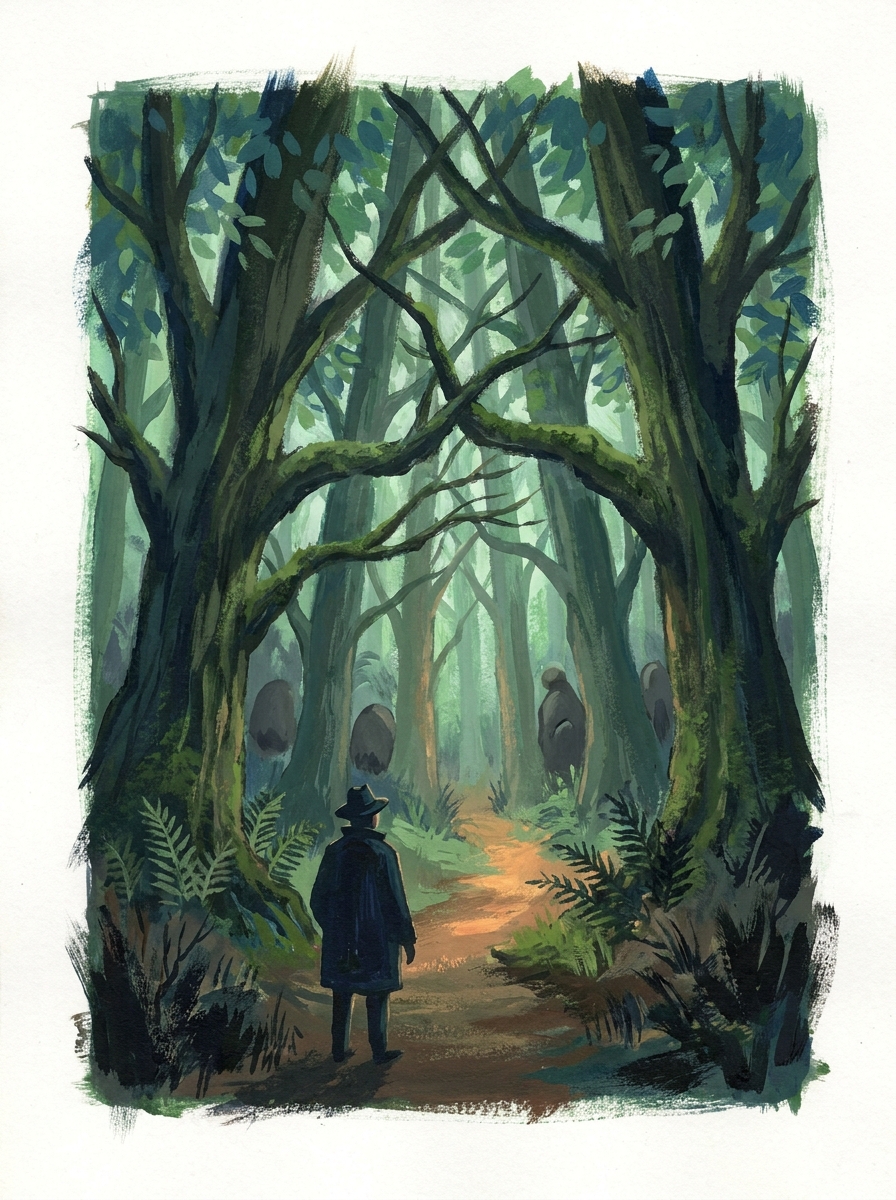
You know the moment. The trail narrows. The canopy closes. The light that was clear and directional a hundred meters ago becomes diffuse, green, sourceless. Sound changes. Birdsong is louder because the trees are closer, but direction is harder to read because the trunks scatter the signal. You cannot see as far as you could, and the reduced visibility produces a feeling that has nothing to do with what you know about the forest and everything to do with what your body has decided about it.
The body has decided that something might be watching.
The forest is the second shape in the series because it is the first place you reach when you leave the hearth. The circle of light ends. The canopy begins. And the cognitive systems that operated at low intensity inside the firelight perimeter ramp up to full vigilance, because the brain's assessment of the forest is ancient, specific, and not entirely wrong.
The Substrate
Reduced visibility is the foundation. The brain's threat-detection system, the amygdala-driven circuit that evaluates environmental input for danger, is calibrated by visual range. Open spaces with long sight lines reduce its activity. Enclosed spaces with limited sight lines increase it. The forest, with its vertical obstructions and lateral screen of trunks and undergrowth, reduces visual range to meters, and the reduction produces uncertainty, and the uncertainty produces vigilance.
Cover affordance runs both ways, and the brain knows it. Trees, undergrowth, and shadow provide cover for the person in the forest. They also provide cover for whatever else is in the forest. The affordance is symmetrical: if you can hide, so can the predator. Gibson's ecological perception research demonstrates that this dual reading is not a learned interpretation. It is a property of how the brain perceives cover. The forest is simultaneously refuge and threat, and the brain holds both readings at once.
Wayfinding becomes unreliable under canopy. Landmarks are harder to see. The sun is harder to track. Distances are harder to judge. The cognitive state researchers call "spatial disorientation" is more common in forests than in any other natural environment except underwater. Getting lost in the forest is not merely a practical problem. It is a cognitive state with its own characteristic profile: increased cortisol, heightened scanning behavior, a shift in time perception that makes minutes feel longer. The lost-in-the-forest experience is consistent across cultures because the cognitive systems producing it are consistent across humans.
The darkness within the forest, the fact that a dense canopy can reduce light levels to a small fraction of the open-field level even at midday, recruits the same fear circuits that darkness recruits at night. The brain does not distinguish well between "dark because it is night" and "dark because the canopy is thick." The reduced light triggers the same ancestral caution in both cases.
The Exemplars
The European folktale forest is the most extensively documented literary version of the shape, and its consistency is remarkable. In the Brothers Grimm alone, the forest appears as the place of danger, transformation, and testing in dozens of stories. Hansel and Gretel are abandoned in the forest. Red Riding Hood crosses the forest. The princess flees into the forest. The youngest son enters the forest to prove himself. The forest in these tales is not a specific location. It is a condition: the place where the rules of the village no longer apply and something else, something older and less negotiable, operates in their place.
The Russian forest of Baba Yaga is the European tradition pushed to its extreme. Baba Yaga lives in a house on chicken legs in the deepest part of the forest. She is not simply a witch. She is a figure of the forest itself: wild, unpredictable, sometimes helpful, sometimes lethal, always operating by rules that the visitor does not understand and must learn or die. The forest here is not merely a setting for the story. It is the story's author. The narrative logic changes once the character crosses the tree line.
The Japanese yama, the mountain forest where kami dwell, is the forest in the sacred register. Shinto tradition treats the forest not as a place of danger but as a place of presence. The trees are inhabited. The water is inhabited. The forest is dense with beings that are neither animal nor human nor divine but something the tradition recognizes as spirits of place. The cognitive substrate is the same as the European version, the reduced visibility, the ambient presence, the sense that something is there, but the cultural elaboration goes in the opposite direction. The presence is not threat. It is sanctity.
Aboriginal Australian traditions of the dense scrub carry different cognitive cargo. The bush is country: a network of songlines, waterholes, sacred sites, and ancestral paths that maps meaning onto terrain with a specificity no European mapping tradition has matched. The forest is not wild in the way European traditions use the word. It is known, densely, specifically, by name. What looks like wilderness to the outsider is, to the person who carries the songlines, a text. The cognitive substrate is identical. The cultural inscription could not be more different.
The Amazon, as both a real place and a cultural figure, operates at the scale of the continent. European accounts of the Amazon, from the conquistadors forward, consistently describe it in terms borrowed from the folktale forest: dark, disorienting, full of hidden dangers, resistant to civilization. The projection is revealing. The Europeans brought their forest template with them and applied it to a landscape that was, in fact, extensively managed by its indigenous inhabitants. The "virgin forest" was a managed landscape, and the inability to see the management was a failure of the template, not of the terrain.
The Variations
The dark forest and the wisdom forest are different elaborations of the same substrate. The European tradition, for reasons that track with its specific cultural history, emphasized the forest as threat. The indigenous traditions of the Americas, of Southeast Asia, of sub-Saharan Africa, of the Pacific, more commonly treated the forest as a place of knowledge: the place where the plants grow that heal, where the animals live that teach, where the spirits dwell that speak. The difference is not in the brain. It is in what the culture decided to do with the brain's evaluation.
The sacred grove is the forest at its smallest and most bounded: a stand of trees set apart for ritual, maintained as a space where the numinous is concentrated. Sacred groves appear across Europe, Africa, India, and East Asia with remarkable consistency. The grove is the forest tamed just enough to be approached, wild enough to retain its charge. The cognitive logic is precise: the grove recruits the forest's ambient presence while providing enough spatial boundedness to make the presence bearable.
The hunting forest, the aristocratic reserve maintained for the chase, is the forest as class instrument. The English royal forests, the French reserves, the deer parks of Mughal India: these are forests whose access is controlled by power, and the control is enforced with lethal consequences. The hunting forest reveals that the forest's wildness can be property, and that the property rights over wildness are among the oldest forms of class distinction.
The Honest Account
The forest has been alternately romanticized and demonized depending on what the surrounding culture wanted from it. Both operations are dishonest.
The "dark wood" of European literary tradition is partly an ideological figure. The forest is the wild that needs civilization, and the civilization that defines itself against the forest is also the civilization that clears the forest. The fairy-tale forest is a record of an ongoing relationship between settled agricultural cultures and the wild land they were converting to farmland. The forest as threat is the story the clearers told to justify the clearing.
Forest peoples have been treated as wild in proportion to their distance from the cleared land. The equation of forest dwelling with savagery is one of the oldest and most persistent colonial tropes, applied to the peoples of the Amazon, the Congo, the Southeast Asian highlands, and the interior of Borneo with remarkable consistency. The template is always the same: the people in the forest are closer to nature, which means further from civilization, which means eligible for displacement.
The romanticization of the forest is the inverse operation and is equally suspect. The "pristine wilderness," the forest untouched by human hands, is almost always a fiction. Most of the world's forests have been managed, burned, planted, harvested, and shaped by human activity for thousands of years. The myth of the untouched forest is often a settler myth, erected on the erasure of the people who were doing the touching.
The Craft Turn
The forest works in story as the place where the protagonist is reduced. Vision narrows. Time distorts. Self-knowledge surfaces because there is nothing else to attend to.
The structural principle is subtraction. The forest removes the protagonist's resources one by one: sight, orientation, companions, certainty. What remains after the subtraction is what the story is about. The forest is the narrative's centrifuge, spinning away everything that is not essential.
The forest that is merely a backdrop, a green corridor the character walks through on the way to the next plot point, is the forest with the substrate removed. The audience can tell. The forest that costs nothing to cross carries no weight. The forest that disorients, that delays, that changes the character who enters it, is doing the work the shape was built to do.
The Return
The forest reveals the species's ambivalence about cover. We need it. We fear it. We enter it and we leave it and we tell stories about what happened inside.
The canopy is still closing. The light is still going green. The trail is still narrowing.
The body still decides, before the mind catches up, that something might be watching.
The forest does not care what the mind decides afterward. The forest was there before the mind, and the forest will be there after.
Your Body Decides Before Your Mind Does
You know the moment. The trail narrows. The canopy closes. The light goes diffuse and green. Sound changes. You can't see as far as you could. And the body decides, before the mind catches up, that something might be watching.
The forest is the first place you reach when you leave the hearth. The circle of light ends. The canopy begins.
Why Forests Feel the Way They Do
Reduced visibility is the foundation. Your brain's threat-detection system calibrates by visual range. Open spaces: low alert. Enclosed spaces with limited sight lines: high alert. The forest, with its trunks and undergrowth, cuts your sight to meters. The brain responds with vigilance.
Cover works both ways. Trees hide you, but they also hide whatever else is in there. The brain holds both readings at once. The forest is refuge and threat simultaneously.
Getting lost in the forest is a measurable cognitive state: higher cortisol, heightened scanning, distorted time perception. It's consistent across cultures because the systems producing it are consistent across humans.
Forests Around the World
The Brothers Grimm forest, where Hansel and Gretel are abandoned and Red Riding Hood is stalked, is a condition more than a location: the place where village rules stop applying and something older takes over.
The Japanese yama, the mountain forest where kami dwell, flips the European reading. The same substrate, the reduced visibility, the ambient presence, is interpreted as sacred rather than threatening.
Aboriginal Australian traditions of the bush carry sixty-five thousand years of precise knowledge. What looks like wilderness to the outsider is, to the person carrying the songlines, a detailed text.
The Amazon was extensively managed by indigenous inhabitants for thousands of years. European explorers brought their "dark forest" template and projected it onto a landscape that was, in fact, a managed system. The "virgin forest" was a failure of the template, not of the terrain.
The Part Nobody Mentions
The "dark wood" of European tradition is partly an ideological figure: the wild that needs civilization. The fairy-tale forest is a record of agricultural cultures converting wild land to farmland and telling stories to justify the clearing.
Forest peoples have been treated as "wild" in proportion to their distance from cleared land. The equation of forest dwelling with savagery has been applied to peoples across the Amazon, the Congo, and Southeast Asia with remarkable consistency.
The "pristine wilderness" is almost always a fiction. Most forests have been managed by human activity for thousands of years. The myth of the untouched forest is often a settler myth, built on the erasure of the people who were doing the touching.
What Makes a Forest Story Work
The forest works when it reduces the character. Vision narrows. Time distorts. Self-knowledge surfaces because there's nothing else to attend to.
The forest that's just a green corridor the character walks through on the way to the next scene has the substrate removed. The audience can tell. The forest that disorients, delays, and changes the person who enters it is doing the work the shape was built to do.
Still Watching
The canopy is still closing. The trail is still narrowing. The body still decides, before the mind catches up, that something might be watching.
The forest doesn't care what the mind decides afterward. The forest was there before the mind.