

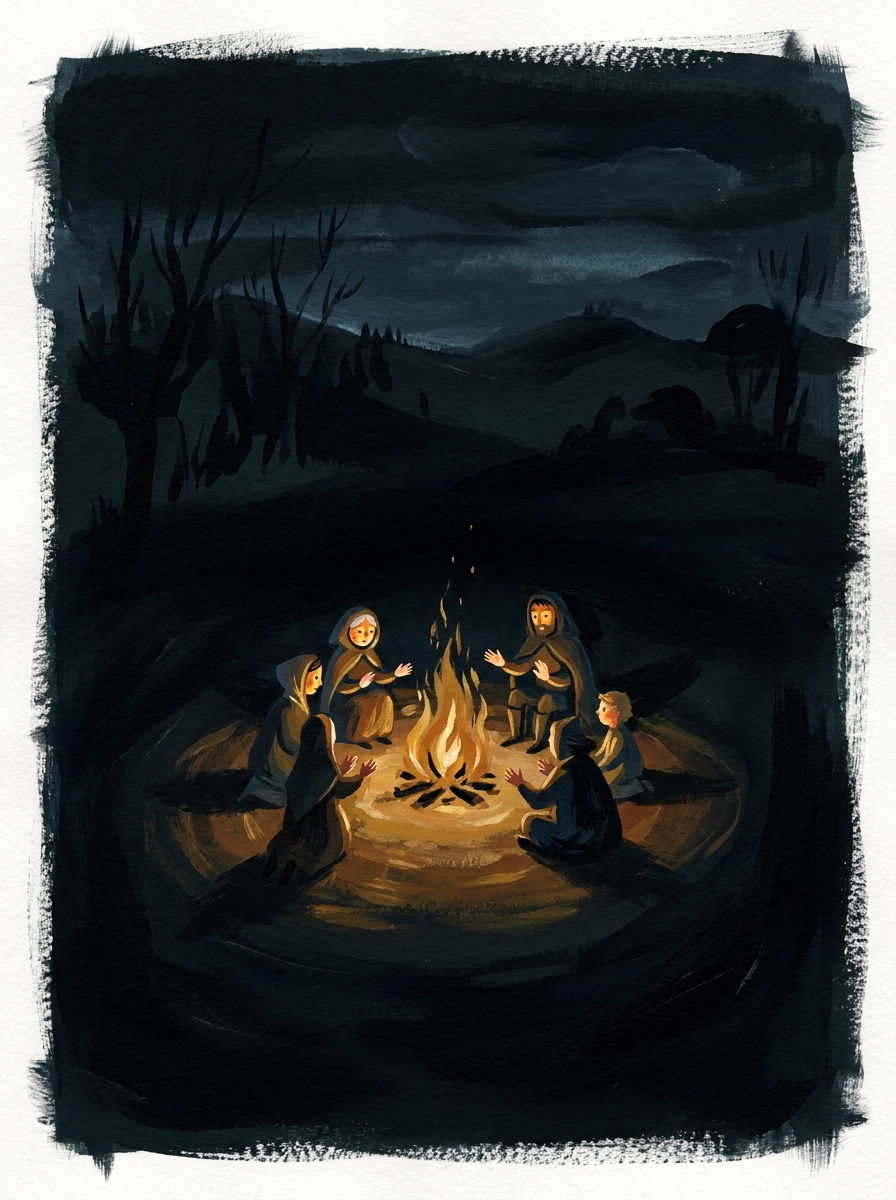
The fire draws a circle. Everything inside the circle is us. Everything outside it is not yet known. The circle is the first architecture, the first boundary, the first political act. It requires no wall, no fence, no survey. It requires only flame, and the flame does the rest.
Humans have been sitting around fires for at least four hundred thousand years. Some estimates push it past a million. The campfire is older than language. It is older than Homo sapiens. It is possibly older than the species that preceded us. Whatever else the hearth is, whatever cultural weight it has accumulated across those millennia, it begins as a fact of the body: the warmth that keeps you alive when the temperature drops, the light that extends the day past sunset, the heat that makes food edible and water safe.
The hearth is the first shape in this series because it is the place from which every other place is encountered. You cannot have a forest without having a clearing to stand in first. You cannot have a wilderness without having a home to leave. The hearth is not merely a location. It is a premise. It is the answer to the question every other place asks: where do you go back to?
The Substrate
Fire-attention is the cognitive foundation. Humans are the only species that voluntarily stares into fire for extended periods. The behavior has been documented across every culture, and the neural profile is distinctive: a campfire produces a measurable reduction in blood pressure, a decrease in sympathetic nervous system arousal, and a shift toward the kind of relaxed alertness associated with social bonding. Christopher Lynn's research at the University of Alabama found that the longer people sit in front of a fire, the more prosocial they become. The fire does not merely warm. It changes the brain's social settings.
Safety perception provides the spatial logic. The firelight creates a perimeter. Inside the perimeter, visibility is high, predators are deterred, and the threat-detection systems that run constantly during daylight and darkness alike can reduce their vigilance. The reduction is not trivial. It is the precondition for the kinds of activities that happen at fires: storytelling, singing, planning, dispute resolution, courtship. The hearth is the space where the species could afford to stop scanning for danger long enough to become cultural.
Acoustic intimacy adds a layer the visual record cannot capture. Voices around fire carry differently than voices in open air. The firelight circle is also a sound circle, a space where conversation is possible at volumes that exclude eavesdroppers beyond the perimeter. The campfire is the original private room.
Cooking gives the hearth its biological foundation. Richard Wrangham's "cooking hypothesis" argues that the control of fire and the cooking of food were the enabling conditions for the expansion of the human brain. Cooked food yields more calories per gram than raw food, and the surplus calories funded the metabolic expense of a larger brain. If Wrangham is right, the hearth is not merely the first cultural space. It is the space that made culture biologically possible.
The Exemplars
Hestia, in the Greek tradition, is the goddess of the hearth, and her position in the pantheon reveals something about how the Greeks understood the shape. Hestia is the oldest of the Olympians and the least dramatic. She does not fight. She does not scheme. She does not have love affairs. She stays. The staying is her function, and the function is so fundamental that every Greek household maintained a fire dedicated to her, and every new colony began by carrying fire from the mother city's hearth.
Vesta, the Roman equivalent, was served by the Vestal Virgins, whose primary duty was to keep the city's fire burning. If the fire went out, the state was endangered. The connection between the hearth and the survival of the polity was not metaphorical in Roman thought. It was structural. The fire was the city's life, and the persons who tended it were treated as sacred precisely because the function they served was considered essential to the city's existence.
The Japanese irori, the sunken hearth at the center of the traditional farmhouse, is the hearth as architectural principle. The irori is not merely a cooking surface. It is the spatial center around which the house is organized, the place where the family gathers, where guests are received, where the smoke rises through the ceiling and preserves the thatch. The space itself is structured as a set of concentric zones radiating outward from the fire: the position closest to the hearth is the position of highest honor.
The Vedic agnihotra, the fire ritual performed at dawn and dusk, is the hearth as cosmic practice. The fire is fed twice daily as a sustaining act, and the feeding is understood not as maintenance but as participation in the order of the universe. The fire that burns in the household is connected to the fire that burns in the sun, and both are connected to the fire that is the principle of transformation in the cosmos. The hearth here is not local. It is the local instance of something universal.
The candle on the dinner table is the modern minimalist version, and its persistence is revealing. The electric light eliminated the practical need for flame. The candle survives because the cognitive system that responds to firelight is not practical. It is affective. The candle does what the campfire did: it draws a circle, it reduces arousal, it makes the people inside the circle feel like they are together in a way that differs from being together under fluorescent light.
The Variations
The royal hearth and the domestic hearth operate at different scales with different politics. Hestia as the city's hearth-goddess is the public version: the fire belongs to the polity, and the polity's survival depends on its maintenance. The domestic hearth is private: this fire belongs to this family, and the family's identity is organized around it. The tension between the two, between the fire that belongs to everyone and the fire that belongs to us, is one of the oldest political tensions in human life.
The mobile hearth, the fire-pot of nomadic peoples, the portable cookstove, the campfire rebuilt every evening at a new site, reveals that the shape is not attached to a specific location. The hearth is not the place. The hearth is the practice. The fire can be carried, and wherever it is set down, the circle forms again. The portability is the cognitive proof that the hearth is a function, not a coordinate.
The ritual hearth, the temple flame, the perpetual fire maintained by religious institutions, is the hearth scaled to the sacred. The fire that must never go out is the community's bet that its continuity is worth maintaining. The Olympic flame, carried from Olympia to every host city, is the secular descendant of this bet.
The Honest Account
The hearth has gendered, classed, and excluded as much as it has gathered. This is the shape's shadow, and it sits as close to the fire as the warmth.
The hearth has been women's space for most of human history, and the assignment has been both honored and confining. The woman at the hearth is the keeper of the fire, the provider of food, the center of the domestic world. She is also the person who does not leave. The hearth's warmth is real. The restriction is also real. The tradition that honored women as hearth-keepers was often the same tradition that prohibited women from the activities that happened away from the hearth: the hunt, the war, the political assembly, the market.
The hearth as private property is the hearth as exclusion. My fire, not yours. The hospitality customs that surround the hearth in nearly every culture, the obligation to feed the stranger, to offer warmth to the traveler, to make room at the fire for the person who has no fire, are partly compensations for the exclusion the hearth creates. The customs acknowledge that the circle of light produces, by definition, a darkness beyond it, and that the darkness contains people.
The modern hearth, the home, the apartment, the house, carries the same tension at industrial scale. Housing is the contemporary version of the hearth-question: who gets warmth, who gets shelter, who gets the circle. The politics of housing are the politics of the hearth extended to the city and the nation, and the extensions are rarely generous.
The Craft Turn
The hearth tells the story it is about return. This is the craft principle that governs everything written from the position of the fire.
Stories told around hearths are not the same as stories told elsewhere. The road story told from a hearth becomes a homecoming story. The underworld story told from a hearth becomes a survival story. The war story told from a hearth becomes a story about what was worth fighting for. The frame matters. The hearth tells the audience: the person telling this came back. The fire is proof of the return.
The hearth also tells stories about what lies beyond it. The fire is the base camp. The wild begins where the light ends. Every campfire story about the forest, the mountain, the cave, the sea is a story told from the position of someone who is not there, who is here, inside the circle, where the thing being described cannot reach them. The safety is the precondition for the telling.
The modern hearth-story problem is the story that never leaves the hearth. The domestic novel that never encounters the wild. The family drama that never confronts the forces the family was built to withstand. The hearth without the dark is the hearth without the fire, because the fire's meaning depends on the darkness it holds back.
The Return
The hearth is the place from which the dark is filled. The series begins here because every other essay is about the world beyond this fire.
The fire is real. The warmth is real. The circle is real. And the fact that the circle produces an inside and an outside, that the warmth creates the cold by distinguishing itself from it, that the light defines the dark by ending at a specific perimeter: these are not costs to be regretted. They are the structure of the shape.
The species has been sitting around fires for longer than it has been speaking. The sitting changed the brain, the diet, the social structure, the relationship to time. Everything that followed, every forest entered, every mountain climbed, every sea crossed, every cave explored, every garden planted, every ruin inherited, was encountered from a position that the fire made possible.
The circle of light is still drawn. The question is who gets to sit inside it.
The Fire Draws a Circle. Everything Inside Is Us.
Humans have been sitting around fires for at least four hundred thousand years. The campfire is older than language. Older than our species, possibly. Whatever the hearth is culturally, it starts as a fact of the body: warmth, light, and the heat that makes food safe.
The hearth is the first place in this series because it's the place from which every other place is encountered. You can't have a wilderness without having a home to leave.
Why Fire Changes Your Brain
Christopher Lynn's research at the University of Alabama found that sitting in front of a fire measurably reduces blood pressure and makes people more prosocial. The longer you sit, the more cooperative you become. Fire doesn't just warm you. It changes your brain's social settings.
The firelight creates a perimeter. Inside: high visibility, reduced threat. The brain's danger-scanning systems can finally relax. That relaxation is the precondition for everything that happens at fires: storytelling, planning, dispute resolution, courtship. The hearth is where the species could afford to stop scanning long enough to become cultural.
Richard Wrangham's "cooking hypothesis" goes further: controlling fire and cooking food funded the metabolic expense of our larger brains. If he's right, the hearth didn't just create culture. It made culture biologically possible.
Hearths Around the World
Hestia, the Greek goddess of the hearth, is the oldest Olympian and the least dramatic. She doesn't fight or scheme. She stays. Every Greek colony began by carrying fire from the mother city.
The Japanese irori, the sunken hearth at the center of the farmhouse, organizes the entire house around it. The seat closest to the fire is the position of highest honor.
The candle on the dinner table is the modern minialist version. Electric light eliminated the practical need for flame. The candle survives because the cognitive system that responds to firelight isn't practical. It's affective.
Who Gets to Sit by the Fire
The hearth has been women's space for most of history, both honored and confining. The woman at the hearth is the center of the domestic world. She's also the person who doesn't leave.
The hearth as private property is the hearth as exclusion. My fire, not yours. The hospitality customs around the hearth, the obligation to feed the stranger, are partly compensations for the exclusion the fire creates.
Housing is the modern version of the hearth question: who gets warmth, who gets shelter, who gets the circle.
What Makes a Hearth Story Work
The hearth tells the story it's about: return. The road story told from a hearth becomes a homecoming. The war story told from a hearth becomes a story about what was worth fighting for.
But the hearth without the dark is the hearth without the fire. The fire's meaning depends on the darkness it holds back. The domestic story that never encounters the wild has lost its engine.
Still Drawing the Circle
The species has been sitting around fires longer than it has been speaking. Everything that followed, every forest entered, every mountain climbed, every sea crossed, was encountered from a position the fire made possible.
The circle of light is still drawn. The question is who gets to sit inside it.