

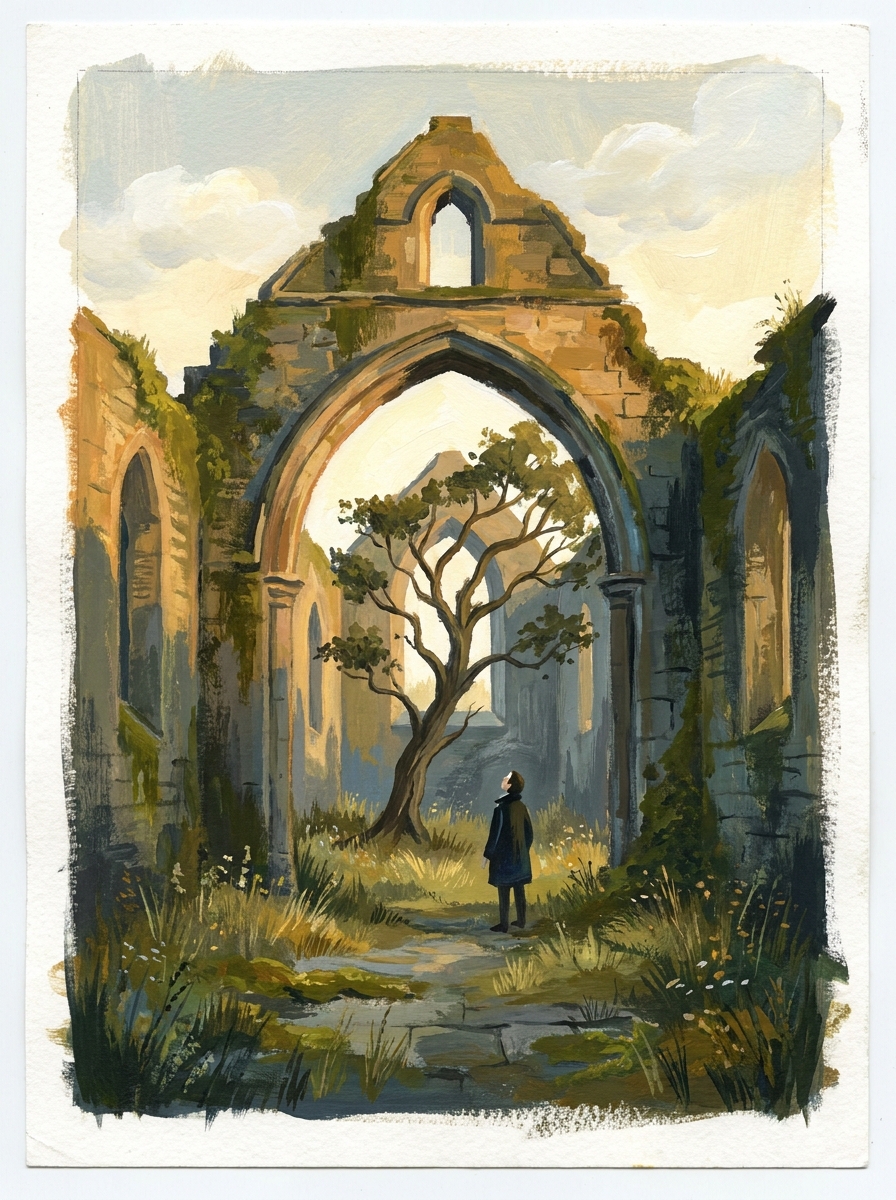
There is a church in the Turkish countryside that has no roof. The walls stand. The arches hold. The windows open onto sky instead of glass. Grass grows in the nave. A tree has taken root where the altar was. The building has been empty for long enough that the emptiness has become the building's primary content.
You know this feeling. Everyone knows this feeling. The ruin produces a specific emotional response that researchers have described as a combination of awe, melancholy, and temporal vertigo: the sense of time becoming visible, of standing in a place where the present moment and the past are layered on top of each other with no insulating material between them. The ruin is the place where time becomes a thing you can see, and the seeing is the substrate.
The Substrate
Decay perception is the primary cognitive input. The brain is exceptionally good at detecting the difference between the functional and the formerly functional. The machinery that recognizes a broken tool, a damaged structure, a face aged past recognition, fires when it encounters a building that once served a purpose and no longer does. The detection is rapid and automatic. The brain does not need to be told that a building is ruined. The brain reads the decay, the missing roof, the crumbled mortar, the vegetation growing through the floor, and arrives at the conclusion before the conscious mind has formulated the question.
Temporal cognition gives the ruin its distinctive emotional weight. The ruin is not merely a damaged building. It is a building that was damaged by time. The distinction matters because the brain processes time-damage differently from event-damage. A building destroyed by a bomb is a catastrophe. A building destroyed by centuries of neglect is a meditation. The bomb-damage produces urgency. The time-damage produces reflection. The ruin's particular emotional register, the melancholy, the pensiveness, the "temporal vertigo," comes from the brain's confrontation with time as a force that does things to structures, including, by implication, to the observer.
Threat-uncertainty around abandoned structures adds the survival layer. The brain treats empty buildings with the same cautious evaluation it applies to other environments where the expected occupant is absent. The abandoned house, the ghost town, the empty fort: these produce a specific kind of vigilance that occupied structures do not. The vigilance is not rational in the sense that the ruin is usually not dangerous. But the brain reads the absence of the expected inhabitants as a signal that requires investigation. Something was here. Something left. The departure is information the brain wants to process.
The memento mori function provides the existential weight. The ruin says: this was built by people who are now dead, for purposes that no longer exist, in a world that has been replaced by this one. The message is not addressed to anyone in particular, but the brain receives it as personal. If this building could fall, so could mine. If this civilization could end, so could mine. The ruin is the landscape's version of mortality salience, and the salience produces the same effects Terror Management Theory has documented in other contexts: increased investment in symbolic permanence, increased attention to meaning-making, increased awareness of what is being built and what will be left.
The Exemplars
The Roman ruin, as a cultural object in European Romantic painting and literature, is the ruin that shaped the Western aesthetic of decay. Piranesi's engravings of Roman ruins, the Grand Tour that brought Northern Europeans to the remains of the Roman Empire, the poets who stood in the Forum and meditated on the transience of power: these constitute the modern tradition of ruin-appreciation, and the tradition is more recent than it feels. Before the Romantics, ruins were mostly treated as quarries, sources of building material for new construction. The transformation of the ruin from resource to aesthetic object was a cultural choice, and the choice reveals a civilization that had become wealthy enough to afford nostalgia.
The pre-Columbian ruin overgrown by jungle, Angkor, Tikal, the Mayan cities consumed by forest, is the ruin in the ecological register. The jungle does not merely decay the building. It absorbs it. The trees grow through the temples. The roots wrap around the stone. The boundary between the built and the natural disappears, and the disappearance is the ruin's argument: that the forest was here first and will be here last, and the building was a temporary assertion against the forest's patience.
The abandoned settlement on the American frontier is the ruin at the smallest scale. The ghost town. The empty farmstead. The schoolhouse with the collapsed roof. The American frontier ruin carries a specific cultural weight because the American myth is a myth of building, of progress, of expansion. The abandoned town is the myth's negation. The building failed. The frontier moved on. The place that was supposed to be the future became the past without passing through a present.
The bombed cathedral, Coventry, Dresden, the churches of the Blitz, is the ruin as wound. The building was not destroyed by time. It was destroyed by violence, and the violence is preserved in the ruins in a way that centuries of neglect would not preserve. The bombed ruin is the ruin-as-testimony: the building bears witness to what was done to it. The decision to leave certain bombed buildings unrepaired, as memorials, is the culture's decision to let the ruin do its testimonial work rather than rebuilding over the evidence.
Pripyat, the abandoned city near Chernobyl, is the modern ruin at its most potent. The city was evacuated in 1986 and has not been reoccupied. The buildings are intact but empty. Trees grow through the amusement park. Classrooms still have textbooks on the desks. The ruin here is not ancient. It is recent, and the recency is what gives it its distinctive horror. The brain's temporal processing, which expects ruins to be old, encounters a ruin that is the viewer's own age, and the encounter produces a different kind of vertigo: not the distance of centuries but the proximity of decades. This could have been mine.
The Variations
The ancient ruin and the recent ruin produce different cognitive and emotional responses. The ancient ruin, Rome, Angkor, the Mayan cities, carries the weight of civilizational time. The distance is part of the experience. The people who built these places are so far removed that the ruin becomes almost geological, a feature of the landscape rather than a product of human failure. The recent ruin, Detroit, Pripyat, the abandoned factory, carries the weight of personal time. The people who built these places may still be alive. The ruin is not a meditation on the deep past. It is a confrontation with the near future.
The catastrophic ruin and the slow ruin differ in their relationship to agency. Pompeii was destroyed by a volcano. Hiroshima was destroyed by a bomb. The slow ruin, the abandoned farmstead, the ghost town, was destroyed by nothing in particular, by the gradual withdrawal of the conditions that sustained it. The catastrophic ruin preserves a moment: the instant the disaster struck. The slow ruin preserves a process: the gradual, undramatic accumulation of neglect. The process is harder to narrate but arguably more honest, because most things do not end with a bang. Most things end with a series of decisions not to repair.
The Honest Account
Ruin aesthetics have been weaponized for nationalism and political nostalgia with a consistency that the catalogue's other places cannot match.
The Nazi cultivation of classical ruin imagery was deliberate and sophisticated. Albert Speer's "theory of ruin value," the idea that the Third Reich's buildings should be designed to produce beautiful ruins thousands of years hence, reveals the political function of the ruin at its most explicit. The ruin legitimates descent. The culture that can point to impressive ruins is the culture that can claim a monumental past, and the monumental past underwrites the monumental future.
The contemporary phenomenon of "ruin porn," the aesthetic appreciation of post-industrial decay, deserves similar scrutiny. The photographers who document Detroit's abandoned factories, the tourists who visit Pripyat, the Instagram accounts dedicated to the beauty of decay: these are engaging with the ruin's aesthetic without engaging with the ruin's causes. The beauty of the abandoned factory elides the livelihoods that were lost when the factory closed. The beauty of the empty city elides the catastrophe that emptied it. The ruin's aesthetic is real. The causes of the ruin are also real. Appreciating the first without reckoning with the second is a form of tourism.
The imperial use of ancient ruins to legitimate present power is as old as the practice of empire. The Romans who built on Greek foundations were claiming Greek civilization as their inheritance. The British who displayed Egyptian antiquities in the British Museum were making a similar claim. The ruin is a transferable credential: the culture that possesses the ruin possesses the past, and the past confers authority.
The Craft Turn
The ruin works in story as the place where time becomes visible. The protagonist in a ruin is in a place that is asking them a question: what will your century's leavings look like?
The structural principle is confrontation with impermanence. The ruin strips away the assumption that what is built will endure. The character who walks through a ruin is walking through evidence that endurance is not guaranteed, and the evidence changes the character's relationship to whatever they are building, protecting, or defending in the story's present tense.
The cheap ruin is the one that is merely atmospheric, a backdrop for the action hero's climactic fight scene. The ruin that functions as set decoration has not done the figure's work. The figure requires the character to register the ruin as a temporal object, to feel the weight of what was here before and what will be here after.
The Return
The ruin is the species's recognition that everything we make becomes the world the next people inherit. The building that was shelter becomes the building that is shelter for the trees. The city that was home becomes the city that is archaeology. The structure that was permanent becomes the structure that was temporary, and the discovery of the temporariness is the ruin's gift.
The series ends here because the walk that began at the hearth arrives at the hearth's future tense. Every fire goes out. Every wall comes down. Every garden goes wild. The ruin is the end of the built world's arc, and the arc is the question the series has been asking from the first essay: what are we making, and what will it become when we are gone?
The roofless church is still standing. The grass is still growing in the nave. The tree at the altar is still reaching for the sky through the space where the ceiling was.
The building does not know it is a ruin. The building is just doing what buildings do after the builders leave.
The builders always leave. The question is what they leave behind.
You Know This Feeling
There's a church in the Turkish countryside with no roof. The walls stand. The arches hold. Grass grows in the nave. A tree has taken root where the altar was.
You know this feeling. The ruin produces a specific response: awe, melancholy, and what researchers call temporal vertigo. The sense that time has become visible. That the past and the present are layered on top of each other with nothing between them.
Why Ruins Hit Different
The brain is very good at detecting the difference between functional and formerly functional. A broken tool, a crumbled building, a face aged past recognition: the brain reads decay fast and automatically. It doesn't need to be told a building is ruined. It arrives at the conclusion before the conscious mind has formed the question.
The ruin's particular emotional register comes from time-damage versus event-damage. A building destroyed by a bomb is a catastrophe. A building destroyed by centuries of neglect is a meditation. The bomb produces urgency. The time produces reflection.
The ruin also delivers a mortality message. This was built by people who are now dead, for purposes that no longer exist. The brain receives it as personal: if this could fall, so could mine. The ruin is the landscape's version of the reminder that everything is temporary.
Ruins That Shaped the Imagination
The Roman ruin in Romantic painting: Piranesi's engravings, the Grand Tour. Before the Romantics, ruins were mostly quarries. The transformation of the ruin from resource to aesthetic object was a cultural choice made by a civilization wealthy enough to afford nostalgia.
Angkor, Tikal, the Mayan cities consumed by forest: the jungle doesn't just decay the building. It absorbs it. Trees grow through temples. The message: the forest was here first, will be here last, and the building was temporary.
The American ghost town: the frontier myth is a myth of building and progress. The abandoned town is the myth's negation. The place that was supposed to be the future became the past without passing through a present.
Pripyat, near Chernobyl: abandoned in 1986. Buildings intact but empty. Trees through the amusement park. Textbooks still on desks. The ruin is the viewer's own age, and the proximity makes it horror instead of meditation.
Ruin Tourism Has a Problem
"Ruin porn," the aesthetic appreciation of industrial decay, often elides the people who lost livelihoods when the ruin was made. The beauty of the abandoned Detroit factory skips the part about what closing it did to the community.
Nazi-era architects deliberately designed buildings to look impressive as ruins thousands of years later. The ruin legitimates descent. The culture that can point to impressive ruins claims a monumental past, and the monumental past underwrites the future.
The British Museum displaying Egyptian antiquities is a similar claim: possessing the ruin means possessing the past, and the past confers authority.
What Makes a Ruin Story Work
The ruin asks the character a question: what will your century's leavings look like?
The character has to feel the weight of what was here before. The ruin that's merely atmospheric, a backdrop for a fight scene, hasn't done the figure's work. The ruin requires the character to register impermanence as real.
Everything Built Is Temporary
The series ends here because the walk that began at the hearth arrives at the hearth's future tense. Every fire goes out. Every wall comes down. Every garden goes wild.
The builders always leave. The question is what they leave behind.