

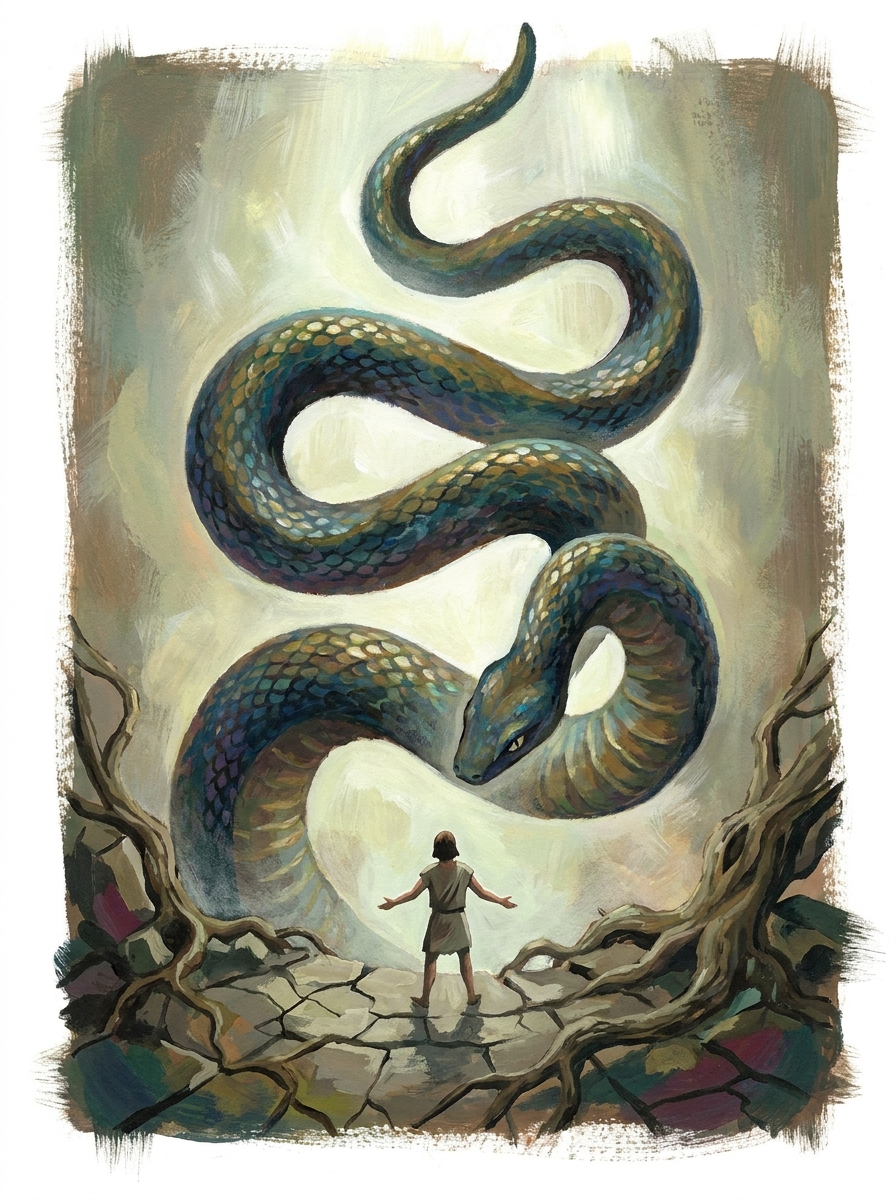
In 2000, an anthropologist named David E. Jones published a book called An Instinct for Dragons that proposed something the academy found either obvious or outrageous, depending on which department was reading it. The dragon, Jones argued, is not a single creature but a composite — a chimera assembled by the primate brain from the three predators that shaped our evolutionary history most profoundly: the raptor, the big cat, and the snake. Eagles hunted our ancestors from the air. Leopards hunted them on the ground. Constrictors and venomous snakes killed them in the trees and on the forest floor. Over millions of years, the neural alarm systems for these three predators became deeply embedded — so deeply that primates alive today, including humans, show measurable startle responses to snake-like shapes, cat-like approaches, and aerial shadows, even when raised in environments where none of these predators exist.
Jones's claim is that the dragon is what the brain produces when it combines these three alarms into a single figure: the wings of the raptor, the body of the great cat, the scales and coils of the serpent. The composite is not designed. It is an artifact — the result of three ancient predator-detection circuits firing simultaneously and producing, at their intersection, a creature that no one has ever seen but that nearly everyone, in every culture, recognizes.
The idea has been refined since Jones, most notably by Lynne Isbell, a primatologist at UC Davis, whose 2009 book The Fruit, the Tree, and the Serpent argues that the snake in particular was the pressure that drove the evolution of primate visual acuity. We see as well as we do, Isbell argues, because the primates who could detect a camouflaged serpent survived to reproduce and the ones who could not did not. The snake is in the wiring in a way that few other threats are. It is not merely a danger we learned to fear. It is a danger that shaped the eyes we use to fear it.
This is the dragon's foundation: predator memory operating at deep time, carrying the silhouettes of threats that preyed on our lineage for millions of years. But the foundation is not the figure. The predator schema explains why the dragon has scales and wings and fire and coils. It does not explain why the dragon is the size of a mountain, or why it swallows the world, or why it is the only monster on this list that is also, in some traditions, a god.
The scaling is the thing that requires explanation, and the explanation takes us past cognitive science into something closer to phenomenology — the study of what it feels like to encounter the world.
Every other figure in this series is human-scaled. The ghost is one person, haunting one room. The shapeshifter wears one face. The vampire sits at one table. Even the ogre, for all its enormity, operates at the scale of a single household, a single village, a single forest. The dragon breaks the scale. Tiamat, in the Babylonian Enuma Elish, is not a creature in the world. She is the primordial chaos from which the world was made. Marduk kills her and splits her body to form the sky and the earth. The world is built from the dragon's corpse. Jormungandr, the Midgard Serpent in Norse mythology, encircles the entire earth, holding its own tail in its mouth. When it releases its grip, the world ends. Apophis, the Egyptian chaos serpent — whom the demon essay treated as a figure of cosmic opposition — is also a dragon, the great snake that swallows the sun each evening and must be defeated each night for dawn to arrive. Leviathan, in the book of Job, is described in language that makes clear it is not an animal. It is a force. "Can you draw out Leviathan with a hook?" God asks Job, and the question is rhetorical in a way that goes beyond sarcasm: the question is whether Job understands what kind of world he is living in.
These are not large predators. They are the predator schema operating at the scale of creation — the fear that began with the snake in the tree and expanded until it became the serpent holding up the sky. The dragon is fear scaled to the size of the world, and the scaling produces something that no other monster produces: awe.
Dacher Keltner and Jonathan Haidt, in their 2003 paper on awe, defined the emotion as the response to something that is vast — that exceeds the mind's current frame of reference — and that requires accommodation, a restructuring of the mental models used to understand the world. Awe is not simple fear. It is not admiration. It is the specific feeling produced when you encounter something so large, so powerful, so far beyond human scale that the mind must either expand to contain it or retreat from the encounter. The night sky produces awe. The open ocean produces awe. A mountain range, seen for the first time from a distance that reveals its full extent, produces awe.
The dragon is the narrative form of this emotion. It is the figure that carries the weight of the world's indifference to human scale — the truth that the forces governing existence (geological, cosmic, evolutionary) do not operate at the level at which human life makes sense, and that encountering these forces without mediation is not merely frightening but annihilating. The sublime, in Kant's formulation, is the experience of encountering something that exceeds the senses' capacity to contain it, and the dragon is the sublime wearing scales.
This is why the dragon can also be a god.
The Chinese lóng is the most important counterweight to the European wyrm, and any treatment of the dragon that ignores the lóng has not understood the figure. The Chinese dragon is not a hoarder of gold, a destroyer of villages, a fire-breathing enemy to be slain by a knight. It is a bringer of rain, a symbol of imperial authority, a force of natural order rather than natural chaos. It is associated with water, fertility, and the rhythms of the seasons. It is venerated. Temples are built for it. Festivals celebrate its arrival. The lóng is the dragon that did not fall — the predator that was not defeated but worshiped, the vast thing that the culture chose to revere rather than resist.
This does not contradict the predator-composite thesis. It complicates it in a way that reveals the figure's full range. The predator schema produces the dragon's shape: the serpent's coils, the great body, the otherworldly power. But the response to the shape is not fixed. Some cultures — European, broadly speaking, though this is a simplification — placed the dragon in opposition to the human order and made the dragon-slayer a hero. Beowulf kills his dragon. Sigurd kills Fáfnir. Saint George kills his. The European narrative is a story of mastery: the human confronts the vast thing and wins. Other cultures — Chinese, South and Southeast Asian broadly — placed the dragon within the natural order and made it a figure of cosmic authority rather than cosmic threat. The Naga of Hindu and Buddhist tradition guard treasure, protect sacred sites, and rule the underwater world. They are dangerous, yes, but they are also necessary. The world depends on them.
Quetzalcoatl, the feathered serpent of Mesoamerican tradition, sits at the boundary between dragon and god with a specificity that neither category fully contains. Quetzalcoatl is a creator deity. He brings civilization, invents the calendar, gives humanity maize. He is also a serpent covered in feathers — the earth-crawler that acquired the sky, the predator that became the lawgiver. The Mesoamerican dragon did not merely survive the transition from threat to god. It embodied the transition. The figure that began as something terrifying became something that organized the world.
The counterargument I should address is the deflationary one: that the dragon is simply a large predator, that ancient peoples found dinosaur bones or encountered crocodiles or Komodo dragons or large pythons and extrapolated, and that the cognitive-composite theory is unnecessary speculation. Fossil bones as the origin of dragon myth has a distinguished pedigree — Adrienne Mayor's The First Fossil Hunters makes a persuasive case that ancient Greeks and Romans interpreted fossil remains as the bones of giants and monsters.
I find this partially correct and deeply insufficient. Yes, fossil finds may have reinforced dragon belief in specific cultures. Yes, encounters with large reptiles may have provided raw material for dragon imagery. But the deflationary account cannot explain the figure's universality — the fact that dragon figures appear in cultures that never encountered large reptile fossils, never saw a crocodile, never lived anywhere near the habitat of a Komodo dragon. Australian Aboriginal serpent mythology is as old as any dragon tradition on earth, and Australia's megafauna were extinct millennia before the serpent stories were recorded. The dragon appears where the fossils do not. The predator-composite theory, whatever its limitations, at least accounts for this: the alarms are in the wiring, and the wiring is species-wide.
For the writer, the dragon's instruction is about scale — and about the genre's most common failure. Treating the dragon as a large lizard is the error that collapses the figure from the sublime to the mundane. A big lizard with wings is a boss fight. A creature whose body is the world, whose movements are geological, whose existence precedes and will outlast everything the hero has ever known — that creature is a dragon. The dragon story does not work at the scale of a village. It works at the scale of a civilization, a cosmos, a world.
Beowulf understands this. The dragon that Beowulf fights in his final battle is not a monster-of-the-week. It is the last thing. It is the force that kills the king and ends the kingdom and closes the story. The dragon is the ending. It is the thing that was always beneath the gold, coiled at the foundation, waiting for the moment when the structure built above it could no longer hold. Beowulf dies killing the dragon, and the poem makes clear that his death is also the death of his people's golden age. The dragon was not a threat to the hero. It was a threat to the world the hero had built.
The dragon protects awe. It encodes the truth that the world contains forces that exceed the human — forces that are not evil in the way the demon is evil but that are indifferent to human welfare in a way that is, from the human perspective, indistinguishable from hostility. The earthquake does not hate you. The deep ocean does not wish you harm. The geological time that will eventually erase every mark your species has made does not bear you any malice. But the effect is the same. The vast thing does not need to hate you to destroy you. It only needs to move.
To disenchant the dragon entirely — to flatten the cosmos to human size, to insist that there is nothing larger than our comprehension, nothing older than our history, nothing more powerful than our technology — is what the introduction to this series called the founding error of the modern. The dragon resists this error. It insists that the world is larger than you think, older than you know, and governed by forces that will not adjust themselves to your comfort. This is not a comforting truth. But the dragon was never about comfort. It was about scale — the recognition that the thing coiled at the root of the world is real, that it has always been there, and that the only honest response to its existence is not mastery but awe.
The coil is at the world's root. It was there before the hero arrived and it will be there after the hero is gone. The question is not whether you can slay it. The question is whether you can stand in its presence long enough to see the world at its true size — which is larger than you, larger than your kingdom, larger than the story you tell yourself about what you are and what you can control.
The dragon does not care about your story. The dragon is the thing your story was built on top of, and it is still moving underneath.
In 2000, an anthropologist named David E. Jones proposed something that sounds either obvious or crazy, depending on who you ask. The dragon, he argued, isn't one creature. It's three, mashed together by the primate brain.
For millions of years, three predators hunted our ancestors: eagles from the air, big cats on the ground, and snakes in the trees. Each left a deep mark on the nervous system. Primates alive today — including humans — show alarm responses to snake shapes, cat approaches, and aerial shadows, even when raised in places where none of those animals exist.
The dragon is what the brain produces when it combines all three alarms at once: the wings of the raptor, the body of the great cat, the scales of the serpent. A creature nobody has ever seen and nearly everyone recognizes.
The Only Monster That Can Be a God
Here's what makes the dragon different from every other figure in this series: it's the only one that some cultures worship.
Every other monster is human-scaled. The ghost haunts one room. The vampire sits at one table. The ogre guards one forest. The dragon breaks the scale entirely.
In Babylonian myth, Tiamat is the primordial chaos from which the world is made — the god Marduk kills her and splits her body to form the sky and earth. The Norse world-serpent Jormungandr encircles the entire planet. The Egyptian Apophis swallows the sun each night. The Hebrew Leviathan in the book of Job is described in language that makes clear it's not an animal. It's a force.
These aren't big lizards. They're the predator fear operating at the scale of creation.
The Chinese Dragon Changes Everything
The European dragon is a hoarder, a destroyer, something to be slain by a hero. The Chinese lóng is the opposite: a bringer of rain, a symbol of imperial power, a force of natural order. Temples are built for it. Festivals celebrate it. The lóng is the dragon that the culture chose to worship rather than fight.
This doesn't break the theory. It completes it. The predator schema gives the dragon its shape — the serpent's coils, the enormous body, the otherworldly power. But the response to that shape isn't fixed. Some cultures made the dragon an enemy to defeat. Others made it a god to serve. The figure can hold both.
The South Asian Naga protects sacred sites and rules the underwater world. The Mesoamerican Quetzalcoatl — the feathered serpent — is a creator deity who brings civilization. The predator that became the lawgiver. The terror that became worship.
Why "Big Lizard" Misses the Point
The easy explanation is that ancient people found dinosaur bones or saw crocodiles and made up dragon stories. And maybe fossil finds did reinforce dragon belief in some places.
But this can't explain the universality. Dragon figures appear in cultures that never saw large reptile fossils, never encountered crocodiles, never lived near anything resembling a Komodo dragon. Australian Aboriginal serpent mythology is among the oldest on earth, and Australia's megafauna were extinct long before the stories were recorded.
The dragon appears where the fossils don't. The alarm is in the wiring, and the wiring is species-wide.
Awe, Not Just Fear
The emotion the dragon produces isn't just fear. It's awe — the specific feeling that arrives when you encounter something so vast it exceeds your mind's ability to contain it. The night sky produces it. The open ocean produces it. A mountain range seen from far enough away to take in its full size produces it.
The dragon is the story-shaped version of this feeling. It carries the truth that the world contains forces bigger than human life — geological, cosmic, evolutionary — and that encountering these forces without mediation isn't just scary. It's overwhelming in a way that rearranges your sense of your own size.
What We Lose
Treating the dragon as a large lizard with wings is the genre's most common mistake. A big lizard is a boss fight. A creature whose body is the world, whose movements are geological, whose existence will outlast everything the hero ever built — that's a dragon.
The dragon protects awe. It insists the world is larger than you think, older than you know, and run by forces that will not adjust themselves for your comfort. To flatten the cosmos to human scale — to insist nothing is bigger than our understanding — is the founding error.
The coil is at the world's root. It was there before us and will be there after. The question isn't whether you can slay it.
The question is whether you can stand in its presence long enough to see the world at its actual size.