

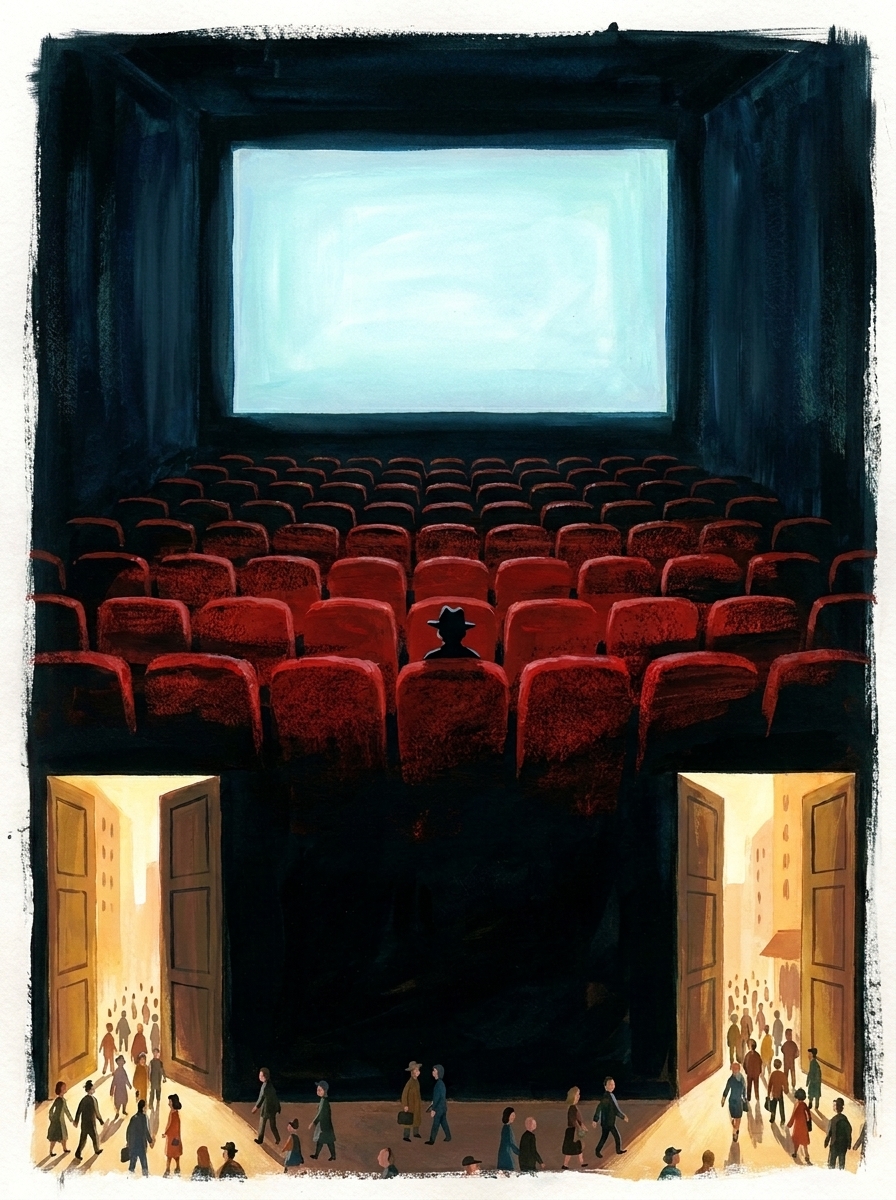
In 2025, for the first time in fourteen years, not a single Marvel Cinematic Universe film cracked the annual top ten at the domestic box office. The franchise that had grossed thirty-two billion dollars worldwide -- a figure that dwarfs the GDP of over a hundred sovereign nations -- simply stopped commanding the attention it once treated as a birthright. Audiences did not picket the theatres. They did not petition for better stories. They drifted. They went to see original genre pictures, comedies, thrillers. The machinery kept turning, but the pews emptied.
That image -- the empty pew -- is not casual. I want to argue that the story Western culture tells itself most obsessively, the story of the heroic band of free individuals defeating a dark hierarchy, functions less like a discovered truth about human cooperation and more like a liturgy: a ritual whose power lies in the performance, not in the accuracy of what it describes. The distinction matters, because it changes what we think the story is teaching us -- and whether we should trust the lesson.
The template is so familiar it barely registers as a template. A diverse group of autonomous individuals, each bringing a unique gift, voluntarily assembles to oppose a centralised, coercive authority. The authority is powerful but brittle; the band is outmatched but resilient. Victory arrives through the alchemy of chosen cooperation -- not institutional leverage, not superior resources, but the specifically liberal miracle of free agents choosing to stand together. Tolkien's Fellowship. Lucas's Rebel Alliance. Whedon's Avengers. Rowling's Dumbledore's Army. The architecture is load-bearing across the most commercially successful narratives of the past eighty years.
The question I want to sit with is simple and uncomfortable: why this shape?
One answer -- the one that feels most instinctive -- is that the story persists because it is true. People keep telling it because voluntary cooperation really does defeat centralised tyranny, and each generation observes the pattern anew. This is not a frivolous claim. It has serious intellectual backing. Erica Chenoweth and Maria Stephan's dataset of 323 resistance campaigns between 1900 and 2006 finds that nonviolent campaigns relying on voluntary, decentralised cooperation succeeded fifty-three percent of the time, against twenty-six percent for violent ones. Campaigns that mobilised at least 3.5 percent of the population never failed -- not once, across every continent, across societies with radically different cultural and media environments. Elinor Ostrom won the Nobel Prize for demonstrating that voluntary cooperative groups manage common resources -- fisheries, irrigation systems, forests -- without state coercion or market mechanisms, in contexts ranging from Swiss alpine pastures to Philippine rice terraces. Tocqueville, writing in 1835 with no culture industry to influence him, identified the American habit of voluntary association as the generative fact of democratic life. The evidence that cooperation can defeat hierarchy is real, measurable, and cross-cultural.
And yet.
If the story persisted simply because it tracked this truth, we would expect it to resemble the truth it tracks. It does not. Chenoweth's data tells us that the decisive mechanism of successful resistance is mass mobilisation -- broad participation crossing a measurable threshold, combined with institutional defection among regime loyalists and sustained noncooperation. The hero-band narrative depicts none of this. It centres a small group of exceptional individuals. It resolves conflict through combat, not nonviolent strategy. It replaces the 3.5 percent threshold with prophecy and destiny. The Jedi do not organise the galactic working class; they wield lightsabers anointed by a mystical bloodline. The Avengers do not build the kind of broad-based civic coalition that Chenoweth's research identifies as the actual engine of regime change; they punch aliens in Manhattan while ordinary people cower in the rubble. The fellowship structure, in story after story, replaces mass participation with elite exceptionalism.
This is not compression. Compression preserves the principle while simplifying the detail -- the way a subway map preserves the topology of a transit network while discarding the geography. What the hero-band template does is something closer to inversion. It takes a principle about the power of broad, ordinary, voluntary action and recodes it as a spectacle of extraordinary individual agency. If you learned everything you knew about resistance from these stories, you would learn the wrong mechanism. You would wait for the chosen one, not organise your neighbours.
I should be honest about where this argument gets genuinely difficult, because the strongest objection to it is a philosophical one. The objection goes like this: identifying the social function of a narrative does not disprove its truth. True beliefs can be ritually retold. The claim that washing hands prevents disease is both liturgically reproduced (every public health campaign repeats it) and empirically true. Showing that the hero-band story functions as a community-constituting ritual does not, by itself, prove that it fails to describe something real. The genetic fallacy -- rejecting a belief because of its social origins rather than its content -- is a real fallacy, and I am not immune to it.
I take this seriously. I take it seriously enough to concede the point in its strongest form: the principle that voluntary cooperation can defeat centralised power is genuinely true. Chenoweth's data is authoritative. Ostrom's findings are robust. The students who organised through group chats in Dhaka in July 2024 and toppled an entrenched authoritarian government were not enacting a liturgy. They were exercising a political capacity that exists independently of any story anyone tells about it. The American Bar Association, analysing the Bangladesh July Revolution, described a decentralised movement organised largely by students and powered by ordinary civilians that managed to overthrow a well-established authoritarian regime. That is not myth. That is a fact about how power works.
But here is where I have not switched sides. The question is not whether the underlying principle is true. The question is what explains the narrative template's dominance -- why this particular distorted version of the truth has become the default story, told so often and so loudly that it crowds out more accurate encodings. A true principle and a dominant narrative about that principle are different things, and the gap between them is where the liturgy lives.
Consider how the template gets deployed in contexts where it manifestly does not correspond to what is happening. Alexandra Homolar's peer-reviewed archival research in Security Dialogue traces the hero-villain narrative structure in American political rhetoric from Samuel Adams to Donald Trump. The frame was applied to justify the Iraq War, in which the United States -- the most powerful military hierarchy on the planet -- cast itself as the heroic band opposing a villainous despot. It was applied to border militarisation, to counterterrorism policy, to nearly every military action of the past two centuries. In these contexts, the narrative does not describe a reality in which voluntary cooperation defeats centralised power. It describes a reality in which centralised power deploys itself while borrowing the moral vocabulary of the underdog. Homolar identifies three operations: following (identifying protagonists and antagonists), framing (establishing causality), and mapping (applying character cues to prime audiences for specific responses). These are the mechanics of a liturgy -- a ritual that constitutes the political community it claims merely to describe.
If truth-correspondence explained the template's dominance, we would expect it to be applied selectively -- to cases where voluntary cooperation actually prevailed -- and corrected where it did not. That is not the pattern. The pattern is universal application, including to cases where the narrative inverts the actual power relationship. Liturgies behave this way. They are applied everywhere, because their function is community constitution, not description.
There is a second reason the liturgical explanation does work the truth-correspondence explanation cannot fully manage: industrial reproduction. The culture industry is not a neutral conduit transmitting some deep signal about human cooperation. Disney, Warner Bros., and Marvel Studios are risk-averse, profit-maximising institutions that greenlight what has worked before. When a formula generates thirty-two billion dollars, it does not need to be true to be repeated. It needs only to be bankable. The infrastructure -- intellectual property, merchandising, theme parks, ancillary licensing -- is built around the template to such a degree that the template's reproduction becomes self-sustaining regardless of its descriptive accuracy. Adorno and Horkheimer's culture-industry thesis from 1944 anticipated this dynamic: when production is formula-driven and sequel-dependent, audience preference becomes tautological. You cannot meaningfully prefer what you are never offered an alternative to.
Now, the counter-argument here is that the age of YouTube, TikTok, and self-publishing has democratised storytelling to the point where the culture-industry thesis is obsolete. Audiences have more choices than ever. If the template persists despite democratised production, doesn't that confirm organic demand? I am less certain this objection is as strong as it sounds. Democratised platforms reproduce the same template because creators are trained on it. YouTube storytelling advice universally teaches the hero's journey. TikTok narrative arcs mirror Hollywood three-act structure. The template's penetration into amateur production demonstrates cultural hegemony -- in the Gramscian sense, the dominant form has been internalised as common sense and reproduced without institutional coercion. Creators do not choose the hero-band frame because they independently verified its truth; they choose it because it is the only frame their creative education made available. This is how hegemonies work: they are invisible to those who inhabit them.
I want to push on the cross-cultural evidence, because it sharpens the argument in ways that raw industrial analysis cannot. Sun, Kinsella, and Igou, publishing in Personality and Social Psychology Bulletin in 2024 across six studies with American and Chinese participants, found that the concept of heroism itself varies systematically with cultural values. Americans rated strength, power, autonomy, and proactive individual action as central to heroism. Chinese participants rated patriotism, dedication, duty, and nobility. The hero-band template -- a diverse fellowship of autonomous individuals who freely choose to cooperate -- maps cleanly onto Anglo-American liberal individualism. It does not map onto collectivist frameworks where duty, sacrifice, and group harmony precede individual choice. The fellowship of free individuals is legible as a specifically Western liberal fantasy, not a structural feature of human storytelling.
The objection that Chinese narrative traditions also feature cooperative groups defeating tyrannical hierarchies -- Water Margin, Romance of the Three Kingdoms -- is worth taking seriously. But the structural differences matter. Water Margin's bandits operate under feudal loyalty to a corrupt court, not liberal voluntarism. Romance of the Three Kingdoms features rival states, not voluntary associations. Reading these as hero bands requires applying the very Anglo-American lens that the cross-cultural data identifies as culturally contingent. Joseph Campbell's monomyth, which gave the template its academic respectability, has been criticised as a colonial-era projection of a single Indo-European structure onto traditions with significantly different architectures. The template's dominance maps onto the distribution reach of the Hollywood apparatus, not onto the deep structure of human narrative cognition.
Where does this leave us? Not, I think, with the clean conclusion that the hero-band story is simply false and should be abandoned. The underlying principle it borrows from -- that voluntary cooperation can defeat centralised coercive power -- is one of the most important truths political science has produced. Chenoweth's work, Ostrom's work, the lived experience of millions of people from Manila to Warsaw to Dhaka -- these are not liturgy. They are evidence that something real and powerful happens when ordinary people choose, without coercion, to act together against systems that depend on their compliance.
The problem is not the principle. The problem is the encoding. The dominant narrative template takes a truth about mass participation, nonviolent strategy, and broad civic mobilisation, and recodes it as a spectacle of elite exceptionalism, combat victory, and prophetic destiny. It takes a phenomenon that depends on the 3.5 percent threshold -- on enough ordinary people showing up -- and makes it about a dozen extraordinary people with special powers. Philip Brown, writing in Spectre Journal, observes that in the Star Wars franchise, workers appear only as background noise: faceless stormtroopers, invisible maintenance crews, a proletariat written out of its own revolution. The one exception -- Andor's prison-factory uprising and funeral insurrection, in which collective, materially grounded resistance replaced Jedi mysticism -- was praised precisely because it broke the template. The exception illuminated the rule.
I think the relationship between the hero-band narrative and the truth about cooperation is best understood as parasitic rather than descriptive. The template borrows credibility from a real phenomenon. People recognise that cooperation can defeat tyranny because they have seen it happen, or at least because they have absorbed the real-world examples -- the Berlin Wall, the fall of Marcos, the Dhaka students -- that confirm the principle. The template attaches itself to that recognition and then recodes the mechanism in a form that serves social and industrial functions: moral clarity, vicarious agency, externalised evil, community constitution. The narrative does not survive because it is accurate. It survives because it is useful -- useful to studios that need bankable formulas, useful to politicians who need simple mobilising frames, useful to audiences who want catharsis more than strategic literacy.
This is what liturgies do. They take something the congregation already half-believes and formalise it into a ritual that feels like confirmation. The ritual does not need to be accurate, because its power lies in the performance, not in the proposition. Every retelling constitutes the community that retells it: we are the kind of people who believe that a small band of free individuals can defeat the dark tower. The belief feels true because we keep hearing it. We keep hearing it because the machinery -- cultural, industrial, political -- keeps producing it. The machinery keeps producing it because the belief is useful to those who operate it. The loop closes, and the congregation grows, and the fact that Dhaka succeeded for entirely different reasons than the Avengers succeeded becomes invisible inside the liturgy.
I keep returning to those students in Dhaka, because they are the test case both sides of this argument must account for. They did something real. They cooperated voluntarily, decentralised their organisation, sustained action under repression, and brought down a government. They did it without prophecy, without superpowers, without a chosen one. They did it the way Chenoweth's data says it actually works: with enough ordinary people showing up.
The hero-band narrative would have cast them differently. It would have found the charismatic leader, the small inner circle, the climactic confrontation. It would have compressed a mass movement into a fellowship. And in doing so, it would have taught the next audience the wrong lesson about why the revolution worked -- that it was about the exceptional few, not the committed many.
We deserve a better story about cooperation. Not a less hopeful one. A more honest one. The truth that Chenoweth documented is more inspiring than anything Hollywood has managed to encode, precisely because it distributes agency to everyone rather than concentrating it in the gifted. The 3.5 percent rule says that if enough ordinary people decide to show up, the hierarchy cannot stand. That is a story worth telling. It is also a story the liturgy, for all its sound and fury, has never quite managed to tell.
The Church of Marvel
Here's a weird fact. In 2025, not a single Marvel movie cracked the top ten at the box office. For the first time in fourteen years, the biggest movie franchise in history -- thirty-two billion dollars in tickets sold -- just stopped filling seats. People didn't protest. They didn't demand better. They wandered off and watched comedies instead.
That tells us something. If these movies were selling us a deep truth about how the world works, we'd miss them when they left. We don't. We miss them the way you miss a song that was always on the radio. It wasn't your favorite. It was just there.
I think the biggest story in Western culture works more like a church service than a history lesson. And the gap between those two things matters more than you'd guess.
The Story You Already Know
You've seen this a thousand times. A ragtag group of special people -- all different, all free, all choosing to be there -- team up against an evil empire run by one powerful villain. The villain has the army. The heroes have each other. And love or friendship or grit pulls them through.
The Fellowship of the Ring. The Rebel Alliance. The Avengers. Dumbledore's Army. It's the same shape, over and over, in the most popular stories of the last eighty years.
The question is: why this shape?
The Real Way Power Falls
One answer is that the story sticks around because it's true. And here's the thing -- part of it is. There's a political scientist named Erica Chenoweth who studied 323 real resistance movements from 1900 to 2006. She found that nonviolent campaigns -- the kind built on regular people choosing to cooperate -- won 53% of the time. Violent ones won only 26%. And here's the kicker: every single campaign that got at least 3.5% of the population to show up succeeded. Every one. No exceptions.
In 2024, students in Bangladesh proved it again. They organized through group chats, built barricades, and toppled an authoritarian government. No superpowers. No prophecy. Just enough ordinary people deciding to show up.
So yes. Voluntary cooperation really can beat a hierarchy. That's not myth. That's a measured fact.
But the Story Gets It Backwards
Here's where it gets uncomfortable. If the story was tracking the truth, it would look like the truth. It doesn't.
Chenoweth's research says the key is mass participation -- millions of regular people. The movies give us twelve special people with superpowers. Real resistance works through nonviolent pressure and strikes. Movie resistance works through sword fights and space battles. The real pattern depends on ordinary people showing up in huge numbers. The movie version depends on a chosen one with a prophecy.
That's not simplification. A subway map simplifies -- it drops detail but keeps the logic. The hero-band story does something worse. It flips the logic. It takes a truth about the power of ordinary people and turns it into a spectacle about extraordinary ones.
If you learned everything about resistance from these movies, you'd learn to wait for a savior. You wouldn't learn to organize your neighbors.
But Couldn't the Story Still Be True?
Fair pushback. Just because a story gets repeated like a ritual doesn't prove it's wrong. Public health campaigns repeat "wash your hands" all the time. That's both repeated like a ritual and genuinely true.
I'll be honest: this is a strong objection. And I think the core idea -- that cooperation beats tyranny -- really is true. Chenoweth proved it. The students in Dhaka lived it.
But the question isn't whether the idea behind the story is true. The question is why this one distorted version of the idea became the default. Why does the version with the small elite band and the combat victory dominate -- instead of a version that actually looks like how resistance works?
The Factory and the Frame
Part of the answer is money. Disney and Marvel aren't in the truth business. They're in the revenue business. When a formula earns thirty-two billion dollars, you don't check if it's accurate. You make another one. The theme parks, the toys, the streaming shows -- all of it is built around this one template. The machine keeps producing the story whether it's true or not.
And it goes deeper than Hollywood. Even on YouTube and TikTok, where anyone can tell a story, creators keep using the same shape. Not because they tested it against real life. Because every writing guide, every film school class, every "how to tell a story" video taught them the hero's journey. The pattern got inside our heads. We repeat it the way we repeat any habit -- without thinking about why.
What a Liturgy Does
A liturgy is a ritual that makes a community feel like a community. You don't go to a church service because the prayers are scientifically accurate. You go because the act of saying them together makes you feel like you belong.
That's what the hero-band story does. Every time we retell it, we're saying: "We're the kind of people who believe a small band of free individuals can beat the dark tower." It feels true because we keep hearing it. We keep hearing it because the movie studios and the politicians keep producing it. They keep producing it because the belief is useful -- useful for selling tickets, useful for rallying support, useful for making you feel like the good guy.
The loop closes. And the fact that Dhaka succeeded for entirely different reasons than the Avengers succeeded becomes invisible.
We Deserve a Better Story
I keep coming back to those students in Bangladesh. They did something real. They cooperated, spread the word, held the line under pressure, and changed their country. They did it the way the data says it actually works: with enough ordinary people showing up.
The hero-band story would have rewritten their revolution. It would have found one leader, one inner circle, one big showdown. It would have compressed a mass movement into a fellowship. And it would have taught the next audience the wrong lesson about why it worked.
The truth Chenoweth found is actually more inspiring than anything Hollywood has managed. It says that if enough regular people decide to show up, the hierarchy can't stand. That's a story worth telling. It's also the one story the blockbuster machine has never quite managed to tell.