

Paul Rozin spent three decades at the University of Pennsylvania mapping the architecture of human disgust, and one of his most useful demonstrations involves a cockroach. He would sterilize it — autoclave it until it was as pathogen-free as a surgical instrument — and then dip it into a glass of apple juice. The juice was safe to drink. Rozin could prove it was safe to drink. No one would drink it.
The experiment illuminates what Rozin calls the contagion principle: once something has been touched by a source of contamination, the contamination persists regardless of subsequent cleaning. The disgust system does not track actual pathogen risk. It tracks the history of contact, and the history is permanent. Sterilize the cockroach and the glass is still ruined. Wash a murder victim's shirt until it is chemically indistinguishable from a new one and nobody will wear it. The contamination lives in the mind's ledger of what touched what, and no amount of bleach can reach the ledger.
The corpse is the contagion principle's masterwork. A living body — touched, held, loved, pressed against in sleep — becomes, within hours of death, an object of profound aversion. The same skin that was kissed becomes something you pull back from. The same hand that was held becomes something that must be handled with gloves, with ceremony, with rituals engineered to manage a contamination the mind insists is present even when the pathologist insists it is not. The speed of the reclassification is the thing worth noticing. It happens faster than reason can intervene. Children who have never been taught a single thing about death or disease will recoil from a dead animal. The system is not learned. It is pre-installed.
The revenant is what happens when the contaminated thing moves.
Where the ghost is the mind without the body — the persistence of a person past the destruction of their flesh — the revenant is the precise inversion. It is the body without the mind. The meat walking. Both figures emerge from the same dualist architecture Paul Bloom identified in his developmental studies, the two cognitive systems that track bodies and minds separately. The ghost is what the mind-tracker produces when it keeps modeling a person the body-tracker has written off. The revenant is what the body-tracker produces when it encounters a body that should have been written off but has not stopped moving. The mind is gone. The face is blank or rotting or swollen past recognition. But the thing is upright. It is coming toward you. And the disgust system, which had already reclassified this body as maximally contaminated, is now screaming that the contamination has become mobile.
This is why the revenant operates in a different emotional register than the ghost. The ghost evokes grief, unease, the eerie sense of a presence that should not be there. The revenant evokes disgust — the deep, stomach-level, pre-rational revulsion that Rozin and his colleagues categorize as "animal-reminder disgust." This is the specific variety triggered by phenomena that remind us we are biological organisms, subject to decay, destined for the same corruption we recoil from in others. The corpse is the ultimate animal reminder. It is you, in the future tense. And it is walking toward you.
Ernest Becker built his 1973 book The Denial of Death around the claim that awareness of mortality is the central psychological fact of human existence, and that the elaborate meaning-making systems cultures construct — religions, nations, artistic legacies, ideologies — function, at root, as buffers against the terror this awareness produces. Sheldon Solomon, Jeff Greenberg, and Tom Pyszczynski spent the next four decades testing this claim empirically under the name Terror Management Theory, and the results are remarkably consistent: remind people of their own death — even subliminally, even with a single word flashed too fast to consciously register — and their attachment to cultural worldviews intensifies, their tolerance for outsiders decreases, their need for the world to make sense sharpens. The mortality reminder does not produce a specific fear. It produces a systemic tightening, a retreat toward the structures that keep the terror managed.
The revenant unmanages it. Every practice the species has developed for dealing with the dead body — burial, cremation, sky burial, embalming, mummification, the closed casket, the sealed tomb — addresses the same problem from a different angle: the corpse must be managed, because leaving it among the living is intolerable to the disgust system and the terror-management system simultaneously. The burial puts the body underground. The cremation destroys it. The embalming preserves the appearance of sleep, neutralizing the visual trigger of decay. Each practice contains the body, manages the contamination, and allows the living to return to the business of not thinking about what they will eventually become.
The revenant breaks every containment. It digs itself out. It sits up on the slab. It walks back into the village and stands in the doorway of the house it used to inhabit. The horror is not that it wants something — it may want nothing, may be incapable of wanting — but that the thing the living did to manage their fear did not work. The burial failed. The rites failed. The dead are not staying where they were put.
William of Newburgh, a twelfth-century English chronicler, recorded several cases of revenants in his Historia rerum Anglicarum with a bureaucratic flatness that makes them more disturbing, not less. In the village of Anantis, a corpse was walking at night. It was spreading disease. The locals went to the churchyard, dug up the body, and found it bloated, the shroud stained with what appeared to be fresh blood. They cut the body open — an enormous quantity of blood poured out — and burned it. The walking stopped. Newburgh does not editorialize. He does not treat the event as a marvel or a morality tale. He treats it as a municipal problem that required a practical solution: the dead were not behaving, so the body was destroyed more thoroughly.
The Norse draugr operates at a different scale but fires the same circuits. In the Icelandic sagas, the draugr is the animated corpse of a person of status who refuses to surrender his burial mound. The draugr is enormously strong, often described as swollen and discolored, black or blue with decay, and ferociously territorial. It does not haunt in the spectral way the ghost does. It fights. It seizes you with physical hands and wrestles you in the dark of the barrow, and if you cannot overcome it, you die in the mound and join its collection. Grettir Ásmundarson's battle with the draugr Glámr in Grettis saga is one of the most visceral scenes in medieval literature — not because the fight is supernatural, but because it reads like a physical struggle with a corpse that is impossibly, obscenely strong. The draugr is a property dispute conducted by a dead man who will not vacate.
The Chinese jiangshi adds a different visual grammar to the same substrate. Stiff with rigor mortis, arms outstretched, incapable of bending its limbs, the jiangshi moves by hopping — an image that borders on comic until you imagine it in a room with you, between you and the door. The jiangshi is reanimated by insufficient funerary rites, by the failure of the living to perform the obligations the dead require. It is not angry. It is not seeking revenge. It is simply unfinished, and the unfinishedness has given it motion.
The Haitian zonbi demands particular care, because the figure carries a historical weight that separates it from the European and Asian revenants. The zonbi in Haitian Vodou tradition is not a mass of shambling dead. It is a single person — a specific person, with a name — reanimated by a bokor and stripped of will. The zonbi works. It labors in fields, follows instructions, performs tasks. The horror is not death but enslavement after death, the final theft of autonomy by a power the victim cannot resist. Wade Davis explored an ethnobotanical basis in The Serpent and the Rainbow in 1985 — a combination of tetrodotoxin and psychoactive compounds that could, he proposed, produce a death-like state from which the victim might be revived in a dissociated condition. Davis's pharmacology has been challenged, but his cultural observation holds: the zonbi is a figure born from a society founded on slavery, and it encodes the specific terror that even death might not free you from forced labor. The revenant, in Haiti, is not just the corpse that will not stay down. It is the laborer who cannot stop.
George Romero's Night of the Living Dead in 1968 took the individual revenant and scaled it, and the scaling changed the figure's meaning entirely. Romero's dead are not single corpses with unfinished business. They are a tide. Their horror is the horror of systemic failure — every containment protocol collapsing at once, every cemetery emptying, every body the species had managed to put away climbing back out. The individual revenant says: the dead require labor, and the labor was not done. The Romero zombie says: the labor cannot be done, because the dead have overwhelmed the living's capacity to manage them. It is the revenant at the scale of civilization. The fact that Romero's figure has generated more cultural offspring than any other horror creation of the twentieth century suggests the scaling struck something the culture already feared but had not yet named.
The counterargument writes itself: the Romero zombie is a modern invention, a product of Cold War anxiety and Vietnam-era nihilism and Watergate-era institutional distrust, and reading it as an expression of deep cognitive substrate is overreach. Romero himself spoke explicitly about the social commentary. And the surface reading is not wrong — the zombie movie of the 1970s is absolutely a commentary on its historical moment. But the question is why the commentary landed. Why audiences did not merely understand the metaphor but felt it in their bodies. The answer is that the metaphor was delivered through the disgust system, the animal-reminder system, the specific pre-rational revulsion that the human body produces when it stops being a person and starts being a thing that moves. Strip the social commentary and the figure still works. Strip the disgust and it does not. The substrate is doing the load-bearing work. The commentary rides on top.
For the writer, the revenant delivers the simplest instruction of any figure on this list: disgust is the cheapest fear and the most reliable. The ghost requires emotional investment — the reader must care about the dead person, must feel the grief that animates the haunting. The shapeshifter requires trust built and then betrayed. The revenant requires only a body that should be still and is not, moving toward you, and the knowledge that wounding it will not make it stop.
The revenant is the only figure that becomes more frightening when it is slow. A fast monster is an action sequence. A slow monster that cannot be killed and does not stop is a nightmare, because the pace mirrors the real quality of dread — not the sharp spike of surprise but the grinding, inescapable knowledge that the thing is coming and nothing you can do will prevent it from arriving. Speed implies agency, intention, the possibility of reasoning with the threat or outmaneuvering it. Slowness implies mechanism. The revenant is not chasing you. It is moving in your direction the way water moves downhill. You are not its quarry. You are simply in its path.
But the figure does more than frighten. It teaches. And what it teaches is the oldest lesson the living have had to learn about the dead: they require labor.
Every culture that has left a record has developed practices for managing the corpse. Burial, cremation, exposure, mummification, excarnation, ossuary storage — the forms differ but the imperative does not. The body must be processed. Not merely removed from sight but moved through a ritual sequence that acknowledges the contamination, manages the disgust, and discharges the obligation the living owe the dead. The obligation is not hygienic. It is moral. The dead person was a member of the community. The community owes them a departure that honors what they were, and the revenant is the figure that appears when the departure is botched.
When the burial was careless. When the rites were skipped. When the living, out of laziness or negligence or the overwhelming scale of catastrophe, failed to do what the dead required. The jiangshi hops because the funerary protocol was incomplete. Newburgh's revenant walks because the burial was insufficient. The draugr guards the mound because the dead man's will was not properly settled. In every case, the revenant arrives not because it is evil but because a duty was left undone. The dead do not come back to punish. They come back to remind.
To flatten this figure into a video-game enemy — something dispatched with a headshot, cleared from a level, respawning when you reload — is to lose the only thing the figure was ever for. The revenant was never about combat. It was about obligation. The dead do not stay managed when the living forget the work. And the work is real: the washing, the wrapping, the watching through the night, the digging of the grave, the words spoken over the body, the slow and irreducible act of acknowledging that someone who was here is gone and that the going demands something of the people who remain.
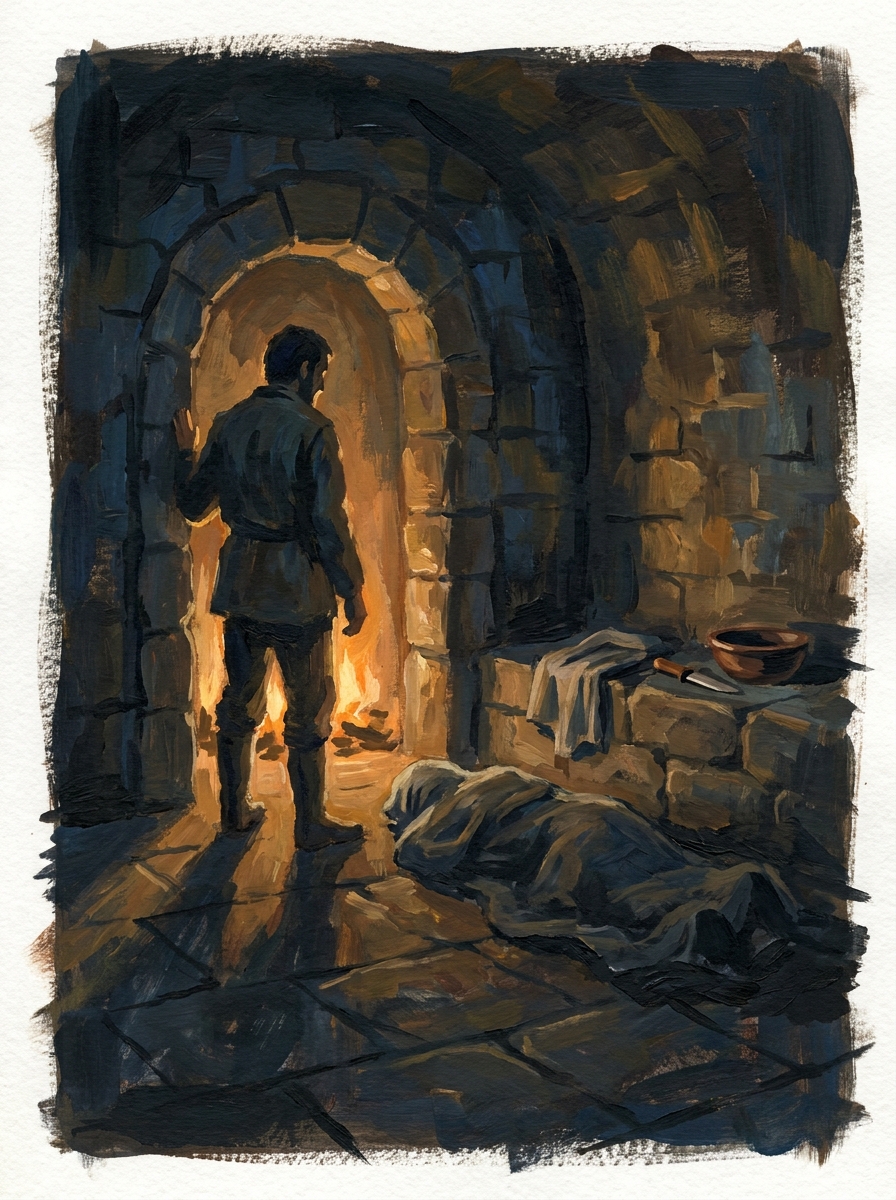
The body is on the floor. It is not finished with you. The question has never been whether it will move. The question is whether you did the work that would have kept it still.
A scientist once sterilized a cockroach — made it as clean as a surgical tool — and dipped it in a glass of apple juice. The juice was perfectly safe. Nobody would drink it.
That's how disgust works. It doesn't track actual risk. It tracks the idea of contamination, and the idea is permanent. You can't wash it off. You can't logic it away. Once something is gross, it stays gross, no matter what you do.
Now think about what happens to a dead body.
The Body That Should Stay Down
A living person is held, kissed, pressed against in sleep. Within hours of death, that same body becomes something people recoil from. The same skin. The same hands. The reclassification is instant, and it's deeper than anything you were taught. Kids who've never been told about death pull back from dead animals. The system comes pre-installed.
The revenant is what happens when the contaminated thing moves.
Where the ghost is the mind without the body — a presence that lingers after death — the revenant is the body without the mind. No personality. No memory. No reason to stop. Just dead meat, walking toward you, and the knowledge that hurting it won't help.
Why It Hits Different
The ghost makes you uneasy. The revenant makes you sick. That's not an accident — the two figures tap completely different systems.
The revenant runs on what researchers call "animal-reminder disgust." That's the specific revulsion triggered by things that remind you that you're a biological organism. That you'll decay. That the corpse on the floor is you, in the future tense. Your brain developed elaborate ways to manage this — burial, cremation, embalming, the closed casket, the sealed tomb. Every one of these is a containment strategy: put the body away, manage the contamination, let the living get back to the business of not thinking about death.
The revenant breaks every containment. It digs itself out. It walks back in.
The Same Horror, Every Culture
A twelfth-century English writer recorded revenants with the calm of someone filing a noise complaint. A body was walking at night. It was making people sick. The locals dug it up, cut it open, burned it. Problem solved.
The Norse draugr is the dead man who won't leave his burial mound. Enormously strong, swollen with decay, he fights anyone who enters. The Chinese jiangshi hops through the dark with its arms out, stiff with rigor mortis — reanimated because someone cut corners on the funeral rites.
The Haitian zonbi deserves special attention. It's not a horde. It's one person, reanimated by a sorcerer and stripped of will. The zonbi works — it labors in fields, follows orders. The horror isn't death. It's slavery after death. The figure comes from a society founded on slavery, and it encodes the fear that even dying won't set you free.
George Romero's 1968 Night of the Living Dead took the individual walking corpse and made it collective. Every cemetery emptying. Every burial failing at once. The revenant scaled to civilization.
The Cheapest Fear
Here's what the revenant teaches anyone who tells stories: disgust is the cheapest scare and the most reliable. The ghost requires emotional investment — you have to care about the dead person. The shapeshifter requires trust built and betrayed. The revenant requires only a body that should be still and isn't, moving toward you, and the knowledge that nothing you do will make it stop.
And it's scarier when it's slow. A fast monster is an action scene. A slow monster that can't be killed and won't stop is a nightmare — because it mirrors how dread actually works. Not a spike of surprise, but the grinding knowledge that it's coming and you can't prevent it.
What It Protects
The revenant teaches the oldest lesson the living have ever learned about the dead: they require labor. Burial. Washing. Watching. Words spoken over the body. Every culture has developed rituals for this, and the revenant is the figure that shows up when the rituals are skipped.
The jiangshi hops because the funeral was incomplete. The draugr guards the mound because the will wasn't settled. The dead don't come back because they're evil. They come back because a duty was left undone.
To turn the revenant into a video-game enemy — something you dispatch with a headshot and forget — is to lose the only thing the figure was for. It was never about combat. It was about obligation.
The body on the floor isn't finished with you. It needs something. The question is whether you know what it is.