

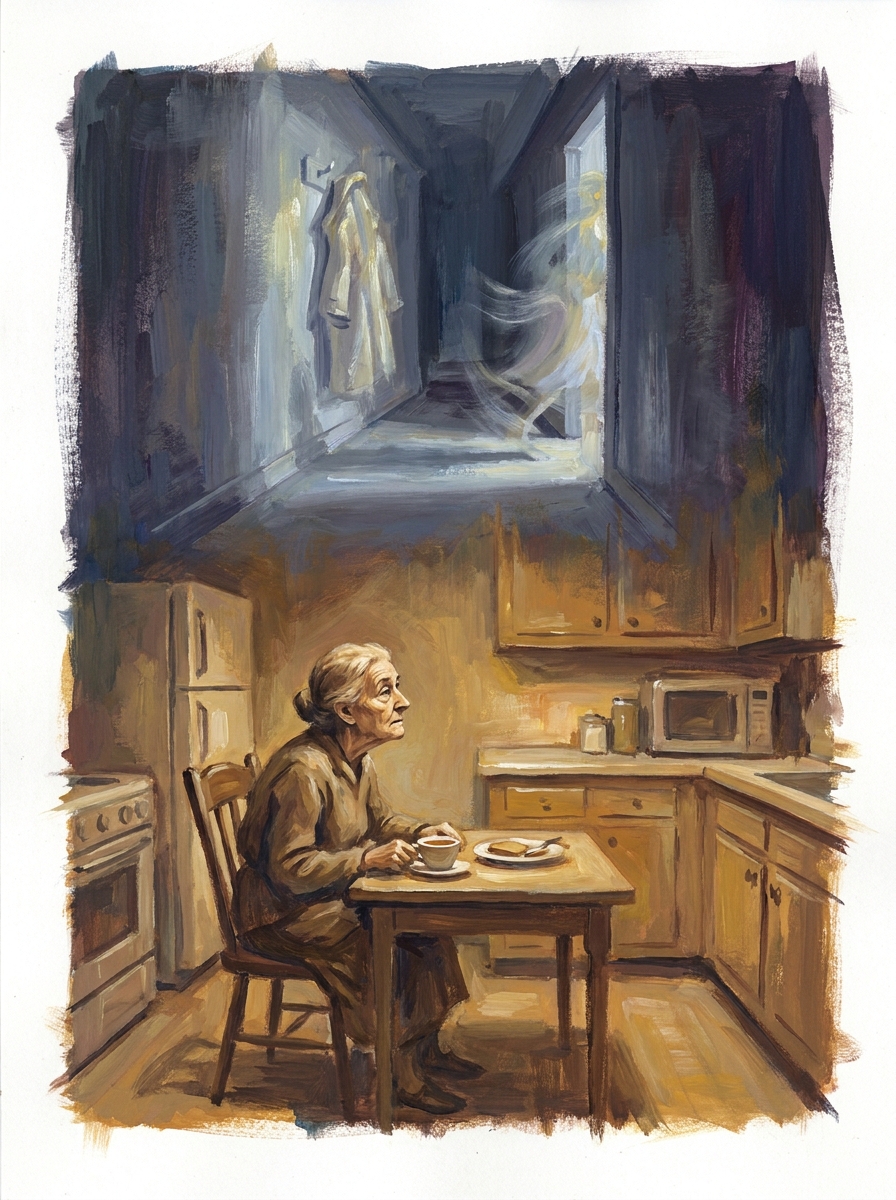
Three months after his wife died, a retired schoolteacher in Cardiff told a researcher that he heard her footsteps in the hallway every morning at seven. He did not believe she was alive. He was not confused, not demented, not even, by any clinical measure, depressed. He simply heard her. The footsteps were exactly her footsteps — the weight, the pace, the slight drag of her left shoe on the hardwood. They lasted about four seconds. Then they stopped, and he ate breakfast alone.
W. Dewi Rees published his findings in the British Medical Journal in 1971. He had interviewed 293 widows and widowers in a Welsh community, and what he found was not an anomaly but a norm: nearly half reported sensing the presence of their dead spouse. They heard voices. They felt touches. They saw figures in peripheral vision that dissolved when they turned to look. They reported these experiences calmly, without distress, often with something closer to comfort. Most had never told anyone, because they assumed it meant they were losing their minds.
They were not losing their minds. They were doing something the mind has always done, something it cannot help but do, something that sits at the root of the oldest and most durable figure in the human bestiary. They were tracking a person who was no longer there.
The ghost is the most intimate monster. It is not out there — not in the forest or beneath the water or coiled at the root of the world. It is in the room with you. It wears the face of someone you loved, or someone who died in the house before you moved in, or someone whose business with the living was never finished. And the question it poses is as simple as it is unanswerable: where did the person go?
Not the body. We know what happens to the body. The question is about the other thing — the presence, the voice, the particular quality of attention that made that person a person and not a corpse. The thing that vanished in a single moment and left the body behind like a coat draped over a chair. Every human being who has watched someone die has registered this disappearance. Every human culture that has buried its dead has tried to account for what went missing. The ghost is that accounting.
The cognitive science of ghost-belief rests on a small number of systems that are not, individually, controversial. The controversy lives in what they produce when they fire together.
The first is agency detection. The system that scans the environment for agents — for things that move with purpose and intention — runs hot by design. Justin Barrett, a cognitive anthropologist at Oxford, named it the Hyperactive Agency Detection Device, and the name captures the essential engineering principle: the system is biased toward false positives because the cost structure demands it. Flinching at a shadow that turns out to be a branch costs you a half-second of embarrassment. Failing to flinch at a branch that turns out to be a snake costs you everything. So the system over-fires. It finds agents in rustling grass, in creaking floorboards, in the play of light on a wall at three in the morning. Most of these detections are corrected instantly — you recognize the branch, the house settling, the headlights passing. But in conditions of ambiguity — darkness, grief, exhaustion, the silence of a house that used to hold two people and now holds one — the corrections come slower, or do not come at all. The agent stays.
The second system is what Paul Bloom, a developmental psychologist at Yale, identified as intuitive dualism. In his 2004 book Descartes' Baby, Bloom demonstrated that children, from a very young age, track bodies and minds through two separate cognitive channels. They understand that a body has location, weight, physical properties. They also understand that a mind has beliefs, desires, intentions. And they do not treat these as the same thing. In one of the studies Bloom describes, children who watch a puppet show in which a mouse is eaten by an alligator will tell you, without hesitation, that the mouse's body has stopped working — it cannot see, cannot hear, will not move. But ask the same children whether the mouse still wants to go home, whether the mouse is still sad about missing its family, and the answer changes. The mouse still wants. The mouse still feels. The mind survives the body's destruction — not as a theological claim the child has been taught, but as a spontaneous output of two tracking systems producing different answers to the same event.
The adult, with effort and education, learns to override the mind-tracker in favor of the body-tracker. But the override is effortful. It is not the default. In grief, in darkness, in the specific quality of attention the bereaved bring to the spaces the dead used to occupy, the override weakens. The mind-tracker keeps running. It keeps expecting the person to be there. It keeps hearing the footsteps at seven.
Jesse Bering pushed this line further. In The Belief Instinct, he argued that the mind cannot simulate its own nonexistence, and by extension, it cannot fully simulate the nonexistence of other minds it has modeled. To truly believe that a person has ceased to exist — not just that the body has stopped, but that there is no longer a perspective, an awareness, a something-it-is-like-to-be-them anywhere in the universe — requires the mind to do something it was not built to do. So it doesn't. It keeps the model running. It keeps setting a place at the table. The ghost, in Bering's framework, is not a belief. It is an inability to disbelieve.
These three systems — the over-eager agent-detector, the dualist tracker that separates mind from body, and the mind-modeler that cannot simulate nonexistence — do not individually produce ghosts. Plenty of false positives from the agent-detector are corrected in a heartbeat. Plenty of mind-body mismatches are resolved without supernatural consequence. The ghost emerges when the systems converge, when agency detection fires in a place freighted with grief, when the mind-tracker is running a model it cannot delete, when the conditions of darkness and silence and emotional weight are exactly right for the correction not to arrive. The ghost is a confluence, not a glitch.
This is why it appears everywhere.
The Chinese hungry ghost — the restless dead who were improperly buried or died with unfinished obligations — demands appeasement through the Ghost Festival, with offerings of food and joss paper burned at the roadside. The Japanese yūrei, particularly the onryō, carries a visual grammar that has persisted from Edo-period woodblock prints into modern J-horror: white burial kimono, limp hands, the absence of feet, an appearance at the boundary between this world and the next. The Greek shade — the psyche Odysseus meets in Book 11 of the Odyssey — is not angry or frightening but diminished, a thin copy of the living person, recognizable but weakened, yearning for blood and warmth and the world it lost. The Igbo ndichie, the returned ancestors, are not feared but consulted. They remain members of the community, their wisdom available to those who know the protocols for reaching them.
These figures look nothing alike on the surface. The hungry ghost and the onryō serve different narrative functions. The Greek shade and the Igbo ancestor occupy opposed cosmological positions — one is pitiable, the other authoritative. A strict cultural-constructionist reading would say the differences are the point: that "the ghost" is not one thing but many, that lumping them under a single category is an act of Western universalism that flattens local meaning. And that objection is worth sitting with. The hungry ghost's demand for ritual feeding tells us something specific about Chinese cosmology and family obligation. The onryō's rage tells us something specific about Edo-period anxieties around female suffering and male guilt. To dissolve these figures into a single cognitive account risks losing precisely the cultural information that makes each one worth studying.
I take that objection seriously. But I think it mistakes the level at which the claim is being made. The claim is not that all ghosts are the same. It is that all ghosts are the same kind of thing — a product of the same cognitive collision, dressed in local cloth. The hungry ghost and the onryō and the Greek shade differ in what they want, how they appear, what they demand of the living. They are identical in what produces them: a person has died, the mind will not stop tracking the person, and the community must do something about the remainder. The cultural dressing is where the meaning lives. The cognitive substrate is where the figure lives. Confusing the two — or insisting that because the dressing varies, the substrate cannot be universal — is like arguing that because languages differ, the language faculty cannot be species-wide.
The bereavement literature confirms this from the clinical side. The felt presence Rees documented in Wales has since been measured across cultures, at rates that are remarkably stable: between 30 and 60 percent of bereaved spouses report sensory experiences of the dead within the first year. These are not hallucinations in the psychiatric sense. They are not associated with psychosis, they do not predict cognitive decline, and the people who report them overwhelmingly describe them as comforting rather than frightening. They appear to be the normal output of the person-tracking system running its routines on a model it has not been able to close.
Sleep paralysis adds another layer. The experience — waking in the night, unable to move, acutely aware of a presence in the room, often pressing on the chest — has been reported in every culture that has been studied. In Newfoundland, the figure is called the Old Hag. In Japan, kanashibari. Among the Hmong, dab tsog — a night spirit so terrifying that the anthropologist Shelley Adler, in her 2011 study, proposed it as a contributing factor in the sudden unexplained nocturnal death syndrome that killed Hmong refugees in their sleep in the 1980s. The figure at the bedside changes — sometimes a stranger, sometimes a demon, sometimes the recently dead — but the mechanism is consistent: the mind wakes before the body, the agent-detector fires into the dark, and the mind-tracker, freed from the body's ability to verify or correct, generates a presence the sleeper cannot dismiss because they cannot move to investigate.
If you write ghost stories — or if you want to understand why certain ones endure while others dissolve on contact — the substrate is a blueprint. A ghost story that operates on a single register underperforms the one that stacks the seams. The pure jump scare fires agency detection and nothing else. It startles and is instantly forgotten. But the ghost that also carries grief — that occupies a specific place the reader recognizes as the kind of place grief inhabits — engages the dualism circuits and the place-bound threat memory simultaneously. The reader is not just frightened. The reader is, briefly, bereaved. The felt presence in the story activates the same systems that produce the felt presence in the widow's hallway, and the result is a figure that lingers long after the book is closed.
This is why the haunted house works. Not because the ghost is scary — plenty of things are scary — but because the house gives the ghost a location that the mind's place-memory system treats as real. The specific staircase. The specific bedroom. The specific creak at three in the morning. Place-bound threat memory is a distinct system: the mind flags locations where danger has been encountered and raises vigilance there, sometimes for years. Layer this onto the person-tracker that will not release its model, and you get a ghost that does not merely appear but belongs — a figure native to a specific threshold, a specific floorboard, a specific angle of moonlight on a wall.
The great ghost stories know this instinctively. They layer dualism, grief, agency detection, and place-bound memory into a single figure, and the result is something the reader's nervous system cannot easily dismiss, because it is running the same programs that produce the experience in life.
But the ghost does more than frighten, and this is where I want the argument to arrive. The ghost protects something. It always has.
Mourning is labor. It takes time — not the five tidy stages Elisabeth Kübler-Ross described in On Death and Dying, which she herself cautioned against treating as a checklist, but the real, unstructured, idiosyncratic time that grief demands as it moves through the person-model the mind cannot delete. Every expectation that included the dead person — every anticipated conversation, every plan that assumed their presence, every morning that began with footsteps that no longer come — must be individually revised. This is not a single act of acceptance. It is thousands of small adjustments, spread across months or years, as the mind encounters each expectation and rebuilds it without the person who was supposed to be there.
The ghost gives this labor a figure. It makes the persistence of the dead visible, external, something the community can acknowledge and address. A culture that has ghosts has a way of saying: the dead are still here, the work of releasing them is real work, and the living owe them attention until the work is done. The Ghost Festival is not superstition. The vigil is not weakness. The felt presence at seven in the morning is not a pathology to be medicated away. These are the forms grief takes when it is allowed to move at its own pace, and the ghost is the figure that licenses the pace.
A culture that denies ghosts — that insists the dead are simply gone, that grief should resolve on a schedule, that the widow who still hears footsteps is indulging a lingering irrationality — denies mourning its native tempo. And the cost is not abstract. It is the cost of forcing a biological process into a cultural timeline that the biology does not recognize, of telling the person-tracker to stop tracking before it has finished its work.
I do not think this is metaphor. I think the ghost — the mind that will not leave until the living have done what they owe — is a direct encoding of a truth the species discovered before it had language to describe it in any other form. The ghost is the mind's insistence that love does not end when the body does, and that the ending, when it finally comes, must be earned through attention, through labor, through the slow and irreducibly human work of letting go.
The figure exists to license slow love. To strip it down to a jump scare is to lose the oldest permission the species ever granted itself: the permission to grieve at the pace grief actually requires.
Tonight, somewhere, a widow will hear footsteps in the hall and sit very still. Not because she believes in ghosts. Because the dead are still in her head, and the mind is doing what it was built to do, and the figure it produces — the one with the familiar weight, the familiar pace, the drag of the left shoe on the hardwood — is the oldest companion the species has ever made for itself in the dark.
Three months after his wife died, a man in Wales told a researcher he heard her footsteps in the hallway every morning at seven. He wasn't confused. He wasn't losing his mind. He just heard her — the exact weight of her step, the drag of her left shoe, lasting about four seconds. Then silence. Then breakfast alone.
He wasn't the only one. Nearly half of all widows and widowers report sensing the presence of their dead spouse — hearing voices, feeling touches, seeing figures in the corner of their eye. Most never tell anyone, because they think it means something is wrong with them.
It doesn't. It means their brain is doing exactly what it was built to do.
Your Brain Won't Stop Tracking
Your mind runs a person-tracking system. It builds a model of the people in your life — their voice, their habits, the sound of their footsteps. When someone dies, the body is gone. But the model keeps running. The system can't just delete a person. It doesn't know how.
On top of that, your brain tracks bodies and minds separately. Kids show this naturally. If you tell a young child that a mouse was eaten by an alligator, they'll say the mouse's body has stopped. But ask if the mouse is still sad? Still wants to go home? They'll say yes. The mind survives the body — not as something they were taught, but as a built-in feature of how children think.
Adults learn to override this. But the override takes effort. In grief, in darkness, in the quiet of a house that feels too empty, the override weakens. The mind-tracker keeps running. It keeps expecting the person to be there.
That's the ghost.
The Same Figure, Everywhere
Every culture has ghosts. The Chinese hungry ghost demands offerings of food and paper money. The Japanese yūrei appears in a white burial robe, hair loose, no feet — an image that's lasted from 1700s woodblock prints all the way to modern horror films. The Greek shade is a faded copy of the living person, thin and longing for the warmth it lost. West African ancestor spirits aren't feared — they're consulted, still treated as part of the community.
These figures look nothing alike on the surface. But underneath, they share the same structure: someone has died, the mind won't stop tracking them, and the community recognizes that the remainder needs attention.
Why the Ghost Isn't Just a Scare
The ghost protects something. It protects mourning.
Grief is work. Real work, not a checklist of five stages. Every plan that included the dead person — every expected conversation, every meal you assumed they'd be at — has to be rebuilt without them. That takes months. Sometimes years. It can't be rushed.
The ghost makes this work visible. A culture that has ghosts has a way of saying: the dead are still here, the labor of letting them go is real, and the living owe them attention until the work is done. Ghost festivals, vigils, funerary rituals — these aren't superstition. They're forms grief takes when it's allowed to move at its real speed.
A culture that denies ghosts often denies grief its time. It tells the bereaved to move on, get over it, stop hearing footsteps. It forces a biological process into a schedule the nervous system doesn't recognize.
What We Lose
To flatten the ghost into a jump scare — a special effect, a cold spot in a hallway — is to strip the figure of its oldest purpose. The ghost was never mainly about fear. It was about obligation. The fear was a side effect. The main function was protecting the slow, difficult, completely human process of letting go.
Tonight, somewhere, a widow will hear footsteps and sit very still. Not because she believes in ghosts. Because the dead are still in her head, and the mind is doing what it was built to do.
The ghost is the oldest companion the species has made for itself in the dark. It was built to say: take your time. The dead aren't finished with you yet.