

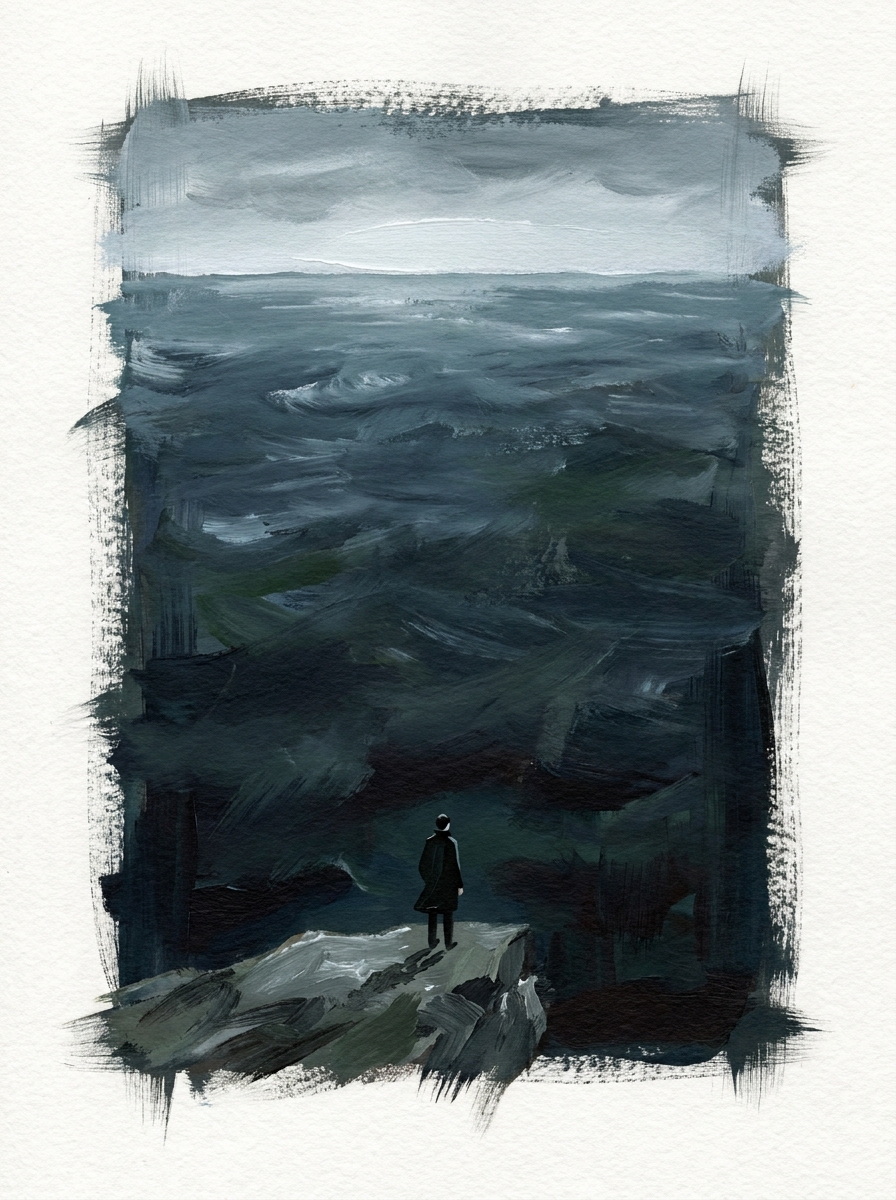
Stand at the edge of an ocean. Not a lake. Not a river. An ocean, the kind where the horizon is a straight line and the water beyond it continues for thousands of miles in every direction. Stand there and try to hold, in the mind, the fact that the floor beneath the water is in some places deeper than any mountain is high. The mind cannot hold it. The mind was not built to hold it. The mind was built for landscapes measured in walking distances and water measured in depths you could, if pressed, swim. The ocean exceeds the instrument, and the exceeding is the experience.
The sea is the fourth place in the series, and it is the first one where human scale genuinely fails. The forest is larger than you but navigable. The mountain is taller than you but climbable. The sea is larger and deeper than the brain's spatial systems were built to model, and the failure of the model is not a problem to be solved. It is the substrate of everything the species has felt in the presence of deep water.
The Substrate
Vastness perception is the dominant cognitive input. The open ocean presents a visual field with no landmarks, no cover, no spatial anchors. The brain's place-cell and grid-cell systems, which normally map the environment using reference points, find nothing to map with. The result is a specific kind of disorientation: not the lost-in-the-forest confusion of too many obstructions but the open-water confusion of too few. The sea is the cognitive opposite of the forest. The forest has too much spatial information. The sea has almost none.
Water-as-life-and-death affordance runs deeper than any landscape feature except fire. The brain reads water as essential and lethal simultaneously, and the dual reading is pre-mammalian. Aquatic organisms that depended on water for everything also evolved to detect changes in water quality, current, and depth that signaled danger. The terrestrial brain inherited the importance signal and added the drowning-specific terror that comes with being an air-breathing organism in a medium that does not contain air. The sea is life and death in the same substance, and the brain holds both valuations at once.
Horizon perception provides the emotional register. The ocean horizon is the longest unbroken sight line available on the planet's surface. It produces what researchers call the "overview effect" in miniature: a reduction in self-focus, an expansion of perceived possibility, and a characteristic shift in emotional tone toward what subjects describe as "openness" or "awe." The horizon is the sea's equivalent of the mountain's summit. Both produce smallness. The mountain produces it through effort. The sea produces it through scale.
The genesis-from-waters pattern provides the mythological substrate. In cosmology after cosmology, the world begins with water. The biblical waters of the deep. The Babylonian apsu. The Hindu samudra manthan, the churning of the cosmic ocean. The Polynesian Te Moana. The pattern is so widespread that it constitutes one of the most consistent features of human mythology. The brain appears to treat water as the original medium, the substance from which form emerges, and the mythologies are elaborations on what the brain already treats as true.
The Exemplars
The Polynesian ocean is the sea known, traversed, and inhabited at a level no other pre-modern culture matched. Polynesian wayfinding navigated thousands of miles of open Pacific using stars, swells, cloud formations, and the flight patterns of birds. The ocean was not a barrier. It was a road, and the people who traveled it had cognitive maps of a territory that included wave patterns, current signatures, and subtle shifts in water color that indicated distance to unseen land. The Polynesian relationship to the sea inverts the European one: where the European tradition treated the sea as the unknown that must be crossed to reach the known, the Polynesian tradition treated the sea as the known and the islands as the destinations that the known connected.
The Mediterranean in the Greek imagination is the sea as bounded but still dangerous. The Odyssey is a sea story, and the sea in the Odyssey is not the open Atlantic. It is the enclosed Mediterranean, a body of water with shores in sight for much of a typical voyage. But the storms, the monsters, the caprice of Poseidon: these fill the bounded water with the unbounded danger the brain associates with deep water regardless of the actual distance to shore. The Mediterranean demonstrates that the substrate does not require vastness to activate. It requires depth, unpredictability, and the knowledge that the water can kill you whether or not you can see land.
The Atlantic in West African and African American memory is the sea as the route of catastrophe. The Middle Passage, the forced crossing of enslaved Africans, has inscribed the Atlantic with a specific cultural meaning that no romantic treatment of the sea can overwrite. The water that separates the continents is also the water that carried millions of people to their deaths and to their enslavement. The Atlantic is a graveyard. It is also, for the descendants of the crossing, the medium through which ancestral memory must be reconstructed. The sea here is not abstract. It is historical, and the history is a wound.
The Norse great sea, the world-encircling ocean that surrounds Midgard, is the sea as cosmological boundary. The Midgard Serpent, Jormungandr, lies at the bottom of this ocean biting its own tail. The sea is not merely large. It is the edge of the world, and what lies beyond it is the domain of chaos, giants, and cosmic forces that the settled world was built to keep out. The sea as boundary between order and chaos is one of the oldest functions of deep water in human mythology.
The Variations
The sea as origin and the sea as boundary are different deployments of the same substrate. The origin-sea, the primordial water from which the world was formed, carries the cognitive weight of beginnings: the place from which everything came and to which everything may return. The boundary-sea, the ocean at the world's edge, carries the cognitive weight of limits: the point beyond which the known world ends. Both readings are available in the same body of water, and many traditions hold both simultaneously.
The journey-sea, the ocean crossed in pursuit of something on the other side, is the sea as narrative medium. The Odyssey. Sinbad. The Polynesian expansion. The European Age of Exploration. The journey-sea is the version that produces the most stories, because the crossing is a natural narrative structure: departure, trial, arrival. The sea provides the trial. The weather, the depth, the duration, the exposure: these are the costs the sea extracts from everyone who attempts the crossing.
The sea as the unconscious, the post-Romantic reading that treats deep water as a figure for the depths of the mind, is the most recent variation and the one most dependent on cultural elaboration. Melville's ocean is not merely water. It is the medium in which the whale, the great white ungraspable, moves and hides and is pursued. The sea-as-unconscious reading is a modern projection, but it works because the cognitive systems that respond to deep water, the vastness, the depth, the inability to see what is below, genuinely resemble the cognitive experience of encountering one's own depth.
The Honest Account
The sea has been the route of empire and the route of the slave trade. These are not separable from the sea's cultural meaning.
The European Age of Exploration was an age of extraction. The ships that crossed the Atlantic carried colonizers, diseases, and economic systems that displaced and destroyed the peoples and ecosystems they encountered. The sea as the medium of discovery is inseparable from the sea as the medium of conquest. The same ocean that brought Polynesian navigators to new islands brought European navigators to continents they proceeded to claim.
The Atlantic specifically carries the Middle Passage as part of its cultural cargo, and any treatment of the sea that does not register this is incomplete. An estimated 12.5 million Africans were forcibly transported across the Atlantic between the sixteenth and nineteenth centuries. Approximately two million died during the crossing. The ocean floor between West Africa and the Americas is a cemetery, and the romantic tradition of the sea, the tradition that treats the ocean as sublime, adventurous, and free, was written largely by the cultures that did the transporting.
The sea has also been the refuge of the displaced and the means of escape. The boat people of Vietnam, the Mediterranean crossings of the twenty-first century, the raft departures from Cuba: the sea is the route of last resort for people who have no other route. The sea does not distinguish between the colonizer's ship and the refugee's raft. The water is the same. What differs is the power of the persons on it.
The Craft Turn
The sea works in story when its scale is felt. Stories that flatten the sea to a background, a blue surface the characters cross between plot points, lose the figure entirely. The sea must be a participant. It must resist. It must have depth, weather, duration, and the possibility of failure.
Melville understood this. Conrad understood this. Hemingway's old man understood this. Le Guin's Earthsea understood this in a different register, where the sea's vastness is the medium of a world's magic and the magic is inseparable from the water's depth. The sea that can be crossed without cost is a swimming pool. The figure requires the crossing to be uncertain.
The modern sea problem is the eliminated sea. The airplane has made the crossing invisible. The container ship has made it economic. The ocean that was the trial, the passage, the medium of transformation, has been converted to a surface that cargo moves across without the cargo noticing. The sea is still there. The crossing no longer is.
The Return
The sea is the species's confrontation with what cannot be tamed. The mountain can be climbed. The forest can be cleared. The wasteland can be irrigated. The sea cannot be possessed. It can be crossed. It can be fished. It can be polluted. But it cannot be owned, and the unownability is the last thing the substrate protects.
The horizon is still there. The depth beneath it is still unmapped in places. The brain still responds to the sight of open water with the same mixture of longing and terror that the first humans felt when they stood at the edge and looked out at what continued beyond the edge of their understanding.
The sea does not care what we feel about it. The sea was there before us. The sea will be there after. The figure's indifference is part of its meaning.
The Mind Wasn't Built for This
Stand at the edge of an ocean. Not a lake. An ocean, where the horizon is a straight line and the water goes on for thousands of miles. Try to hold the fact that the floor beneath the water is deeper than any mountain is high.
The mind can't hold it. It wasn't built to. The mind was built for walking distances and swimmable depths. The ocean exceeds the instrument, and the exceeding is the experience.
Why the Sea Overwhelms
The open ocean has no landmarks, no cover, no spatial anchors. The brain's mapping systems find nothing to map with. The forest has too much spatial information. The sea has almost none.
Water reads as essential and lethal at the same time. We need it to live. We can drown in it. The brain holds both facts about water simultaneously, and the dual reading is older than mammals.
The ocean horizon is the longest unbroken sight line on the planet's surface. It produces what researchers describe as a reduction in self-focus and an expansion of possibility. The horizon is the sea's version of the mountain summit. Both make you feel small.
In cosmology after cosmology, the world begins with water. The biblical deep. The Babylonian apsu. The Hindu cosmic ocean. The pattern is so consistent it seems the brain treats water as the original medium from which everything else emerged.
The Sea Across Cultures
Polynesian wayfinders navigated thousands of miles of open Pacific using stars, swells, and bird flights. For them, the ocean wasn't a barrier. It was a road. They treated the sea as the known and the islands as destinations the known connected.
The Atlantic in West African and African American memory is the route of catastrophe. The Middle Passage carried millions to death and enslavement. The romantic tradition of the free, sublime sea was written largely by the cultures that did the transporting.
The Norse great sea encircled the world. The Midgard Serpent lay at the bottom. The sea was the edge of order, and beyond it was chaos.
The Part That's Hard to Romanticize
The European Age of Exploration was an age of extraction. The ships that crossed the Atlantic carried colonizers, diseases, and economic systems that destroyed what they found.
An estimated 12.5 million Africans were forcibly transported across the Atlantic. About two million died during the crossing. The ocean floor between Africa and the Americas is a cemetery. Any romantic treatment of the sea that doesn't register this is incomplete.
The sea is also the route of last resort. Vietnamese boat people. Mediterranean crossings. Raft departures from Cuba. The sea doesn't distinguish between the colonizer's ship and the refugee's raft.
What Makes a Sea Story Work
The scale has to be felt. Stories that flatten the sea to a blue surface the characters cross between plot points lose the figure entirely. The sea must resist. It must have depth, weather, and the possibility of failure.
The modern sea problem: the airplane has made the crossing invisible. The container ship has made it economic. The ocean that was the trial, the passage, the medium of transformation, has been converted to a surface cargo moves across without noticing.
Still Indifferent
The sea can't be owned. It can be crossed, fished, polluted. But it can't be possessed. The unownability is the last thing the substrate protects.
The sea doesn't care what we feel about it. It was there before us. It will be there after. The indifference is part of the meaning.