

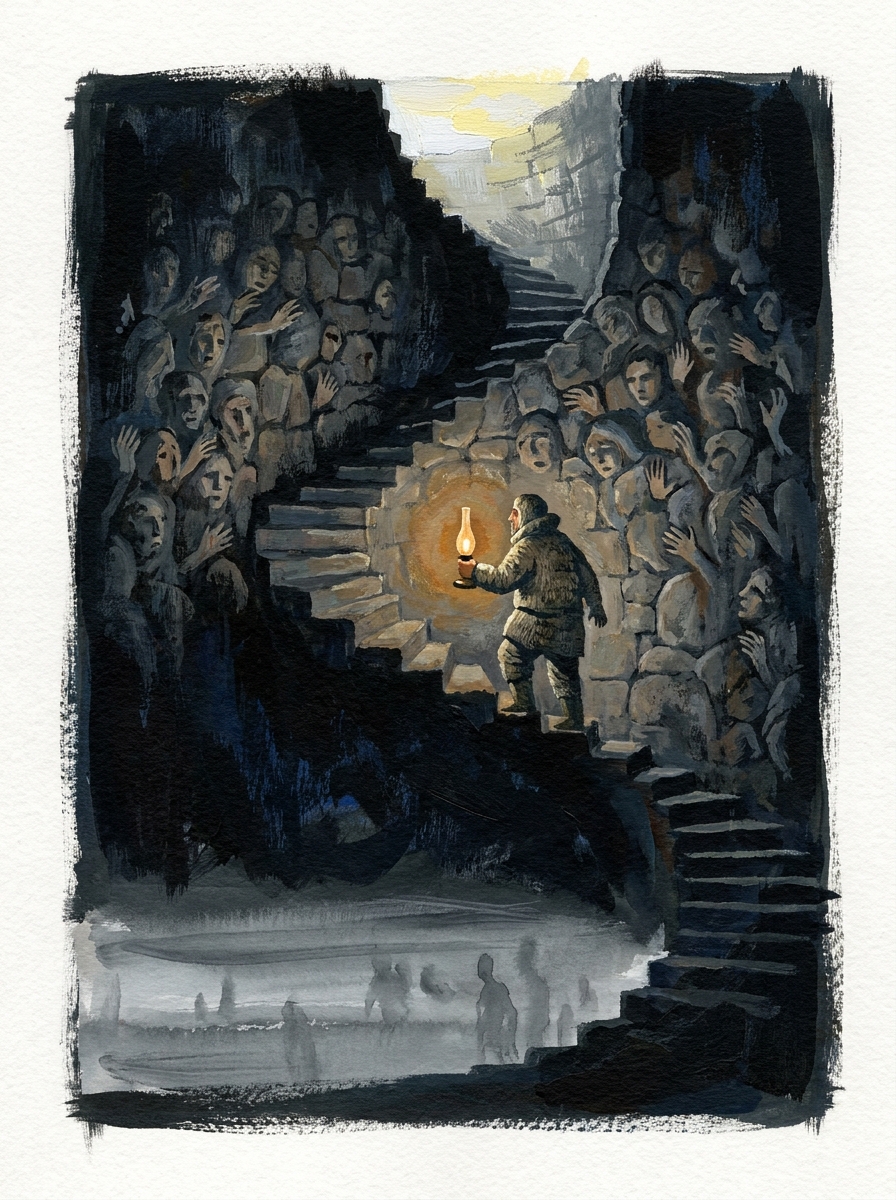
The dead have to go somewhere. This is not a theological proposition. It is a cognitive one. The brain tracks persons. It builds models of people it knows, and those models do not deactivate when the person dies. The dead parent is still modeled. The dead friend is still expected. The brain continues to allocate space for the person who is no longer there, and the allocation creates a problem: the person exists in the model but not in the world. The underworld is the species's geographical solution to this mismatch. The dead are not gone. They are elsewhere.
The underworld is the eighth place in the series, and it is the only one that does not correspond to a physical landscape the audience can visit. Every other place in the catalogue, the hearth, the forest, the mountain, the sea, the wasteland, the river, the cave, the garden, the ruin, has a real-world correlate. The underworld does not. It is a place the brain has constructed from the materials the other places provide, a synthesis of burial, cave-darkness, root systems, and the downward direction, assembled into a location that exists entirely in the imagination and does more cultural work than most places that exist on a map.
The Substrate
Underground cognition provides the spatial foundation. The brain extrapolates from its experience of caves, burials, and root systems to construct a concept of "beneath." The concept is not abstract. It is spatial. People who are asked to describe the underworld consistently describe it in spatial terms: it is down, it is dark, it is enclosed, it is reached by a descent. The hippocampal place cells and entorhinal grid cells, the systems that map physical space, extend their mapping to imagined spaces, and the underworld is the species's most elaborate imagined space.
Death-realm projection is the psychological driver. The brain needs to put the dead somewhere. The alternatives are limited. The dead could go up (many cultures send them to a sky realm). The dead could go far away (some traditions send them to an island or a distant land). The dead could go down. The downward option recruits the burial instinct, the cave association, and the universal experience of gravity. Things that are put down stay down. The dead, who are also put down, are projected downward by the same cognitive logic.
The descent narrative provides the structural template. The descent to the underworld is one of the most consistent narrative structures in human mythology, and its consistency reveals something about the brain's relationship to vertical space. Going down is cognitively different from going across. The descent recruits effort, disorientation, and a specific kind of fear that horizontal travel does not. The vertical trip to the underworld activates the same spatial-motor systems that a real descent would activate, and the activation gives the mythological journey a bodily reality that a journey to a distant island would not have.
Justice cognition provides the moral weight. The underworld is not merely where the dead go. In many traditions, it is where the dead are sorted. The righteous go one way. The wicked go another. The sorting is the underworld's cultural function: the enforcement of moral order after death, in a place the living cannot reach and therefore cannot corrupt. The underworld as court of judgment is the species's geographical solution to the problem of justice. This world is unfair. The underworld will settle the accounts.
The Exemplars
Hades, in the Greek tradition, is the underworld as neutral destination. Most of the dead, in the oldest Greek conception, go to the same place: a dim, shadowy realm where the dead persist as diminished versions of their living selves. The Elysian Fields, reserved for heroes, and Tartarus, reserved for the most egregious offenders, are late additions. The original Hades is simply where the dead are, and the destination does not depend on moral worth. The Greek underworld is the most honest version of the shape: the dead are gone, and where they have gone is gray.
Mictlan, the Aztec underworld, requires the dead to travel through nine levels over four years. The journey is difficult. The dead face rivers, mountains, and winds made of obsidian knives. The Aztec underworld is not a judgment. It is a process, and the process strips the dead of everything they carried from the living world. The nine-level structure reveals a culture that treated death not as a destination but as a journey, and the journey's difficulty was the point. The dead earn their rest.
The Egyptian Duat, where the heart of the dead is weighed against the feather of Ma'at by the god Anubis, is the underworld as moral accounting. The Egyptian system is explicit: the dead are judged, and the judgment has consequences. Those whose hearts are light pass to the Field of Reeds. Those whose hearts are heavy are devoured by Ammit, the eater of the dead. The image of the scales is the underworld's justice function at its most literal: the dead are measured, and the measurement determines everything.
The Christian Hell, in its fully developed medieval form, is the underworld as punitive cosmos. Dante's Inferno organizes the damned by category, each sin assigned its appropriate level, each punishment designed to mirror the sin. The medieval Christian underworld is the most architecturally elaborate underworld in the catalogue, and the elaboration reveals a culture that invested enormous intellectual energy in the question of what happens to the wicked after death. The answer was spatial: they go down, to a place designed to hold them, forever.
Yomi, the Japanese land of the dead, appears in the Kojiki as the place Izanagi descends to retrieve his dead wife Izanami. He finds her rotting. She is furious at being seen. The underworld here is the place where the boundary between the living and the dead has been violated, and the violation produces horror rather than resolution. Yomi demonstrates that the descent to the underworld does not always end in success. Sometimes the living go down and discover that the dead are better left where they are.
The Variations
The neutral underworld and the judgment underworld carry different moral structures. The Greek Hades, the Hebrew Sheol, the early Mesopotamian underworld: these are places where the dead simply are, without moral sorting. The Egyptian Duat, the Christian Hell and Heaven, the Buddhist Naraka: these are places where the dead are evaluated and assigned. The difference reveals the culture's relationship to cosmic justice. Cultures with neutral underworlds have decided that justice is a problem for the living. Cultures with judgment underworlds have decided that justice extends beyond death.
The accessible underworld, the one that living people can visit and return from, is the narrative version. Orpheus descends for Eurydice. Inanna descends and is killed and reborn. Aeneas descends to learn the future. The accessibility is the narrative's gift: the underworld becomes a destination the hero can reach, and the reaching produces the story. But the accessibility always comes with a cost. The visitor returns changed. The return is never complete. Something is left behind or something is brought back that should not have been.
The tiered underworld, the multi-level structure of the Aztec Mictlan, the Buddhist Naraka with its hot and cold hells, the Dante-influenced Christian model, reveals a culture that has thought carefully about degrees. Not all dead are the same. Not all sins are equal. The tiers are the culture's answer to the problem of moral nuance, applied to the geography of the dead.
The Honest Account
Underworld mythology has been used to legitimate punishment and social control with a directness that few other mythological systems match.
The threat of hell is a powerful tool. Medieval Christianity used the threat explicitly, consistently, and with detailed geographical specificity. The preacher who described the torments of the damned was performing a social function: maintaining behavioral compliance through the promise of posthumous punishment. The function was so effective that it persisted for centuries, and its decline in the modern West has not been replaced by any equally effective mechanism of moral regulation, which is part of why the decline makes some cultural observers nervous.
The underworld has also been the place where dissident traditions imagined justice that the living world denied. The Egyptian judgment, where the pharaoh and the peasant face the same scales, is a radical egalitarian claim embedded in a rigidly hierarchical society. The Book of Revelation's lake of fire is reserved, notably, for the powerful: the kings, the merchants, the false prophets. The underworld's justice function can be turned against the earthly order as easily as it can be deployed to support it.
The same machinery serves both purposes. The brain that constructs a place of punishment for the wicked can construct a place of punishment for the dissidents, the heretics, the foreigners, the people the culture has decided are wicked for reasons that have nothing to do with morality and everything to do with power. The underworld is as politically flexible as it is psychologically durable.
The Craft Turn
The underworld story works when the descent is irreversible in its costs. The protagonist who goes down and comes back unchanged has not been to the underworld. The protagonist has been to a basement.
The cost must be visible. Orpheus looks back and loses Eurydice. Inanna returns from the dead but must send someone else to take her place. Aeneas learns the future and the knowledge weighs on him. The underworld extracts a toll, and the toll is the narrative's proof that the journey was real.
The cheap underworld is the one that functions as a level in a video game: a challenge with escalating difficulty that the hero powers through. The figure requires the descent to change the descender. The change is the underworld's gift and its price, and the two are not separable.
The Return
The underworld is the species's geographical solution to two problems: the problem of the dead and the problem of justice. The dead must be somewhere. The unjust must eventually face consequences. The underworld solves both by providing a place beneath the living world where both solutions operate.
The solution is imaginary. The dead are not beneath the ground in any recoverable sense. The unjust are not sorted by cosmic authorities. The underworld is a construction, and the construction is as real as any place the brain has ever built, because the brain builds places with the same systems whether the places exist physically or not.
The dead are still modeled. The brain still expects them. The gap between the model and the reality still needs a geography to hold it.
The underworld is still there, beneath every culture that has ever buried its dead and wondered where they went.
The Dead Have to Go Somewhere
The brain tracks people. It builds models of everyone it knows, and those models don't shut off when the person dies. The dead parent is still modeled. The dead friend is still expected. The person exists in the brain's model but not in the world.
The underworld is the species's solution to this mismatch. The dead aren't gone. They're elsewhere.
The Only Place You Can't Visit
The underworld is the only place in this series with no real-world equivalent. You can visit a forest, a mountain, a cave. You can't visit the underworld. It's built from the materials the other places provide: burial, cave-darkness, root systems, the downward direction. Assembled into a location that exists entirely in the imagination and does more cultural work than most places on a map.
The brain puts the dead downward because things that are put down stay down. Burial, caves, gravity: the brain extrapolates from these experiences to construct a concept of "beneath" that is spatial, not abstract.
Many traditions add a justice function. The underworld isn't just where the dead go. It's where they're sorted. The righteous go one way, the wicked another. The underworld is the species's geographical solution to two problems: what to do with the dead, and what to do about injustice.
Underworlds Around the World
Greek Hades: in the oldest version, most dead go to the same dim, gray place regardless of how they lived. The most honest version of the shape: the dead are simply gone, and where they've gone is gray.
The Egyptian Duat: the heart is weighed against a feather by Anubis. If it's light, you pass. If it's heavy, you're devoured. Moral accounting, literally on scales.
Aztec Mictlan: the dead travel through nine levels over four years, facing rivers, mountains, and winds of obsidian knives. Death isn't a destination. It's a journey that strips away everything from the living world.
Dante's Hell: the most architecturally elaborate underworld ever built. Every sin has its level. Every punishment mirrors the sin. A culture that invested enormous energy in the question of what happens to the wicked.
The Shadow Side
The threat of hell has been one of history's most powerful tools of social control. Medieval Christianity used it explicitly: detailed descriptions of torment to maintain behavioral compliance.
But the underworld has also been where dissident traditions imagined justice. The Egyptian judgment, where pharaoh and peasant face the same scales, is a radical egalitarian claim inside a rigid hierarchy.
The same machinery serves both purposes. The brain that constructs punishment for the wicked can also construct punishment for dissidents, heretics, and foreigners. The underworld is as politically flexible as it is psychologically durable.
What Makes an Underworld Story Work
The descent has to be irreversible in its costs. Orpheus looks back and loses Eurydice. Inanna returns but must send someone to take her place. The underworld extracts a toll, and the toll proves the journey was real.
The cheap underworld is a video-game level: escalating challenges the hero powers through. The figure requires the descent to change the person who descends.
Still There
The dead are still modeled. The brain still expects them. The gap between the model and reality still needs a geography to hold it.
The underworld is still there, beneath every culture that has ever buried its dead and wondered where they went.