

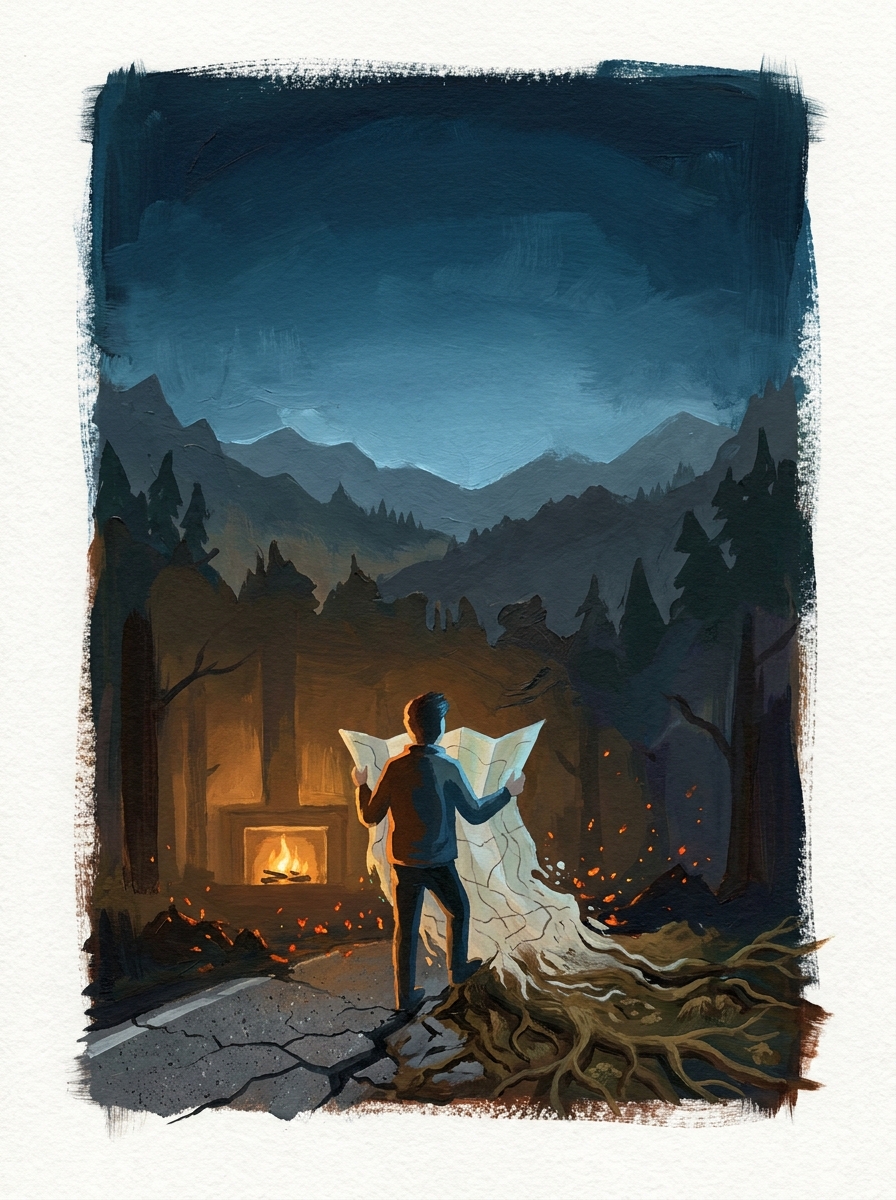
Ten places. Ten kinds of ground the species keeps returning to. Ten kinds of meaning the ground keeps producing.
The hearth draws the circle and defines who is inside it. The forest stands beyond the circle and watches. The mountain breaks the horizon and the brain reads the breaking as sacred. The sea overwhelms scale and forces the admission that the brain was not built for this. The wasteland strips away cover, resource, and distraction and leaves the person standing in the open with nothing but themselves. The river divides and connects, flows and drowns, gives life and carries the dead. The cave encloses and resonates and holds the first art in the first dark. The underworld extends the cave downward into the geography of the dead and the geography of justice. The garden bounds and cultivates and excludes. The ruin records the built world's final argument with time.
Every place carries its shadow. Every shadow is cast by the same substrate. The substrate is real. The shadow is also real. The catalogue does not resolve the tension. The catalogue holds it.
What the Catalogue Reveals
The first revelation is that place-meaning is biological before it is cultural.
The hippocampal place cells and the entorhinal grid cells are not cultural preferences. They are neural architecture. They map space in every brain that has been studied, across every population, with a consistency that makes the cultural variation interesting precisely because the substrate is so stable. The forest feels wild because the brain reads the affordances of reduced visibility and lateral cover before the mind decides what to think about trees. The mountain feels sacred because the brain responds to verticality with effort, awe, and vulnerability before the mind decides whether gods live at the summit. The sea overwhelms because the brain's spatial systems cannot map the boundless, and the failure of the mapping produces the feeling that cultures have called sublimity.
This means the places are not going away. A culture can pave over every forest, dam every river, and level every mountain. But the brain that responds to forests, rivers, and mountains will continue to respond to whatever activates the same circuits. The suburb that eliminates all landscape variation does not eliminate the brain's appetite for landscape variation. It just ensures the appetite goes unfed.
The second revelation is that places reveal the culture more than they reveal the landscape. Every culture has forests, but which forests it treats as sacred and which it treats as timber tells you what the culture values. Every culture has rivers, but which rivers it worships and which it dams tells you what the culture is willing to sacrifice. The garden, with its wall and its exclusions, reveals what the culture considers worth cultivating and what it considers a weed. The ruin, with its accumulated time, reveals what the culture built and what it let go.
The catalogue is a ground survey. The survey does not care whether the culture likes the results.
The third revelation is that places are tools, and tools can be turned. The sacred mountain that legitimates the pilgrimage also legitimates the territorial claim. The promised land that sustains the exile also justifies the conquest. The frontier that represents freedom also represents the erasure of the people who were there before the frontier arrived. The substrate provides the feeling. The culture directs the feeling. The direction is politics, and the politics has never been separable from the ground.
The Modern Flattening
The places persist. The modern world has not abolished them. It has homogenized them.
The gated community is the garden minus the cultivation. The walls are there. The exclusion is there. But the bounded space contains no argument about the relationship between order and wildness. It contains property values. The substrate, the satisfaction of enclosure, the pleasure of the bounded, is activated by the gated community in the same way it is activated by the Persian paradeisos. But the meaning the substrate was built to carry, the claim about nature, order, and the human relationship to both, has been replaced by the claim about square footage and school districts.
The theme park is the forest minus the wild. The reduced visibility is simulated. The cover affordances are designed. The threat is eliminated or theatricalized into a ride. The brain's forest-response fires, dimly, because the designers know enough about the substrate to trigger it. But the response is managed. The disorientation is controlled. The fear is optional. The theme-park forest is the substrate monetized into a consumer experience, and the consumer experience evacuates the meaning the forest's wildness produced.
The infinity pool is the sea minus the depth. The visual horizon is extended. The water is blue. The vastness-perception circuits fire. But the depth beneath the surface is four feet, and the organism that evolved a terror of drowning in uncharted water can touch the bottom. The infinity pool is the sea's awe response harvested for a hotel amenity, and the harvest leaves the awe shallow.
The airport is the threshold minus the arrival. The terminal is a passage. The gates are boundaries. The spatial structure recruits the threshold cognition the cave mouth and the river crossing activate. But the passage leads to another passage, and the arrival is another departure, and the threshold that was supposed to mark a transition marks only a transfer. Marc Auge called these "non-places," and the name is cognitively precise: the place-machinery fires, but the place is not there.
The demolition site is the ruin minus the memory. The building comes down in hours. The rubble is cleared. The ground is leveled for the next construction. The ruin's essential function, the making of time visible, the confrontation with impermanence, the testimony of what was here before - is eliminated by the speed of the destruction. The slow ruin taught patience. The demolition teaches efficiency. The lesson is not the same.
What the Flattening Costs
The cost is not that people stop responding to places. The cost is that the responses stop doing work.
A functional forest tradition tells a culture what the wild is and what the wild costs. A flattened one tells the culture that the wild is a weekend activity and the cost is a parking fee. A functional mountain tradition tells a culture that ascent requires effort, exposure, and the willingness to be changed by the altitude. A flattened one tells the culture that the summit is a photo opportunity and the effort is an inconvenience the gondola eliminates.
The flattening happens because places are valuable, and valuable things get captured by the systems that can profit from them. The resort captures the sea. The developer captures the garden. The heritage industry captures the ruin. The national park captures the wilderness. The capture is not conspiracy. It is economics. The places fill cognitive needs that billions of people need filled, and the entity that fills the need captures the attention, and the attention is worth money.
The problem is that the filled need is not the same as the functioning place. The brain that receives the infinity pool's horizon stimulus has not received the sea's depth. The brain that receives the theme park's simulated forest has not received the forest's disorientation. The need is partially met. The work is not done.
The Dwelling
The catalogue does not argue that places are good. The catalogue argues that places are inevitable. The brain's spatial machinery is not optional. The place cells fire. The affordance perceptions run. The topophilia and topophobia produce their evaluations. The question is not whether a culture will have places that carry meaning. The question is whether the meaning will be allowed to do its work.
The work is old. The hearth taught the species that warmth is social. The forest taught that the world beyond the circle is not under control. The mountain taught that some things require effort and exposure to reach. The sea taught that the brain has limits. The wasteland taught that the self is different when the furnishings are removed. The river taught that boundaries flow. The cave taught that the dark has content. The underworld taught that the dead need geography. The garden taught that cultivation is a power as well as a pleasure. The ruin taught that everything built is temporary.
The teachings are in the wiring. The ground carries them. The culture decides whether to listen.
This series has been an attempt at listening. Ten places. Ten kinds of ground. Ten kinds of work. And the recurring question that the species has been asking since the first campfire was lit and the first forest darkened beyond it:
Where are we?
The catalogue does not answer the question. The catalogue reveals that the question is spatial, that the answer is cognitive, that the ground we stand on shapes what we feel about standing, and that the feelings are older than the words for them.
The land is beneath the story. The land was the first story. The land will be the last.
The question is whether we will still know how to read it.
Ten Places. Ten Kinds of Ground.
The hearth draws a circle and defines who's inside. The forest watches from beyond the light. The mountain breaks the horizon and the brain reads it as sacred. The sea overwhelms scale. The wasteland strips everything away. The river divides and connects. The cave holds the first art in the first dark. The underworld gives the dead somewhere to be. The garden bounds and cultivates and excludes. The ruin records the built world's argument with time.
Every place carries a shadow. The substrate is real. The shadow is also real.
The Places Are Biological
Place cells and grid cells are neural architecture, not cultural preferences. The forest feels wild because the brain reads reduced visibility before the mind decides what to think about trees. The mountain feels sacred because the brain responds to elevation with awe before the mind decides whether gods live up there.
A culture can pave over every forest and dam every river. But the brain that responds to forests and rivers keeps responding to whatever activates the same circuits. The suburb that eliminates all landscape variation doesn't eliminate the brain's appetite. It just ensures the appetite goes unfed.
The Modern Flattening
The gated community is the garden minus the cultivation. The walls and exclusion are there. The argument about order and wildness has been replaced by property values.
The theme park is the forest minus the wild. Reduced visibility is simulated. Threat is eliminated. The brain's forest-response fires dimly because the designers know enough about the substrate to trigger it. But the response is managed.
The infinity pool is the sea minus the depth. The vastness circuits fire. The depth beneath the surface is four feet.
The airport is the threshold minus the arrival. The place-machinery fires, but the place isn't there.
What the Flattening Costs
The cost isn't that people stop responding to places. It's that the responses stop doing work. A functional forest tradition teaches what the wild is and what it costs. A flat one says the wild is a weekend activity and the cost is parking.
The flattening happens because places are valuable and valuable things get captured. The resort captures the sea. The developer captures the garden. The heritage industry captures the ruin. The national park captures the wilderness. The capture isn't conspiracy. It's economics.
But the filled need isn't the same as the functioning place. The brain that receives the infinity pool's horizon hasn't received the sea's depth.
Where Are We?
The catalogue doesn't argue places are good. It argues they're inevitable. Place cells fire. Affordance perceptions run. The question isn't whether a culture will have meaningful places. It's whether the meaning will be allowed to do its work.
The hearth taught that warmth is social. The forest taught that the world beyond the circle isn't under control. The mountain taught that some things require effort to reach. The sea taught that the brain has limits. The wasteland taught that the self is different when the furnishings are removed.
The land is beneath the story. The land was the first story.
The question is whether we'll still know how to read it.