

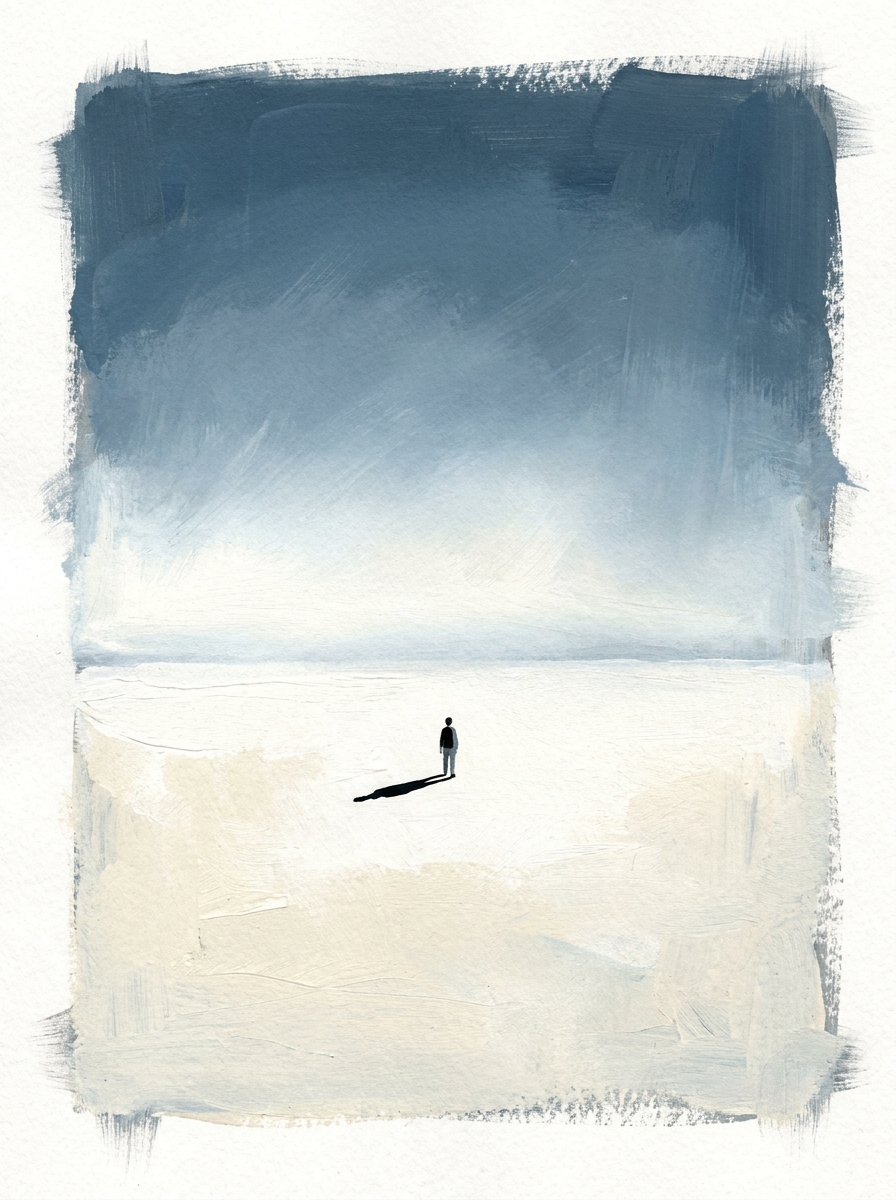
The first thing the desert takes is shade. The second thing it takes is the assumption that the world is arranged for your benefit. The heat, the exposure, the horizon that retreats at the same speed you approach it: these are not hostile. They are indifferent, and the indifference is worse than hostility, because hostility implies a relationship. The desert does not have a relationship with you. The desert has sun and sand and distance, and if you happen to be standing in it, that is your problem.
The wasteland is the place where the cognitive machinery for cover, for shelter, for resource extraction finds nothing to grip. The brain is a survival organ, and the survival organ's first task in any environment is to identify what the environment offers. The forest offers cover. The river offers water. The mountain offers prospect. The wasteland offers nothing, and the nothing is the experience.
The Substrate
Open-space exposure cognition is the dominant input. The brain tracks exposure the way it tracks other survival-relevant features: automatically, continuously, and with affective consequences. In open terrain with no cover, no shade, and no visible resource, the threat-detection system does not relax the way it relaxes in safe, bounded spaces. It escalates. The escalation is not about predators. It is about the body's awareness that it is visible from every direction, that there is nowhere to retreat, and that the environment is not providing the inputs the survival system needs to function at baseline.
Resource-scarcity perception compounds the exposure. The brain evaluates environments partly by their perceived resource density: water, food, shelter, materials. A resource-rich environment produces cognitive ease. A resource-poor one produces cognitive strain. The wasteland produces maximal strain because the resource assessment returns, in every direction, the same answer: there is nothing here.
Temperature extremity adds the physiological layer. The desert variant produces heat stress. The tundra variant produces cold stress. The steppe variant produces wind exposure. Each is a different physical key, but the cognitive melody is the same: the body is being asked to maintain homeostasis without environmental assistance. The body is on its own, and the aloneness is felt as a cognitive state, not merely a physiological one.
The test function emerges from the confluence of these inputs. When the environment strips away cover, resources, and comfort, what remains is the person. The wasteland is the place where the species meets itself without distraction, and the meeting is the substrate of every ascetic tradition, every vision quest, every forty-day temptation in every desert the species has ever walked into on purpose.
The Exemplars
The biblical wilderness is the wasteland as spiritual proving ground. Moses leads the Israelites through it for forty years. Jesus enters it for forty days. The number is formulaic but the function is precise: the wilderness is the place where the covenant is tested, where faith is refined by deprivation, where the absence of comfort becomes the presence of God. The biblical tradition treats the wasteland not as a place to avoid but as a place where encounter happens, specifically because the noise of the settled world has been removed.
The Australian outback, in the cultural imagination of settler Australia, is the wasteland as national character. The outback is vast, hot, dry, and deadly. The settler mythology treats survival in the outback as proof of worthiness: the person who can handle the outback can handle anything. The mythology is revealing because it operates by erasure. The outback is not empty. Aboriginal Australians have lived in it for sixty-five thousand years, not by surviving it but by knowing it, with a density of ecological and sacred knowledge that the settler mythology cannot see because the mythology requires the land to be empty in order for the survival to be heroic.
The Mongolian steppe is the wasteland in the grass register: not sand but wind and grass extending to the horizon in every direction. The steppe produced the nomadic cultures that intermittently conquered the settled world, from the Scythians to the Mongols. The cognitive substrate is the same as the desert's, full exposure, no cover, resource scarcity relative to the settled lands, but the cultural elaboration is different. The steppe peoples did not treat their landscape as a test to be endured. They treated it as a world to be inhabited, and the inhabitation produced a relationship to space, to movement, to distance that the settled cultures never developed.
Heaney's bog, the wet wasteland of the Irish midlands, operates in a different cognitive key. The bog is flat, treeless, saturated, and preserves things: bodies, objects, memories. Heaney's bog poems treat the landscape as a repository, a place where the past is held in suspension and occasionally surfaces. The wasteland here is not empty. It is full, but full of things that have been submerged, and the submersion is the landscape's function.
The salt flats of the Andean altiplano are the wasteland at its most alien. The surface is white. The sky is reflected. The horizon disappears into a mirror. The brain's spatial systems, which depend on contrast and differentiation to map the environment, lose their inputs entirely. The salt flat is the place where the substrate's failure is most complete: there is literally nothing for the mapping systems to map.
The Variations
The desert and the tundra are the same cognitive shape in different temperatures. Both strip cover. Both reduce resources. Both expose the body. The desert does it with heat. The tundra does it with cold. The steppe does it with wind. The bog does it with wet. Each is the cognitive empty in a different physical key, and the fact that the shape survives the change in medium confirms that the shape is cognitive, not climatic.
The wasteland as punishment and the wasteland as purification are different moral readings of the same substrate. The biblical tradition uses both: the wilderness is where the Israelites wander as punishment for disobedience, and it is where Moses receives the law as preparation for the promised land. The Quranic tradition treats the desert similarly: the place of testing is also the place of revelation. The double reading is not a contradiction. It is the wasteland's structural duality. The same absence that punishes also purifies, and the culture decides which reading to emphasize.
The irradiated zone, Chernobyl's exclusion zone, the Nevada Test Site, the Bikini Atoll, is the modern wasteland: land made empty by human action rather than by natural process. The cognitive substrate is the same, exposure, emptiness, resource absence, but the cause is different, and the difference changes the meaning. The natural wasteland tests the person against the indifference of nature. The man-made wasteland tests the person against the consequences of human decisions. The second is harder to mythologize, which is partly why the modern wasteland has not yet produced the spiritual traditions the ancient ones did.
The Honest Account
"Wasteland" is often what the colonizer calls land the colonizer cannot yet see how to profit from. The name is a political act disguised as a geographical description.
The American "Great American Desert," the label applied to the Great Plains by nineteenth-century surveyors, was full of nations. The Lakota, the Cheyenne, the Arapaho, the Comanche: these peoples had lived on the plains for centuries, not in spite of the landscape but in relationship with it. The label "desert" was the precondition for the displacement. If the land is empty, taking it is not theft. It is development.
The Australian outback follows the same pattern. The British declaration of terra nullius, the legal fiction that the continent had no owners, treated a landscape full of people, stories, sacred sites, and sixty-five millennia of continuous habitation as a wasteland. The cognitive substrate is real: the settler brain, encountering a landscape without the features the settled agricultural brain considers resources, genuinely registers emptiness. But the registration is a failure of the settler's categories, not a property of the land.
The modern version of the same operation is the brownfield, the blighted zone, the "economically distressed area." The language of the wasteland is applied to urban landscapes that have been deliberately disinvested, and the label justifies the next round of extraction: demolition, redevelopment, gentrification. The wasteland is made, and then the making is used to justify what comes after the making.
The Craft Turn
The wasteland works in story as the place where the protagonist meets themselves without distraction. This is the craft principle, and it is the same principle the ascetic traditions discovered independently.
The wasteland strips. It takes away the protagonist's resources, comforts, companions, and certainties, and whatever is left after the stripping is the story's real subject. McCarthy's Blood Meridian is the wasteland essay in advance: the desert as the medium through which violence, philosophy, and the question of human nature are conducted without any cushioning. The landscape is not a backdrop. It is the argument's medium.
The cheap wasteland is the one that is merely difficult. A hot hike. A cold night. The wasteland that functions as an inconvenience rather than a revelation has not done the figure's work. The figure requires the stripping to reach something the protagonist did not know was there, or something the protagonist knew was there and was hoping the world's furnishings would keep hidden.
The Return
The wasteland reveals what the human mind does when the environment offers nothing. The answer varies. Some people find God. Some people find themselves. Some people find that the self they thought they had was a construction the environment had been supporting, and that without the support, the self is different from what they assumed.
The ground that offers nothing is also the ground that takes nothing for granted. The species keeps returning to wastelands, voluntarily, in pilgrimage and retreat and vision quest, because the nothing is where certain kinds of truth are available. Not comfortable truths. Not convenient truths. The truths that survive the stripping.
The desert is still there. The steppe is still there. The tundra is still there. And the brain still registers, in each of them, the same primordial assessment: there is nothing here but you.
What you find there is the question.
The Desert Takes Your Shade First
The first thing the desert takes is shade. The second is the assumption that the world is arranged for your benefit. The heat, the exposure, the horizon that retreats at the speed you approach it: these aren't hostile. They're indifferent. And indifference is worse than hostility, because hostility at least implies a relationship.
The wasteland is the place where the brain's machinery for cover, shelter, and resources finds nothing to grip.
Why Empty Space Gets Under Your Skin
The brain tracks exposure constantly. In open terrain with no cover, no shade, and no resources, the threat-detection system escalates. Not because of predators. Because the body knows it's visible from every direction with nowhere to retreat.
Resource-scarcity perception makes it worse. The brain evaluates environments by their resource density. The wasteland returns the same answer in every direction: there's nothing here.
When the environment strips away cover, resources, and comfort, what remains is the person. The wasteland is where the species meets itself without distraction. That's the substrate of every vision quest, every forty-day temptation, every ascetic retreat into the desert.
Wastelands Around the World
The biblical wilderness: Moses wanders it for forty years. Jesus enters it for forty days. The wilderness is where faith is refined by deprivation, where the absence of comfort becomes the presence of God.
The Australian outback: the settler mythology treats survival there as proof of worthiness. But the outback isn't empty. Aboriginal Australians lived in it for sixty-five thousand years, not by surviving it but by knowing it.
Heaney's Irish bog: flat, treeless, saturated, and it preserves things. Bodies, objects, memories. The wasteland here isn't empty. It's full of things that have been submerged.
The Andean salt flats: the surface is white, the sky is reflected, the horizon disappears into a mirror. The brain's spatial systems lose their inputs entirely.
"Wasteland" Is Often a Political Word
"Wasteland" is often what the colonizer calls land they can't yet extract from. The American "Great American Desert" was full of nations. The Australian outback required the legal fiction of terra nullius to justify taking it.
The modern version: the brownfield, the "blighted zone," the "economically distressed area." The language of wasteland is applied to urban landscapes that have been deliberately disinvested, and the label justifies the next round of extraction.
What Makes a Wasteland Story Work
The wasteland strips. It takes away resources, comforts, companions, and certainties. Whatever's left after the stripping is the story's real subject.
The cheap wasteland is merely difficult. A hot hike. A cold night. The wasteland that works reaches something the character didn't know was there, or something they knew was there and hoped the world's furnishings would keep hidden.
What Survives the Stripping
The species keeps returning to wastelands voluntarily, in pilgrimage and retreat and vision quest, because the nothing is where certain kinds of truth are available. Not comfortable truths. The truths that survive the stripping.
The desert is still there. The brain still registers the same assessment: there is nothing here but you.
What you find there is the question.