

In the first weeks of 2025, the Bureau of Labor Statistics reported that computer graphic artist employment in the United States had fallen thirty-three percent in a single year. The prior year, the decline had been twelve percent. Screenwriter employment, over the same period, held steady. Both professions create entertainment. Both require years of specialized training. Both face disruption from the same class of generative tools. The variable that separates a thirty-three percent collapse from stable employment is not a philosophical distinction between types of creative contribution, not a theory of personhood or authorial agency, not even a difference in the quality of the threat. It is a union contract.
I want to sit with that fact before I dress it in argument. There is something clarifying about a number like thirty-three percent. It does not leave room for the word "eventually."
The conversation about artificial intelligence in the creative industries has organized itself, over the past two years, around a set of moral claims: that training on copyrighted work without consent violates the rights of creators. That an individual's voice and likeness are extensions of their personhood and cannot be digitally replicated without permission. That creative labor has dignity and should not be automated away. I find these claims persuasive. Most thoughtful people do. But there is a second pattern running beneath the moral claims, and it is harder to look at directly — partly because acknowledging it feels like a betrayal of people whose concerns are real, and partly because the pattern implicates not the technology companies most people want to blame but the creative institutions most people want to defend.
The pattern is this: the workers who secured enforceable AI protections are, almost without exception, the workers who already had collective bargaining power. The workers who did not have it received nothing. And the moral vocabulary of the opposition — consent, personhood, creative dignity — has traveled precisely as far as institutional leverage could carry it and no farther.
This is not a comfortable thesis. Let me try to earn it.
The 2023 entertainment strikes were, by any measure, a landmark in labor history. Writers and actors shut down Hollywood for months, and when they returned to work, they had won something unprecedented: contractual language specifically addressing artificial intelligence. The Writers Guild of America secured provisions ensuring that AI cannot be credited as a writer and cannot be used to undermine writers' compensation. The Screen Actors Guild negotiated consent requirements for digital replicas, voice synthesis, and likeness use. These were real achievements, hard-won, and they addressed real threats.
What they did not address — what nobody at the bargaining table was empowered or inclined to address — was the concept artist, the VFX compositor, the entry-level animator, the sound designer. A study commissioned by the Concept Art Association and the Animation Guild in 2024, conducted by the research firm CVL Economics, surveyed three hundred entertainment executives and projected roughly two hundred four thousand positions adversely affected by AI within three years. The positions most at risk were precisely those without guild-level protections: pipeline roles, freelance contracts, work-for-hire arrangements.
Seventy-five percent of the executives surveyed reported that AI tools had already supported the elimination, reduction, or consolidation of jobs in their divisions. Production designers, one executive noted, were never written into hiring contracts the way other essential film workers were. Budget managers were already evaluating replacement. The same studios that had agreed to protect their writers' rooms were using generative tools to hollow out their art departments.
If the ethical principle driving the opposition to AI were "creative labor deserves protection," you would expect the protections to cluster around vulnerability. They do not. They cluster around leverage.
The standard defense against this observation is what I will call the triage argument, and it deserves real space, because it is the strongest version of the case that the unevenness is principled rather than self-interested.
The argument runs like this: labor organizing has always been sequential. The American Federation of Labor preceded the Congress of Industrial Organizations. Skilled trades unionized before unskilled labor. When a building is on fire, you rescue the people nearest the exit first — not because you value them more but because acting where you can is rational under time pressure. The guilds that could negotiate AI clauses did so. The sectors without collective bargaining infrastructure are working to build it. VFX workers at Marvel Studios voted unanimously to join IATSE in 2023. The movement spread to Disney Pictures and the Avatar sequels. The Animation Guild explicitly planned to use the CVL study in its next contract cycle to push for protections comparable to those won by writers and actors.
This is a genuine description of what is happening on the ground. The below-the-line sectors are organizing. They are not passive. The Concept Art Association, the Animation Guild, the Human Artistry Campaign, and the National Cartoonist Society Foundation jointly commissioned the CVL research — a cross-sector coalition doing exactly what a principled movement would do.
And yet.
The triage metaphor breaks if you look at who was rescued first. Triage, in any honest use of the word, means prioritizing the most critical cases. The writers and actors who walked picket lines in 2023 were not the most vulnerable creative workers facing AI displacement — they were the most powerful. They had star power, audience attachment to named individuals, and the organizational infrastructure to shut down production. Concept artists, sound designers, freelance illustrators — the workers absorbing the sharpest and most immediate displacement — had none of those things. What happened in 2023 was not triage. It was each group fighting for itself, which is understandable, even rational. But it is not the same thing as principled ethics, and calling it triage does not make it so.
There is a harder version of this critique. The National Labor Relations Act constrains what a union can bargain for: mandatory bargaining subjects are limited to the wages, hours, and conditions of the bargaining unit's own members. The WGA could not legally have demanded IATSE protections at the AMPTP table any more than a plumbers' union can negotiate electricians' wages. This is a real constraint, and it matters. But it explains only the contractual limitation. It does not explain the silence. During the most-watched labor action in a generation, the WGA had a cultural platform of extraordinary reach. It could have used that platform to name the concept artists and sound designers facing identical threats. It could have conditioned its public messaging, if not its bargaining demands, on a broader vision of creative protection. It did not. The constraint was legal. The silence was a choice. And choices that consistently align with institutional self-interest tell us something about what is actually being optimized.
There is a second fault line in the architecture of AI opposition, and it runs through the legal infrastructure itself. The protections being built — in legislation, in contract language, in proposed federal law — overwhelmingly protect identity: a person's name, face, voice. They do not protect style.
Tennessee's ELVIS Act, signed into law in 2024, was the first state legislation to explicitly add "voice" to right-of-publicity protections against AI. The proposed federal NO FAKES Act would create intellectual property protections for the right of publicity with seventy-year post-mortem terms and First Amendment carve-outs. SAG-AFTRA's consent requirements cover digital replicas and voice synthesis. These are serious legal instruments addressing a serious problem.
But consider what they do not cover. An illustrator who has spent a decade developing a recognizable visual language — the particular way she renders light through fog, the emotional temperature of her color palettes, the compositional grammar that makes her work identifiable at a glance — has no equivalent protection. Her style is not copyrightable. US copyright law has been clear on this for decades: style is a method, and methods are not protectable expression. The right of publicity covers commercial identity, not aesthetic identity. No state law, no proposed federal statute, no guild contract addresses the appropriation of an artistic style by a generative model trained on an artist's corpus.
Now, there is a philosophically serious defense of this distinction. Hegelian personality theory — one of the three foundational pillars of intellectual property philosophy, alongside utilitarian incentive and Lockean labor-desert — holds that certain creative expressions are extensions of the self. A face and a voice are constitutive of identity in a way that a method of working, however distinctive, is not. When another human illustrator studies your technique and produces work in a similar vein, no law is violated and no reasonable person objects. Style is transmissible. A face is not. The courts have recognized something like this distinction since at least the 1953 Haelan Laboratories decision, which established the right of publicity as a protectable interest. The ELVIS Act and the NO FAKES Act are deductions from a principle with deep philosophical roots, not post hoc rationalizations of guild leverage.
I want to sit with this counterargument, because there is real intellectual substance in it and dismissing it too quickly would be dishonest. The distinction between identity and method is genuine. It maps onto intuitions most people share. We feel violated by a deepfake of our face in a way we would not feel violated by someone painting in our style. The Hegelian account explains this feeling and grounds it in a tradition of moral reasoning that long predates AI.
Where the account falters is not in its philosophical coherence but in its explanatory reach. If personhood is the operative principle, then a freelance voice actor in Ohio should receive the same protection as a SAG-AFTRA member in Los Angeles. Both possess a voice. Both face the same threat from voice synthesis. But the ELVIS Act is Tennessee law; roughly fifteen states have no right-of-publicity statute at all. SAG-AFTRA consent clauses cover members under covered contracts. The principle may be philosophically sound. Its deployment tracks bargaining power with uncomfortable precision.
There is also the question of whether the identity-versus-style distinction holds as neatly as its defenders claim once the mechanism of harm shifts from imitation to industrial-scale replication. A human illustrator who studies your style produces work slowly, operates within the same economic constraints you do, and competes on a human scale. A generative model trained on your corpus replicates your aesthetic in seconds, at volumes that collapse the economic value of the original. The ontological distinction between face and style may be real. The economic distinction — which is what actually determines who gets harmed and how badly — does not track it.
There is a third fault line, and it is the one that cuts deepest into the moral self-image of the creative industries. The consent framework at the center of the opposition — the argument that AI should not be trained on creative work without the creator's permission — is built on copyright. And copyright, as it actually operates in the American entertainment industry, does not protect all creative workers. It protects copyright holders. Under the work-for-hire doctrine, which has governed copyright assignment since the Copyright Act of 1976, creators who produce work under employment or certain contractual arrangements do not hold the copyright to their own output. The employer does.
This has consequences that the consent framework does not acknowledge. Andy Hall is a Grammy-winning dobro player. He discovered that a songwriter had used an AI music tool to generate a dobro part rather than hiring him. Under the consent framework the music industry has built its AI opposition around, no violation occurred. Hall never held the copyright. The major labels' promises to protect "copyright holders" from AI training explicitly exclude session musicians, who perform some of the most skilled and vulnerable creative labor in the industry. Forty-six point seven percent of the global recorded music market consists of independent artists and small labels who generally cannot afford the litigation that would make the consent framework enforceable.
The standard response is that work-for-hire is a pre-existing inequity — that the creative industries did not design it to exclude anyone from AI protections, that the doctrine predates generative AI by half a century, and that the gap reflects institutional inertia rather than strategic selection. This is true as far as it goes. But it does not go as far as its defenders need it to. The creative industries had a choice of framework. They could have built their opposition on labor rights — a framework that would have covered every worker regardless of copyright status. They built it on copyright consent instead. This choice protects the interests of those who hold the assets (studios, major labels, established authors with retained rights) while leaving exposed those who perform the labor (session musicians, work-for-hire illustrators, contract animators). When you choose your moral framework, you reveal your priorities, and the priority revealed here is ownership over labor.
The European Union's AI Act, it should be said, represents something closer to a genuinely universal approach. It codifies training-data disclosure and opt-out requirements at supranational scale, covering creators regardless of guild membership or copyright status. Eleven and a half thousand respondents to the UK copyright consultation — from freelance illustrators to major publishers — articulated the same consent principle. The principle is real. It is articulable by anyone. Its codification in EU law by a body with no stake in any particular guild's bargaining position is meaningful evidence that the ethical claim has substance independent of leverage.
But the American creative industries did not build the European approach. They built a copyright-based opposition that systematically excludes the people with the least power. The principle exists in articulation. Its enforcement follows the money.
I want to acknowledge the strongest piece of evidence against the thesis I have been building, because intellectual honesty requires it and because the evidence is striking. Surveys of visual artists — the very workers most exposed to AI displacement and least protected by institutional frameworks — consistently show overwhelming rejection of AI tools. Eighty-five percent of visual artists completely abstain from AI. Eighty-eight percent refuse to use AI for image generation. The Association of Illustrators found that ninety percent feel AI has taken away commissions, jobs, and career opportunities. These are refusal rates as emphatic as any profession has recorded.
If self-interest were the sole engine of creative opposition to AI, these numbers would not exist. Freelance illustrators without union protection, without bargaining leverage, without any institutional apparatus that benefits from their refusal, are absorbing real economic harm rather than adopting tools that would make them more competitive. This is not strategic behavior. It is principled behavior, and pretending otherwise would be dishonest.
But here is where I think the conversation needs a distinction it has mostly failed to make. Individual opposition to AI among creative workers appears to be overwhelmingly principled. Institutional opposition — the pattern of who gets protected and who does not, which frameworks are chosen and which are not, whose vulnerability triggers action and whose triggers only sympathy — is a different matter. Those eighty-five percent of illustrators are sincere. They are also unprotected. The guilds that claim to share their principle are protected, and they did not extend that protection outward. Sincerity among the powerless does not redeem selectivity among the powerful.
This is the uncomfortable synthesis the conversation has been avoiding. Both things are true. The consent principle is real. The personhood distinction has philosophical grounding. The individual creative workers who refuse AI tools on ethical grounds are genuine in their convictions. And the institutional architecture that determines who actually receives enforceable protection tracks leverage, prestige, and commercial value with a precision that principle alone cannot explain. The creative industries are not lying about their ethics. They are also not building institutions that serve those ethics equally.
I find myself thinking about a concept from institutional economics — the idea that organizations do not have beliefs, only incentives. Individual actors within organizations can hold beliefs, passionately and sincerely. But the organization's behavior is shaped by the structure of its incentives, and over time, the organization's moral vocabulary converges on whatever justifies its incentive-driven behavior. The belief is real. The behavior it produces is selective. And the selectivity follows the incentives.
The creative industries have a documented history of this pattern that long predates AI. The Center for Data Innovation compiled a record: the gaming industry monetized viral dance moves from Black artists as in-game emotes without compensation and without the copyright objections now raised against AI training. Advertising firms commercialized uncopyrighted cultural expressions for profit. The music industry built itself, in part, on the appropriation of musical styles developed by marginalized communities. In each case, the absence of intellectual property protection for the appropriated work was treated not as a moral crisis but as a business opportunity. The moral vocabulary appeared only when the same absence of protection threatened the industry's own assets.
Eighty percent of music producers surveyed by Tracklib oppose AI-generated songs. But the same producers readily accept AI tools that augment their own workflows. The distinction they draw — between assistive AI and generative AI — maps perfectly onto which side of the tool they stand on. Tools that enhance their productivity are welcome. Tools that replace their output are immoral. This is a comprehensible human response, and I am not sure I would behave differently. But it is not the same thing as principled ethics. It is self-interest with a moral accent.
I am less certain about what follows from all of this than I am about the diagnosis. The fact that the creative industries' opposition to AI is shaped by self-interest does not mean the opposition is wrong. A doctor who advocates for universal healthcare partly to protect her own income is still correct that universal healthcare serves the public good. The question of motive is separate from the question of merit, and on the merits, the case for consent-based protections, for limits on unconsented training data use, for institutional responses to mass displacement — all of this remains strong regardless of who benefits most from its enforcement.
What the pattern does demand is a different kind of honesty from the creative institutions leading the opposition. The two hundred four thousand workers the CVL study projects will be adversely affected are not waiting for a principle to become enforceable. They are experiencing displacement now, at a pace measured in quarters, in an industry whose organizing timelines are measured in decades. The research documents that once pipeline restructuring occurs and skills atrophy sets in, displacement is largely irreversible. By the time the Animation Guild wins protections comparable to those the WGA secured in 2023, the floor will have fallen out beneath the people those protections were meant to catch.
The honest position is not that creative industries should stop opposing AI. It is that the opposition should be rebuilt on a foundation wide enough to include every creative worker it claims to speak for. That means a labor framework, not just a copyright framework. It means advocacy for the concept artist and the session musician with the same institutional urgency as advocacy for the screenwriter and the lead actor. It means acknowledging that a principle articulated by everyone but enforced only for the powerful is not yet a principle — it is an aspiration with a very selective implementation plan.
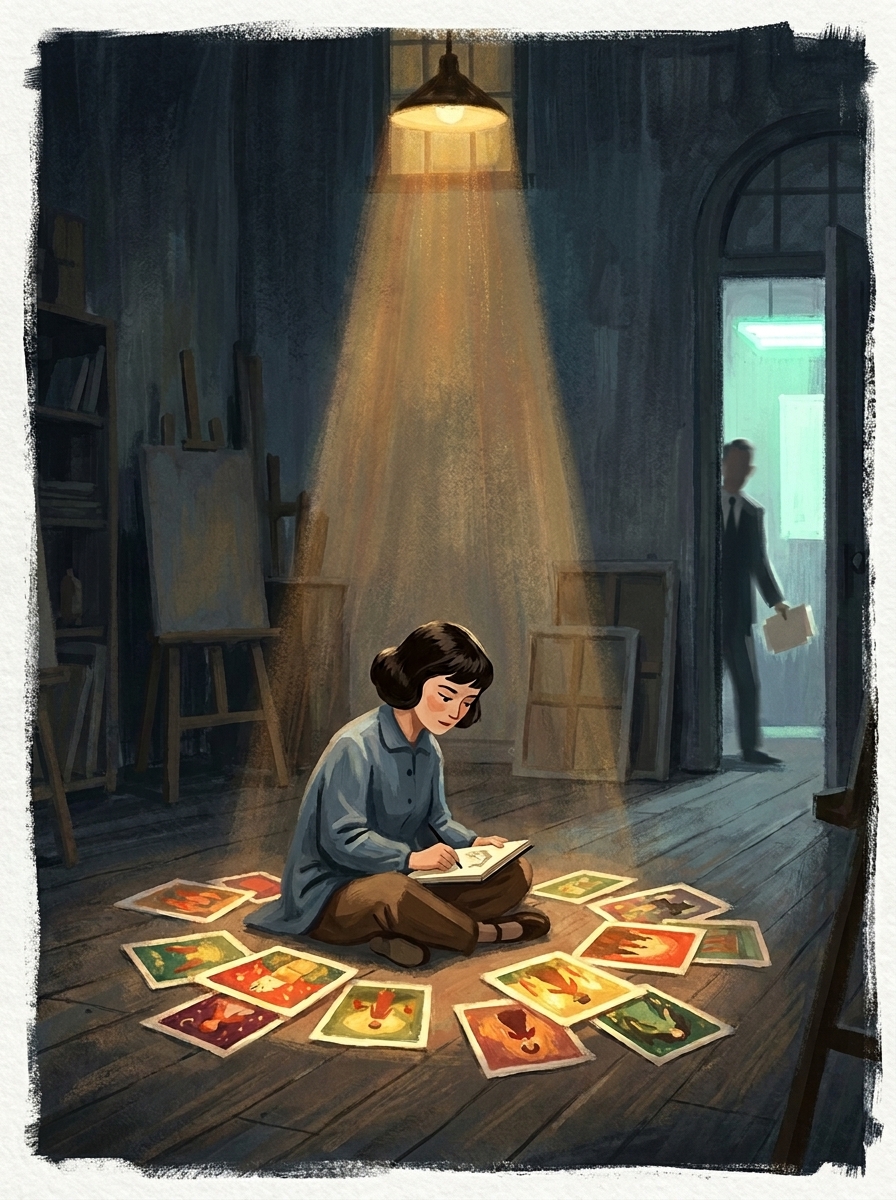
I keep returning to the illustrator. The one who refuses AI tools despite having every material incentive to adopt them. She has the principle the institutions claim. She does not have their protection. Until the gap between her conviction and her coverage closes, the creative industries' opposition to AI will remain what it currently is: a real ethic, unevenly worn, stretched tightest where the leverage is, threadbare where it is not.
The Number That Says It All
Here's a fact that should bother you. In 2025, one out of every three computer graphic artist jobs in America vanished. Gone. The year before that, it was one in eight. Meanwhile, screenwriters? Their jobs held steady. Same industry. Same AI threat. Same tools doing the disrupting. The only difference? Screenwriters have a union contract. The graphic artists don't.
That's not a theory. That's a number. And it doesn't leave room for "maybe."
Who Got Saved and Who Didn't
In 2023, Hollywood writers and actors went on strike. They shut down production for months. When they came back, they'd won real protections against AI. Writers can't be replaced by chatbots. Actors can't have their faces copied without permission. Good.
But here's what nobody at that table fought for: the concept artist. The animator. The sound designer. The VFX worker. A study of three hundred entertainment executives found that about 204,000 jobs are at risk from AI in the next few years. The jobs most at risk? The ones without union protection.
Seventy-five percent of those executives said AI had already helped them cut or shrink roles. Production designers were never even written into hiring contracts. Studios that promised to protect their writers' rooms were using AI to gut their art departments at the same time.
If the rule were "creative work deserves protection," you'd expect the most at-risk people to get help first. They didn't. The people with the most power got help first.
The Best Argument Against This
There's a fair pushback here, and it deserves space. Labor movements have always been step-by-step. One group organizes, then the next. VFX workers at Marvel voted to unionize in 2023. The Animation Guild is building its case. People are trying.
That's real. But triage means you save the most critical cases first. Writers and actors weren't the most at risk. They were the most powerful. They had fame, fans, and the ability to shut everything down. Concept artists had none of that. They had the sharpest threat and the fewest tools to fight it.
What happened wasn't triage. It was each group fighting for itself. That's human. It makes sense. But it's not the same thing as fighting on principle for everyone.
And there's a harder point. During the biggest labor action in a generation, the WGA had the whole country watching. They could have named the concept artists and sound designers facing the same threat. They could have said "this isn't just about us." They didn't. The law limited what they could bargain for. But nothing limited what they could say.
Your Face Is Protected. Your Art Isn't.
There's a second crack in the wall. The laws being built right now protect identity — your name, face, voice. Tennessee's ELVIS Act. The proposed federal NO FAKES Act. SAG-AFTRA's consent rules. All of these stop AI from cloning who you are.
But they don't protect what you do.
An illustrator who spent a decade building a way of painting light, choosing colors, framing a scene — AI can copy all of it. And there's no law against that. Style isn't owned. It never has been. If a human studies your technique and paints like you, that's legal. So when AI does it at machine speed, the law shrugs.
Now, there's a real reason for this split. Your face is you in a way your painting style isn't. We feel deeply violated by a deepfake of our face. We don't feel the same way about someone painting in our manner. That moral feeling is ancient and it's honest.
But here's where it breaks down. If the point is to protect personhood, then a freelance voice actor in Ohio should get the same deal as a SAG-AFTRA member in LA. Both have a voice. Both face the same threat. But one has a contract and the other has nothing. The principle sounds clean. Its reach follows the money.
The Framework They Chose
The creative industries built their fight against AI on one idea: consent. Don't train AI on our work without permission. That's a strong argument. I believe it.
But consent, the way they've set it up, runs through copyright. And under American law, if you made something as an employee or contractor, you probably don't own the copyright. Your boss does.
A Grammy-winning musician named Andy Hall found out a songwriter used AI to generate a part instead of hiring him. Under the industry's own consent rules, nothing wrong happened. Hall didn't hold the copyright.
The industry could have built its case on labor rights — a framework that covers every worker. Instead, it chose copyright, which covers whoever holds the assets. That's a choice. And the choice tells you something about what's really being protected.
What's Actually True
I want to be honest about the strongest evidence against everything I've just said. Eighty-five percent of visual artists refuse to use AI. No union told them to. No contract requires it. They're losing money because of it. They refuse anyway, on principle. That's real.
So here's the distinction nobody wants to make. Individual opposition to AI among creative workers looks deeply principled. Institutional opposition — the system of who gets covered and who doesn't, which laws get written and which don't — that's a different story.
Both things are true at once. The consent argument is real. The artists who refuse AI are sincere. And the architecture of protection follows power with a precision that principle alone can't explain. The creative industries aren't lying about their ethics. They're also not building systems that serve those ethics equally.
Who's Still Standing Outside
I keep thinking about that illustrator. The one who won't use AI even though it would save her career. She holds the principle the big guilds claim. She doesn't have their protection.
Until the gap between her belief and her coverage closes, the creative industries' fight against AI will stay what it is now: a real ethic, stretched tight where the power is, threadbare where it isn't.