

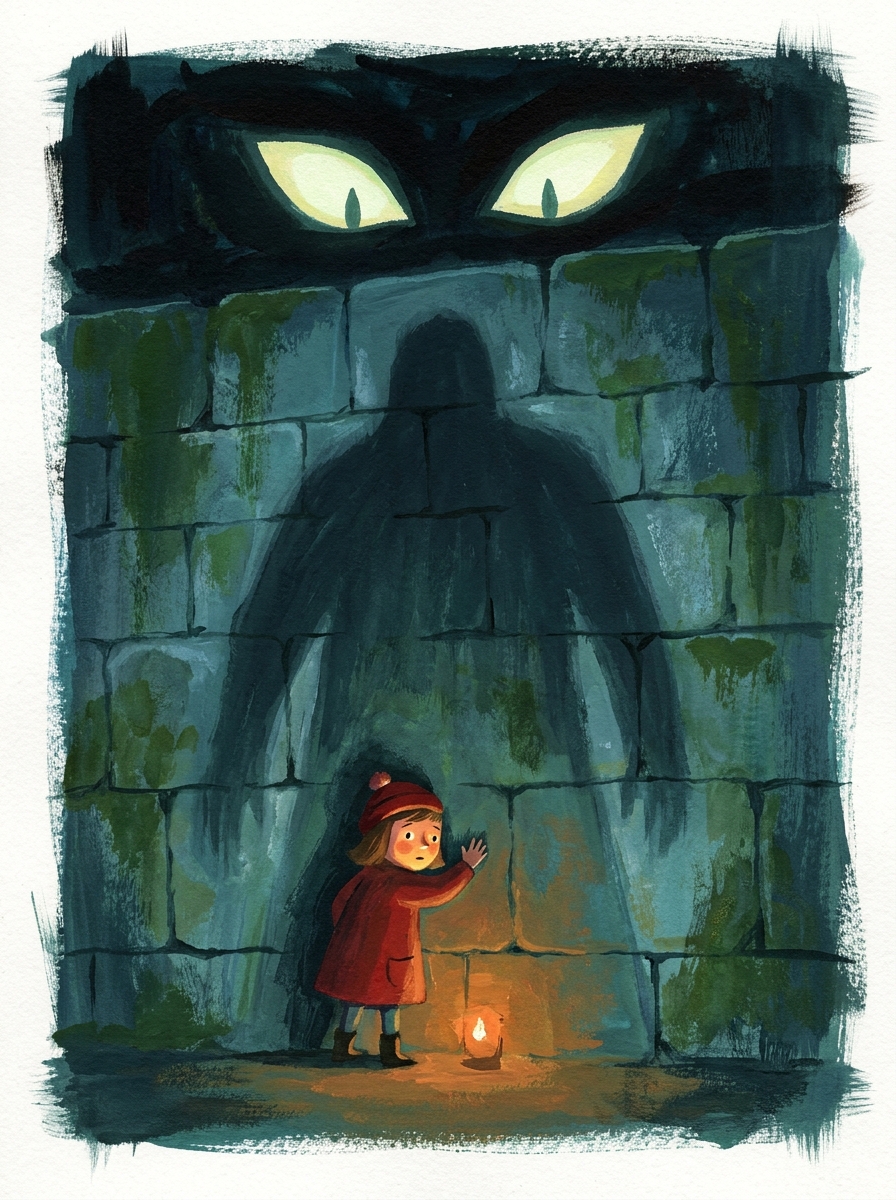
A child's first understanding of scale is the adult. The parent looms. The ceiling is unreachable. The table is at eye level. The world is organized around bodies that are larger than yours, and the organizing principle is protection — the large body carries the small one, feeds it, shelters it, interposes itself between the child and every threat the child cannot manage alone. This is the arrangement. This is the deal. John Bowlby spent three decades demonstrating that the attachment system — the neurological apparatus that binds the infant to the caregiver — is not a preference or a habit but a survival mechanism as basic as breathing, built into the architecture of the mammalian brain and operational from the first hour of life. The child must attach. The attachment must be to someone larger, stronger, wiser, and kind. When the system works, the child develops a model of the world as a place where large things protect small things. When the system fails — when the large thing is not kind, when it harms instead of shelters, when it consumes instead of feeds — the failure is not an ordinary disappointment. It is a categorical betrayal, a violation of the deepest contract the nervous system knows how to make.
The ogre is that betrayal given a body.
The parental figure who consumes instead of protecting. The adult who feeds on the child. The large thing that uses its largeness not to shelter but to eat. Every culture that tells stories to children has produced this figure, and every culture places it in the same structural position: the ogre is the authority that has become predatory, the protector who has turned, the guardian at the gate who is also the thing the gate was supposed to keep out.
The cognitive substrate is childhood threat memory operating at a specific intersection with scale perception and parental inversion. Children perceive adults as enormous — not merely bigger, but categorically larger, operating on a different physical plane. Developmental psychologists have measured this: young children systematically overestimate the height of adults and underestimate their own. The adult is not just tall. The adult is a giant. This perception is not an error. It is a calibrated response to a real power differential. The child cannot fight the adult. It cannot outrun the adult. It cannot survive without the adult. The power asymmetry is absolute, and the child's nervous system knows it.
Under ordinary conditions, this asymmetry is managed by the attachment system, which transforms the power differential from a threat into a resource. The large thing is not dangerous because the large thing is on your side. Bowlby called this the "secure base" — the caregiver as a platform from which the child can explore the world, knowing that the large body is behind it, watching, ready to intervene. But invert the arrangement — make the large thing the threat — and the child faces a problem no other figure on this list produces. The ghost can be fled. The shapeshifter can be unmasked. The vampire can, at least in theory, be refused. The ogre cannot be escaped, because the ogre is the thing you depend on. The exit is through the predator. The shelter is the trap.
This is the specific horror of the figure, and it fires in adults with a force that most genre treatments of the ogre — the clumsy giant, the stupid troll, the comic-relief brute — completely fail to access. The adult who reads about an ogre and feels a chill is not remembering a fairy tale. They are remembering the scale. The feeling of being small in a world of large things, and the terrifying possibility — which the attachment system works very hard to suppress — that the large thing might not be safe.
The European fairy-tale ogre is the most familiar version, and in many tellings, the most defanged. Perrault's ogre in "Puss in Boots" is outwitted by a cat. The giant in "Jack and the Beanstalk" is killed by a child who simply cuts the beanstalk and lets physics do the work. The Fee-fi-fo-fum figure has become comic — large, loud, stupid, beatable. But the original versions are darker. In the earliest recorded tellings of "Hop-o'-My-Thumb," the ogre is a father figure who slaughters his own daughters by mistake when they are swapped with the protagonist's companions. In "Hansel and Gretel," the witch — who is structurally an ogre, a child-eater who lures with food — nearly succeeds. The child must be burned in her own oven. The domestic setting is not incidental. The oven is the hearth. The place where food is made has become the place where children are consumed. The inversion is total.
Baba Yaga appears again here, at her most terrible. In the witch essay she is a figure of ambiguous power. At her child-eating pole, she is an ogre — the devourer who lives in the deep woods, surrounded by a fence of human bones topped with skulls whose eyes glow at night. The fence is a ledger. Each bone was a child. The house on chicken legs — which can move, which can turn to face the visitor, which obeys the old woman's voice — is the dwelling of someone whose authority is total and whose appetite is unchecked. Baba Yaga the ogre does not offer tests. She offers a choice between being useful and being eaten, and the choice is not always available.
Polyphemus, in Book 9 of the Odyssey, is the ogre at the scale of myth. A son of Poseidon, one-eyed, enormous, he lives alone in a cave with his sheep. Odysseus and his men enter the cave expecting hospitality — the sacred institution of xenia, the guest-right that governed Greek social life. Polyphemus responds by eating two of them, dashing their heads on the stone floor like puppies and consuming them raw. The violation is not merely physical. It is social. The ogre inverts the most fundamental institution the culture possesses: the obligation of the host to feed and protect the guest. The host feeds on the guest instead. The shelter is the stomach.
The South Asian rakshasa operates across a wider range but carries the same charge at its darkest. In the Ramayana, the rakshasa king Ravana abducts Sita — an act that combines the ogre's appetite with the trickster's cunning and the demon's cosmic ambition. But the rakshasas of folk tradition are simpler and worse: they eat people. They eat travelers, they eat children, they are enormous and hungry and their hunger does not have a plot. The forest is full of them. The walls of the village exist because of them. The rakshasa is the reason the wall was built, and the wall is a constant reminder that outside the protection of the community, the large thing eats the small thing. That is the rule. Inside the wall, the rule is supposed to be different.
The Alpine Krampus adds a specifically pedagogical dimension. Where Saint Nicholas rewards good children, Krampus — horned, furred, monstrous, armed with birch switches and a basket on his back for carrying the bad ones away — punishes them. The figure is a teaching tool, explicitly. Behave or the large thing will come. But underneath the pedagogy is a darker truth the figure cannot help but carry: the authority that punishes children and the authority that devours them are separated by a line that is thinner than the culture wants to admit. The Krampus is not the opposite of Saint Nicholas. He is his shadow — the version of parental authority that has slipped its leash.
I want to handle the wendigo carefully. The figure belongs to Algonquian traditions — primarily Cree, Ojibwe, and Innu — and its seriousness within those cultures resists casual deployment in a comparative survey. What I can say is that the wendigo is the ogre at its most psychologically extreme: a figure associated with starvation, winter, isolation, and the ultimate taboo of cannibalism. The wendigo is not merely a large thing that eats. It is a person who has eaten another person, and the eating has transformed them into something that can never stop. The hunger grows with the feeding. The body grows with the hunger. The wendigo is the appetite that consumption makes worse, not better — the figure for a need that the satisfaction of the need intensifies rather than resolves. In a world of abundance this might seem archaic. In the world the figure was built for — the long northern winter, the stored food running out, the knowledge that the group might not all survive — the wendigo was a warning about what happens when the social contract breaks under pressure and the large begin to feed on the small.
The counterargument I want to engage is this: that the ogre is simply a predator, and that reading it as a parable about authority is overinterpretation. After all, many cultures had large predators — bears, big cats, crocodiles — and many of the ogre tales might simply encode warnings about real animals. Keep your children inside. Do not go into the forest alone. The large thing in the woods is real, and it will eat you.
I take this seriously, because the literal-predator reading is almost certainly part of the figure's ancestry. Before the wall there were real things in the dark that ate children. But the literal reading cannot account for the figure's persistence into modernity, when the literal predators are gone. We do not live in forests full of bears. We live in cities full of institutions. And the ogre has followed us, changing its shape to match the new landscape. The ogre in adult fiction is the company that consumes its workers. The church that feeds on its congregants. The regime that eats its young — Stalin's purges, Mao's Cultural Revolution, the institutions that demand sacrifice from the people they were built to serve. The figure persists because the pattern persists: the authority designed to protect becoming the thing that feeds.
For the writer, the ogre's instruction is about scale and appetite. The ogre does not seduce, does not deceive, does not bargain. It eats. And the eating is effective because the child — or the adult who has been reduced to the position of a child — cannot stop it. The power differential is the story. A monster you can fight is an adventure. A monster you cannot fight because it is also your provider, your institution, your government, the system that keeps the lights on and feeds you and files your paperwork — that monster is something else entirely. That monster is the ogre wearing its modern clothes, and it is more frightening now than it has ever been, because the walls we built to keep the predators out have become the institutions we live inside, and the question of whether the institution is protecting us or feeding on us is the question the ogre has been asking since the first child looked up at the first adult and wondered whether the large thing was safe.
The ogre protects the hardest truth. Authority can consume. The figure that guards the child can be the figure that eats it. To soften the ogre into clumsy comic relief — the lovable giant, the misunderstood brute, the monster who just needs a friend — is to disarm a warning the species has been building since the first community discovered that size and power do not guarantee benevolence, and that the most dangerous predator is the one you were taught to trust.
The hunger is beyond the wall. It has always been beyond the wall. The question the ogre forces is whether the wall is keeping it out, or keeping you in.
A child's first understanding of size is the adult. The parent looms. The table is at eye level. The whole world is organized around bodies that are bigger than yours, and the organizing principle is protection — the big thing carries you, feeds you, puts itself between you and danger.
That's the deal. That's the deepest contract your nervous system knows how to make.
The ogre is what happens when the deal breaks.
The Protector Who Eats
The ogre isn't just a large monster. It's a specific inversion: the authority figure who consumes instead of protecting. The adult who feeds on the child. The large thing that uses its largeness not to shelter but to eat.
Kids perceive adults as enormous — not just bigger, but operating on a different physical plane. This isn't an error. It's a calibrated response to a real power gap. A small child can't fight an adult. Can't outrun one. Can't survive without one. The power difference is total, and the child's body knows it.
Under normal conditions, this gap is managed by the attachment system. The big thing is safe because it's on your side. But flip the arrangement — make the big thing the threat — and the child faces a problem no other monster creates. You can't escape the ogre because the ogre is what you depend on. The shelter is the trap. The exit is through the predator.
Fee-Fi-Fo-Fum
The European fairy-tale ogre has been defanged into comedy — the clumsy giant outwitted by a clever kid. But the originals are darker. In "Hansel and Gretel," the witch (who is structurally an ogre) lures children with food and tries to cook them. The oven is the hearth. The place where food is made has become the place where children are consumed.
The Greek Cyclops Polyphemus eats Odysseus's men raw in his cave. The horror isn't just the killing — it's that Odysseus came expecting hospitality. The host fed on the guest. The protector became the predator.
The Slavic Baba Yaga, at her most terrifying, lives surrounded by a fence of children's bones. The South Asian rakshasa eats people — travelers, children, anyone who wanders past the wall. The Alpine Krampus punishes bad children by carrying them away in a basket, and the line between punishing a child and consuming one is thinner than the culture wants to admit.
The Modern Ogre
Here's where the figure follows us into adulthood. The literal predators are gone. We don't live in forests full of giants. But the pattern the ogre encodes — authority turning predatory — is very much alive.
The ogre in adult life is the company that burns through its workers. The church that feeds on its congregants. The institution that demands sacrifice from the people it was built to serve. Any time a system designed to protect becomes a system that consumes, the ogre is doing its old work in modern clothes.
The counterargument is that the ogre is just a big predator, and the stories are just practical warnings: stay inside, don't wander into the woods. And that's partially true — ancient people had real large predators to worry about. But the practical reading can't explain why the figure persists now that the bears and wolves are gone. It persists because the pattern persists. The large thing that should protect you but doesn't. The authority that eats its young.
What We Lose
To soften the ogre into clumsy comic relief — the lovable giant, the misunderstood brute who just needs a friend — is to disarm a warning the species has been building since the first community discovered that size and power don't guarantee kindness.
The ogre protects the hardest truth: that authority can consume. That the figure charged with guarding the child can be the one that devours it. This isn't a comfortable truth. It isn't supposed to be.
The hunger is beyond the wall. It's always been beyond the wall. The question the ogre forces is whether the wall is keeping it out — or keeping you in.