

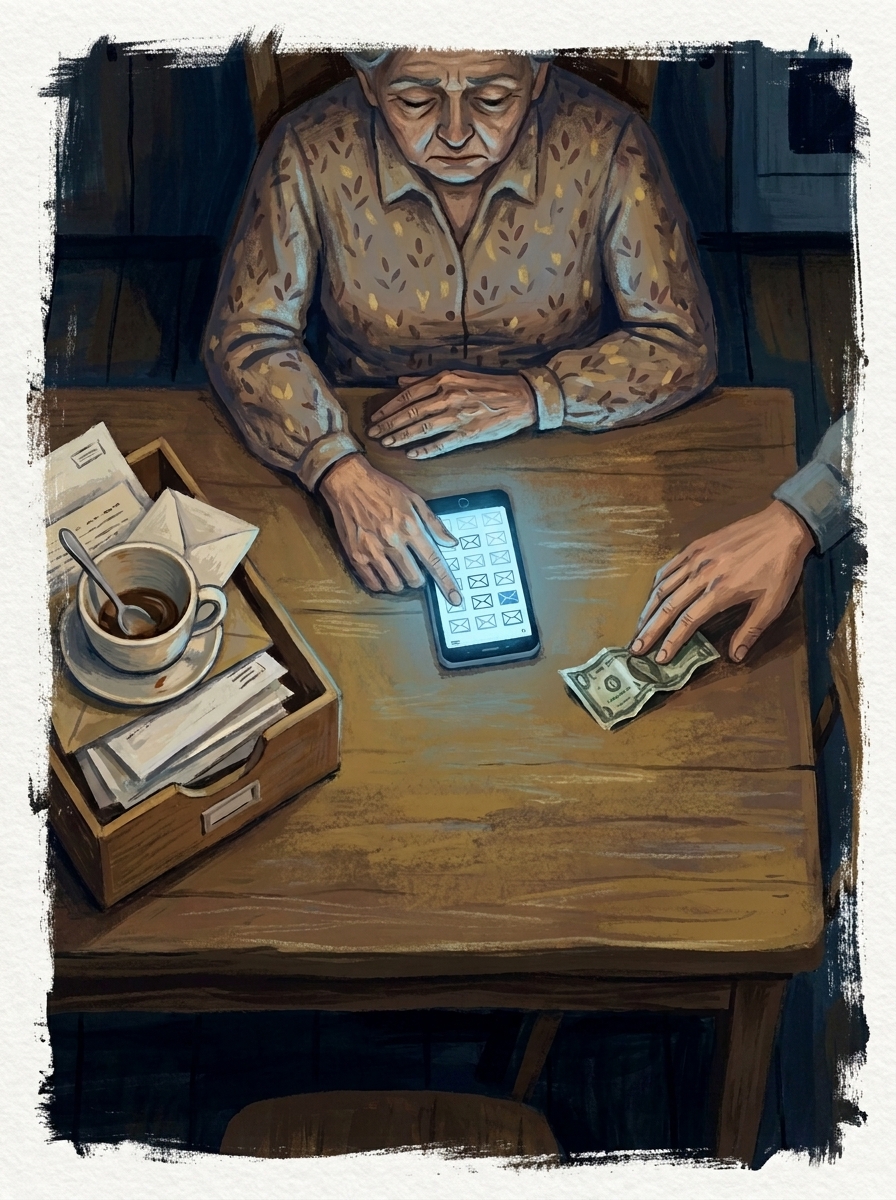
Forty-seven emails by Tuesday. A retired teacher in suburban Pittsburgh, sixty-three years old, opens her phone to find subject lines screaming at her in capital letters. A membership-activation deadline that does not exist. A nine-thousand-times match no accountant on earth could substantiate. At 11:47 on a Saturday night her phone buzzes with another text — a tactic the operatives who deploy it call, with the kind of candor that arrives only inside the trade, "drunk donating." The political scientist Adam Bonica, working from FEC data at Stanford, has shown the late-Saturday timing is not coincidence. The vendors know exactly what they're doing.
I want to begin with her inbox because the conversation about small-dollar political fundraising has spent most of the last decade in the wrong register. It's been waged either in the romantic vocabulary of civic empowerment — the three-dollar gift, the demos financing its own politics, the McGovern-era list direct-mailed into the smartphone age — or in the technical language of consumer protection, where the issue becomes whether the prechecked recurring-donation box constitutes a "dark pattern" under the EU's Consumer Rights Directive. Both registers are honest. Neither is sufficient. What is happening to the retired teacher in Pittsburgh and to the line cook in Phoenix who has, for the first time in his life, given thirty dollars across three election cycles, is not one phenomenon. It is two, fused at the surface and severable underneath. To see the whole thing requires holding the fusion and the severance in the same sentence.
Start with the financial archaeology, because the numbers do the framing work that argument cannot. In April 2021, Shane Goldmacher of the New York Times published a forensic account of what the Trump operation had done to its own donors in 2020. The campaign and the RNC refunded about $122.7 million to WinRed donors that year — roughly 10.7 percent of everything raised online through the platform. The comparable refund rate at ActBlue, the Democratic equivalent, was 2.2 percent. What is striking is that before the Trump operation introduced a second prechecked recurring-donation box in mid-June 2020 — the "money bomb" — refund rates at the two operations were essentially identical, 2.18 and 2.17 percent. The instant the second box went live, the WinRed refund rate vaulted to 12.29 percent for the rest of the year. Wells Fargo and Capital One representatives told the Times that, at the peak, political-platform fraud complaints accounted for one to three percent of total customer fraud-claim volume at major banks. In October and November of that year, the Trump operation was sending an average of about fifteen fundraising emails per day to its list, plus heavy SMS traffic on top of that.
What that data captures is not voter persuasion or even ordinary aggressive marketing. It is the financial signature of a sustained, automated extraction event aimed at people who did not know they were being charged again. CNN's investigations team, working in October 2024, identified more than fifty elderly donors out of roughly three hundred they contacted who had given far more than they intended, many in clear cognitive decline. The Trump campaign and affiliated committees pulled in more than $400,000 from just that small snapshot of vulnerable Americans between July 2019 and June 2024. The same reporting documented per-page customization designed to identify which donors were most susceptible to particular emotional appeals — fear of imminent loss, urgency, simulated personal contact from the candidate. The system had become, in a precise technical sense, predatory: it had learned which of its sources to press hardest, and pressed them.
I am dwelling on the Republican numbers because they are the most dramatic, but the Democratic side is not innocent and pretending otherwise would be cowardice. ActBlue itself used prechecked recurring boxes; the DCCC, the DSCC, the NRCC, and the NRSC continued to deploy them after ActBlue began phasing them out as a default in 2021. In December 2024, more than 140 Democratic consultants, vendors, and nonprofit staff signed an open letter to ActBlue's CEO begging the platform to "do a better job" of protecting Democratic contributors from being "exploited." Markos Moulitsas of Daily Kos has said that the constant "we're going to lose" doom-loop messaging "does not create an environment where Democrats are eager to fight and win." Dan Pfeiffer, the former Obama communications director, wrote in 2025 that the downsides of his party's pursuit of grassroots funding "go far beyond mere annoyance" and amounted to a "credibility crisis." Both parties are running the same engine. One is louder.
Here is where the conventional understanding usually stops — at the catalogue of abuses, the cataloging of bad actors, the call for reform of the worst tactics. The trouble is that this framing flatters the surface and misses the structure. So let me put on the table what I think is the strongest case for the defense, because the case is real and not refuting it would be a kind of intellectual dishonesty I cannot afford.
The defense runs roughly as follows. American politics, for most of its history, has been financed by a narrow donor class — bundlers, maxed-out checks, corporate PACs, and after Citizens United, a Super PAC and dark-money ecosystem whose pass-through to political speech is also dismal but whose victims are at least not the donors themselves. The arrival of online small-dollar fundraising, beginning meaningfully with Howard Dean in 2003 and reaching maturity with Obama in 2008 and 2012 and again with Sanders and Trump in 2016, represented the first sustained mechanism by which ordinary citizens financed federal politics at scale. ActBlue alone has processed billions in small contributions over its lifetime. The legitimacy implications of that shift are not trivial. The political theorist Richard Pildes has argued in the Yale Law Journal that small-donor financing creates its own distortions — particularly an incentive toward ideological extremism, since polarizing rhetoric converts best — but he acknowledges the legitimacy gain as real. The Brennan Center's Daniel Weiner and Ian Vandewalker have countered that public-matching programs of the sort New York City uses can preserve the legitimacy benefit while mitigating the polarization tax. The argument across this academic literature is over how to keep the gain, not over whether the gain exists.
A democracy whose financing class does not include the demos is structurally answerable to the financing class. That is not a controversial claim. The political scientist Martin Gilens established as plainly as anyone could that, controlling for everything else, U.S. policy outcomes track the preferences of the affluent decile and almost ignore the preferences of the bottom half. The Pew Research Center has been asking the same question in different forms for years; the October 2023 reading found that 80 percent of American adults believe political donors have too much influence on members of Congress. That belief is not paranoia. It is empirical pattern recognition. The aggressive small-dollar ecosystem is, on the most generous reading, the first thing in a century that has even attempted to widen the funder base of American politics to something resembling the demos itself. The thirty-one-year-old line cook in Phoenix whose grandfather was a Goldwater Republican and whose parents have never given a dollar to anything — he exists, even if any single example is anecdotal. A three-dollar text reached him. He gave. He gave again. He watched the next debate. Psychologists have a name for this: the foot-in-the-door effect. The behavior precedes and produces the identity, not the other way around. Strip away the ecosystem and the line cook is never found, and the financing of American politics returns to a room he has never been in.
That is the case I want to sit with for a moment, because it is the case I myself find most persuasive on principle. The demos financing its own politics is a structural good of a kind that cannot be replaced by good intentions or by reform of the rentier class above it. I have written elsewhere about the difference between procedural and substantive democratic legitimacy, and small-dollar fundraising, at its best, produces both. I do not want to give that up. Anyone who lives through the choice and lands on the proposition's side has to admit that the choice is genuinely costly.
But the choice as just stated is not the choice the country is actually being offered. And this is where the argument has to push past the conventional defense and into the deeper structure.
What is being offered is not "small-dollar fundraising" in the abstract. It is a specific industrialized layer riding on top of it — the prechecked boxes, the fabricated matches, the manufactured deadlines, the late-Saturday-night texts engineered for cognitive vulnerability, and behind all of it a consultant-fee structure that turns the donor's three-dollar gift into a transfer payment to a professional class. Bonica's 2025 FEC analysis of the Mothership Strategies PAC network is the clarifying document here. Between 2018 and 2024, the network raised approximately $678 million from individual donors. Of that, $159 million paid directly to Mothership Strategies as consulting fees. Another $22.5 million went to a single text-messaging vendor. At most $11 million reached actual candidates, campaigns, or party committees. The pass-through efficiency rate from grassroots donor to political speech was 1.6 percent. Ninety-eight cents on every dollar stayed inside the consulting apparatus. On the Republican side, the Conservative Majority Fund raised nearly $10 million from grassroots conservatives and delivered $48,400 to actual candidates.
This is not, on inspection, the demos financing its politics. This is the demos financing a new extractive class — digital consultants — that has been quietly grafted onto American political infrastructure over the last fifteen years. The principal-agent problem here is structural and almost embarrassingly clean. When the consultant's compensation scales with the gross amount raised and the candidate's marginal benefit from each additional spam blast approaches zero, the interests of the agent and the principal diverge sharply, and the agent's interests are what get optimized for. The Association of Fundraising Professionals has an ethical norm against percentage-based fundraising compensation precisely because of this dynamic; political consulting routes around the norm because politics is exempt from most fundraising-sector self-regulation. The result is that the grassroots fundraiser has become, in a structural sense, the most rent-extractive layer of American political finance — more so, in some respects, than the bundler class it nominally displaced, because the bundler class was at least competing for influence with the candidate, not solely for the income stream of the solicitation.
The defense's strongest reply — and it deserves a fair hearing — is that the alternative is worse. If grassroots fundraising disappeared tomorrow, the consultant rent would simply migrate to the Super PAC and corporate-PAC ecosystem, where it already lives and where ordinary citizens are not even nominally inside the transaction. There is real force to this. The U.S. is, as the comparative literature establishes plainly, a global outlier in both the volume of unsolicited political solicitation and the absence of consumer-protection regulation covering it. European democracies finance their politics through some mix of party-membership dues, capped private donation, and meaningful public financing. We do not, and absent grassroots small-dollar money, we would simply revert to a financing structure dominated by the people Citizens United enfranchised. The line cook in Phoenix would lose his on-ramp. The retired teacher in Pittsburgh would not get a quieter inbox; she would simply get a politics in which her phone was no longer being marketed to and in which her preferences were no longer even being aggregated, however cynically.
This is the moment where the argument has to do its hardest work, because the defense and the indictment are both partly right. The honest synthesis runs like this: the small-dollar layer is broadly democratizing and the aggressive layer is broadly predatory, and the entire question is whether the two are causally fused or only contingently joined. The defense's case requires that they be fused — that you cannot have the reach without the dark patterns, the on-ramp without the prechecked box. The indictment's case requires that they be severable — that the predatory layer can be stripped off without collapsing the on-ramp underneath.
The evidence on severability is, I think, decisive against the defense. ActBlue removed prechecked recurring-donation boxes as a default in 2021 and continued processing record small-dollar volumes afterward. The 92 percent decrease in new matching-program forms created at ActBlue in the two weeks after the 2024 election — once the platform tightened its Account Use Policy to require documentation for matching claims — is not the signature of an industry that needs the fabrications to survive. EMILY's List in 2025 piloted a "Friends of the List" Substack-based program offering donors fewer solicitations in exchange for a $15 monthly commitment. The pilot exists, in plain language, because EMILY's List has concluded that the churn-and-burn model is destroying its own donor base faster than it is replacing it, and the math is starting to bite. The Fundraising Effectiveness Project's data is unambiguous on this: first-time donor retention sits at 18.6 percent, climbing to 84.3 percent only once a donor has reached their seventh contribution. Everything turns on the second gift. The aggressive layer is the mechanism that prevents the second gift from arriving. The industry is, in slow motion, beginning to figure this out from the inside.
The FEC, for what little it is worth, voted unanimously in May 2021 to recommend that Congress ban prechecked recurring-donation boxes outright. Senators Klobuchar and Durbin introduced corresponding legislation. The bill died. As of mid-2026, no federal statute prohibits the practice, and the DCCC, DSCC, NRCC, and NRSC have continued to deploy it. So the defense gets to say, fairly, that the reformist world I am describing has not actually arrived; that the ecosystem as it operates is still the one in which the elderly donor with dementia gets charged ninety-three times. That is true. But it is an argument for reform urgency. It is not an argument that the reform is impossible or that the predatory features are constitutive of the participatory ones.
There is a deeper point I think is worth surfacing here, because it cuts across the technical debate and into something more sociological. What the aggressive small-dollar ecosystem is doing, week in and week out, is teaching tens of millions of Americans that participation in democratic life is itself a transaction in which they are the marks. The retired teacher who eventually demands the refund — and gets it, because the refund mechanism does work, $122.7 million worth of work in a single cycle — has not learned that the system protects her. She has learned that the system tried to take from her and that she had to spend three hours on the phone with her bank to get it back. The 21 percent of voters who told the Center for Campaign Innovation that political messaging makes them feel "annoyed, irritated, or frustrated" are not abstract data points. They are people whose ambient experience of democracy is being shouted at and lied to by people who claim to want their vote. The trust the system is burning is the same trust it depends on to make the legitimacy claim work.
David Brooks, writing in another context about institutional decay, has observed that institutions hollow out from the inside long before they collapse from the outside, and that the warning signs are almost always the same: the people inside the institution begin treating its constituency as a resource to be harvested rather than a community to be served. Whatever else can be said about American political parties at the present moment, the donor-as-resource framing has won so completely inside the consultant class that the actual donors have begun to notice. The micro-donor segment — the $1-to-$100 donors who are by far the closest analogue to the small-dollar political contributor — is shrinking sectorwide faster than any other category, down 11.1 percent year-over-year as of the most recent quarter. The structural achievement the defense rightly celebrates — the demos financing its own politics — is being eaten alive by the consultant layer that has built itself on top of it. The on-ramp is collapsing under its own freight.
I'm less certain about this next claim than I'd like to be, because the briefing's own evidence flags it as plausible rather than proven, but I think it is the most important claim on the table: aggressive small-dollar fundraising, in its current form, is not merely failing to generate the democratic participation it promises. It is consuming the appetite for participation faster than it is producing it. The dollars refunded are recoverable. The trust isn't. A democracy can survive a great deal of donor cynicism, but the specific cynicism this ecosystem manufactures — the conviction, slowly drilled in by every fake match and every late-Saturday text, that even the actors who claim to want your civic engagement actually want your credit-card number — is a corrosion of a different kind. It does not produce apathy in the classic sense. It produces a more dangerous thing, a sense among ordinary citizens that the entire civic interface they have access to is rigged against them, which is precisely the sense that authoritarian and post-democratic political appeals feed on.
There is a sentence I keep returning to from the comparative literature. The EU's Consumer Rights Directive prohibits the kind of prechecked-box dark patterns WinRed and ActBlue spent half a decade deploying domestically. That is not a coincidence and not a quirk of European political culture. It is a deliberate regulatory choice grounded in a particular theory of consumer dignity: that the architecture of consent, in transactions where one party has structural informational advantages, has to be designed to protect the weaker party from being baited into commitments they would not otherwise make. The Europeans have decided, as a matter of consumer law, that the prechecked box is a fraud against the consumer's will. American political fundraising has decided, as a matter of unregulated commercial practice, that the prechecked box is a feature of the civic on-ramp. The difference between those two stances is the difference between treating the citizen as the principal of the political transaction and treating her as the audience of it.
The question the country actually faces is not whether the demos should finance its politics. Of course it should. The question is whether a financing system whose dominant grassroots architecture is engineered to extract from confusion can sustainably produce the legitimacy gain it claims to produce. I think the honest answer, sitting with the evidence and with the strongest version of the defense, is no. Not because grassroots fundraising is bad. Because the predatory layer riding on top of it has begun to cannibalize the very on-ramp that justified it, and because the people being asked to keep funding the system are starting, in increasing numbers, to figure out that they are the product.
The reforms that would address this without burning the on-ramp down are not mysterious. Ban prechecked recurring-donation boxes by statute, as the FEC unanimously recommended and Congress has refused to do for five years. Prohibit percentage-based fundraising-consultant compensation in federal politics, as the AFP already prohibits in the nonprofit sector. Require opt-in for list rental rather than the current opt-out default that recycles donor contact information across the entire consultant network. Require meaningful disclosure of pass-through rates from PACs to actual campaigns, so that a donor giving three dollars to the Conservative Majority Fund can see, before she gives, that $48,400 of $10 million reached candidates. None of this dismantles small-dollar fundraising. All of it lets the demos keep financing its own politics while denying the consultant class its 98-cent margin on the demos's grocery money.
I want to end where I started — with the inbox in Pittsburgh and the kitchen in Phoenix, because abstraction without people in it is a kind of cheating. The retired teacher does not need her inbox emptied. She needs the lies in it to stop being lies. The line cook does not need to be left alone. He needs the three-dollar text that found him to be honest about what it is asking for, and to not silently re-bill him every Friday until his card is maxed. The two of them want, in the end, the same thing the demos has always wanted from its political class: to be treated as funders rather than as audience, as principals rather than as marks. That is the structural achievement small-dollar fundraising once promised. The aggressive layer is what stands between us and that promise. And it stands there, increasingly, on a foundation of the very civic trust it is in the business of dissolving.
Picture your grandma's phone on a Tuesday. By lunchtime, forty-seven emails. All from political campaigns. The subject lines are screaming in caps. One says her "membership" runs out tonight. Another claims her gift will be matched nine thousand times. A text buzzes at 11:47 on a Saturday night.
That last one isn't random. The people who send those texts have a name for the trick. They call it "drunk donating." A Stanford researcher named Adam Bonica dug into the data and proved it. The late-Saturday timing is on purpose. They want to catch people when their guard is down.
I want to start there because that inbox is the real story. Not the cute version you hear about three-dollar donors saving democracy. The actual machine. And once you see how it works, you can't unsee it.
So What's Actually Going On?
In 2020, Donald Trump's campaign added a pre-checked box to its donation page. If you didn't notice and uncheck it, you got billed again. And again. Every week.
The result? The campaign had to give back $122.7 million to angry donors. That's about one out of every ten dollars it raised online. The Biden campaign's refund rate was less than a quarter of that. Banks like Wells Fargo and Capital One said political fraud complaints made up as much as three percent of all their fraud calls at the peak.
CNN found more than fifty elderly people who got charged way more than they meant to give. Many had dementia. They didn't know what was happening to their accounts.
This isn't fundraising. It's a trap.
And before anyone says this is just a Republican problem, it isn't. The Democratic side uses the same tricks, just a little quieter. In late 2024, more than 140 Democratic staffers signed an open letter begging their own party's donation platform to stop "exploiting" donors. Both parties run the same engine.
But Wait, There's a Real Argument On The Other Side
Here's the part most takes skip. There's a real case for keeping this system, and I want to be fair to it.
For most of American history, politics was paid for by rich people. Big checks. Bundlers. Corporate money. Regular people were not in the room. Then, starting around 2003, something new happened. Online donations let ordinary people chip in five or ten bucks. Suddenly the funders of politics looked a little more like the country itself.
That matters. A government that is paid for by rich people tends to answer to rich people. There's a famous study by a political scientist named Martin Gilens. He found that U.S. policy tracks what the rich want and mostly ignores what the bottom half want. So getting more regular people inside the funding process is a real win.
Think about the line cook in Phoenix. Thirty-one years old. His parents never gave a dollar to politics. Then a text asks him for three bucks. He gives it. He gives again. He starts watching debates. He talks his roommate into registering to vote. That's a real person who got pulled into democracy by a text message. Strip the system away and he's never found.
I take that argument seriously. I really do.
Where The Defense Falls Apart
Here's the catch. We aren't actually being asked to choose "small donations or no small donations." That's a fake choice.
What we have is small donations plus a layer of scams sitting on top. The pre-checked boxes. The fake matches. The fake deadlines. The drunk-donating texts. And behind it all, a class of consultants getting rich off the whole thing.
Bonica did another study. He looked at a network of groups run by a firm called Mothership Strategies. Between 2018 and 2024, this network raised about $678 million from regular people. How much actually went to candidates? At most $11 million. That's 1.6 cents on the dollar.
Read that again. Of every dollar a grandma gave thinking she was helping a candidate, ninety-eight cents stayed inside the consulting business.
On the Republican side, a group called the Conservative Majority Fund raised nearly $10 million and sent just $48,400 to actual candidates. Not even half a percent.
This isn't regular people funding politics. It's regular people funding a new class of middlemen who took the job from the old class of middlemen. The faces changed. The skim got worse.
Can You Have The Good Without The Bad?
This is the real question. Are the scammy parts glued to the helpful parts, or can you peel them apart?
The evidence says you can peel them apart. ActBlue, the big Democratic platform, dropped the pre-checked boxes as a default in 2021. It kept raising record amounts after. A group called EMILY's List started a new program in 2025 that offers donors fewer emails for a small monthly gift. Why? Because the constant spam is killing donor loyalty faster than it's adding donors.
The numbers back this up. Only 18.6 percent of first-time donors ever give a second time. But once someone gives seven times, 84.3 percent keep going. The whole thing turns on getting people to give a second time. And constant lying is exactly what stops them from giving again.
The FEC, our federal election agency, voted unanimously in 2021 to ask Congress to ban pre-checked boxes. Congress did nothing. Five years later, the scam is still legal. Europe banned this kind of thing for regular shopping years ago. We never bothered for politics.
What This Trains People To Believe
Here's the part that bothers me most. Every fake match, every late-night text, every charge your grandma didn't agree to — these things teach people something. They teach tens of millions of Americans that politics itself is a scam. That even the people who say they want your voice actually just want your credit card.
Eighty percent of Americans already think donors have too much power in Washington. That number isn't paranoia. It's pattern recognition. The system burned the trust. The people noticed.
I don't think the small-dollar idea is bad. I think it was one of the best things to happen to American politics in a hundred years. But it's being eaten alive by the scammy layer sitting on top of it. And the people running that layer don't care, because they get paid either way.
The fix isn't to shut down small donations. The fix is to ban the pre-checked boxes. Stop paying consultants by the percent. Make groups show how much actually reaches candidates. None of that kills the on-ramp. All of it kills the skim.
The grandma in Pittsburgh doesn't need her inbox to go silent. She needs the lies in it to stop. The line cook in Phoenix doesn't need to be left alone. He needs the text that found him to be honest about what it's asking for.
That's a system worth fighting for. The one we have isn't it yet.