

In 1805, a portrait miniaturist named Andrew Robertson wrote to his brother that he had been "run over by the daguerreotype." He meant this metaphorically. The camera had not yet been invented. Robertson was referring to cheaper competitors using mechanical aids — the camera lucida, the physiognotrace — that allowed less skilled painters to produce likenesses faster and at lower cost. When actual photography arrived thirty-four years later, Robertson's complaint became a premonition. The miniaturists, whose value had been defined by execution fidelity, collapsed as a profession within a generation. The painters who survived — the Impressionists, the Post-Impressionists, the whole lineage of modern art that followed — survived because they had relocated their value proposition from the rendering to the seeing.
We are living through the same selection event. And I think we placed the bet wrong.
The Pennsylvania Academy of the Fine Arts, founded twelve years before the Constitution was signed, stopped offering degrees after the 2024–25 academic year. California College of the Arts, which had been teaching students to draw and paint for a hundred and nineteen years, announced it would close as an independent institution. These are not market corrections. They are the structural consequences of a civilization that spent centuries teaching artists that their essential contribution was how well they execute — and teaching the people who hire artists that execution is what they are paying for.
The data is no longer suggestive. It is conclusive. A Stanford study by Goldberg and Lam tracked what happened when a major image platform began permitting AI-generated content: non-AI artist participation fell twenty-three percent per month while total available images rose seventy-eight percent. The Brookings Institution found that experienced, higher-priced freelancers suffered disproportionately — their premium collapsed when lower-rated freelancers achieved comparable output quality using AI tools. The Society of Authors surveyed its membership and found that twenty-six percent of illustrators had already lost work to generative AI. A third reported decreased income. UNESCO projects global creator revenue losses of up to twenty-four percent in music and twenty-one percent in audiovisual sectors by 2028.
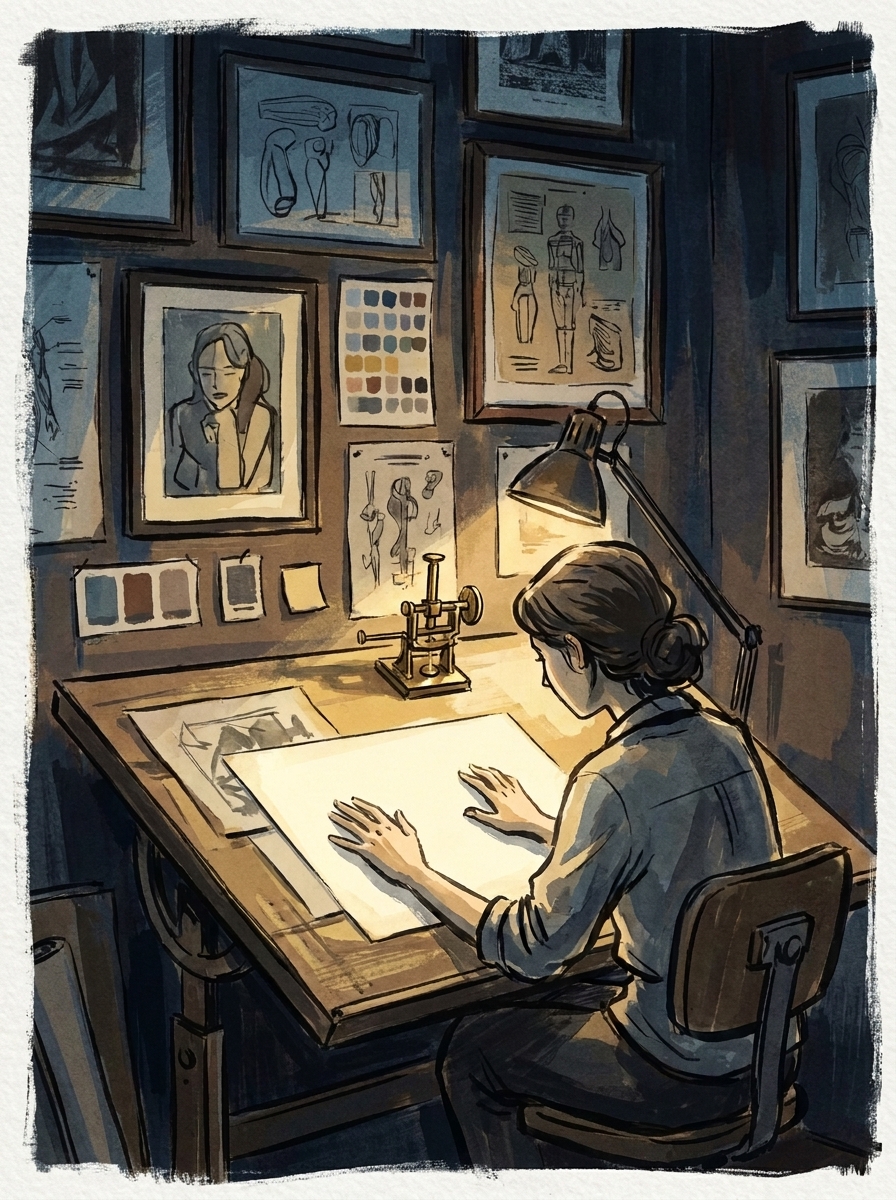
These numbers describe a specific kind of person. She is thirty-four. She spent five years in an illustration program and two more building a portfolio that demonstrates her command of figure drawing, color theory, perspective, and digital rendering. She earns fifty-five thousand dollars a year from freelance commissions. Her clients — publishers, ad agencies, game studios — chose her because she could produce what they envisioned but could not execute themselves. Her savings cover two months of rent. She has no union. And the market has just informed her that what she spent seven years acquiring is now available at near-zero marginal cost in minutes.
The conventional response to this situation is to call it a technology problem. AI is disrupting creative labor the way looms disrupted weavers, the way cameras disrupted portrait painters, the way synthesizers disrupted session musicians. The prescription follows naturally: adapt, retrain, find the new niche. This response is not wrong, exactly, but it mistakes the symptom for the disease. The question is not why a new technology displaced workers whose value was defined by execution. That is what technologies do. The question is why we defined their value that way in the first place — why the culture taught both artists and their clients that what matters most about an artist is how well she renders rather than what she chooses to render, and why, and for whom.
I want to sit with the strongest version of the answer, because it deserves to be heard before it is challenged.
Richard Sennett argued in The Craftsman that making is thinking — that technical understanding develops through the powers of imagination engaged in material work. A cellist who has practiced a single passage four hundred times discovers, on the four hundred and first repetition, a micro-hesitation before the resolution that no score prescribes and no conductor requests. That hesitation is not execution in the narrow sense. It is the place where execution became vision — where ten thousand hours of bow pressure and rosin and muscle memory crossed a threshold and produced something that could not have been conceived in the abstract. The woodcut printmaker who reads cherry grain through her fingertips possesses a form of knowledge that is held in the body, impossible to transmit outside actual engagement with production. Japan's Living National Treasure program funds the training of such practitioners specifically because their embodied knowledge cannot be written down, filmed, or prompted. It can only pass hand to hand, body to body, across years of shared labor.
This is a genuine and important truth. Strip the practice and you do not liberate the idea. You eliminate the conditions under which the idea could have existed at all. A culture that systematically underinvested in the embodied practice through which artistic vision is discovered would be a culture that produced thinner, more abstract, less materially grounded art. The woodcut printmaker does not exist without the tradition that honored the ten thousand blocks her master required before acknowledging her hand was ready.
Craft-centrality also solved a practical problem that no proposed alternative addresses cleanly. Art is a credence good — buyers cannot fully evaluate quality before or even after purchase. A portfolio of technically accomplished work served as a legible, verifiable, fraud-resistant signal in a market defined by radical information asymmetry. It told the client: this person can deliver. Vision, by contrast, is subjective, hard to verify, and trivially easy to fake. The contemporary art market — which has partially de-centered execution in favor of conceptual novelty and institutional endorsement — demonstrates the resulting dysfunction. Valuation in that world is driven by insider networks conferring reputation: opaque, volatile, speculative, and disconnected from any stable notion of quality. Damien Hirst's works now fetch sixty percent less than what collectors originally paid. Jeff Koons drove at least three dealers into bankruptcy. The Artsy 2026 survey found that only fifteen percent of galleries reported collector interest in AI-generated art, and there is still no industry-wide definition of what AI art even is. The vision-first market already partially exists in the gallery world. It is not a model anyone should want to generalize.
So craft-centrality was genuinely valuable. It sustained a functional creative economy for centuries. It transmitted embodied knowledge across generations. It provided signals that allowed strangers to transact honestly. None of this is trivial. I am less certain than I would like to be about the argument I am about to make, because the defense of craft is not a straw man — it is a position I take seriously and find partially persuasive.
But I think the defense confuses two things that need to be separated: the value of craft as a practice and the elevation of craft as the primary measure of artistic worth. These are not the same. And confusing them is what left us structurally exposed.
Here is the conceptual error, stated as plainly as I can manage. When a culture defines artistic value primarily by how well someone executes — renders, paints, sculpts, draws — it locates the artist's essential contribution in the replicable part. Technique is, by definition, method and procedure. Anything replicable is, in principle, automatable. A craft-centric value framework therefore logically entails that the artist's essential contribution is the automatable part. This is not a prediction about any particular technology. It is a definitional consequence of where the culture chose to place the emphasis. A culture that instead located value in authorial judgment — what to make, why, and for whom — would have identified the non-automatable, constitutively human contribution as primary. The artist's identity would have been organized around the part of her work that no machine can replicate: the act of choosing, interpreting, directing, making meaning.
The Sennett defense actually proves this point, if you follow it to its conclusion. The cellist's micro-hesitation emerges from embodied practice. No one disputes that. But what emerges — the judgment, the taste, the irreplaceable interpretive act — is the higher-order product of that practice. Vision is what execution produces that matters most. A culture that recognized this hierarchy would not have eliminated practice. It would have organized its markets, its training pipelines, and its signals of worth around the part of the artist that practice creates and that no machine can replicate. You do not honor a tree by treating the bark as more valuable than the fruit. You build the economy around the harvest.
I can hear the objection: this is a distinction without a practical difference. It does not matter what we call the artist's value if capital logic is the real driver of displacement. Clients buy outputs, not processes. When a cheaper substitute for the desired output exists, the buyer switches. The weavers declined from two hundred and fifty thousand to seven thousand in sixty years despite a rich cultural tradition honoring their craft. Culture did not save them.
This objection is strong, and I want to grant it as much as it deserves. The proximate driver of displacement is cost optimization. Clients switch to cheaper alternatives because they are cheaper, not because they have pondered the philosophy of craft. The Brookings data and the Stanford study both confirm this: consumers chose AI images based on price and availability, not on any theory of artistic value.
But notice what this argument requires: it requires that what the client is purchasing is fixed — that the deliverable is a rendering, full stop, and that no cultural reframing could change what counts as the deliverable. I do not think this holds. What clients believe they are buying is culturally constructed. In a craft-centric culture, the client learned to think of the illustrator as someone who produces images. When AI could produce images, the illustrator became redundant. But consider the film director. No technology has displaced the director's role — not the transition from silent to sound, not celluloid to digital, not practical effects to CGI. Why? Not because directors lack technical skills. Kubrick was a photographer before he was a director. Nolan shoots on film because he understands celluloid's technical properties. Directors survived because the culture defined their output as vision, not as any particular technical format. The rendering technology changed underneath them repeatedly, and each time, the director's value proposition remained intact because it had never been defined by the rendering.
The counterargument — that cinema is a capital-intensive industry with union contracts and studio infrastructure, and that the director's survival reflects industrial organization rather than cultural framing — is partially valid. You cannot simply import the auteur model into the freelance illustration market. But the underlying principle holds across domains: where the culture locates the artist's essential contribution determines which part of the artist's work survives technological change. The weavers were displaced because the culture defined their output as cloth. If the culture had defined their output as design — as the judgment about what patterns to weave, for whom, and to what aesthetic end — some displacement would still have occurred, but the human role that survived would have been the design role, not the loom-operation role. The difference between being valued for what you direct and being valued for what you render is the difference between surviving a technological transition and being consumed by it.
I am uncomfortable with how clean this argument sounds, because the reality is messier than the theory. The vision-first market I am describing would face its own dysfunctions. The legibility problem is real: a portfolio of technical skill is easier to verify than a claim of authorial vision. A vision-first market would be noisier, more dependent on reputation and insider networks, slower to credential newcomers. The contemporary gallery world — the closest approximation we have — is dominated by exactly these pathologies. I do not want to trade one set of problems for another and call it progress.
But weigh the problems by severity. Signal friction is a coordination problem. It makes hiring slower and more dependent on relationships. It does not destroy careers. What we are witnessing now is not signal friction. It is the wholesale collapse of an economic infrastructure: fifty-percent demand drops in substitutable creative roles, art schools closing, experienced freelancers losing their price premium overnight. A noisier signal in a functioning market is better than a crystal-clear signal in a market that no longer exists.
There is also a justice dimension that operates independent of the displacement question. The elevation of technical execution as the primary value marker created gatekeeping structures — academies, guilds, portfolio standards — that systematically excluded artists by class, gender, and race. Technical mastery requires years of dedicated practice, which requires tuition, materials, and leisure time distributed unequally along every axis of disadvantage. The European guild system was explicitly hereditary. Academic traditions excluded women from life-drawing classes — and therefore from "serious" art — until the late nineteenth century. Women today comprise over half of art school graduates but receive less than two percent of global auction sales. A vision-first culture would not have eliminated all barriers. New forms of gatekeeping — institutional access, cultural capital, network effects — would likely have emerged. But the specific barrier most tightly correlated with economic class — the cost of prolonged technical training — would have been lowered. When you cannot afford seven years of academy training, a culture that evaluates your ideas rather than your rendering speed is more likely to let you through the door.
The deeper issue, the one that makes me think the regret is warranted despite everything the defense of craft gets right, is structural. A value framework that locates the artist's essential contribution in the automatable part does not merely create vulnerability to a specific technology. It creates a permanent structural condition: every sufficiently capable automation will trigger the same crisis, because the moat is always built on the part that machines are getting better at. The history of art is a history of exactly such technologies arriving — the printing press, the camera, the synthesizer, the digital audio workstation, the generative model — and each time, the artists whose value was execution-bound were the ones who fell. The pattern is not accidental. It is the logical consequence of where the culture placed the emphasis.
A culture that had organized its value hierarchy around authorial judgment and creative direction — while still teaching and honoring craft as the substrate through which vision is discovered — would not have prevented displacement entirely. Capital still optimizes around cost. Cheaper substitutes still capture market share. But the human artist's irreducible contribution would have been the thing the market pays for, rather than a byproduct of the thing the market pays for. The illustrator trained as a creative director would not compete with AI. She would direct it. Her career would survive the transition because her value was never located in the part that became automatable.
The global handicrafts market — seven hundred and forty billion dollars in 2024, growing — offers an unexpected coda. Collectors are actively gravitating toward work that foregrounds the artist's hand: visible evidence of time spent and skill honed. The Saatchi 2026 trends report documents this as a direct response to the ubiquity of machine-generated imagery. It looks, at first glance, like vindication of craft-centrality. But look closer. What those collectors are paying for is not execution speed or technical fidelity. They are paying for authorial singularity — the proof that a particular consciousness made particular choices with particular materials. That is a vision-first market wearing craft-first clothing. The premium exists because the work is irreducibly someone's, not because it was technically difficult. The market, in other words, is already correcting the category error the culture made centuries ago. It is beginning to value the fruit.
Whether that correction will arrive in time for the thirty-four-year-old illustrator watching her commissions evaporate is a question I cannot answer. The art schools are already closing. The economic infrastructure is already collapsing. The correction, if it comes, will come too late for a generation of artists who were taught that their hands were their value and then watched the market agree — right up until it found cheaper hands.
The craft tradition gave those artists something real: the embodied knowledge through which vision is discovered, the discipline of the hand, the long apprenticeship between eye and material that produces work no prompt can replicate. That tradition deserves to be preserved and honored. What it did not deserve was to be made the primary measure of artistic worth — the thing the market pays for, the thing the academy gates on, the thing the client evaluates above all else. That elevation was a category error. It mistook the instrument for the end. And the invoice, two centuries in the making, has come due.
The Bet We Lost
You know those old painting apps on phones from ten years ago? The ones that let you smear colors around and feel like an artist for a few minutes? They were toys. Nobody worried about them.
Now think about what happened next. AI tools showed up that can paint, draw, and design at a level that took humans years to learn. And the art world cracked in half.
America's oldest art school -- the Pennsylvania Academy of the Fine Arts, open since before the Constitution was signed -- stopped giving out degrees. After more than two hundred years of teaching people to draw and paint, it looked at the job market and quit. It's not alone. Schools are closing. Freelancers are losing work. A Stanford study found that when one big image site let AI art in, human artists dropped off at a rate of twenty-three percent per month. One in four illustrators has already lost gigs to AI.
Here's the thing. This wasn't just bad luck. This was a bill coming due. For centuries, we taught artists that their main value was their skill -- how well they could draw, paint, or render. We taught the people who hire artists the same thing. And then a machine showed up that could do that part faster and cheaper.
We bet on the wrong thing.
The Craft Was Real
Before I make that case, I want to be fair to what we're criticizing. The tradition of craft skill wasn't fake. It was beautiful, and it was useful.
A cellist who has played one passage four hundred times discovers something on try four hundred and one. A tiny pause before the note lands. No sheet music told her to do it. It came from her body, her muscle memory, her years of practice. That's real. You can't get that from an idea alone.
Japan has a program called Living National Treasures. It funds master craftspeople because their knowledge lives in their hands. You can't write it down or film it. It passes from teacher to student through years of shared work.
Craft also solved a business problem. Art is hard to judge. How does a client know if an artist is good before hiring them? A portfolio of skilled work was proof. It said: "I can deliver." That signal kept the market running for centuries.
So craft-centrality wasn't dumb. It worked -- right up until it didn't.
Where It Went Wrong
Here's the mistake, said as plainly as I can.
When a culture says an artist's main value is how well they render, it puts the artist's worth in the part that can be copied. Technique is, by definition, a method. Methods can be replicated. And anything that can be replicated can, sooner or later, be automated.
So we built a system where the artist's core value was the automatable part. That's not a tech prediction. It's a logic problem.
Think about film directors. Cameras went from film to digital. Effects went from models to CGI. The tech changed under directors' feet over and over. But directors kept their jobs. Why? Because no one ever defined a director's value as "the person who operates the camera." Directors are valued for vision -- what story to tell, how to tell it, why it matters. The tech is their tool, not their identity.
Now think about illustrators. They were defined by how well they render. When AI started rendering, they became replaceable. The difference between a director and an illustrator isn't talent. It's how the culture defined their worth.
But Doesn't Money Just Win?
The strongest pushback goes like this: culture doesn't matter. Money does. Clients buy the cheapest option that's good enough. A different cultural story wouldn't change that.
There's truth here. The data shows clients switched to AI because it was cheaper and faster, not because they'd thought deeply about what art means. British weavers declined from 250,000 to 7,000 in sixty years, and no amount of cultural pride saved them.
But this argument has a hole. It assumes that what the client is buying is fixed -- that they'll always want "a rendering" and nothing more. I don't think that's true. What clients think they're buying is shaped by culture. When the culture taught them they were buying execution, they replaced the executor. If the culture had taught them they were buying creative direction -- judgment about what to make and why -- then AI would have become the director's tool, not the director's replacement.
We can't know for certain. But we can see who survived past tech shifts. Portrait painters were wiped out by photography. The Impressionists thrived -- because they offered something the camera couldn't: a way of seeing, not just a way of recording.
Who Got Locked Out
There's another cost we should name. Making craft skill the entry test for art kept a lot of people out.
Technical mastery takes years. Years cost money -- tuition, supplies, time you're not earning. That filters by class. The old European guild system was nearly hereditary. Women were banned from life-drawing classes -- and therefore from "serious art" -- until the late 1800s. Today, women make up more than half of art school graduates but get less than two percent of auction sales.
A system that judged artists more by their ideas and less by years of expensive training would have lowered that specific barrier. It wouldn't have fixed everything. New gatekeeping would appear. But the door would have been wider for people with vision and without money.
What Comes Next
Here's what's strange. The market may already be correcting this on its own.
The global handmade-art market hit nearly $740 billion in 2024, and it's growing. Collectors are seeking out work where you can see the artist's hand -- proof that a real person made real choices with real materials. It looks like a win for craft. But look closer. Those collectors aren't paying for speed or technical precision. They're paying for proof that a specific person made specific choices. That's a vision-first value dressed in craft-first clothes.
Whether this shift arrives in time for the freelancer watching her inbox go quiet is a question I can't answer. The schools are closing now. The commissions are drying up now.
The craft tradition gave artists something real: a way of thinking through their hands that no prompt can copy. That tradition deserves to survive. What it didn't deserve was to be made the thing the market pays for above all else -- the main gate, the main signal, the main measure of an artist's worth.
That was a mix-up. It treated the tool as the point. And the bill has arrived.