

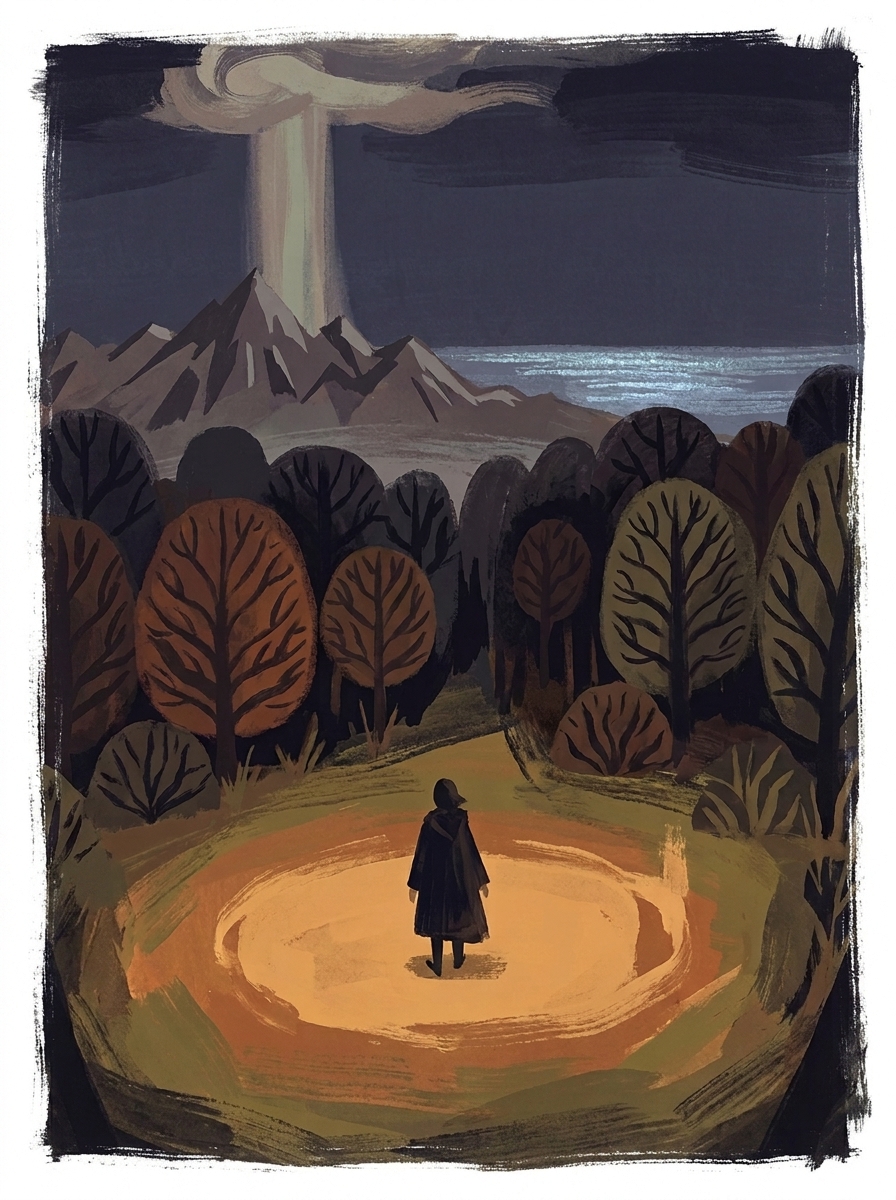
You have been in a forest that felt wrong. Not dangerous in any identifiable way. No animal threat. No visible hazard. Just wrong, in a register the body recognized before the mind could name it. The light was too diffuse. The canopy was too close. The path had disappeared into something that was not a path anymore. And the feeling arrived before the thought, as it always does with places, because places are older than thoughts.
This is not a metaphor. The brain has dedicated machinery for landscape, and that machinery produces feeling before it produces interpretation. Place cells in the hippocampus fire when you are in a specific location. Grid cells in the entorhinal cortex map the spatial structure of the environment around you. The neuroscience of place is among the best-mapped systems in cognitive science, honored by the 2014 Nobel Prize to John O'Keefe and May-Britt and Edvard Moser. And the system does not merely locate you. It evaluates. It tells you, before you have time to think about it, whether the place you are standing in is safe, dangerous, enclosed, exposed, elevated, submerged, bounded, or infinite.
Cultures elaborate on the evaluation. They name it. They ritualize it. They build on it and mythologize it and fight wars over it. But the evaluation comes first, and the evaluation is biological, and the biology is the same in every human being who has ever stood in a forest and felt the trees watching.
This series investigates the places.
The Same Ten Places
Ten sites recur across human cultures with a regularity that cannot be explained by contact or coincidence. The hearth. The forest. The mountain. The sea. The wasteland. The river. The cave. The underworld. The garden. The ruin.
Not every culture elaborates all ten equally. But the core forms, the hearth, the forest, the mountain, the sea, appear wherever humans have lived long enough to develop stories about where they live. The forms are in the wiring. The elaboration is in the culture. The interaction between the two is where the meaning lives.
The evidence converges from multiple directions. James Gibson's ecological psychology demonstrated that we do not perceive landscapes as pictures. We perceive them as affordances: what the landscape lets us do. The cliff affords falling. The cave affords shelter. The river affords drinking and drowning. The perception of what a place offers precedes any cultural interpretation of what the place means.
Yi-Fu Tuan, the geographer who coined the term "topophilia," documented that humans form attachments to specific places with an intensity and specificity that resembles attachment to persons. We love places. We grieve when they are destroyed. We fight over them with a ferocity that cannot be explained by economics alone, because the attachment is not merely economic. It is spatial. It is bodily. It is wired into the system that tells us where we are, and "where we are" is never a neutral fact.
Gaston Bachelard, in The Poetics of Space, argued that the house is not merely a physical structure but a psychological one: the rooms of the house correspond to regions of the mind, and the way we inhabit physical space is inseparable from the way we inhabit mental space. The argument extends beyond the house. Every place the species keeps returning to in story, the forest, the mountain, the cave, the sea, is a place the mind keeps returning to because the cognitive machinery that responds to it is running whether we are physically there or not.
What the Places Are Not
They are not symbols waiting to be decoded. The forest does not "stand for" the unconscious. The mountain does not "stand for" transcendence. The forest activates specific cognitive systems, reduced visibility, cover affordance, wayfinding difficulty, and the activation produces affect that cultures then interpret through whatever frameworks they have available. The affect is primary. The interpretation is secondary. The symbol is the culture's attempt to name what the brain already felt.
They are also not a ranking. The order of the series, from the hearth to the ruin, traces a walk: out from the center, across the wild horizontals, down into the depths, and back to the human-made world. But this is a journey, not a hierarchy. The hearth is not more important than the sea. The cave is not deeper in any moral sense than the mountain is high. Each place does different work, and the work is not commensurable.
And the places are not innocent. This is where the investigation gets honest.
The Cost of the Land
Sacred geography has legitimated conquest. The holy land justifies the crusade. The promised land justifies the displacement. The frontier justifies the clearing of the people who were there before the frontier arrived.
Place-attachment becomes exclusion. This is our land, not yours. The same cognitive machinery that produces the love of home produces the hatred of the outsider who threatens it. Indigenous traditions and settler nationalisms deploy the same substrate with different politics. The machinery does not distinguish.
The wilderness myth requires its woods to be empty before they can be wild. John Muir's Sierra was always inhabited. The American frontier required the legal and cultural erasure of the nations who lived on it. "Wasteland" is often what the colonizer calls land the colonizer cannot yet see how to extract from.
Architecture is power made spatial. The cathedral was built to make its occupants feel small. The open-plan office was built to make resistance visible. The prison is designed to control through enclosure. Every built place encodes a relationship between the builder and the dweller, and the relationship is rarely equal.
The series treats all of this directly. Romanticizing landscape without naming what landscape has been used for is its own kind of dishonesty.
Why It Matters
Because the machinery does not stop. The place cells keep firing. The affordance perception keeps running. The topophilia and the topophobia keep producing their evaluations whether the culture acknowledges them or not.
A culture that loses its relationship to specific places does not lose its place-machinery. It loses the framework within which the machinery did meaningful work. The suburb that flattens every landscape feature into homogenized middle ground does not make the brain stop wanting cover, prospect, refuge, and verticality. It just ensures the brain never gets them in coherent form.
The generic apartment complex is a hearth with no fire. The theme park is a forest with no danger. The infinity pool is a sea with no depth. The gated community is a garden with no wildness to bound against. The demolition site is a ruin without memory. Each is the substrate monetized into product, and the product evacuates the meaning the substrate was built to carry.
This is the pattern the series traces. Ten places. Ten kinds of work. Ten kinds of cost. And the recurring question: what happens to the species when the land beneath the story goes flat?
The Walk
The series moves from the center outward and back.
We start at the Hearth, the bounded warmth from which every other place is encountered. The fire that draws the circle. We move into the Forest, the wild that begins where the firelight ends. The Mountain, the vertical that breaks the horizon. The Sea, the boundless that overwhelms human scale. The Wasteland, the stripped ground where there is nowhere to hide.
Then the terrain turns. The River, the moving boundary that divides and connects. The Cave, the inner dark where the species first made art. The Underworld, the cosmological beneath where the dead are given somewhere to be.
We return to the human-made. The Garden, the piece of wild made deliberate. The Ruin, the made place undone by time. The series ends where it began, at the built world, but the built world now seen through everything the walk has crossed.
The coda asks what the catalogue reveals. What does it mean that the species keeps mapping these same territories? What does it cost when the map goes cheap? And what is at stake in the dwelling?
The land is beneath the story because the land was the first story. The places are durable. The ground remains. How we stand on it is partly up to us.
The question is whether we keep the dwelling honest.
That Forest Felt Wrong. Here's Why.
You've been in a forest that felt wrong. Not dangerous in any clear way. Just wrong, in a register the body recognized before the mind could name it. The light was too diffuse. The path disappeared. The feeling arrived before the thought.
This isn't a metaphor. Your brain has dedicated machinery for landscape, and that machinery produces feeling before it produces interpretation. Place cells in the hippocampus fire in specific locations. Grid cells map the space around you. The neuroscience of place won the 2014 Nobel Prize. And the system doesn't just locate you. It evaluates. It tells you whether you're safe, exposed, enclosed, or in danger, before you have time to think about it.
Cultures elaborate on that evaluation. They name it. They ritualize it. They build on it. But the evaluation comes first.
The Same Ten Places Keep Showing Up
Ten sites recur across human cultures: The Hearth. The Forest. The Mountain. The Sea. The Wasteland. The River. The Cave. The Underworld. The Garden. The Ruin.
James Gibson's ecological psychology showed that we don't see landscapes as pictures. We see them as affordances: what they let us do. The cliff affords falling. The cave affords shelter. The river affords drinking and drowning. This perception comes before any cultural story about what the place "means."
Yi-Fu Tuan documented that humans form attachments to places with the same intensity as attachments to people. We love places. We grieve when they're destroyed. We fight over them in ways economics alone can't explain.
Places Aren't Innocent
Sacred geography has justified conquest. The holy land justifies the crusade. The frontier justifies clearing the people who were already there. "Wasteland" is often what the colonizer calls land they can't yet see how to profit from.
Architecture is power made spatial. The cathedral was built to make people feel small. The open-plan office was built to make resistance visible. Every built place encodes a relationship between the builder and the dweller.
What Happens When Places Go Flat
The brain's place machinery doesn't stop. A culture that loses real places doesn't lose its need for them. It loses the framework where the need did meaningful work.
The gated community is a garden with no wildness to bound against. The theme park is a forest with no danger. The infinity pool is a sea with no depth. Each is the substrate turned into a product, and the product evacuates the meaning.
The Walk
This series moves from the center outward and back. We start at the Hearth, the fire that draws the circle. Move into the Forest, the Mountain, the Sea, and the Wasteland. Then down through the River, the Cave, and the Underworld. We return to the human-made world: the Garden, and finally the Ruin.
The coda asks what the catalogue reveals. The land was the first story. The places are durable. How we stand on them is partly up to us.