

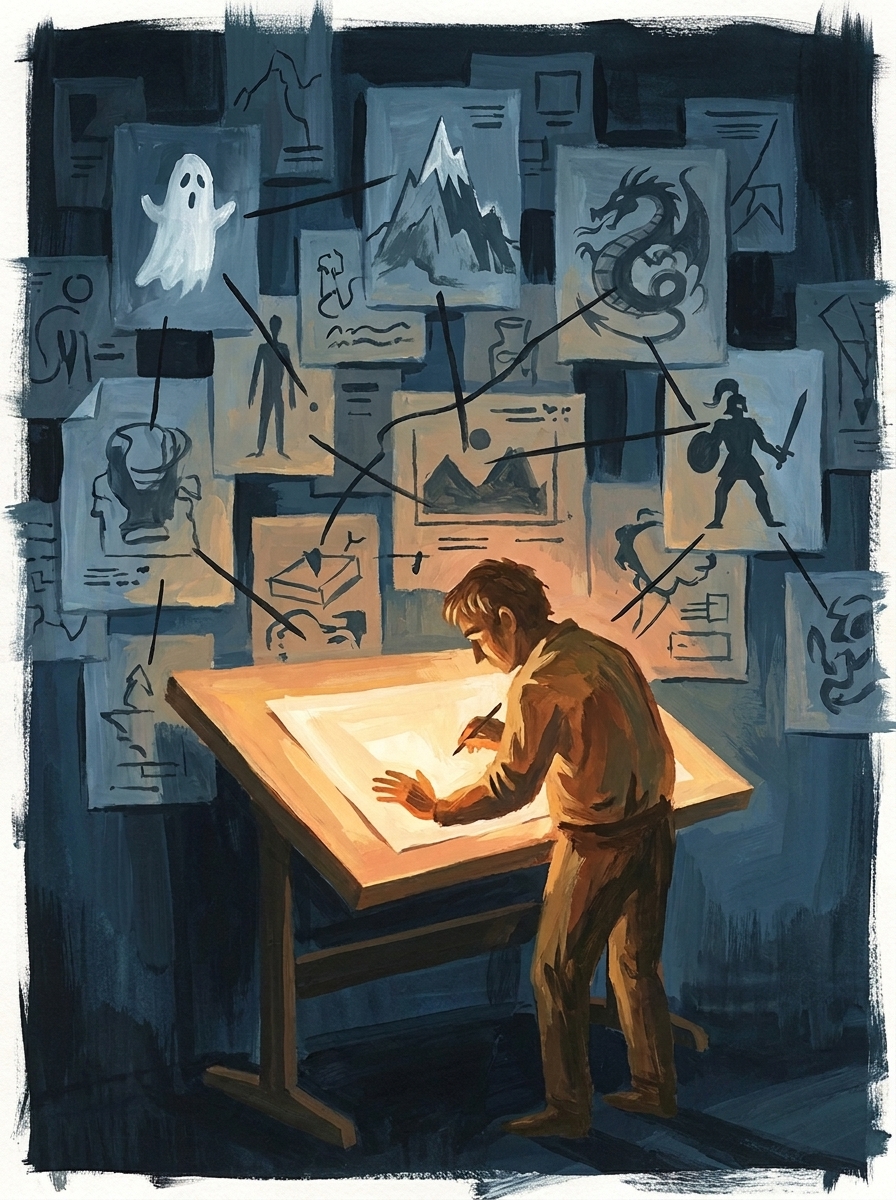
This is a framework document. It is not an essay. It does not argue a single thesis and defend it against counterarguments. It lays out the principles, methods, and convictions behind the body of work published in this theory section — a practitioner's account of what I am studying, how I approach it, and why I believe it matters to anyone who makes things for human audiences.
The premise
Every artist learns a craft. How to draw. How to compose a shot. How to shape a melody, block a scene, time a cut. The training is real and necessary. An artist who cannot execute is an artist with no voice.
But craft answers the question of how. It does not answer the question of what happens next — what occurs in the mind of the person who encounters the work. That second question is not a matter of taste or opinion. It is a matter of mechanism. When a viewer's pupils dilate at a composition, when a listener's heart rate locks to a tempo, when a reader leans forward at a narrative turn, something is happening in a specific organ, and that something can be studied.
I spent fifteen years as an art director and creative director in video games. I taught students. I sat in critiques. And I kept arriving at the same problem: the people in the room could execute at a high level, but when asked why a choice worked — why this silhouette read as threatening, why that colour palette felt sacred, why a particular story beat landed with one audience and slid past another — the answers were intuitive at best and superstitious at worst. Not because the people were incapable, but because no one had ever given them the analytical vocabulary for the question.
I used to tell my students: you think your medium is the pencil. It isn't. Your medium is the human brain. The pencil is the delivery mechanism. If you want to move people, to frighten them, to make them lean forward, to change how they see something, you need to understand the organ you are working on — not at the level of neurosurgery, but at the level of a practitioner who knows what their instrument does and why.
That understanding is what this body of work attempts to build.
The core claim
Human brains are not identical. They vary by genetics, experience, culture, language, and history. But they cluster. They gather around a mean. The variance is real and important — it is the reason cultural specificity matters, the reason the same story lands differently in Lagos and Kyoto, the reason no formula will ever replace judgement. But beneath the variance, the architecture is shared.
The same hippocampal place cells that fire when you enter a room fired in your ancestors a hundred thousand years ago. The same fusiform face area that reads a human face reads a painted one, a sculpted one, a pixelated one on a screen. The same agency-detection system that made your predecessors flinch at shadows in the grass makes a modern viewer flinch at a shape in a dark hallway in a film they know is fictional. The same prestige-detection circuitry that made a young hunter watch and imitate the best tracker in the band makes a modern reader model themselves on a character in a novel.
These systems were not designed for art. They were designed for survival, reproduction, and social coordination. Art is what happens when a maker — consciously or not — activates these systems on purpose, outside their original operating conditions, in order to produce an experience the audience could not have generated alone.
This is not a reductive claim. I am not saying that art is "just" neuroscience, or that a brain scan explains the Sistine Chapel. I am saying that a practitioner who understands the machinery has access to a layer of craft that a practitioner who does not understand it is navigating blind. A pharmacologist who understands receptor binding is not thereby reduced to a chemist. They are a practitioner with deeper knowledge of their instrument. The same applies here.
Substrate and cargo
The central distinction in this work is between what I call substrate and cargo.
The substrate is the cognitive architecture — the neural systems, the perceptual biases, the evolved heuristics that are species-wide. Agency detection. Contamination avoidance. Predator recognition. Attachment circuitry. Prestige detection. Fairness intuitions. Threshold sensitivity. Place-mapping. These are not cultural products. They are biological givens. They fire before culture can interpret them.
The cargo is everything a culture builds on top of that substrate — the specific myths, the local iconography, the particular moral framework, the historically contingent meaning a society assigns to the signal the substrate produces. The substrate explains why every culture has ghosts. The cargo explains why the ghost wears a white sheet in one tradition and appears as a flickering light in another. The substrate explains why mountains feel sacred. The cargo determines which mountain, and to whom, and what the sacredness demands.
Most cultural criticism operates exclusively at the level of cargo. It asks what the vampire means — sexuality, class anxiety, colonial guilt — and the answers are real and interesting. But they do not explain why the figure exists in the first place, why it recurs independently across cultures that had no contact with one another, or why the same structural features (predation through intimacy, asymmetric exchange disguised as reciprocity) appear in traditions separated by thousands of miles and thousands of years.
Most cognitive science operates exclusively at the level of substrate. It identifies the mechanism — cheater-detection, contagion-avoidance, the uncanny valley — and the identification is precise and testable. But it does not explain what a culture does with the mechanism, why the same cognitive output becomes a figure of worship in one society and a figure of persecution in another, or what is lost when the mechanism's cultural expression is commercially hollowed out.
This work operates at the seam. It starts with the substrate, surveys the cargo across cultures, and then asks the practitioner's question: what does this mean for someone who is making something?
The method
Each piece of work in this theory section follows a consistent approach:
Identify the cognitive seam. Every recurring figure, every sacred landscape, every narrative structure that appears across independent cultures is a candidate for substrate-level analysis. The first move is to identify the specific neural systems in collision — not "the unconscious" or "the archetype" but named, testable mechanisms. Justin Barrett's Hyperactive Agency Detection Device. Paul Bloom's intuitive dualism. Paul Rozin's contagion principle. Leda Cosmides and John Tooby's cheater-detection module. John Bowlby's attachment theory. Dacher Keltner's research on awe. James Gibson's affordance perception. The precision matters. Vague appeals to "the subconscious" are not actionable for a practitioner. Named mechanisms are.
Survey the cross-cultural evidence. If a figure or landscape or structure is genuinely substrate-driven, it should appear independently in cultures that had no historical contact. A single culture's version proves nothing except that one culture produced it. Five independent versions — separated by geography, language, and era — begin to indicate shared architecture. The survey is not decorative. It is the evidence.
Separate substrate from cargo. For every cross-cultural instance, distinguish what is structurally consistent (the substrate) from what is locally specific (the cargo). The ghost is always a mind-model that persists after the body's death — that is substrate. Whether the ghost is vengeful, benevolent, ancestral, or demonic — that is cargo. The mountain always produces awe through vertical effort and exposed summit — that is substrate. Whether the mountain is where God delivers law, where the gods live, or where the emperor demonstrates sovereignty — that is cargo.
Name the shadow. Every figure, every place, every narrative structure has been weaponized, gendered, suppressed, or commercially hollowed. The warrior tradition sends people to die. The founder's story covers a murder. The sacred mountain legitimates territorial conquest. The garden was built on evicted tenants. To study these figures without naming their costs is to produce propaganda, not understanding. The honest account is not an appendix. It is a structural requirement.
Extract the craft principle. The final move is the one that makes this a practitioner's framework rather than an academic exercise. What does this substrate-level understanding mean for someone building a monster, writing a hero, designing a landscape, scoring a scene? What is the diagnostic for whether the figure is doing its work — carrying its full cognitive and emotional payload — or has been defanged into decoration? This is the question that justifies the entire investigation. Without it, the work is scholarship. With it, the work is a set of tools.
What this is not
This is not a formula. There is no algorithm that converts cognitive science into effective art. The substrate constrains the possibility space; it does not dictate what to build within it. Understanding that the brain's agency-detection system produces ghost-percepts in conditions of grief and darkness does not tell you how to write a ghost story. It tells you what the ghost story is working on — which systems it activates, what emotional and cognitive operations it triggers, what it protects when it is done well and what it loses when it is defanged. The craft decision remains yours. The framework gives you a map of the territory your decisions operate in.
This is not audience optimization. I am not advocating for A/B testing, market research, or the reduction of creative work to engagement metrics. The commercial creative industries formalized parts of this knowledge under economic pressure, and some of what they built is genuinely useful. But the goal here is understanding, not conversion rates. Understanding what the brain does with a mountain is not the same as designing the mountain that performs best in a focus group. The distinction matters, and I hold it seriously.
This is not a replacement for craft, for vision, or for lived experience. An artist who understands every cognitive mechanism in this framework but cannot draw, cannot write, cannot compose, and has nothing to say will produce nothing of value. The framework is a third layer — beneath craft (the how) and above content (the what) — that addresses the question most art education has decided to leave unanswered: what happens in the mind on the other side?
And this is not Jung. The collective unconscious is a metaphysical claim about a shared psychic reservoir that produces archetypal images. The substrate claim is a biological one about shared neural architecture that produces predictable outputs. The distinction is not pedantic. Jung's archetypes cannot be tested. Cognitive mechanisms can be. Barrett's agency-detection research generates falsifiable predictions. Rozin's contagion experiments are replicable. Keltner's awe studies produce measurable physiological signatures. The framework I am building stands or falls on evidence, not on faith in a psychic commons. Where the evidence is strong, I follow it. Where it is weak or contested, I say so.
What this affords
A practitioner who works with this framework gains three things.
Diagnostic language. When a piece of work fails to land — when the monster isn't frightening, the hero isn't compelling, the landscape doesn't resonate — the framework provides a vocabulary for asking why at the level of mechanism rather than taste. The ghost story fails because it does not give the audience's person-tracking system a model to keep running. The hero falls flat because the prestige-detection system has nothing to calibrate against — no cost, no weight, no credential earned through suffering. The landscape feels generic because the place-mapping system has no affordances to evaluate. These are actionable diagnostics. They point to specific craft decisions that can be revised.
Cross-cultural fluency. The substrate-cargo distinction allows a practitioner to work across cultural contexts without either flattening difference (assuming what works in one culture works everywhere) or retreating into relativism (assuming nothing can be said across cultures). The substrate is shared; the cargo is specific. A practitioner who understands both can make work that engages the universal machinery while respecting the local meaning — or can deliberately transgress the local meaning with full awareness of what they are doing and what it will cost.
A defence against hollowing. The most commercially successful creative industries in the world are systematically stripping these figures of their payloads — keeping the aesthetic of the monster, the hero, the sacred place, while removing the cognitive and emotional weight that made them functional. The romantic vampire. The comedy ogre. The franchise warrior who kills without cost. The infinity pool that harvests awe four feet deep. A practitioner who understands what these figures are for — what neural systems they engage, what cultural work they perform, what is lost when the teeth are filed down — is a practitioner who can resist the pressure to hollow, not out of nostalgia but out of an informed understanding of what the hollowing removes.
The work so far
The theory section of this site currently contains three major works and a growing collection of standalone essays, all built on this framework.
Filling the Dark maps ten monster archetypes — ghost, shapeshifter, revenant, vampire, witch, ogre, trickster, drowner, demon, dragon — to the specific cognitive systems that produce them. It argues that these figures are not cultural reflections of passing anxieties but cognitive byproducts that do protective work, and that commercially defanging them silences the alarms they were built to carry.
Chosen Shapes maps ten hero archetypes — warrior, founder, healer, underdog, trickster, sage, lover, sacrificer, renunciate, returner — to the prestige-detection, coalition-cognition, and mortality-salience systems that produce them. It argues that the shapes are permanent features of the cognitive landscape, that no culture can choose not to have heroes, and that the only question is whether the figures that fill the slots are carrying their full weight or have been hollowed into franchise products.
The Land Beneath Story maps ten landscape archetypes — hearth, forest, mountain, sea, wasteland, river, cave, underworld, garden, ruin — to the place-mapping, affordance-perception, and spatial-cognition systems that make them inevitable. It argues that these places are not symbols but activators of specific neural systems, and that the modern world is systematically homogenizing them into consumer experiences that trigger the response while evacuating the meaning.
The standalone essays extend the framework to specific questions: what happens when art education excludes this knowledge, how belief-feeling operates in an attention economy, whether cooperative narratives invert the real mechanisms of collective power.
The project is ongoing. The framework is not finished. But the foundation is laid, and everything published here is built on it.
An invitation
I am not an academic. I am a practitioner — an art director, a creative director, a maker of things intended to work on human minds. The framework I have described here was not assembled in a university. It was assembled in production pipelines, in critique rooms, in the gap between what I could execute and what I could explain. I built it because I needed it, because the knowledge existed in scattered form across disciplines that do not talk to one another, and because no one had assembled it into a form that a working artist could use.
If you make things — if you write, paint, design, compose, direct, build worlds, tell stories — the work on this site is for you. Not as a set of rules. Not as a formula. As a map of the instrument you are already playing, drawn by someone who spent a career wondering why no one had drawn it before.
The medium is the mind. Learn the instrument.