

The College Art Association publishes the guidelines that govern the Master of Fine Arts -- the terminal degree in studio art, the highest credential a practising artist can earn in the United States. The document requires "advanced professional competence" in studio practice, "critical skills that pertain to meaning and content," coursework in art history and visual culture, and the development of verbal and written abilities. Search the text for the word "audience." It does not appear. Not once. Search for "reception," for "semiotics," for "cognitive," for "psychology." Nothing. The governing document for the profession's highest credential does not ask, even in passing, whether the graduate understands what happens in a viewer's mind when they encounter a piece of work.
I want to sit with that fact before explaining why it matters, because it is easy to read it as a bureaucratic quirk -- a gap in the language of a standards body, not a gap in the education itself. But the absence is not accidental. Carol Wild, writing in the International Journal of Art and Design Education in 2024, argues explicitly that the approaches of cognitive science are "at odds with" art education as an aesthetic, social, and material practice. The exclusion is not an oversight. It is a position.
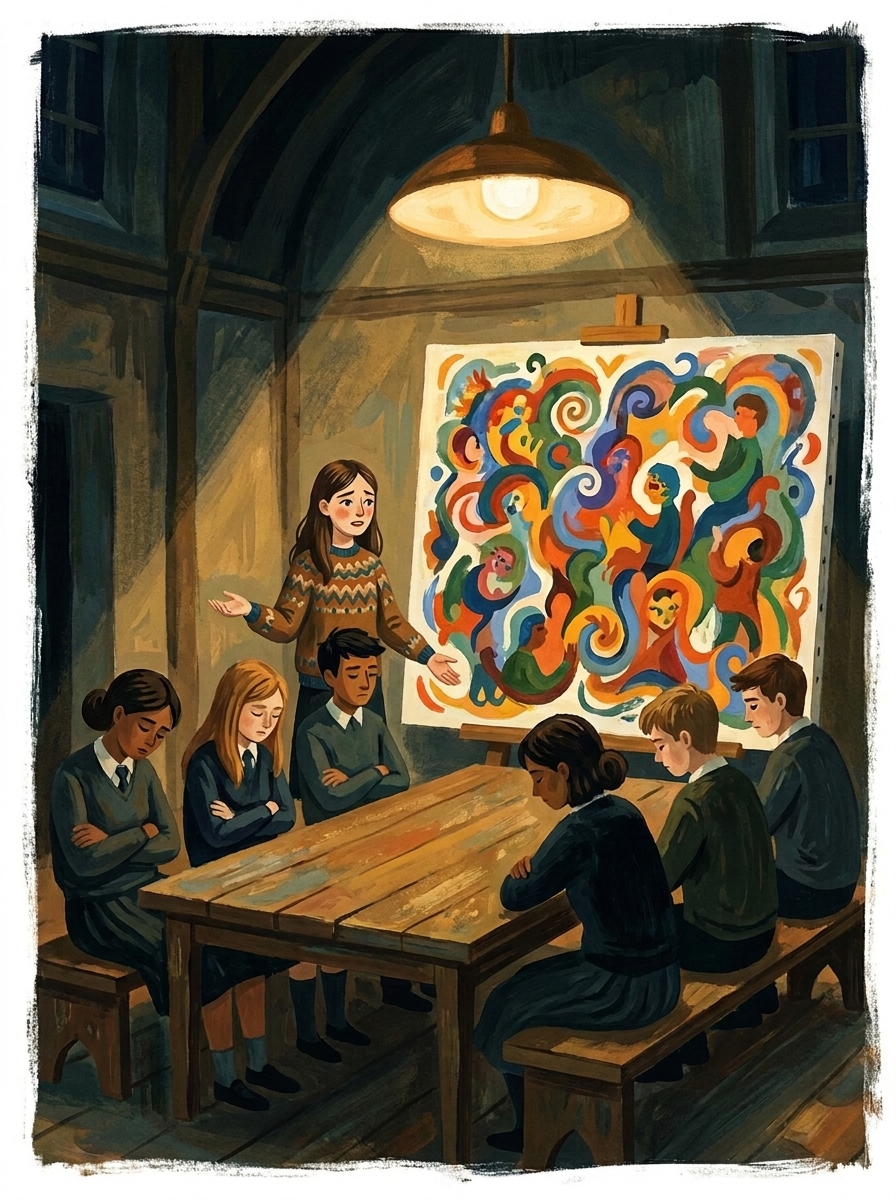
And that position has consequences for people whose lives are shaped by it. Consider a twenty-eight-year-old, two years into an MFA, carrying forty thousand dollars a year in tuition debt. Her days revolve around studio time and weekly critiques. She can paint. Her craft is real. She has lived enough to have things she needs to say. But when she presents her work to her cohort, the room drifts into what the critic Brad Troemel has described as silence and vague commentary. Not because her peers are indifferent or unkind, but because no one in that room has ever been given a shared vocabulary for explaining why a representational choice lands with one person and slides past another. She can execute. She has material. What she has never been taught is the bridge between her intention and her audience's reception -- the systematic understanding of how signs, forms, and narratives produce meaning in minds that are not her own.
That bridge is what I want to talk about: the body of knowledge that sits at the intersection of semiotics, cognitive science, and cultural psychology, that addresses directly and empirically how representational choices function, and that formal fine-art education has decided, on principle, not to teach.
To argue that such a body of knowledge exists, I need to show that three scholarly traditions converge on a single phenomenon in a way that is more than coincidental.
Start with semiotics. From Peirce and Saussure through Barthes and Eco, the semiotic tradition has built a grammar of how signs combine to produce meaning. Barthes's 1967 essay on authorship made the core claim: meaning resides not in the maker's intention but in the reader's decoding. That is a claim about the system of signification -- about the structure of the bridge itself, not about the craft of building it or the life experience of the builder. Scott McCloud's Understanding Comics, published in 1993, extended this grammar to visual representation with a precision that made it teachable: iconic versus realistic rendering, closure, masking, the spectrum of abstraction. McCloud demonstrated that no visual decision is neutral, that every representational choice activates a specific set of cognitive operations in the viewer, and that these operations can be mapped, discussed, and learned.
Now add the empirical layer. Paul Zak's neuroscience laboratory at Claremont Graduate University measured what happens in the body when narrative structure does its work. Participants exposed to stories with dramatic arcs showed increased oxytocin and ACTH -- and those whose neurochemistry responded most strongly donated 261 percent more to charity than control groups. The finding that matters most, though, is the one that undermines the idea that artists can simply intuit their way to communicative power: Zak's subjects could not accurately articulate what they liked. The mechanisms of narrative engagement operate below conscious access. You cannot introspect your way to understanding them. At Princeton, Uri Hasson's neural coupling research showed that storyteller and listener brain patterns align in real time, with the strength of that alignment predicting how deeply the listener encodes the experience into memory. These are not metaphors. They are measurements.
The third tradition -- cultural psychology and reception theory -- explains why the same representational choice resonates differently depending on who encounters it. Reception theory, developed through the work of Iser and Jauss and extended by H.H. Clark's research on audience design and common ground, holds that a text's meaning emerges through the reader's interaction with it, shaped by cultural background, historical moment, and the knowledge the reader brings. Effective communication requires modelling the receiver's knowledge state -- a cognitive operation that is analytically distinct from both the craft of execution and the content of personal experience.
Three traditions. Different methods. Different institutional homes. But a single object of study: the mechanism by which representational choices produce effects in human minds. When a body of knowledge possesses its own object, its own methods, and a literature that cannot be reduced to either craft manuals or autobiography, it starts to look like a discipline.
The obvious objection is that it does not look like one yet -- not institutionally. No university department is called "Audience Resonance Analysis." No professional association unites the semiotician, the neuroscientist, and the cultural psychologist under a single banner. The Johns Hopkins neuroaesthetics course launched in Fall 2024 is housed in the neuroscience department, not in a freestanding interdisciplinary unit. What we have, the argument goes, is three fields in a trench coat: an artificial agglomeration with topical overlap but no methodological core.
I take this objection seriously because it is partially right. The institutional infrastructure is nascent. The convergence is real but incomplete. And it would be dishonest to claim that a fully unified discipline already exists with the kind of shared standards and professional community that, say, cognitive science has today.
But cognitive science is exactly the precedent that makes the objection interesting rather than fatal. Before the 1970s, cognitive science did not exist as a discipline. It was philosophy, psychology, linguistics, neuroscience, and computer science -- five fields with different epistemologies and different methods, sharing nothing except a conviction that they were all studying the same thing: the mind. The discipline emerged not because someone designed it from a blueprint but because practitioners in each field noticed that their findings kept converging. The institutional label caught up to the intellectual reality. Ernst Gombrich's Art and Illusion was doing exactly this convergence work in 1960, combining art history with perceptual psychology to ask how pictorial representation functions in the viewer's mind. Kendall Walton's Mimesis as Make-Believe did it in 1990, analysing how representations serve as cognitive props that prescribe specific imaginings. The convergence around audience resonance has been building for decades. The question is not whether it is real -- even sceptics tend to concede the topical overlap -- but whether it will consolidate the way cognitive science did. I think the commercial creative industries have already answered that question.
In games, the answer is a job title. Games User Researcher. It is formally distinct from Game Artist and from Game Programmer. It requires different training -- cognitive psychology, human-computer interaction, behavioural research methods -- and involves different daily work: running playtests, analysing player behaviour, measuring where attention lands and where it drops. The field is explicitly defined as "a discipline of science and design for overcoming the difficulties in making games that deliver on their experiential intent." At DigiPen, you can study it. At Player Research, you can practise it. At Epic Games, Celia Hodent built an entire UX practice grounded in cognitive psychology that was essential to Fortnite's ability to communicate its systems to millions of players -- a role requiring no art-craft skill but deep knowledge of how representational choices produce effects in minds.
In film, Pixar brought psychologists and gesture experts into their pipeline to teach animators how audiences read facial expressions and eye movements -- supplementing world-class craft with a distinct analytical layer about reception. At the American Film Institute, the screenwriting curriculum teaches "character, relationship, and depth psychology" alongside dramaturgical models. These are not craft courses. They are courses in understanding why specific narrative structures produce specific emotional responses in specific audiences.
In UX design more broadly, the discipline has been codified for years: empathy mapping, user research methodologies, design thinking -- all centred on modelling how the person on the other side of the screen will experience the choices the designer has made.
These are separate job titles, separate hiring pipelines, separate professional communities. The commercial creative industries did not invent the knowledge. They formalised it, because economic pressure forced the question: does this representational choice actually work for the audience we are trying to reach? Fine art has no equivalent pressure, which is part of its freedom and part of its problem. The discipline exists wherever the stakes of miscommunication are high enough to demand it. In fine-art education, the stakes have never been counted.
Now, there is a strong counterargument that I want to give full space, because it is not wrong about everything and it gets at something genuinely important about what art education is for.
The counterargument goes like this: artistic maturity is not a single competency. It is the integration of multiple capacities -- craft mastery, experiential depth, critical self-awareness, the formation of an authorial voice, and yes, some understanding of how work communicates. But to isolate one of these capacities and call it "the defining discipline" is to commit a category error. No serious account of artistic maturity privileges one dimension over all others. An artist with perfect audience-resonance analysis but no personal vision, no craft skill, and no experiential depth would not be called artistically mature. They would be called a market researcher.
This is a real objection and not a straw man. Research on artistic development consistently identifies maturity as multidimensional -- involving compositional thinking, temporal awareness, the accrual of life experiences that feed the work. The strongest version of this argument does not deny that audience understanding matters. It denies that it matters more than everything else. And it suggests that what I am really advocating is not the identification of a single defining discipline but rather a curriculum reform: arts education should teach more about how work communicates, alongside the craft and critical theory it already teaches. That is a reasonable position, and I want to be honest about the degree to which I agree with it.
I do think artistic maturity is multidimensional. I do not think a single analytical capacity exhausts what it means to be a mature artist. If the claim were that audience-resonance analysis is the only thing that matters, I would not make it.
But here is where the counterargument, for all its reasonableness, misses something that changes the calculation. Craft improves through practice. Every hour in the studio compounds. Lived experience accumulates whether or not it is taught -- the twenty-eight-year-old will be fifty regardless of her programme. Neither craft nor experience depends on formal education for its existence; education accelerates them, but their acquisition is not contingent on curriculum. The systematic understanding of how representational choices produce effects in minds is different. Zak's research demonstrates that the mechanisms operate below conscious access. You cannot introspect your way into semiotics any more than you can introspect your way into pharmacology. If you are never taught it, you are unlikely to stumble into it.
That asymmetry matters. When you have a system that requires three inputs and the educational pipeline supplies two while systematically excluding the third, the excluded input becomes the binding constraint -- not because it is ontologically superior, but because it is the one whose absence is hardest to remedy. The strongest version of the counterargument concedes that arts education could do more. It concedes that the knowledge is genuine. It concedes that the MFA candidate is real and underserved. What it disputes is the hierarchy. But a hierarchy of absence is not the same as a hierarchy of importance. The question is not which capacity matters most in the abstract. The question is which capacity, if left out of the curriculum, is least likely to be acquired any other way.
There is a second counterargument that deserves real engagement, and it is the one that genuinely makes me uncomfortable. It runs like this: the history of art's most significant ruptures -- Impressionism, abstraction, punk, the entire tradition of the avant-garde -- consists of work that initially failed every available test of audience resonance. The Paris Salon rejected the Impressionists. The first audiences for abstract expressionism were bewildered. Punk violated every principle of musical audience appeal. If these artists had been systematically trained to understand and optimise for audience reception, the innovations might never have occurred. A pedagogy that teaches artists to close the gap between intention and reception is a pedagogy that selects against the art that creates new gaps no one knew existed.
I feel the force of this argument. The freedom to make work that does not yet have an audience, that does not yet make sense, that fails on every metric currently available -- that freedom is constitutive of what makes art valuable. Any account of artistic education that does not protect it is deficient.
But the argument has a structural flaw that becomes visible when you look at the actual artists it invokes. Picasso painted Les Demoiselles d'Avignon in 1907 -- a canvas so confrontational that even Georges Braque, his closest ally, reportedly felt as though Picasso were asking him to drink gasoline. The painting failed every test of audience resonance available. But Picasso did not make it in ignorance of how visual representation works. He had spent years studying African masks and Iberian sculpture -- specifically studying how their formal distortions produce psychological effects in viewers, how they operate as semiotic systems across cultural contexts. He understood the grammar of visual shock. He chose to violate audience expectations with precision, not with naivety. Understanding how representational choices function does not compel an artist to confirm expectations. It enables an artist to transgress them with purpose. A pharmacologist who understands how drugs bind to receptors is not thereby compelled to prescribe every drug indiscriminately. Understanding is not optimisation.
The avant-garde counterargument assumes that teaching artists about audience reception would nudge them toward conformity. But the mechanism by which analytical knowledge produces conformity has never been specified. Craft training can produce formulaic technicians. Lived experience can produce narcissistic confessional art. Every form of knowledge carries the risk of misuse. The risk does not invalidate the knowledge. It is an argument about pedagogy -- about how to teach the material well -- not an argument against the material's existence or importance.
I am less certain about this than I am about the curricular gap itself. I can see a version of the argument where institutional incentives -- enrollment metrics, exhibition success, job placement rates -- would reward artists who optimise for legibility, creating a systemic pressure toward conformity even if individual artists resist it. Art has no objective standard of quality equivalent to medicine's standard of health, which means audience reception might exert gravitational pull in ways that are harder to counteract. This is a genuine concern. But it is a concern about implementation, not about the underlying knowledge. And it seems strange to argue that the correct response to a risk of misuse is permanent ignorance.
There is one more tension I want to name honestly, because it cuts at the question of whether what I am describing is really a single discipline or simply a useful collection of insights from several disciplines.
A semiotician doing close reading of Barthes, a neuroscientist running fMRI scans, and a cultural psychologist conducting ethnographic fieldwork are not doing the same thing. Their methods are different, their standards of evidence are different, their professional communities rarely overlap. To call their combined output a single discipline is, at minimum, a stretch. It might be more accurate to say that what I am advocating is interdisciplinary training -- a curriculum that draws from multiple established fields to address a question that none of them fully answers alone.
I think that is fair. And I think the distinction between "a discipline" and "an interdisciplinary training programme" matters less than it might seem. What matters is whether the knowledge is real (it is), whether it is teachable (the commercial creative industries have demonstrated that it is), and whether formal fine-art education currently teaches it (the CAA guidelines confirm that it does not). Whether we call the result a new discipline or a well-designed interdisciplinary curriculum, the practical upshot is the same: something coherent and important is missing, and its absence has consequences.
The consequences are most visible in that weekly critique session. The MFA candidate presents her work. Her peers and faculty respond, because studio critique is, in theory, a form of audience feedback. But there is a categorical difference between exposing a student to reactions and teaching a student to systematically analyse, predict, and design for reactions. A medical student who observes patients recovering is not studying pharmacology. A music student who notices that audiences applaud after certain pieces is not studying psychoacoustics. Exposure to audience response, without analytical tools for understanding the mechanisms behind that response, produces anecdotes. It does not produce knowledge.
Brad Troemel's documentation of MFA critiques collapsing into silence is not evidence that the students are unintelligent or the faculty incompetent. It is evidence that the analytical vocabulary for discussing representational resonance has never been part of the curriculum. The infrastructure for that vocabulary exists -- in Gombrich, in McCloud, in Zak, in reception theory, in the formalized practices of games user research and narrative psychology. It exists in scholarship. It does not exist in pedagogy. And the distance between those two facts is the distance the MFA candidate crosses alone, if she crosses it at all.
I keep returning to the asymmetry, because it is the thing that survives every counterargument I can mount against my own position. Craft can be refined at any career stage. Experience accumulates with living. But the systematic understanding of how representational choices function in minds that are not your own -- that does not emerge from practice, does not arrive with age, and does not follow from having something important to say. It follows from studying a body of knowledge that three scholarly traditions have been building for over a century, that the commercial creative industries have formalized into professional roles, and that the institutions responsible for training artists have decided to exclude.
The exclusion is not a mystery. Wild's 2024 paper names the logic directly: cognitive science's emphasis on measurement and replicable outcomes feels foreign to the aesthetic, exploratory ethos of art education. There is something to that concern. Art education should protect the space for work that is not yet legible, not yet successful, not yet understood. But protecting that space does not require enforcing ignorance about the mechanisms of legibility itself. The two commitments -- to artistic freedom and to analytical understanding -- are not in tension unless you believe that knowledge inevitably constrains action. If you believe that, you should advocate for removing art history from the curriculum too, since knowing what has been done might constrain what an artist attempts next. No one makes that argument. The selective application of the constraint-through-knowledge theory to audience-resonance analysis, and only to audience-resonance analysis, suggests that the resistance is not principled but territorial.
What the MFA candidate needs is not to be told what her audience wants. She needs the vocabulary to understand what her representational choices do -- how they function as signs, how they activate cognitive processes, how they land differently across cultural contexts. She needs, in short, to be literate in the one dimension of her practice that her education has decided is someone else's problem. Whether we call that literacy a discipline, a training programme, or simply an overdue correction to a curriculum that has not been updated since the atelier model was filtered through postwar conceptualism, the name matters less than the fact. The knowledge exists. The need exists. The gap between them is a choice -- and it is a choice that the people most harmed by it were never asked to make.
You Already Know This Feeling
You show someone your work. You spent months on it. You know it's good. And the room goes quiet. Not because they don't care. Because nobody can explain what's happening between the thing you made and the person looking at it.
This happens every week in MFA programs across the country. A student shows a painting. The group stares. Someone says it's "interesting." Someone else says they "like the color." Then silence. Not because the students are dumb. Because nobody ever taught them the words for what they're actually trying to talk about.
Here's the thing: there's a whole body of knowledge about how art lands in people's brains. Scientists study it. The games industry uses it daily. Film studios hire people for it. But art schools? They've decided not to teach it.
Three Fields, One Blind Spot
Let me break this down.
There are three areas of study that all point at the same question: why does a specific creative choice hit one person hard and bounce off another?
Semiotics is about how signs and images carry meaning. A skull means danger. A warm color feels safe. These aren't random — they're patterns in how humans decode what they see. Scott McCloud mapped this for comics in the 1990s. He showed that every visual choice — how realistic a face looks, how much you show vs. hide — triggers a specific response in the viewer's brain. None of it is neutral.
Cognitive science adds hard data. Paul Zak's lab found that stories with dramatic arcs cause your brain to release oxytocin — the chemical tied to empathy and trust. People who had the strongest response gave 261% more to charity. But here's the kicker: those same people couldn't explain why they were moved. The reaction happened below their awareness. You can't just feel your way to understanding this.
Cultural psychology explains why the same image means different things to different people. Your background, your era, what you've already seen — all of it shapes how you read a piece of art. A cross means one thing in a church and something else in a horror film. Knowing your audience means knowing what they bring with them.
Three fields. Different tools. Same question.
The Game Industry Already Figured This Out
If this stuff sounds abstract, look at who's already using it.
In the games industry, there's a job title called Games User Researcher. It's not the same as Game Artist. Different training, different skills. These people run play tests, track where players look, measure where attention drops. Celia Hodent built Epic Games' entire UX practice on cognitive psychology. She can't draw a game character. She doesn't need to. Her job is understanding what happens in the player's mind — and that skill helped make Fortnite work for millions of people.
Pixar brought in psychologists to teach animators how audiences read facial expressions. Not to replace craft. To add a layer of understanding on top of it.
Film schools teach this too. The American Film Institute includes depth psychology and audience response in its screenwriting program. These aren't art classes. They're classes about why stories work.
So the knowledge exists. It's teachable. Entire industries depend on it. But walk into an MFA program and you won't find it on the syllabus.
The Best Argument Against This
I want to be fair about the pushback, because the strongest version isn't wrong about everything.
The argument goes like this: artistic maturity isn't one thing. It's a mix. Craft skill. Life experience. A personal voice. The ability to reflect on your own work. And sure, some sense of how your work lands. But you can't pull out one piece and call it "the thing." An artist with perfect knowledge of audience response but nothing to say and no skill to say it with isn't a mature artist. They're a market researcher.
That's a real point. I don't think one skill is all that matters.
But here's where it breaks down. Craft gets better with practice. You paint more, you get better. Life experience comes whether you want it or not — you'll be forty, then fifty, and you'll have more to draw on. Neither of those depends on school. Education speeds them up, but they happen anyway.
The audience stuff? It doesn't work that way. Zak's research shows the mechanisms are invisible to you. You can't stumble into semiotics the way you stumble into heartbreak. If nobody teaches it to you, you probably won't learn it.
That's the gap that matters. Not because audience knowledge is more important than craft or experience. Because it's the one you can't pick up on your own.
But What About the Rebels?
There's another objection, and it's the one that keeps me honest. The history of art is full of work that bombed with its first audience. The Impressionists got rejected. Abstract art confused people. Punk broke every rule of what sounds good. If those artists had been trained to understand and design for audience response, would they have made the same leaps?
I feel the pull of that argument. Art needs the freedom to fail. To confuse. To not make sense yet.
But look closer at the example. Picasso didn't paint Les Demoiselles d'Avignon out of ignorance. He'd spent years studying African masks — studying how their distortions create shock, how they work as visual systems across cultures. He understood the grammar of what he was breaking. He chose to break it on purpose, not by accident.
Understanding how your choices affect viewers doesn't force you to give them what they want. It lets you challenge them with precision. A doctor who knows how drugs work isn't forced to prescribe everything. Knowledge isn't the same as obedience.
The Gap Is a Choice
The College Art Association writes the rules for the MFA — the highest degree a studio artist can earn. The word "audience" doesn't appear in those rules. Not once. Neither does "reception," "semiotics," "cognitive," or "psychology."
This isn't an accident. A 2024 paper in the International Journal of Art and Design Education argues openly that cognitive science is "at odds with" art education. The exclusion is a position, not an oversight.
But here's what sits wrong with me about that position. Nobody argues that teaching art history constrains artists. Nobody says that knowing what came before you will stop you from making something new. So why would knowing how your choices land in someone else's brain be any different?
The MFA student I started with doesn't need to be told what her audience wants. She needs the vocabulary to understand what her choices do. How they work as signs. How they activate something in a viewer's mind. How they hit differently depending on who's looking.
That knowledge exists. The need exists. The fact that art schools have decided to leave the gap open? That's a choice. And it's a choice the people most hurt by it never got to make.