

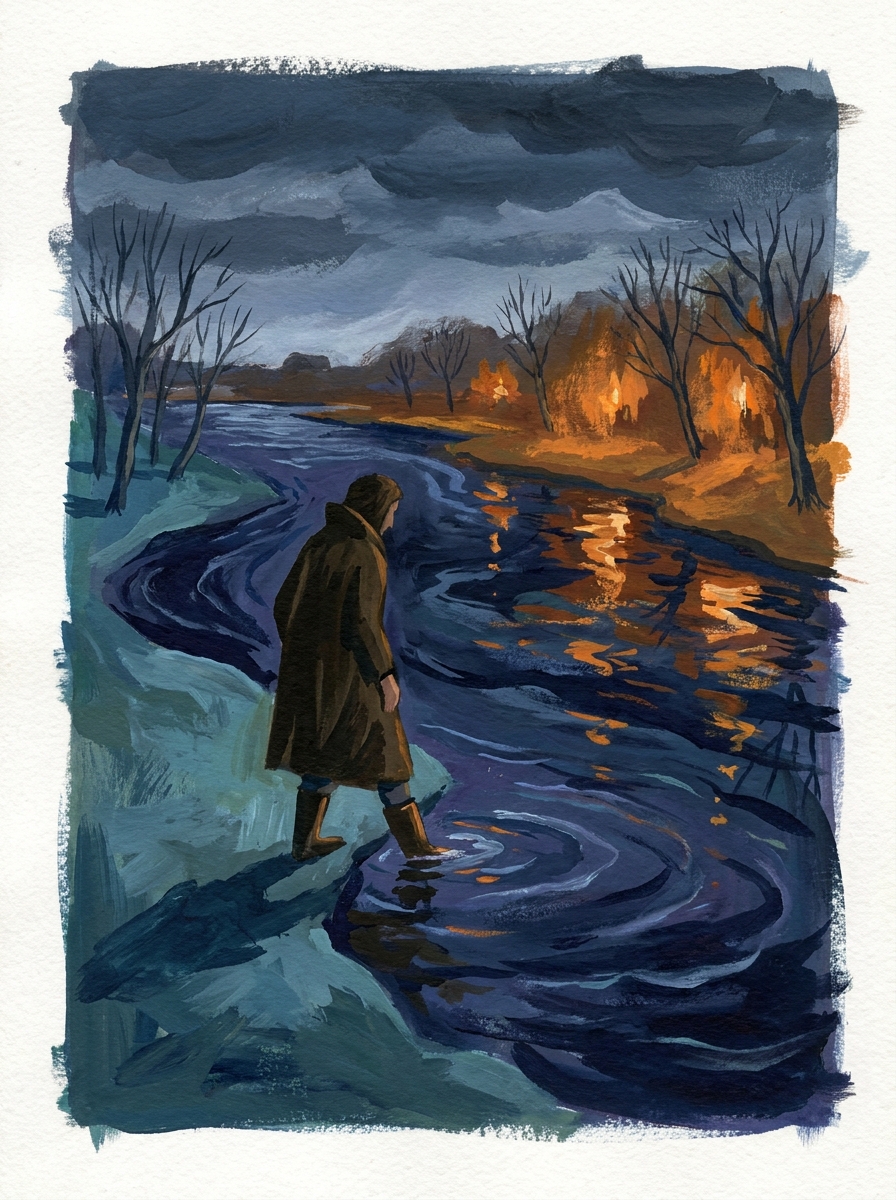
The Rubicon was, by every geographical measure, a minor stream. Shallow enough to ford. Narrow enough to cross in minutes. Strategically insignificant as a defensive position. Caesar crossed it in January of 49 BCE, and the crossing ended the Roman Republic. Not because the river was difficult to cross. Because the river was a boundary, and the crossing of it could not be uncrossed.
Rivers are the places that divide and connect simultaneously. The same water that marks the border between two nations also carries goods between them. The same current that drowns the swimmer also moves the boat. The river is the place in the catalogue where the line between separation and passage is thinnest, where the threshold is not a gate you walk through but a flow you commit to.
The Substrate
Linear water perception is the cognitive foundation, and it differs from the perception of lakes, oceans, and rain in specific ways. A river has direction. It has a source and a terminus. It moves. The brain reads the movement and assigns it meaning: the river is going somewhere, and the going-somewhere produces a sense of narrative that standing water does not. Lakes are static. Oceans are vast. Rivers have plots.
Threshold cognition activates at rivers more reliably than at any other natural feature except cave mouths. The brain reads the far bank as categorically different from the near bank, even when the two banks are ecologically identical. The distinction is spatial, not rational. The river creates a cognitive boundary by the simple mechanism of being difficult to cross, and the difficulty converts the spatial gap into a conceptual one. The people on the other side of the river are, by that fact alone, slightly more "other" than the people on this side.
Drinking-water perception provides the life-source dimension. The brain evaluates water sources with a precision that reflects the species's absolute dependence on them. A moving stream is evaluated as safer than standing water, a heuristic that is generally correct and that produces the positive valence most people feel toward flowing water. The sound of running water, which activates auditory-spatial mapping and is used therapeutically for stress reduction, is the perceptual signature of a resource the brain treats as essential.
The dual function, life-source and death-passage, is built into the river's cognitive profile. Rivers drown people. Rivers have been used for the disposal of the dead across many cultures. The same water that sustains the living carries the dead away, and the dual function produces a cognitive complexity that no other single landscape feature matches. The river is the place where the life-giving and the death-carrying share a channel.
The Exemplars
The Ganges is the river as sacred mother. In Hindu tradition, the Ganges is not merely a river. It is Mother Ganga, a goddess whose waters purify the living and release the dead. The cremation ghats of Varanasi, where the bodies of the dead are burned and their ashes given to the river, represent the river's dual function at full intensity: the water that sustains the living also receives the dead, and the receiving is understood not as pollution but as purification. The Ganges is the river as cosmological hinge, the point where the living world and the world of the dead share a medium.
The Nile is the river as civilization's condition. Egyptian culture was the Nile, in a way that is not metaphorical. The annual flood deposited the silt that made agriculture possible. The rhythm of the flood organized the calendar, the tax system, the religious festivals, and the political structure of the state. When the flood failed, the state weakened. When the flood was strong, the state prospered. The Nile demonstrates that some rivers are not features of a landscape. They are the landscape, and everything else is arranged around them.
The Styx is the river as ultimate boundary. In Greek cosmology, the Styx separates the world of the living from the world of the dead. Charon ferries the souls across. The fare is a coin placed on the tongue. The crossing is one-way for most travelers, and the one-way quality is what makes the Styx the most potent version of the river-as-threshold: the boundary you cross and do not cross back. Every culture's death-river carries this weight. The Japanese Sanzu-no-Kawa, the Hindu Vaitarani, the Welsh river of forgetting in Annwn: each is the same cognitive shape, the river as the point of no return.
The Mississippi in American literature is the river as the nation's spine. Twain's Mississippi is the medium through which the country's central contradictions, freedom and slavery, settlement and wilderness, innocence and knowledge, are conducted. The river moves. The raft moves with it. The characters on the raft encounter the nation as the current delivers it, one bend at a time. The river here is not a setting. It is a method. The flowing is how the narrative works.
The Rhine and the Rio Grande are rivers as political boundaries, and their status reveals the intersection of cognitive and political threshold-making. The Rhine divided Roman from Germanic territories for centuries. The Rio Grande divides the United States from Mexico today. In both cases, the river's natural function as a cognitive boundary is recruited for political purposes, and the recruitment feels natural because the brain already treats the far bank as other. The political border inherits the cognitive border's authority.
The Variations
The life-source river and the boundary river are the same water performing different work. The Nile is the river you depend on. The Styx is the river you cross. The Ganges is both simultaneously, which is part of why the Ganges is the world's most cognitively dense river: it carries the life-source, the boundary, and the death-passage functions in a single body of water.
The journey river is the river as narrative structure. The Odyssey is a sea journey, but Huckleberry Finn is a river journey, and the difference matters. The sea journey is about exposure and vastness. The river journey is about encounter: the current delivers new territory in sequence, and the sequence is the story. The river journey has a direction that the sea journey does not, and the direction produces a different kind of narrative. The river tells you which way the story goes.
The flood river is the river as catastrophe. The Yangtze, the Tigris, the Mississippi at intervals: these are rivers that exceed their boundaries, and the exceeding is experienced as a violation of the agreement the culture thought it had with the water. The flood reveals that the boundary the river drew was provisional, that the water was cooperating, and that the cooperation can be withdrawn. The flooded river is the river asserting its own terms.
The Honest Account
Rivers are also property. They have been dammed, diverted, polluted, and contested with a ferocity that reflects how much the species depends on them and how unevenly the species distributes the dependency's benefits.
The Colorado River no longer reaches the sea. The water that once carved the Grand Canyon is now allocated to seven states, two nations, and millions of acres of agriculture. The river that was a geological force is now an infrastructure asset, and the asset is oversubscribed. The cultural meaning of the Colorado, the wild river, the untameable force, is now a fiction. The river is tamed. The taming has costs that the downstream ecosystem pays and the upstream users prefer not to count.
The Ganges as sacred and the Ganges as toxic share a watershed. The river that purifies in the religious tradition is among the most polluted major rivers on earth. The tension between the sacred meaning and the physical reality is not a paradox the culture has resolved. The resolution would require choosing between the river's spiritual identity and the industrial economy that poisons it, and the choice has not been made because the choice is, in a deep sense, impossible.
Damming is the modern version of the river's political capture. The Aswan High Dam transformed the Nile, ending the annual flood that had sustained Egyptian agriculture for millennia and displacing the Nubian communities that had lived along the upper river for as long as the Egyptians had lived along the lower. The Three Gorges Dam displaced 1.3 million people. The damming of rivers is always presented as a development project. It is also always a redistribution of the river's benefits from downstream communities to upstream ones, from rural to urban, from the old economy of the river to the new.
The Craft Turn
The river works in story as both setting and event. The crossing of a river is a structural beat, and the beat changes the story's direction. Before the crossing, the character is on one side. After the crossing, the character is on the other. The sides are different, not because the landscape is different but because the crossing has happened, and the crossing cannot be taken back.
The Rubicon principle: the river that matters in story is the river whose crossing is irreversible. The Jordan that the Israelites cross into the promised land. The Mississippi that Huck drifts down into the slave-holding South. The Styx that Orpheus crosses into the underworld. Each crossing changes the terms of the narrative, and the change is permanent.
The river that is merely scenery, water that the character crosses without consequence, has not done the figure's work. The river must divide. The division must matter. The crossing must cost.
The Return
The river reveals that the deepest cognitive structures, boundary, flow, life-source, threshold, often arrive in the same physical form. The species reads multiple meanings off the same water, and the water accommodates all of them.
The river is still flowing. It was flowing before the culture named it, and it will be flowing after the dam fails. The question the river asks is which side you are standing on, and what it costs to cross.
The current does not wait for the answer. The current has its own direction. And the direction of the river, like the direction of the story, is something you can ride but not reverse.
Caesar Crossed a Stream and Ended a Republic
The Rubicon was shallow, narrow, and strategically meaningless. Caesar crossed it in 49 BCE, and the crossing ended the Roman Republic. Not because the river was hard to cross. Because it was a boundary, and the crossing couldn't be uncrossed.
Rivers divide and connect at the same time. The same water that marks a border carries goods across it. The same current that drowns the swimmer moves the boat. The river is where the line between separation and passage is thinnest.
Why Rivers Feel Like Boundaries
A river has direction. It has a source and an end point. It moves. The brain reads the movement and assigns it meaning. Lakes are static. Oceans are vast. Rivers have plots.
The brain treats the far bank as different from the near bank, even when both sides look identical. The distinction is spatial, not rational. The river creates a cognitive boundary simply by being hard to cross, and the difficulty converts the gap into a concept: the people on the other side are slightly more "other."
Rivers also carry the life-death duality. The same water that sustains the living has been used to carry the dead across many cultures. The river is where life-giving and death-carrying share a channel.
Rivers That Shaped Civilizations
The Ganges: sacred mother, purifier of the living, receiver of the dead. At Varanasi, bodies are cremated and ashes given to the water. The river carries the life-source and death-passage functions in a single body of water.
The Nile: Egyptian culture was the Nile. The annual flood deposited soil for farming, organized the calendar, and structured the state. When the flood failed, the civilization weakened.
The Styx: the Greek boundary between living and dead. Charon ferries souls across for a coin. The crossing is one-way. Every culture's death-river carries this weight: the river as the point of no return.
The Mississippi: Twain's medium for the nation's central contradictions. The river moves. The raft moves with it. The country is encountered one bend at a time.
Rivers Are Also Property
The Colorado no longer reaches the sea. The water is allocated to seven states, two nations, and millions of acres of agriculture. The "wild river" is now an infrastructure asset, and the asset is oversubscribed.
The Ganges is both sacred and among the most polluted major rivers on earth. The tension between spiritual identity and physical reality hasn't been resolved.
Damming is the modern version of the river's political capture. The Aswan High Dam ended the Nile's annual flood and displaced Nubian communities. The Three Gorges Dam displaced 1.3 million people. Damming is always presented as development. It's always also a redistribution.
What Makes a River Story Work
The crossing has to be irreversible. The Jordan into the promised land. The Mississippi into the slave-holding South. The Styx into the underworld. Each crossing changes the story's terms permanently.
The river that's merely scenery, water the character crosses without consequence, hasn't done the figure's work. The river must divide. The division must matter. The crossing must cost.
Still Flowing
The river was flowing before the culture named it. It'll be flowing after the dam fails. The question the river asks is which side you're on, and what it costs to cross.
The current doesn't wait for the answer. The current has its own direction.