

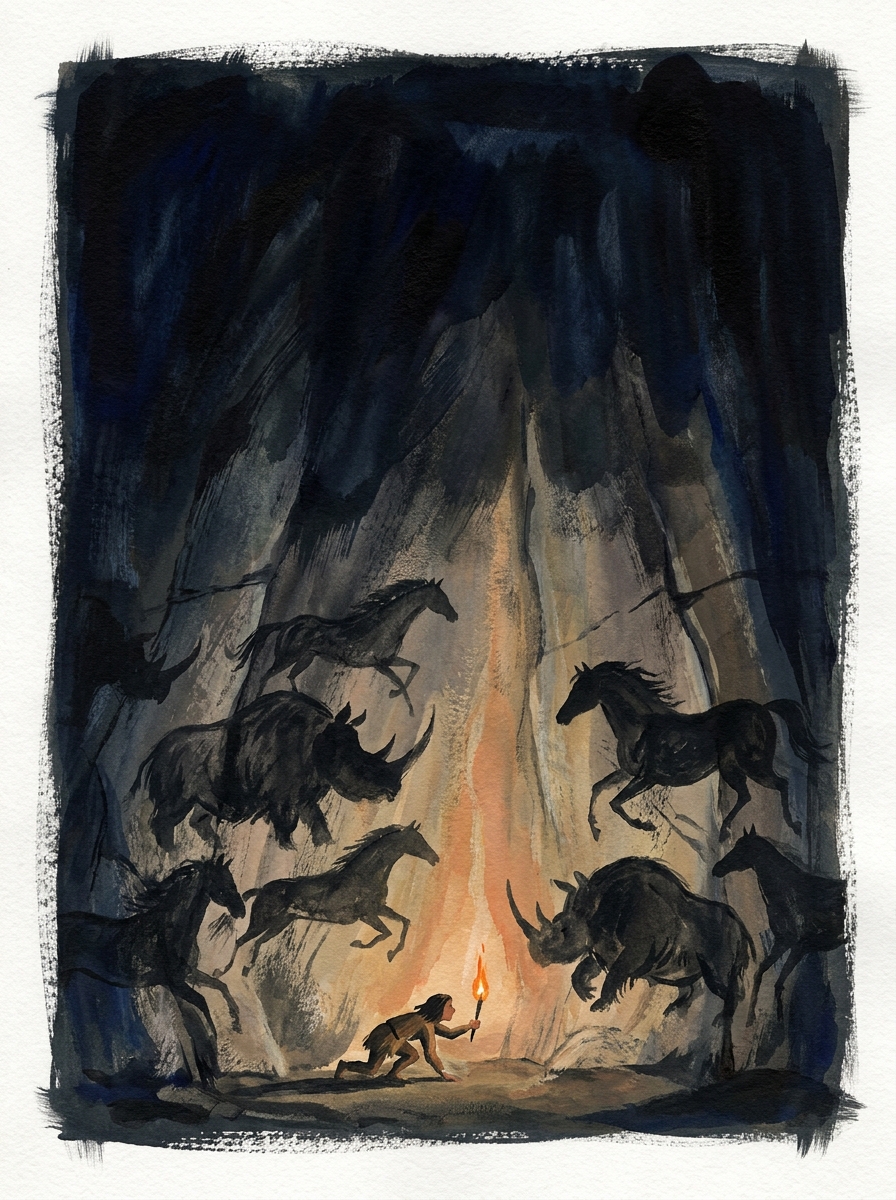
Thirty-six thousand years ago, someone crawled into a cave in what is now southern France and painted a rhinoceros on the wall. The cave is Chauvet. The painting is, as far as the evidence allows us to say, among the oldest works of art the species has ever produced. The painter went past the daylight. Past the entrance chamber. Into the deep interior where no natural light reaches, where the only illumination was the flame the painter carried. The painter chose the dark.
This is the part that should not be skipped. The cave paintings were not made near the entrance. They were made deep inside, in chambers that require crawling, climbing, and navigating in conditions that would have been genuinely dangerous. The painters went where they did not need to go, into a place the body's every survival circuit was telling them to avoid, and they made art there. The cave is the place where the species first combined darkness with creation, and the combination has never stopped being meaningful.
The Substrate
Enclosure perception is the primary cognitive input. The cave is the only natural environment that encloses on all sides: above, below, and around. The enclosure activates a specific cognitive profile that differs from both open-space exposure and the partial enclosure of the forest. In the cave, the walls are close. The ceiling may require crouching. The exits may be limited to one. The brain evaluates the enclosure as both shelter and trap, and the dual evaluation produces the cave's characteristic emotional register: safety and claustrophobia in the same breath.
Darkness perception adds the layer that separates the cave from every other enclosed space. The deep cave is dark in a way that no other natural environment is dark. Not the darkness of night, which has starlight and moon. Not the darkness of the forest, which has filtered daylight. The darkness of the deep cave is total, and total darkness is a cognitive emergency. The visual system is the brain's dominant spatial input, and when the visual system receives nothing, the other systems compensate with heightened activity: hearing sharpens, tactile sensitivity increases, and the threat-detection system escalates to a level it rarely reaches in light. The cave's darkness is not the absence of information. It is the replacement of visual information with a different cognitive regime.
Acoustic enclosure is the cave's most distinctive perceptual feature and the one most consistently linked to its sacred function. Caves resonate. Specific chambers within caves have been shown to amplify and sustain certain frequencies, particularly in the range of the human voice. Iegor Reznikoff's acoustic studies of painted caves in France demonstrated that the chambers with the densest concentrations of paintings are also the chambers with the strongest acoustic resonance. The species did not paint randomly. It painted where the walls sang back. The cave was the first cathedral, and the acoustics were part of the design.
The womb analogy is crude but cognitively real. The cave's enclosure, darkness, warmth relative to exterior, and spatial structure activate the same comfort-seeking systems that the infant's experience of enclosure activates. Rebirth rituals conducted in caves, documented across multiple continents, exploit this cognitive mapping directly. The initiate enters the dark, undergoes transformation, and emerges. The cave provides the spatial metaphor the ritual requires: the interior that is both origin and passage.
The Exemplars
The painted caves of southwestern Europe, Chauvet, Lascaux, Altamira, and dozens of others, are the cave as original studio. The art is extraordinary by any standard. The animals are rendered with a precision and dynamism that reveals acute observation and sophisticated technique. But the art's location is as significant as its quality. These were not casual sketches near the entrance. They were deep-cave productions, made in spaces that required effort and risk to reach, under conditions that must have been physically uncomfortable. The choice of the deep cave as the art's location is itself a statement: whatever the art was for, it was for the dark.
Plato's allegory of the cave in Book VII of the Republic is the cave as epistemological argument. The prisoners chained facing the wall see only shadows and take the shadows for reality. The philosopher who escapes the cave and sees the sun returns to tell the prisoners what the light is like, and the prisoners do not believe the report. The cave here is not a physical place. It is a model of the mind, and the model argues that ordinary perception is a form of imprisonment. The cave-as-mind is one of the most influential philosophical images in Western history, and its persistence reveals how naturally the brain maps its own interiority onto the spatial structure of enclosure.
The Buddhist cave temples of India and China, Ajanta, Ellora, the Mogao Caves at Dunhuang, represent the cave as devotional architecture. The caves were carved, painted, and sculpted over centuries, producing interior spaces of extraordinary beauty and complexity. The choice of the cave as the medium for these temples is not accidental. The enclosure concentrates attention. The darkness eliminates distraction. The resonance amplifies the chanted sutra. The cave provides what the open-air temple cannot: the experience of interiority at the architectural level.
The Christian catacombs and desert caves are the cave as refuge and as resistance. The early Christians used caves and underground chambers as worship spaces partly because they were persecuted and needed to hide, and partly because the cave's spatial properties, the enclosure, the darkness, the acoustic intimacy, served the worship. The cave church became a form, and the form survived the persecution. The churches of Cappadocia, carved into volcanic rock, are the cave-as-church tradition at its fullest development.
The witch's cave, the dragon's cave, the treasure cave: these are the cave in the folk tradition, where the cave's darkness contains whatever the culture fears most and values most. Aladdin's cave of wonders. Smaug's lair under the Lonely Mountain. The cave of the Sibyl at Cumae. The darkness inside is not empty. It is full of the things the culture has placed in the dark, and the placement is always revealing.
The Variations
The painted cave and the hermit's cave are different uses of the same enclosure. The painted cave is communal: a place where the group gathered, where the art was made for multiple viewers, where the acoustic properties suggest group vocalization, chanting, singing, or speaking in unison. The hermit's cave is solitary: the desert father's cell, the Daoist's mountain grotto, the Hindu sadhu's retreat. Both use the cave's enclosure, but one uses it to concentrate the group and the other uses it to isolate the individual. The difference reveals whether the culture's relationship to interiority is communal or private.
The threshold cave, the cave that functions as an entrance to the underworld, is the cave as cosmological portal. The cave at Eleusis, where the Eleusinian Mysteries were conducted, was the threshold between the world of the living and the world of the dead. The cenotes of the Maya were understood as entrances to Xibalba, the underworld. The cave here is not a destination. It is a passage, and the passage connects the surface world to whatever the culture places beneath it.
The treasure cave, the cave that contains wealth or knowledge hidden in the dark, is the cave as vault. The Dead Sea Scrolls were found in caves. The cave paintings themselves are treasures preserved by darkness. The figure of the cave-as-vault argues that some things are better kept in the dark, that the darkness preserves what the light would destroy, that the cave's enclosure is not merely shelter but protection.
The Honest Account
Caves have been sites of hiding from violence, and the hiding should not be romanticized past the terror that produced it.
The Cathar caves of southern France, where heretics hid from the Albigensian Crusade. The caves where enslaved people hid during escapes. The caves where indigenous peoples cached sacred objects to protect them from confiscation by colonial authorities. The cave as refuge is the cave at its most desperate: the place you go when every other place is occupied by the people who want to hurt you.
The archaeology of caves raises persistent questions about possession, ownership, and the ethics of study. Whose ancestors are in the cave? Whose art is on the walls? Who gets to decide what happens to the bones, the paintings, the artifacts? The cave preserves, and the preservation creates a record that multiple groups may claim. The painted caves of Europe are now tourist attractions and UNESCO heritage sites. The Chauvet cave is sealed to the public and accessed only by researchers. The decision to seal or open, to study or protect, to treat the cave's contents as human heritage or as the specific property of specific descendants, is never settled permanently.
The cave's sacred function has also been exploited. Oracular caves, where priests or priestesses delivered prophecies, were often mechanisms of political influence. The Sibyl at Cumae, the Oracle at Delphi (which was a cave-like structure), the cave oracles of various traditions: these were institutions that used the cave's numinous atmosphere to amplify the authority of the message delivered within. The darkness lent credibility. The enclosure produced suggestibility. The cave's cognitive properties were tools, and the tools were used.
The Craft Turn
The cave works in story as the place where the protagonist is sealed in with whatever they brought. The cave admits. Then the cave closes. And whatever is inside, whatever the character carried in, whatever was already waiting in the dark, becomes the only material the narrative has to work with.
The principle is compression. The cave reduces the world to the enclosure, and the reduction forces confrontation. The dragon in the cave must be faced because there is no other direction. The treasure in the cave must be evaluated because there is nothing else to evaluate. The self in the cave must be met because there is no one else to meet.
The cheap cave is the one that is merely a room with unusual walls. The cave that functions as a hiding place, a shortcut, a tunnel to the next scene, has not done the figure's work. The cave's work is to enclose, to darken, and to force the encounter that the open world would have allowed the character to postpone.
The Return
The cave is where the species first made art and where it first encountered something it called sacred. Both happened in the same place, in the same dark, by the same firelight. The coincidence is not a coincidence. The cave provided the conditions under which both experiences were possible: the enclosure that concentrated attention, the darkness that eliminated distraction, the resonance that amplified the voice, and the separation from the ordinary world that made the extraordinary available.
The dark is still there. The walls still resonate. The paintings at Chauvet are still on the walls, preserved by the darkness that the painters chose.
Thirty-six thousand years later, the species still goes into the dark to find things that cannot be found in the light. The cave is the figure that carries the going.
Someone Crawled Into a Cave and Painted a Rhinoceros
Thirty-six thousand years ago, someone crawled deep into a cave in southern France and painted animals on the wall. Not near the entrance. Deep inside, in chambers that required crawling through total darkness. The painter chose the dark.
The cave paintings at Chauvet are among the oldest art the species has produced. And they were made in one of the hardest places to reach. The question: why would anyone go there?
Why Caves Feel the Way They Do
The cave is the only natural environment that encloses on all sides. The brain reads the enclosure as both shelter and trap at the same time.
Deep-cave darkness is total. Not nighttime dark, which has starlight. Not forest dark, which has filtered light. Cave dark is absolute, and the brain treats absolute darkness as a cognitive emergency. Hearing sharpens. Touch gets more sensitive. Threat detection maxes out.
Here's what's remarkable: Iegor Reznikoff's acoustic studies of painted caves showed that the chambers with the most paintings are also the chambers with the strongest acoustic resonance. The species didn't paint randomly. It painted where the walls sang back.
The cave was the first cathedral. The acoustics were part of the design.
Caves Around the World
The painted caves of Chauvet, Lascaux, and Altamira: the art is extraordinary. The animals are rendered with precision and life. But the location matters as much as the quality. These were deep-cave productions, made under dangerous conditions. Whatever the art was for, it was for the dark.
Plato's cave allegory: prisoners chained facing a wall see only shadows and take them for reality. The cave as a model of the mind, where ordinary perception is a form of imprisonment. It's one of the most influential philosophical images in Western history.
The Buddhist cave temples of Ajanta and Dunhuang: carved, painted, and sculpted over centuries. The cave concentrates attention, eliminates distraction, and amplifies chanted sutras.
The witch's cave, the dragon's cave, the treasure cave: in folk tradition, the darkness inside contains whatever the culture fears most and values most.
The Uncomfortable Part
Caves have been sites of hiding from violence. Cathar caves during the Albigensian Crusade. Caves where enslaved people hid during escapes. Caves where indigenous peoples cached sacred objects to protect them from colonial confiscation.
The archaeology of caves raises persistent ownership questions. Whose ancestors? Whose art? Who gets to decide what happens to what's inside?
The cave's sacred atmosphere has also been exploited. Oracular caves, where priests delivered prophecies, used the darkness and acoustics to amplify the authority of whatever message was delivered. The cave's cognitive properties were tools.
What Makes a Cave Story Work
The cave seals the character in with whatever they brought. Then it closes. Whatever's inside, whatever was already waiting in the dark, becomes the only material the story has to work with.
The principle is compression. The dragon must be faced because there's no other direction. The treasure must be evaluated because there's nothing else. The self must be met because there's no one else.
The cheap cave is just a room with unusual walls. A hiding place, a shortcut, a tunnel to the next scene. The cave's real work is to enclose, darken, and force the encounter the open world would have let the character postpone.
Still Going Into the Dark
The dark is still there. The walls still resonate. The paintings at Chauvet are still preserved by the darkness the painters chose.
The species still goes into the dark to find things that can't be found in the light.