

There is a wasp called Ampulex compressa — the emerald cockroach wasp — that does something no horror writer has improved upon. It stings a cockroach twice: once in the thorax to temporarily paralyze the front legs, and once, with extraordinary precision, directly into the brain, targeting the ganglia that govern the escape reflex. The cockroach does not die. It does not lose consciousness. It simply loses the ability to want to leave. The wasp then leads it by the antenna — gently, almost tenderly — into a burrow, lays an egg on its abdomen, and seals the entrance. The cockroach waits, docile and alive, while the larva hatches and eats it from the inside.
The wasp does not overpower the cockroach. It does not chase it down. It removes the cockroach's will to resist and then feeds at leisure. If the vampire has a biological analogue, this is it — not the wolf or the bat or the predator that hunts in the open, but the parasite that disables the host's defenses and consumes from within, wearing the intimacy of the relationship as camouflage.
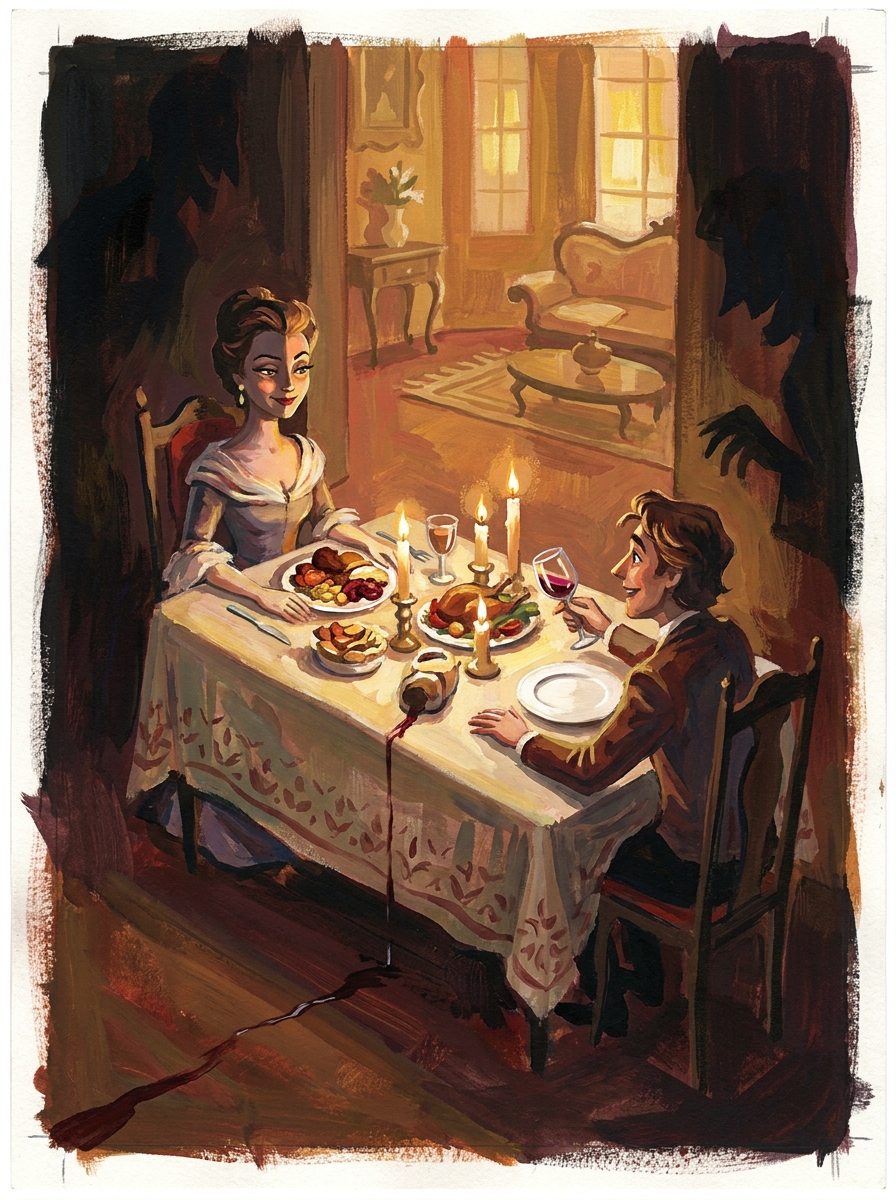
The vampire is the predator who has learned our manners. This is the thesis, and every regional version of the figure, no matter how different the surface, converges on this structure: a predator that does not attack from outside but feeds from inside the social bond. It sits at your table. It speaks your language. It knows your customs and observes them with a fluency that disarms suspicion. And it takes more than it gives — always — but the taking is dressed as desire, as affection, as an exchange you entered willingly and cannot quite identify as lopsided until the deficit has become your life.
The cognitive substrate here is a collision between two systems that rarely trouble each other. The first is predator detection — the ancient, pre-mammalian set of circuits that scan for things that want to eat you. David Rakison's developmental work has shown that infants as young as five months display attention biases toward predator-associated stimuli: the forward-facing eyes, the sudden movement, the low approach. The system is fast, mostly automatic, and calibrated for a world of physical threat — the big cat in the grass, the snake in the path, the shape overhead that might be a raptor. It works beautifully when the predator looks like a predator.
The second system is social exchange — the extraordinarily sophisticated apparatus the human mind uses to track reciprocity, detect cheaters, and evaluate the fairness of transactions. Leda Cosmides and John Tooby, working at the intersection of evolutionary psychology and cognitive science, demonstrated in the 1990s that the mind contains what amounts to a specialized cheater-detection module: a reasoning system that performs dramatically better when a logical problem is framed as a social contract ("If you take the benefit, you must pay the cost") than when the identical logical structure is framed abstractly. We are wired, at a level deeper than conscious reasoning, to notice when someone is taking more than they are giving.
The vampire is the figure that defeats both systems simultaneously. It does not trigger predator detection because it does not look like a predator. It looks like a person — an attractive person, a charming person, a person you want at your table. And it does not trigger cheater detection because the exchange it offers appears reciprocal. It offers desire, attention, immortality, the flattery of being chosen. What it takes — blood, vitality, autonomy, years — is extracted so gradually, so intimately, so intertwined with what feels like mutual pleasure, that the host does not recognize the asymmetry until the account is already overdrawn.
This is not the revenant. The revenant is the body without the mind — mindless, disgusting, incapable of deception. The vampire is all mind, all social performance, all fluency. The revenant triggers the disgust system. The vampire triggers the desire system and hides behind it. The two figures could not be more different in their emotional register, and yet they share a common ancestor in the Slavic folklore traditions where the boundary between them was once unclear. The original Eastern European vampire — the strigoi, the upir — was closer to a revenant than to Bram Stoker's count: a bloated corpse, ruddy with stolen blood, found in its grave with dirt under its fingernails and fresh blood on its lips. The villagers did not find this figure seductive. They found it disgusting, and they dealt with it the way they dealt with any revenant: they dug it up and destroyed it. It was John Polidori in 1819, and then Sheridan Le Fanu in 1872, and then Stoker in 1897 who took the bloated corpse and dressed it in evening clothes, and in doing so they moved the figure from one cognitive register to another — from disgust to desire, from the body's corruption to the mind's seduction, from the revenant's territory to the vampire's.
The transformation was not a literary invention from nothing. It was a literary excavation of something the figure had always contained. Because the drinking of blood — the central act, the one feature no vampire tradition omits — is an act of intimacy before it is an act of predation. The mouth on the neck. The piercing of skin. The mingling of fluids. The exchange that the victim did not resist and perhaps, in some versions, invited. The blood-drinker was always adjacent to the lover. What the literary vampire did was bring the adjacency to the surface and make it the point.
The cross-cultural record supports this reading with uncomfortable consistency.
The Romanian strigoi drains the living, often family members, often beginning with the spouse. The intimacy is part of the mechanism — the strigoi feeds on the people closest to it, and the feeding mimics the closeness it had in life. The Greek lamia, in her earliest mythological form, is a woman driven mad by the loss of her children, who now preys on the children of others — a figure of grief turned to predation, the maternal bond inverted into consumption. The Malay penanggalan is a woman's head that detaches from her body at night, trailing viscera, to feed on the blood of pregnant women and newborns. The feeding target is specific: the penanggalan preys on the most intimate biological relationship — mother and child — at the moment of its greatest vulnerability. The Akan asanbosam, iron-toothed and tree-dwelling, drops on travelers from above, but its bite carries a specific charge: it feeds and does not kill immediately, keeping the victim alive to drain over time. The Filipino manananggal separates at the waist and flies to feed, and in many tellings the creature is by day a quiet, unremarkable neighbor — charming, even. The predator's disguise is not a cape and a castle. It is a life you would not think to suspect.
What these figures share is not surface — the penanggalan and the strigoi look nothing alike — but the deep grammar of predation through intimacy. In every case, the feeding occurs within or through a relationship the victim trusted. The vampire does not hunt strangers in the wild. It feeds on the people closest to it, using the closeness as the vector. The blood is not incidental to the relationship. It is what the relationship was for.
The counterargument here comes from the romantics — the writers and readers and filmmakers who have spent the last two centuries arguing that the vampire is not fundamentally a predator but a tragic figure, a creature of longing and exile, beautiful and damned. Anne Rice built a cathedral on this reading. Stephenie Meyer built a franchise. The romantic vampire is not merely popular; it is, by audience numbers, the dominant version of the figure in contemporary culture.
I want to take this seriously, because the romantic reading is not stupid. The vampire does long. It does suffer. The immortality that makes it powerful also makes it lonely, and the loneliness is real — it is the consequence of a life that continues past every relationship it enters, that watches the beloved age and die while it does not. There is genuine pathos in this, and a competent writer can make it land. But the romantic reading achieves its pathos by performing a specific surgery: it removes the asymmetry. The romantic vampire loves you back. It wants the relationship to be mutual. It restrains its hunger, or at least feels terrible about failing to. The feeding is reframed as a shared experience — erotic, mutual, even liberating.
This is the surgery that defangs the figure. Because the vampire's entire cognitive payload is the warning about asymmetric exchange dressed as desire. You think you are in a relationship. You are in a feeding arrangement. You think the attention is a gift. The attention is a lure. You think the desire is mutual. One of you is dinner. Remove the asymmetry and the vampire becomes a boyfriend with unusual dietary requirements. Keep the asymmetry and the figure does the work it was built for: it trains the mind to suspect charm, to interrogate desire, to ask, when someone beautiful and compelling enters your life and offers you something that feels too good, what exactly the exchange is costing you and whether you are the one who will pay.
For the writer, the instruction is precise: the vampire is most effective when its hunger reads as desire. The exchange is the engine. You give something — attention, trust, access to your body, access to your time — and you get something back: flattery, intensity, the intoxicating feeling of being chosen. The asymmetry is hidden until the cost has already been extracted. Sex, money, attention, loyalty, years. The blood is metaphor. The blood is also blood.
The vampire protects a specific kind of suspicion: suspicion of charming asymmetric exchange. It warns that the most dangerous predator is not the one that attacks from outside the social order but the one that enters through the front door, sits at the table, and feeds so gracefully that the host mistakes the feeding for communion. Every culture that has produced a blood-drinker has produced this warning alongside it, and the warning is always the same: look at the exchange. Look at what you are giving. Look at what you are getting. Count the cost.
To strip this away — to rebuild the vampire as a love interest whose predation is either absent or forgiven — is to remove the warning precisely where it does its work. The romantic vampire does not train the mind to detect asymmetric exchange. It trains the mind to find asymmetric exchange beautiful. It teaches the audience that being chosen by a powerful, dangerous figure is a form of love rather than a form of predation, and that the correct response to the discovery that your partner feeds on you is not to leave but to be flattered.
I do not think this is a harmless transformation. I think it is the figure's specific betrayal — the one form of defanging that costs the species the most — because the predators the vampire was built to detect are real, and they are still at the table. They are still charming. They are still offering you something that feels like desire and is actually extraction. The figure that warned you about them has been redesigned to look like them. And the audience, trained on the redesigned version, has lost the pattern-recognition the original figure was built to install.
The parasite is at the table. It is charming. It is paying attention to you in a way that no one else does, and the attention feels like sunlight and is not. The vampire knows your name, knows your hunger, knows the exact shape of the thing you want most. It is offering that thing now, across the table, with a smile that reaches its eyes.
The question is not whether the offer is real. The question is what the offer costs, and whether you will notice the price before the account is empty.
There's a wasp that stings a cockroach directly in the brain — not to kill it, but to remove its will to escape. The cockroach stays alive, stays conscious, and calmly follows the wasp into a burrow where a larva hatches and eats it from the inside.
The wasp doesn't overpower the cockroach. It disables the roach's desire to leave, then feeds at leisure.
If the vampire has a real-world model, that's it. Not the wolf or the bat — the parasite that uses intimacy as camouflage.
The Predator Who Learned Manners
The vampire is different from every other monster on this list because it doesn't look like a threat. The ghost is eerie. The revenant is disgusting. The ogre is enormous. The vampire is charming.
It sits at your table. It speaks your language. It pays attention to you in a way nobody else does. And it takes more than it gives — always — but the taking is dressed up as desire, as affection, as a deal you entered on purpose. You don't realize you're being drained until the account is empty.
Your brain has a system for detecting predators and a separate system for detecting cheaters in social deals. The vampire beats both. It doesn't look like a predator, so the predator alarm stays quiet. And the exchange it offers seems fair — it gives you attention, desire, the thrill of being chosen. What it takes, it takes slowly, wrapped in something that feels like love.
Blood-Drinkers on Every Continent
The Romanian strigoi drains family members first — the people closest to it. The Malaysian penanggalan is a flying head that feeds on pregnant women and newborns, targeting the most intimate biological bond at its most vulnerable moment. The Filipino manananggal is a quiet neighbor by day. The West African asanbosam keeps its victims alive to drain them over time.
Different surfaces. Same structure: a predator that feeds through relationships, using closeness as the attack vector.
The original Eastern European vampire wasn't attractive at all. It was a bloated corpse with dirt under its fingernails. Villagers dug it up and burned it, same as a revenant. It was writers in the 1800s — Polidori, Le Fanu, Stoker — who put the vampire in evening clothes and moved it from the graveyard to the ballroom. They didn't invent the seduction. They brought to the surface something the figure had always carried: the blood-drinker was always adjacent to the lover.
The Romantic Problem
The romantic vampire — Anne Rice, Stephenie Meyer — is the most popular version of the figure alive today. And it's not a stupid reading. The immortal who watches everyone they love grow old and die carries real sadness. There's genuine pathos there.
But the romantic version performs a specific surgery: it removes the asymmetry. The romantic vampire loves you back. It feels bad about feeding. The exchange becomes mutual.
This is exactly the surgery that defangs the figure. Because the vampire's entire point is warning about asymmetric exchange dressed as desire. You think you're in a relationship. You're in a feeding arrangement. You think the attention is a gift. The attention is a lure.
Remove the asymmetry and the vampire becomes a boyfriend with unusual dietary needs. Keep the asymmetry and the figure does what it was built for: it trains your mind to suspect charm, to question desire that feels too intense, to ask what the deal is really costing you.
What We Lose
The vampire protects suspicion of charming extraction. It warns that the most dangerous predator doesn't look dangerous — it looks like the best thing that ever happened to you. Every culture that produced a blood-drinker produced this warning alongside it.
To rebuild the vampire as a love interest whose predation is either absent or forgiven doesn't just soften a story. It trains the audience to find asymmetric extraction beautiful. It teaches people that being chosen by someone powerful and dangerous is romance, not predation.
The predators the vampire was built to detect are real. They're still charming. They're still at the table. The figure that warned you about them has been redesigned to look like them.
The offer is generous. The attention is intense. The question is what it's costing you — and whether you'll notice the price before it's too late.