

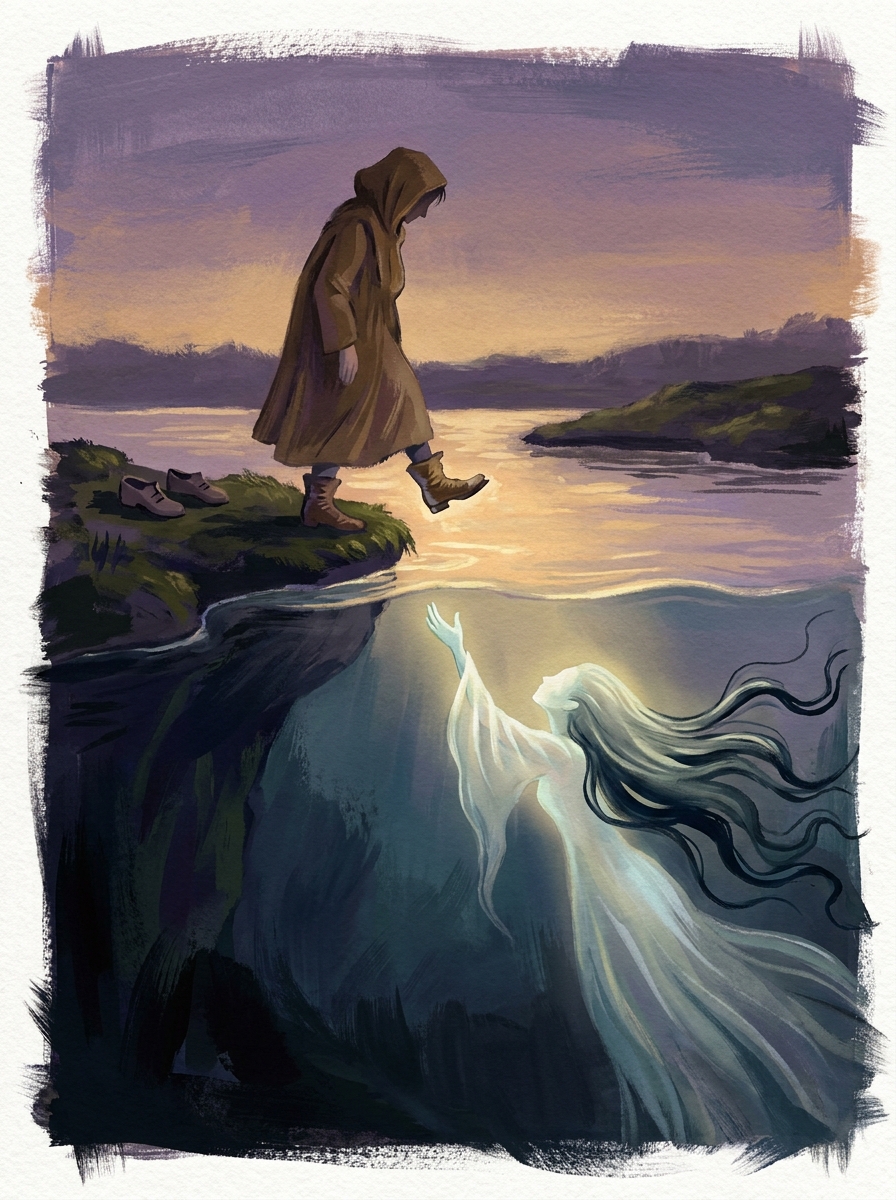
Water cancels human advantages. On land, you can run. You can climb. You can see the threat coming and calculate a response. In water, every capacity that makes you a competent terrestrial animal — your bipedal speed, your fine motor control, your visual range, your ability to breathe — is degraded or destroyed. You cannot sprint in water. You cannot see clearly beneath its surface. You cannot breathe in it. And the crossing from the medium in which you are competent to the medium in which you are helpless takes a single step. One step off the bank. One step past the depth where your feet touch bottom. One step and the rules change entirely, and the thing that was beneath the surface, waiting for you to cross, has you on its ground.
The drowner is the lure at the threshold you cannot fight on.
Every other figure in this series operates within the human world. The ghost is in the room. The shapeshifter is at the table. The vampire, the witch, the ogre, the trickster — all of them occupy spaces the human body can move through, fight in, flee from. The drowner is the only figure that pulls you into a world where your body does not work. The water is not merely the setting. It is the weapon. And the drowner's fundamental strategy — the feature that every regional version shares — is the lure that draws you past the line you should not have crossed.
The cognitive substrate is a collision between two systems: threshold sensitivity and predator detection.
Threshold sensitivity is the mind's disproportionate allocation of attention to boundaries — places where one thing becomes another. Doorways, shorelines, dusk, the tree line, the edge of the known territory. Cognitive psychologists have documented a literal version of this as the "doorway effect": walk through a doorway and the mind performs a kind of context reset, flushing working memory as it transitions from one space to another. The effect is automatic and difficult to override. The mind treats thresholds as significant — as places where the rules change — and allocates heightened vigilance to them.
The water's edge is the most ancient threshold the species has known. Before doorways, before tree lines, before the walls of the village, there was the shore — the line where the environment you could survive in met the environment you could not. The attention the mind gives to water boundaries is measurable. Children who have never been taught about drowning hesitate at the edge of deep water. The hesitation is not learned. It is the threshold system doing its job, flagging the boundary where the medium changes and the body's capacities collapse.
The drowner exploits this threshold by providing a reason to cross it. Something beautiful on the other side. A voice calling from the water. A figure that is lovely and wet and beckoning. The lure is not incidental to the figure. It is the figure's essential mechanism — the specific cognitive exploit that distinguishes the drowner from every other predator. The ogre does not lure. The ogre catches. The shapeshifter deceives, but the deception operates within the human world. The drowner offers something the victim wants — beauty, music, desire, the promise of something extraordinary just past the edge — and the acceptance of the offer is the crossing of the threshold. The victim does not fall into the water. The victim walks in.
The Slavic rusalka is the figure at its most emotionally loaded. In pre-Christian Slavic tradition, the rusalka is the spirit of a woman who died by drowning — often a suicide, often a young woman who died of grief or was driven into the water by betrayal. She lives in rivers and lakes, and she is beautiful: long hair loose in the current, pale skin, eyes that hold you. She sings, or she dances on the bank at night, or she simply appears at the water's edge at dusk, looking at you with an expression that might be longing and might be something else entirely. If you follow her in, you drown. The rusalka does not pull you under. She does not need to. She gives you a reason to enter the water, and the water does the rest.
The figure encodes something specific about the phenomenology of drowning that no other monster captures: the lure precedes the kill. The water does not chase you. It waits. It is perfectly patient. It has been there since before you were born and will be there after you are gone, and all it needs is for you to take one step past the point where your feet no longer touch bottom. The rusalka is the beautiful reason for that step.
The Japanese kappa operates on a completely different emotional register while engaging the same seam. The kappa is a river creature — small, turtle-like, with a dish-shaped depression on its head that holds water. It is often depicted as mischievous rather than malevolent, fond of cucumbers and sumo wrestling. But its primary activity, in the folklore, is pulling people — especially children — into rivers and drowning them. The kappa does not lure through beauty. It lures through proximity and curiosity. Children play near the water. The kappa waits in the water. The threshold is the same. The mechanism is the same. The bait is different — not desire but the child's natural inclination to play at the boundary, to test the edge, to put one foot in — and the result is the same.
The Norse nøkk — also called the neck, or nixie — combines the lure of the rusalka with the kappa's patience. The nøkk appears as a beautiful musician, sitting on the surface of a lake or river, playing a fiddle so exquisitely that the listener cannot resist moving toward the sound. The music is the lure. The water is the trap. And the nøkk, like the rusalka, does not need to use force. It provides a reason to cross the threshold, and the physics of the threshold provide the killing mechanism. You cannot fight in water. You cannot flee in water. The nøkk does not need to be strong. It only needs to be compelling enough to draw you in, and the medium does the rest.
The Scottish kelpie adds a layer of bodily intimacy to the crossing. The kelpie appears as a beautiful horse at the water's edge — usually a white horse, wet and gleaming, standing just close enough to the bank to be mounted. The traveler, tired, climbs on. The kelpie plunges into the water. The rider discovers that their hands are stuck to the mane — the kelpie's skin is adhesive, and the rider cannot dismount. The horse dives and the rider drowns. The kelpie exploits not just the threshold but the desire for easy passage — the exhausted traveler's willingness to accept help from an unknown source. The crossing is a transaction. The cost is concealed until the descent has begun.
The Greek siren, in its original form — not the mermaid it later became, but the bird-woman of the Odyssey — lures through knowledge rather than beauty. The sirens do not sing of love or desire. They sing of what they know. They offer Odysseus a song that contains the truth of everything that has happened and will happen — irresistible to a man whose defining trait is his need to know, to see, to understand. The lure is tailored to the victim. The water is incidental (the sirens sit on rocks, not in the sea), but the structural position is the same: a figure at a boundary, offering something the traveler wants, requiring them to leave the path to get it.
Mami Wata, across West and Central African and diasporic traditions, is the water spirit at her most ambiguous. She is beautiful, powerful, associated with wealth and fertility and modernity — she is sometimes depicted with European commodities, mirrors and watches, suggesting her power includes the power of the foreign and the new. She can bestow enormous fortune. She can also drown. The relationship with Mami Wata is an exchange — you give devotion, fidelity, sometimes your sexuality, and you receive prosperity — but the exchange is binding, and breaking it is fatal. The drowner here has absorbed the trickster's mechanism: the contract. But the contract is still enforced by water. The consequence of breach is the same as it has always been. You go under.
The counterargument for the drowner is the simplest on this list: water is genuinely dangerous, and cultures that live near water develop stories warning people away from it. This is not cognitive science. It is common sense. Children drown in rivers. Adults drown in seas. The stories about water spirits are cautionary tales — public safety campaigns in narrative form — and reading a cognitive substrate behind them is unnecessary.
I accept the pragmatic function. These stories do warn. They are meant to warn. A parent who tells a child about the kappa is performing a practical service. But the pragmatic reading does not explain why the warning always takes the same form: a beautiful or compelling figure at the water's edge, offering something the victim wants, requiring the victim to cross a threshold they cannot cross safely. If the stories were purely pragmatic — "don't play near the river, you might fall in" — they would not need the lure. The lure is the cognitive architecture showing through the narrative surface. It is the threshold-sensitivity system recognizing that the danger of the boundary is not that you might accidentally fall in, but that something might give you a reason to walk in on purpose. The drowner does not warn against accidents. It warns against the specific class of beautiful thing that draws you past the line you should not have crossed.
For the writer, the drowner's instruction is structural: the lure is the story, the crossing is the climax, and the water is the antagonist's weapon. A drowner story that skips the lure — that begins with the victim already in the water — has missed the figure's mechanism entirely. The reader must want what the victim wants. The reader must feel the pull of the music, the beauty, the voice, the extraordinary thing offered at the water's edge. The reader must understand why the victim crossed. And then the water must close over both of them, and the reader must feel, in the way you feel it in your chest when you read a scene in which the ground drops away, the specific helplessness of being in a medium that does not support your body.
The drowner protects the threshold. It teaches the boundary. Not all boundaries are drawn by human hands. Some were drawn by the world itself — by the physics of which environments support human life and which ones kill you — and the drowner is the figure that stands at those boundaries, looking beautiful, sounding like the thing you want most, offering you a reason to cross the line the species has been warning its children about since before it could write the warning down.
Cultures that lose their drowners lose their fluency in saying no — in not crossing, in recognizing that some thresholds were drawn by older hands than ours and that the beauty on the other side is not what it appears to be. The figure at the water's edge is not offering you a gift. It is offering you a passage, and the passage goes one way.
The water is still there. It is still patient. And the thing at the edge is still beautiful, still singing, still holding out its hand.
The question is whether you will step in.
Water cancels everything that makes you dangerous on land. You can't run in it. You can't see clearly under it. You can't breathe in it. And the crossing from capable to helpless takes a single step — one step past the depth where your feet touch bottom. One step and the rules change completely.
The drowner is the beautiful thing waiting for you to take that step.
The Lure at the Line
Every other monster in this series operates in the human world. The ghost is in the room. The shapeshifter is at the table. The drowner is the only figure that pulls you into a world where your body doesn't work.
And it always works the same way: something beautiful or compelling appears at the water's edge, and it gives you a reason to cross.
Your brain gives disproportionate attention to boundaries — places where one thing becomes another. Doorways, shorelines, dusk. Scientists have documented this as the "doorway effect": walk through a doorway and your mind performs a kind of reset, flushing your working memory. The mind treats thresholds as important. It raises vigilance at the border.
The water's edge is the oldest threshold the species has known. Before doorways, before walls, there was the shore — the line where the world you could survive in met the world you couldn't. Kids who've never been taught about drowning hesitate at deep water. The system is built in.
The drowner provides the reason to ignore it.
Beautiful and Deadly
The Slavic rusalka is the spirit of a drowned woman — beautiful, wet-haired, singing at the river at dusk. If you follow her in, you drown. She doesn't pull you under. She gives you a reason to enter, and the water does the rest.
The Japanese kappa waits in rivers for children playing at the edge. The Norse nøkk appears as a musician playing music so beautiful you can't resist walking toward the sound. The Scottish kelpie appears as a gorgeous white horse by the water. You climb on. Your hands stick to its mane. It dives.
The Greek sirens don't sing about love. They sing about knowledge — the truth of everything that has happened and will happen. The lure is tailored to the victim.
West African Mami Wata is associated with beauty, wealth, and modernity. She can make you rich. She can also drown you. The relationship is an exchange — give devotion, get prosperity — and breaking the deal is fatal.
Different lures. Same structure: something at the boundary that makes you want to cross it, and a medium on the other side that your body can't survive.
Not an Accident
The counterargument is obvious: water is genuinely dangerous, and these stories are just safety warnings. Don't play near the river. Don't swim alone. Common sense in narrative form.
That's partly true. These stories do warn. But if they were purely practical, they wouldn't need the lure. "Don't play near the water, you might fall in" is a complete warning. The drowner adds something the practical reading can't explain: the idea that something might give you a reason to walk in on purpose.
The drowner doesn't warn about accidents. It warns about a specific category of beautiful thing that draws you past a line you shouldn't cross. The attraction is the danger. The beauty is the weapon.
What We Lose
The drowner protects the threshold. Not all boundaries are human-made. Some were drawn by the world itself — by physics, by the limits of the body — and the drowner is the figure that stands at those boundaries looking beautiful, teaching the species that the beauty on the other side is not what it seems.
Cultures that lose their drowners lose their ability to say no. To recognize that some thresholds were drawn by older forces than ours. That the attractive thing at the edge is not offering a gift. It's offering a passage that goes one way.
The water is still there. Still patient. The thing at the edge is still beautiful, still singing, still holding out its hand.
The question is whether you step in.