

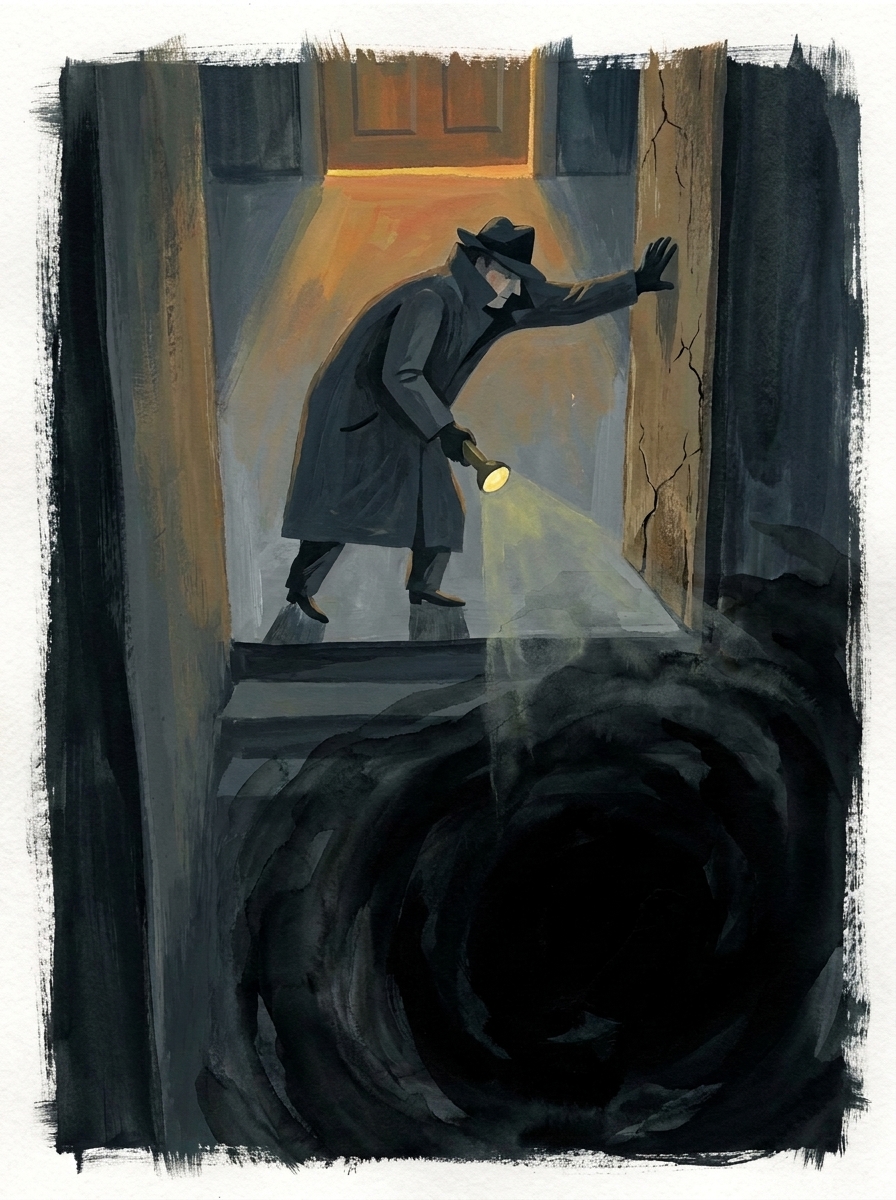
In 1914, a young officer named Wilfred Owen arrived at Craiglockhart War Hospital in Edinburgh with a stammer he could not control and nightmares he could not stop. His doctor, Arthur Brock, prescribed an unusual therapy: write it down. Owen began composing poems about gas attacks, about drowning in green light, about the particular sound a man makes when his lungs dissolve. Within months he had produced work that would outlast every monument the British government ever erected to the war. What interests me is not the poems. It is the assumption Brock made -- that the right formal container for a wound could do something that silence, rest, and time could not. That the shape you put around suffering matters.
This assumption runs beneath every serious argument about art and healing. It is the reason Aristotle believed tragedy restored soldiers returning from the Peloponnesian campaigns. It is the reason Toni Morrison built a ghost into the center of a novel about slavery. It is the reason a mother in a 2014 Australian film opens a basement door and finds a creature made of shadow and teeth standing behind it, and audiences around the world recognize the thing they have been carrying in their own chests. The question is not whether art can access trauma. That argument was settled at Craiglockhart, and probably long before. The question is whether horror -- specifically, uniquely, irreplaceably -- reaches a place no other form can touch.
I have spent a long time thinking the answer was obviously yes. I am less certain now. But the uncertainty is instructive, and the case for horror's particular gift turns out to be stranger and more limited than its advocates usually admit.
Start with what horror actually does that other forms do not. Cathy Caruth, the trauma theorist whose work at Cornell reshaped how literary scholars think about suffering, argued that trauma persists because it resists symbolization. The mind cannot metabolize what it cannot name. The flashback is not a memory -- it is a fragment of experience that never became a memory, looping through the nervous system without narrative shape or conscious address. Trauma, in Caruth's account, is the wound that cannot find its own edges.
Horror's genre-defining move is to give that wound edges. To take the formless pressure in the chest -- the thing that has no face and therefore no name -- and externalize it as an entity you can see standing across the room from you. Jennifer Kent's The Babadook is the canonical example, and it earns its reputation. The monster in that film is not metaphorically related to the mother's unprocessed grief. It is the grief, given claws and a top hat and a pop-up book. The film's resolution -- the Babadook is not destroyed but contained, fed in the basement, lived with -- maps so precisely onto therapeutic acceptance models that clinicians have written about it in professional journals. Jason Wallin at the University of Alberta has documented how monsters in horror function as cognitive instruments: they elevate unconscious fears to conscious thought, transforming what the sufferer cannot articulate into something they can point at. Scholarly analysis of metaphor theory identifies the patterns at work -- "depression is a dark creature," "grief is a thing with teeth" -- and argues they are not ornamental. They give the audience something to think with, not merely think about.
This is a genuinely distinctive operation. Tragedy shows you suffering, but its formal conventions direct your pity and fear toward a protagonist's downfall -- you feel for Oedipus, not with your own survival circuitry. Memoir narrates the wound from inside it, with the narrator serving as both subject and container; it does not set the wound apart from the sufferer in a shape that can be confronted as a separate entity. Magical realism dissolves the boundary between the real and the impossible, but it does not weaponize fear as a confrontation device. Horror takes the thing you cannot speak and stands it in front of you and says: look.
I want to sit with how unusual that is before I start qualifying it. Most genres ask you to understand suffering. Horror asks you to face it in your body. The predictive-processing framework advanced by Miller, White, and Scrivner in 2024 -- published in the Philosophical Transactions of the Royal Society B, which is not a venue given to casual speculation -- argues that horror films exploit evolutionarily prepared threat-detection systems in ways no other genre replicates. Predator cues, ambush patterns, acoustic mimicry of danger signals: horror activates the ancient machinery that kept your ancestors alive on the savanna and then teaches you, somatically, that the activation passed and you survived it. Your heart raced. Your hands gripped the armrest. The credits rolled. You are still here.
Scrivner and his colleagues at the University of Chicago found that horror fans exhibited significantly lower psychological distress during the early months of the COVID-19 pandemic, and that individuals high in morbid curiosity showed greater positive resilience. The study recruited 310 participants through Prolific and was powered to detect small effect sizes. The results are consistent with what Mathias Clasen at Aarhus University has argued for years: horror functions as a form of play behavior, a rehearsal of threat scenarios that builds preparedness the way a flight simulator builds piloting skill. No other genre is architecturally designed to simulate mortal danger in the service of emotional regulation.
That is the case for horror's unique therapeutic reach. It is, on its own terms, compelling. And it is not enough.
The first crack is evidentiary. The pandemic resilience study -- the single strongest empirical anchor in horror's therapeutic portfolio -- is correlational. Its own authors flagged that they could not determine whether horror consumption caused resilience or whether resilient people are simply drawn to horror. The effect sizes were small. No controlled clinical trial of horror-based trauma therapy exists in the published literature. Danielle Rousseau at Boston University has proposed integrating horror media into trauma treatment, but her framework remains theoretical; no institutional review board has approved the trial, and she herself has warned explicitly that horror "could exacerbate symptoms or trigger distressing memories" and requires careful screening.
Compare this to what we know about expressive writing. A six-week intervention at Northeastern University -- using a structured sequence of expressive, transactional, poetic, affirmative, legacy, and mindful writing prompts with outpatient trauma populations -- demonstrated statistically significant reductions in depressive symptoms, perceived stress, and rumination, alongside increased resilience. These were controlled measurements on validated scales. Memoir and autobiographical writing achieve the very externalization that horror claims as its signature: writing makes internal states concrete, transforms mental experience into something tangible that can be examined from the outside. The writer becomes the narrator of their own wound, gaining agency through authorship. The mechanism is different in register -- cognitive rather than somatic, authored rather than confronted -- but the therapeutic outcomes are documented, replicable, and safe.
The second crack is structural, and it runs deeper. Not all trauma takes the shape of a monster. Slavery, generational dispossession, colonial erasure -- these are injuries that are systemic, distributed, and ongoing. They have no single locus, no defeat condition, no climactic confrontation. Horror's formal architecture depends on giving dread a body, but the trauma of inherited dispossession has no body to give it. It is the water you swim in.
Morrison understood this. The ghost of Beloved is not a horror antagonist. She is a wound that refuses to stay buried, a presence that embodies both individual anguish and two centuries of communal suffering. She is not confronted in a climactic scene and defeated or contained. She is remembered -- held in the collective consciousness of a community that must decide whether to carry her or release her. Scholarly analysis of Morrison's work demonstrates that Beloved functions as what researchers call a "healing narrative": one that addresses group remembrance and legitimizes the political and emotional reality of a people whose suffering was systematically denied. The therapeutic operation here is integration, not confrontation. The ghost is not given a face so it can be fought. It is given a name so it can be mourned.
Horror cannot do this. Its binary architecture -- safe and threatened, human and monster, survival and annihilation -- requires a thing to face, a threshold to cross, a creature on the other side of the door. For the survivor whose trauma is embodied and formless, whose nightmares have no narrative but arrive as pure somatic dread, horror's door may be exactly the right one. But for the survivor whose suffering is woven into the fabric of history, whose pain is not a creature in the basement but the basement itself, horror's conventions are structurally incapable of providing what is needed. Morrison's magical realism reaches wounds that horror's monster-in-the-doorway cannot touch. So does Aristotelian tragedy, which processes suffering through moral witness rather than somatic confrontation -- and which, as Edward Hoffmann's scholarship at Xavier University documents, was being used to restore combat-traumatized soldiers in ancient Greece two thousand years before the horror genre existed.
This is where the argument gets uncomfortable for me, because I believe in horror's power and I have felt it work. I have watched films that gave me language for states I could not previously describe. I have seen the creature in the doorway and felt the thing in my chest acquire edges for the first time. That experience is real, and I do not think memoir or tragedy or magical realism could have provided it in quite the same way. The somatic rehearsal -- the heart racing, the hands gripping, the knowledge afterward that the body survived its own alarm -- is not something you get from reading Morrison, however extraordinary her prose.
But I also know a woman -- a real one, not a rhetorical device -- who tried watching Hereditary on the recommendation of a friend who insisted horror was good for processing grief. She did not experience mastery. She experienced a panic attack at eleven o'clock on a Wednesday night, followed by three weeks of disrupted sleep and a setback in therapy her counselor spent a month repairing. She is not an outlier. A review of clinical literature identified thirteen case reports of PTSD-like syndrome induced by horror films, with two meeting full DSM diagnostic criteria. Thirteen documented cases out of billions of exposures sounds negligible until you consider that only the most severe reactions produce clinical documentation. The subclinical population -- the people who simply sleep worse, who develop new avoidance behaviors, whose anxiety quietly increases -- is invisible in the data and almost certainly orders of magnitude larger.
Here is what strikes me about this. The same evolved threat-detection systems that make horror's mechanism distinctive also make it dangerous. Hyperarousal, exaggerated startle response, fight-or-flight activation -- these are horror's signature somatic effects. They are also PTSD's signature symptoms. The genre that deliberately activates the neurological pathways most damaged by trauma is playing with live ammunition in a way that memoir, tragedy, comedy, and magical realism simply are not. This does not mean horror cannot heal. It means horror's healing operates within a narrower window of tolerance than its advocates typically acknowledge, and that window requires the kind of graduated calibration -- pacing, professional oversight, individualized screening -- that a film designed for mass audiences cannot provide. Foa and Kozak's foundational work on exposure therapy established that therapeutic fear processing requires not just activation but within-session habituation: the arousal must peak and then subside while the patient is still in the therapeutic environment. A horror film's jump scares and relentless escalation may prevent exactly this kind of habituation, producing activation without resolution -- which is not therapy. It is retraumatization with better production values.
What emerges from all of this is not that horror fails as a therapeutic form. It is that the question was wrong. "Can horror heal trauma in ways no other genre can?" assumes trauma is one thing and healing is one operation. Neither is true.
Trauma comes in at least four registers that I can identify, each with different formal needs. There is embodied trauma -- the formless somatic dread, the body holding terror without language -- and horror may indeed be the only genre whose conventions are built to meet it. There is narrative trauma -- the wound that needs to be told, sequenced, and authored -- and memoir reaches it with an evidentiary base horror cannot currently match. There is systemic trauma -- the inherited, distributed, ongoing suffering that has no single antagonist -- and magical realism accesses it through formal operations horror's binary architecture cannot perform. And there is moral trauma -- the suffering that demands witness, recognition, and some reckoning with justice -- and tragedy has been processing it since Aeschylus.
No single genre's formal conventions can access all four. The more honest claim -- the one I think the evidence actually supports -- is that horror occupies a genuinely valuable niche within a broader ecology of forms, each suited to different wounds, different populations, and different stages of recovery. Horror is the right door for the survivor whose dread is formless and somatic. Morrison is the right door for the survivor whose pain is inherited and systemic. Owen's poetry was the right door for the soldier whose lungs still burned with phantom gas. The question is not which genre heals trauma uniquely. The question is which door matches which wound -- and whether the survivor has access to the right one.
I keep returning to the Babadook, not because it proves horror's supremacy but because it illustrates something more interesting. The film does not destroy the monster. It teaches the mother to live with it -- to feed it in the basement, to acknowledge its presence without being consumed by it. That is not a genre asserting its unique therapeutic power. That is a story about coexistence with suffering. And coexistence, it turns out, is available through many doors. The one you walk through depends on the shape of what you carry.
The Thing Without a Name
You know that feeling. The one that sits in your chest like a fist. It shows up at 2 a.m. It has no face. It has no words. It's just there -- heavy and shapeless and yours.
Trauma does that. It takes a piece of your life and locks it somewhere your mind can't reach. You can't talk about it because you can't name it. You can't name it because it has no edges. It just loops through your body like a song stuck on repeat.
So here's the question: can a scary movie fix that? Some people think so. And they're not entirely wrong.
The Monster in the Doorway
Horror does something no other kind of story does. It takes the nameless thing in your chest and gives it a face.
Think about The Babadook. A mother is drowning in grief she can't process. Then a creature shows up -- shadow and teeth and a top hat. That creature is her grief. It's not a symbol. It's the feeling, walking around with claws.
And here's the key: she doesn't kill it. She learns to live with it. She feeds it in the basement. She checks on it. She keeps going.
Therapists have actually written about this film. Researchers have studied how monsters in horror work like tools for the brain. They take fears you can't put into words and turn them into something you can point at. "That. That's the thing I've been carrying."
No other type of story does this the same way. Tragedy makes you feel sad for a character. Memoir tells a story from inside the wound. Horror sets the wound across the room and says: look at it.
Your heart races. Your hands grip the seat. The credits roll. You survived.
But It's Not That Simple
Here's where it gets harder. The best study we have -- one that showed horror fans handled the early days of COVID better -- can't prove that horror caused that strength. Maybe tough people just like scary movies. The researchers said so themselves.
And there's a real risk. A woman I know tried watching Hereditary after a friend said horror was good for grief. She didn't feel stronger. She had a panic attack. She couldn't sleep for weeks. Her therapist spent a month cleaning up the damage.
She's not alone. The same brain wiring that makes horror powerful also makes it dangerous. The racing heart, the jump, the flood of adrenaline -- those are horror's tools. They're also the exact symptoms of PTSD. The genre that turns on your alarm system is playing with the same wires that trauma already broke.
Real exposure therapy -- the clinical kind -- works because a trained professional controls the pace. They turn the dial slowly. Horror films crank it to ten and hold it there. That's not always healing. Sometimes it's just re-opening the wound with better sound design.
Not Every Wound Is a Monster
There's a deeper problem. Not all pain has a face you can fight.
Slavery. Generations of loss. Entire communities carrying hurt that has no single villain and no final battle. Horror needs a monster in a doorway. But some suffering is the doorway. It's the house. It's the ground the house sits on.
Toni Morrison understood this. The ghost in Beloved isn't there to be fought. She's there to be remembered. She holds the pain of one woman and two hundred years of history at the same time. The community doesn't defeat her. They decide whether to carry her or let her go.
That's a different kind of healing. Not confrontation. Integration. And horror's structure -- monster versus human, safe versus threatened -- can't do it.
The Right Door for the Right Wound
Here's what I think the evidence actually shows. The question "can horror heal trauma?" gets it wrong. It assumes trauma is one thing. It's not.
Some trauma lives in the body. Formless dread with no story attached. Horror might be the only genre built to meet that kind of pain.
Some trauma needs to be told. Written down. Given a beginning and middle. Memoir does that, and the proof is stronger than anything horror can offer right now.
Some trauma is inherited. Woven into history. Bigger than any single person. Stories like Morrison's reach that wound in ways a monster movie never could.
Some trauma needs a witness. Someone to say: this mattered, and it was wrong. Tragedy has been doing that job since ancient Greece.
No single kind of story can handle all four. Horror isn't the answer. It's an answer -- for a specific kind of pain, for people whose bodies hold terror without language.
The Babadook doesn't prove horror is the best medicine. It shows something quieter: that living with pain is possible. You don't have to destroy the thing in the basement. You just have to know it's there and keep going.
That kind of peace comes through many doors. The one you choose depends on the shape of what you carry.