

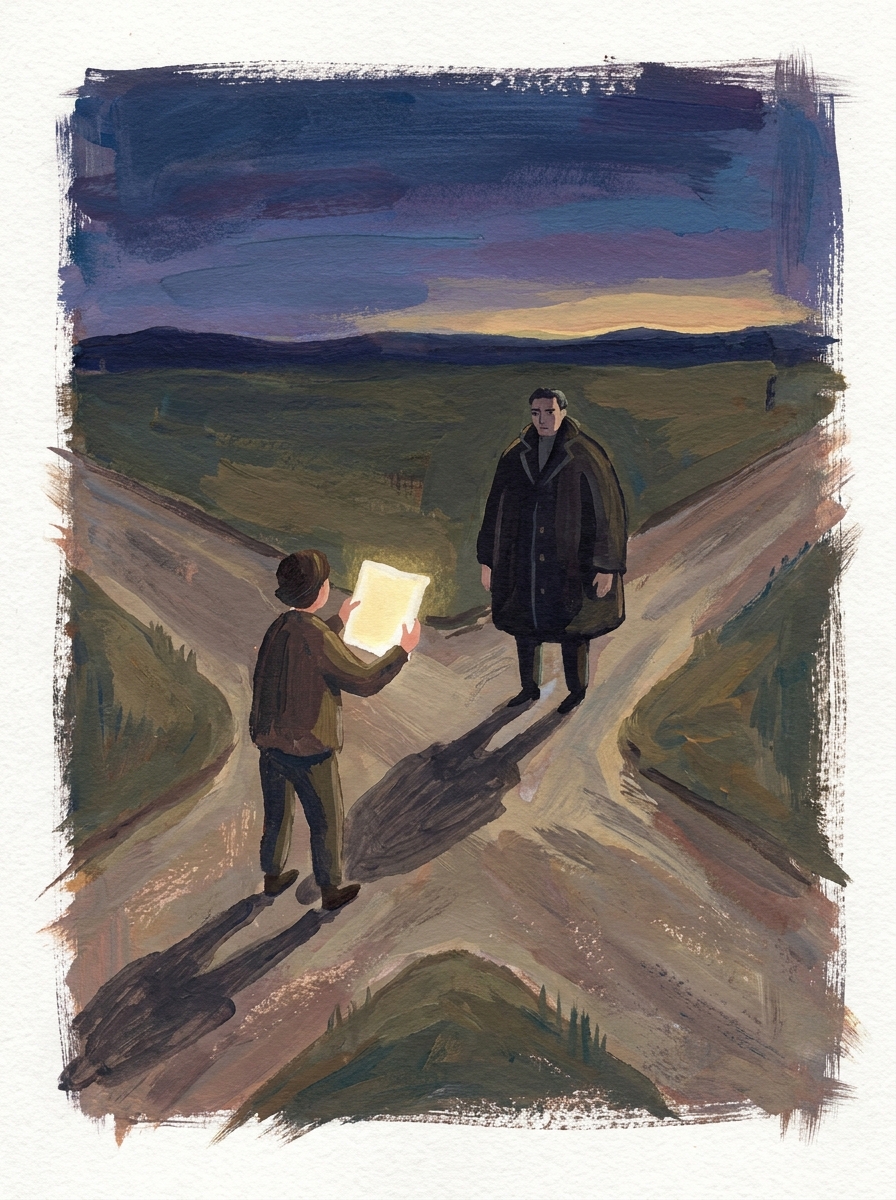
There is a story — it appears in so many traditions that no single culture can claim it — about a man who is offered exactly what he wants. The terms are clear. The price is stated. He agrees, because the thing he wants is the thing he has always wanted, and the price, as described, sounds manageable. He receives the gift. It is exactly what was promised. And then, slowly or suddenly, he discovers that the words he agreed to meant something other than what he understood them to mean, and that the price, correctly parsed, is everything he has.
He was not lied to. That is the specific cruelty. Every word was true. The contract was honored to the letter. The man failed not because he was deceived in the ordinary sense — the trickster did not tell him falsehoods — but because language contains a gap between what is said and what is meant, and the trickster lives in that gap the way a parasite lives in a host: feeding on the difference between the two.
The trickster is the figure who weaponizes language and exchange. Where the shapeshifter hides behind a false face and the vampire hides behind false desire, the trickster hides behind true words that mean false things. It does not lie. It does not need to. It finds the seam in the sentence — the place where the speaker's intention and the listener's interpretation diverge — and operates there, in the open, in plain sight, with a fluency that makes the victim's destruction feel like a grammatical inevitability.
The cognitive substrate here is the human dependence on pragmatic inference — the vast, largely unconscious process by which we interpret what people mean from what they say. Paul Grice, the philosopher of language, identified the core mechanism in 1975: communication depends on the assumption that the speaker is being cooperative, that they are saying what is relevant, that they are giving the right amount of information, that they mean what they appear to mean. These are not conscious rules. They are the operating system of conversation, so deeply embedded that we do not notice them until they are violated. The trickster violates them without technically violating them. It speaks cooperatively. It says what is relevant. It gives exactly the right amount of information. And it means precisely what it says — but what it says, read a second time with different emphasis, means something the listener did not bargain for.
The second system at work is contract cognition — the mind's specialized apparatus for tracking reciprocal exchange. Cosmides and Tooby showed that the human mind has a dedicated circuit for detecting cheaters in social contracts, and that this circuit is fast, automatic, and remarkably sensitive. We are wired to notice when someone takes a benefit without paying the agreed-upon cost. The trickster defeats this circuit through a specific exploit: it does pay the cost. It delivers the benefit. The contract is honored. The problem is not breach but precision — the trickster honored the words of the contract rather than the spirit, and the words, it turns out, permit an interpretation the other party never considered.
This is the monkey's paw. The wish granted exactly as stated. The prayer answered literally. The deal that was fair on its terms and catastrophic in its consequences. The trickster figure encodes the species' accumulated wisdom about the danger of language — the discovery, made and remade across every culture, that words are not transparent vessels for meaning but structures with seams, and that anyone who masters the seams can use the words as weapons.
The Djinn of Arabic and Persian tradition is the purest expression of this mechanism. Made of smokeless fire, capable of enormous power, bound by specific rules of engagement, the djinn grants wishes — and the granting is the horror. The fisherman releases the djinn from the bottle. The djinn offers three wishes. The wishes are granted, and each one destroys something the wisher failed to specify as protected. The djinn is not cruel. It is precise. It gives you what you asked for, not what you meant, and the difference between the two is the body of the story.
The Fae of Celtic tradition operate on the same mechanics with a different emotional register. The good neighbors — the name itself is a trickster's formulation, a polite fiction maintained to avoid giving offense — offer gifts, hospitality, music, beauty. They invite you into the hill. The music is extraordinary. The food is extraordinary. The time passes differently. When you emerge, a hundred years have gone by and everyone you loved is dead. The Fae did not lie. They offered you an evening. They gave you an evening. They simply did not specify whose clock was running, and you did not think to ask.
Anansi, the spider of Akan tradition and its Caribbean diaspora, is the trickster as culture hero — a figure who uses cunning and linguistic mastery to defeat enemies far more powerful than himself. Anansi tricks the sky-god Nyame. Anansi tricks death. Anansi tricks every authority that tries to contain him, and his victories are the victories of the weak against the strong, won not through force but through the manipulation of the terms of engagement. This is the trickster's other face — the one the figure shows to people who have no power and need to find some in the cracks of the system. The trickster is terrifying when it faces you. It is liberating when it faces your oppressor. The same mechanism that destroys the naïve wisher also destroys the arrogant lord. The weapon does not care who it is aimed at.
Coyote, across many Native American traditions, carries this duality further than any other trickster figure. Coyote is the creator and the fool. He brings fire to humanity and also gets his head stuck in a jar. He establishes the order of the world and also disrupts it, often in the same story, often through the same act. The seriousness of Coyote varies enormously across traditions — in some tellings he is sacred, in others comic, in most he is both at once — but the common structure is consistent: Coyote is the figure who demonstrates that the rules governing the world are not as stable as they appear, and that the same intelligence that builds order can disassemble it.
Loki, in Norse mythology, is the trickster bound to a specific narrative arc: from useful chaos to destructive chaos, from the gods' clever ally to the father of monsters, from the figure who solves problems through deception to the figure who causes Ragnarok. Loki's trajectory is a warning about the trickster's long game: the cunning that serves the community in the short term may consume it in the long term. Use the trickster's intelligence and you borrow from a ledger that will eventually come due.
Mephistopheles — the figure who offers Faust unlimited knowledge and pleasure in exchange for his soul — is the trickster distilled to its contractual essence. The deal is stated clearly. The price is named. Faust agrees, because the thing he wants (knowledge, experience, mastery) seems worth the thing he is giving up (a soul he is not sure he believes in). The tragedy is not that Mephistopheles cheats. He does not cheat. He performs the contract flawlessly. The tragedy is that Faust did not understand the terms until the bill arrived, and by then the terms had consumed him.
The American folk tradition of the Devil at the Crossroads — Robert Johnson selling his soul for guitar mastery, Tommy Johnson before him, the unnamed thousands who told the story before either of them played a note — condenses the trickster to a single image: the meeting at the liminal place, the exchange offered, the gift received, the cost deferred. The crossroads is the threshold — the place where two paths cross and the rules of either road are temporarily suspended. It is the trickster's natural habitat, and the deal struck there carries the trickster's natural risk: you will get what you asked for, and you will pay what you agreed to, and the difference between what you thought you were agreeing to and what you actually agreed to is the space in which the trickster lives.
The counterargument I want to address is the romantic one: that the trickster is essentially a liberatory figure, the rebel who breaks unjust rules, the subversive who speaks truth to power through wit and indirection. This reading has deep roots and genuine cultural weight. Henry Louis Gates Jr. built his concept of Signifyin(g) in part on the African American trickster tradition. Lewis Hyde's Trickster Makes This World argues that tricksters are the agents of cultural creativity, the figures who cross boundaries so that new possibilities can emerge.
I do not dispute this. The trickster's liberatory potential is real. Anansi is genuinely a figure of resistance. Coyote is genuinely a figure of creative disruption. The wit that exploits the gap in language can be aimed at the powerful as easily as at the powerless, and when it is aimed upward, it is a weapon of the dispossessed.
But the romantic reading smooths over the figure's other edge, which is that the trickster does not care about justice. The trickster cares about the exploit. The same linguistic mastery that frees the oppressed also enslaves the gullible. The same wit that dismantles an unjust system also dismantles a just one. The trickster is not a moral agent. It is a cognitive agent — a figure that maps the terrain of language and exchange with inhuman precision and operates on whatever it finds there. To purify the trickster into a hero is to lose the warning. To purify it into a villain is to lose the liberation. The figure holds both, and the discomfort of the holding is the point.
For the writer, the trickster's instruction is that the story lives in the wording. Not in the spectacle, not in the confrontation, not in the moment of power — in the sentence. The contract. The wish. The specific arrangement of words that seemed to mean one thing and turned out to mean another. Every trickster story is, at bottom, a close reading — a demonstration that language is not the transparent medium we treat it as, that words have edges, and that the person who sees the edges before you do has already won.
The trickster protects wisdom about exchange and articulation. Every gift has a cost. Every contract has a seam. Every sentence, spoken or signed, carries the possibility that the person on the other side is reading it differently than you are. The figure exists to teach this, and the teaching is not comfortable, because it asks you to treat every exchange — every promise, every offer, every deal that seems too good — as a text that requires closer reading.
To flatten the trickster into either pure villain or pure hero is to lose what the figure was for. The trickster is the figure that lives in the gap between what was said and what was meant, and the gap is not a flaw in language. It is a feature. The trickster simply knows it before you do.
The stranger at the crossroads is smiling. The offer is generous. The terms are clear.
Read the contract.
There's a story that shows up in so many cultures that nobody can claim it. A man is offered exactly what he wants. The terms are clear. The price is stated. He agrees. He gets the gift. It's exactly what was promised.
Then he discovers that the words he agreed to meant something different from what he thought. And the real price is everything he has.
He wasn't lied to. Every word was true. That's the cruelty.
The Gap in the Sentence
The trickster is the figure who weaponizes language and exchange. It doesn't lie. It doesn't need to. It finds the gap between what words say and what they mean, and it lives there, operating in plain sight.
Your brain depends on something called pragmatic inference — the mostly unconscious process of figuring out what people mean from what they say. You assume the other person is being cooperative, that they're saying what's relevant, that they mean what they appear to mean. These aren't rules you think about. They're the operating system of conversation.
The trickster exploits this operating system. It speaks cooperatively. It says what's relevant. It means exactly what it says. But what it says, read a second time with different emphasis, means something you didn't bargain for.
This is the monkey's paw. The wish granted exactly as stated. The prayer answered literally. The deal that was fair in its terms and catastrophic in its results.
Every Culture Has One
The Djinn of Arabic and Persian tradition grants wishes — and the granting is the horror. The wishes are fulfilled precisely as requested, and each one destroys something the wisher forgot to protect.
The Celtic Fae offer gifts, music, hospitality. They invite you into the hill. The time passes differently. You come out and a hundred years have gone by. They didn't lie. They offered you an evening. They just didn't say whose clock was running.
Anansi, the spider of West African and Caribbean tradition, uses wit and language to defeat enemies far more powerful than himself. Coyote, across many Native American traditions, creates the world and also gets his head stuck in a jar — sometimes in the same story. Loki starts as the Norse gods' clever ally and ends as the father of the monsters that destroy them. Mephistopheles offers Faust unlimited knowledge in exchange for his soul, and every term of the contract is honored perfectly.
The American folk tradition of the Devil at the Crossroads — Robert Johnson selling his soul for guitar mastery — puts it in one image: the meeting at the liminal place, the exchange offered, the gift received, the cost deferred.
Not a Hero, Not a Villain
The romantic reading says the trickster is a rebel figure — the subversive who breaks unjust rules, the voice of the powerless outsider. And that's real. Anansi is genuinely a figure of resistance. The wit that exploits gaps in language can be aimed at the powerful as easily as the powerless.
But the trickster doesn't care about justice. It cares about the exploit. The same linguistic skill that frees the oppressed also enslaves the gullible. The same cleverness that dismantles an unjust system can dismantle a just one.
To purify the trickster into a hero is to lose the warning. To purify it into a villain is to lose the liberation. The figure holds both, and the discomfort is the point.
What It Protects
The trickster protects wisdom about exchange. Every gift has a cost. Every contract has a seam. Every sentence — spoken or signed — carries the possibility that the other person is reading it differently than you are.
The figure exists to teach a truth that's never comfortable: language is not transparent. Words have edges. And the person who sees the edges before you do has already won.
The stranger at the crossroads is smiling. The terms are clear. The offer is generous.
Read the contract.