

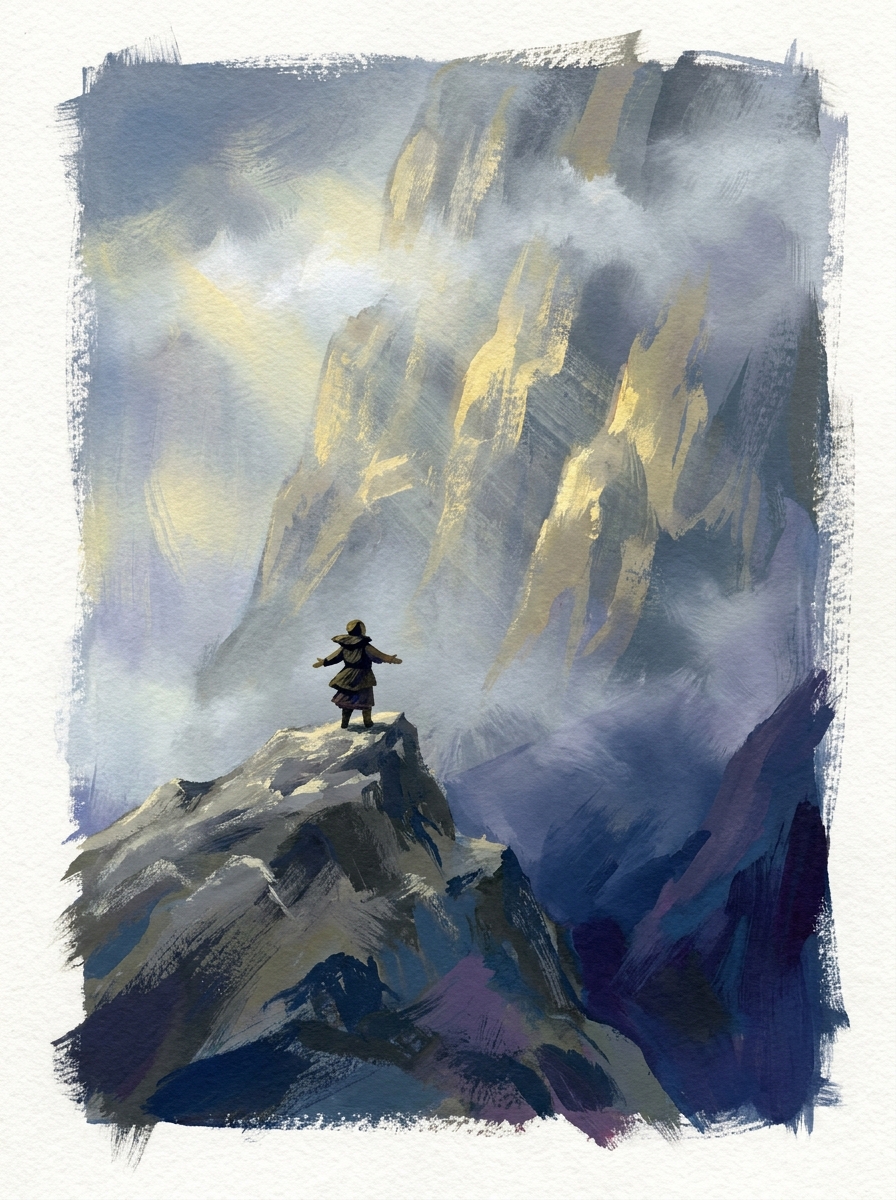
Somewhere on this planet, a mountain has been sacred for as long as the people at its base have had words for sacred. This is true of every continent that has mountains. Olympus. Sinai. Meru. Kailash. Fuji. Kilimanjaro. Denali. The Andes peaks that the Inca dressed in silver. The list does not run out. It circles the globe.
The repetition is the argument. Mountains become sacred not because one culture invented the idea and exported it. Mountains become sacred because the brain does something specific when it encounters a vertical break in the horizon, and that something has been available for religious elaboration in every culture that has ever looked up.
The Substrate
Verticality activates what cognitive scientists call ascent cognition: the coupling of physical effort with perceived reward. Climbing is hard. The brain treats hard things that produce visible progress as meaningful. The summit is the reward. The effort is the credential. The conjunction of difficulty and elevation produces a state that the religious traditions of the world have consistently interpreted as transcendence, not because transcendence is a property of altitude, but because the brain's response to altitude resembles the brain's response to transcendence closely enough that the mapping is almost inevitable.
The awe response provides the emotional register. Dacher Keltner's research at UC Berkeley on the psychology of awe demonstrates that vastness plus a need for accommodation (the need to revise existing mental models) produces a distinctive emotional state: a feeling of smallness, a reduction in self-focus, and an increased willingness to connect with something larger than the individual. Mountains produce this response reliably because they are vast, because they break the ordinary plane of the horizon, and because their scale requires the brain to recalibrate its sense of the observer's size.
The weather differential makes mountains ecologically distinct. Temperature drops with altitude. Moisture condenses. Clouds form at predictable elevations. The mountain that is warm at its base and frozen at its summit contains, in a single physical structure, the full range of climatic experience the brain associates with different seasons and different places. The summit is another country. The brain treats it as one.
Visibility from the summit provides the perceptual payoff. The elevated position offers prospect: the ability to see far, to scan the terrain, to locate resources and threats from a distance. The prospect affordance is deeply wired. Savanna-preference research has consistently shown that humans prefer landscapes that offer elevated views with refuge nearby. The mountain summit is the extreme case of this preference: maximum prospect, maximum exposure. The exposure is part of the experience. The summit strips away cover and leaves the climber visible to everything, which is another way of saying the summit produces vulnerability, which is another way of saying the summit produces the conditions under which the sacred has traditionally been encountered.
The Exemplars
Mount Sinai in the biblical tradition is the mountain as revelation site. Moses ascends. The people stay below. The law is received at the summit, in fire and cloud, in conditions that only one person can tolerate. The structure is precise: the mountain separates the receiver from the community, elevates the receiver to the threshold of the divine, and returns the receiver with something, the tablets, the law, that the community needs but could not have obtained at ground level. The mountain is the mechanism of the revelation. The revelation could not have happened in a valley.
Mount Meru in Hindu, Buddhist, and Jain cosmology is the mountain as cosmic axis. Meru is the center of the universe, the pillar around which the sun and moon revolve, the vertical structure that connects the underworld to the heavens. The mountain here is not a specific peak. It is the principle of verticality itself, elevated to the organizing structure of the cosmos. Every real mountain that is treated as sacred in these traditions is, at some level, a local instance of Meru: a place where the cosmic vertical touches the terrestrial horizontal.
Mount Fuji is the mountain as national icon, and its status reveals the political dimension of the sacred mountain. Fuji has been a pilgrimage site, a subject of art, a marker of national identity, and a UNESCO World Heritage Site. Its meaning has shifted with each era of Japanese history, from the Shinto understanding of the mountain as the dwelling place of deities to the Edo-period aesthetic treatment by Hokusai and Hiroshige to the modern status as a symbol of Japan itself. The mountain remains. What the culture projects onto it changes.
Uluru, in central Australia, functions as a mountain in the cognitive sense despite being geologically a different formation. It rises from the flat desert with the vertical break that the brain reads as significant. For the Anangu people, Uluru is a sacred site whose specific stories are not for general circulation, which is itself revealing: the sacred mountain often carries knowledge that is restricted, that belongs to specific persons or groups, that is dangerous if encountered without preparation. The mountain's height is not merely physical. It is epistemological. There are things you can know at the summit that you cannot know at the base, and the knowledge is guarded because the knowledge is powerful.
The Andes peaks that received Inca child sacrifices, the capacocha, represent the mountain at its most extreme conjunction of the sacred and the terrible. Children were brought to the summits and killed as offerings to the mountain deities. The archaeology is unambiguous. The sacred mountain is not always benign. The altitude that produces awe also produces sacrifice, and the sacrifice reveals what the culture was willing to pay for the mountain's favor.
The Variations
The home of the gods and the hermit's height are different uses of the same substrate. Olympus houses a community of deities. The Christian hermit's mountain houses a single person seeking solitude. The cognitive input is the same: elevation, exposure, separation from the human community below. The output differs according to what the culture sends up the slope.
The cosmic axis, the axis mundi that connects the underworld to the heavens through the mountain, is the mountain as cosmological infrastructure. Meru, Yggdrasil (which is a tree but operates as a mountain in the structure), the ziggurat (which is a built mountain): these are all versions of the same idea, that the vertical dimension of the cosmos requires a physical structure to hold it in place, and the mountain is the natural candidate.
The volcano is the mountain combined with the underworld and with power. The volcano erupts. The mountain that was static becomes active, and the activity is experienced as both divine and destructive. Pele in Hawaiian tradition, Vulcan in Roman tradition, the volcanic gods across the Pacific Ring of Fire: these are mountains that remind the species that the sacred is not always safe, that the vertical can open downward as well as upward, that the mountain is not only a place of ascent but a place where the earth's interior forces its way to the surface.
The Honest Account
The sacred mountain has been claimed by religions and nation-states with overlapping and incompatible claims. Sinai is contested territory. Kailash is politically controlled by China. The Temple Mount in Jerusalem is a mountain at the center of one of the most intractable conflicts in modern history. The sacred geography of mountains does not produce peace. It produces competing claims to the sacred, and competing claims to the sacred produce wars.
The romantic-sublime construction of the mountain, the post-Burke, post-Wordsworth European tradition that treated mountains as aesthetic and spiritual objects, is a relatively recent elaboration that was exported globally during the colonial period. Before the eighteenth century, European travelers generally treated mountains as obstacles. The transformation of the mountain from obstacle to spiritual destination was a cultural choice, and the choice had consequences. The European mountaineering tradition that followed was, in part, a colonial project: the conquest of peaks in the Himalayas, the Andes, and the Alps as extensions of national prestige.
The summit as conquest is the mountain's shadow. "Because it is there" is Mallory's answer, and the answer reveals the assumption: the mountain is a challenge to be overcome, a peak to be claimed, a record to be set. The commodification of summiting, the guided Everest expedition, the Instagram post from the peak, is the modern version of the same impulse. The mountain's sacred weight is converted to achievement metrics, and the conversion evacuates the meaning the substrate produced.
The Craft Turn
The mountain story works when the ascent costs. The summit that is reached without effort is a platform, not a mountain. The figure earns its weight through what the climb demands.
The best mountain stories are stories about what the climb does to the climber. McCarthy's mountains in Blood Meridian and The Crossing are not backgrounds. They are interlocutors. The mountain changes the character who crosses it, and the change is permanent, and the permanence is what separates the mountain from the hill.
The summit is also the place where the story must decide what was worth the climb. The protagonist who reaches the top and finds what they expected has been on a hike. The protagonist who reaches the top and finds something they did not expect, or finds nothing at all, or finds that the view from the summit changes what they thought they were climbing for, is having the mountain experience the substrate produces.
The Return
The mountain is the species's recognition that vertical space is morally weighted. Up is closer to the divine. Down is closer to the dead. The bias is in the wiring, and the wiring does not care whether the culture believes in gods or not. The brain still responds to elevation with the same cocktail of effort, exposure, awe, and vulnerability that the sacred traditions named and the secular traditions have tried, mostly unsuccessfully, to rename.
The mountain is still there. It was there before the culture, and it will be there after. The question the mountain asks is not what is at the top. The question is what the climb costs, and whether the climber is honest about the cost.
Every Continent Has a Sacred Mountain. That's the Argument.
Olympus. Sinai. Meru. Kailash. Fuji. Kilimanjaro. Denali. The list circles the globe. Mountains become sacred not because one culture invented the idea. They become sacred because the brain does something specific when it encounters a vertical break in the horizon.
Why Mountains Move Us
Climbing is hard, and the brain treats hard things that produce visible progress as meaningful. The summit is the reward. The effort is the credential. The conjunction of difficulty and elevation produces a state that religious traditions have consistently called transcendence, not because transcendence is a property of altitude, but because the brain's response to altitude resembles the brain's response to transcendence closely enough that the mapping is almost inevitable.
Dacher Keltner's research on the psychology of awe shows that vastness plus the need to revise your mental models produces smallness, reduced self-focus, and connection to something larger. Mountains produce this reliably.
The summit offers maximum visibility and maximum exposure. You can see everything. Everything can see you. The exposure produces vulnerability, which is another way of saying it produces the conditions under which the sacred has traditionally been encountered.
Sacred Mountains Around the World
Mount Sinai: Moses ascends. The people stay below. The law is received at the summit in fire and cloud. The revelation couldn't have happened in a valley.
Mount Meru: the center of the universe in Hindu, Buddhist, and Jain cosmology. The pillar around which the sun and moon revolve. Every real sacred mountain is, at some level, a local instance of Meru.
Mount Fuji: pilgrimage site, art subject, national icon. The mountain remains. What the culture projects onto it changes with each era.
Uluru: it functions as a mountain even though it's geologically different. The Anangu people treat it as sacred and restrict certain knowledge about it. The mountain carries things you can know at the summit that you can't know at the base.
The Shadow of the Height
Sacred mountains get claimed by competing groups. Sinai is contested territory. Kailash is politically controlled by China. The Temple Mount is at the center of one of history's most intractable conflicts.
The Romantic tradition that treated mountains as spiritual objects is relatively recent and was exported globally during colonialism. Before the eighteenth century, Europeans mostly treated mountains as obstacles. The European mountaineering tradition that followed was partly a colonial project: conquering peaks as extensions of national prestige.
"Because it is there" reveals the assumption: the mountain is a challenge to be conquered. The Instagram post from the summit is the modern version. The mountain's sacred weight gets converted to achievement metrics.
What Makes a Mountain Story Work
The ascent has to cost something. The summit reached without effort is a platform, not a mountain. The best mountain stories are about what the climb does to the climber.
The character who reaches the top and finds what they expected has been on a hike. The character who finds something unexpected, or nothing at all, is having the experience the substrate produces.
Still Looking Up
The brain still responds to elevation with effort, exposure, awe, and vulnerability. It doesn't care whether the culture believes in gods. The mountain was there before the culture. The mountain will be there after.
The question isn't what's at the top. It's what the climb costs, and whether the climber is honest about it.