

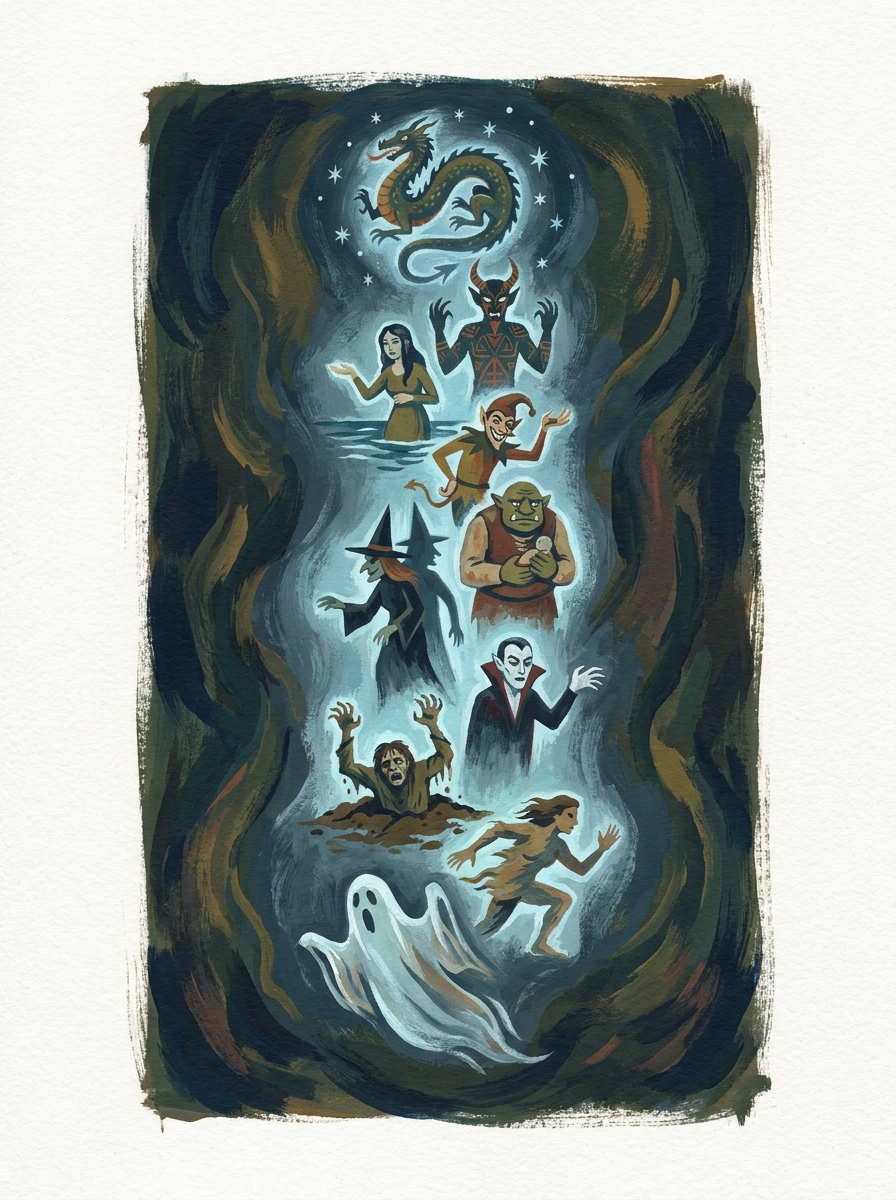
We have walked from the room to the root of the world. From the dead in the head to the coil beneath the sky. Ten figures, ten cognitive seams, ten collisions between the machinery of the mind and the conditions that make the machinery fire without supervision. The dark has been filled, and the fill has been read, and the question that remains is the one the introduction promised to pay off: what do the monsters protect, and what does it cost us when we let them stop?
The ghost protects mourning. It gives grief a figure — makes the persistence of the dead visible, external, something the community can acknowledge and attend. The person-tracker will not stop running. The mind-model will not delete. The ghost licenses the time this requires and names the labor it demands. Without the ghost, grief has no figure, and a culture that denies grief its native pace is a culture that tells the bereaved to recover on a schedule the nervous system does not recognize.
The shapeshifter protects vigilance about hidden nature. It warns that the person you trust may not be what you think — and may not be what they think — and that the recognition system, for all its sensitivity, can be beaten by someone wearing the right face. Without the shapeshifter, the warning goes silent, and the dangerous one at the table goes undetected not because the signs are absent but because the figure that trained the mind to read them has been retired.
The revenant protects the duty owed to the dead. The body that will not stay buried is the body whose departure was not properly honored — the burial botched, the rites skipped, the labor of farewell left undone. Without the revenant, the dead become disposable, and the community loses the oldest insistence the species has ever made about the moral weight of the body: that it must be handled with care, with ceremony, with the specific attention that acknowledges a person was here.
The vampire protects suspicion of charming asymmetric exchange. It warns that the most dangerous predator does not look like a predator — it looks like desire, and it takes more than it gives, and the asymmetry is hidden until the account is empty. Without the vampire, the species loses the figure that trained it to inspect the deal that feels too good, and the charming extractor moves through the world without a name.
The witch protects attention to harm from within. She warns that the community contains people who wish you ill, and that the harm they do — through envy, gossip, social sabotage — operates through channels the social order cannot easily police. She also warns, with equal force, that the accusation of hidden harm is itself a weapon, and that the mob that forms around the accusation can be as dangerous as the witch herself. Without both edges, the figure loses its balance and becomes either a license for persecution or a denial that insider harm exists. Both losses are real.
The ogre protects the hardest truth: that authority can become predatory. The figure that guards the child can be the figure that eats it. The institution built to shelter can become the institution that feeds. Without the ogre, the species loses its oldest warning about the power differential between the large and the small, and the children — literal and metaphorical — are left without the pattern-recognition the figure was built to install.
The trickster protects wisdom about language and exchange. Every gift has a cost. Every contract has a seam. Every sentence carries the possibility that the person on the other side is reading it differently than you are. Without the trickster, the species loses its inoculation against the gap between what is said and what is meant — the gap where the con lives, where the wish turns on its grantee, where the fine print devours the promise.
The drowner protects the threshold. Not all boundaries are drawn by human hands. Some were drawn by the world itself — the waterline, the depth, the crossing past which the human body ceases to function — and the drowner is the figure that stands at these boundaries, beautiful and beckoning, to teach the species that the beauty on the other side of the line is not always what it appears to be. Without the drowner, the species loses its fluency in saying no, its recognition that some thresholds were drawn by older forces than ours and are not to be crossed because someone lovely is asking.
The demon protects the line under evil. It insists that some acts are not merely harmful but aimed — not merely destructive but opposed to everything the species has built for itself. The modern collapse of evil into preference difference, the sophisticated shrug that refuses to call anything by its name, is the specific erasure the demon exists to resist. Without the demon, the species loses its oldest insistence that evil is real, that it has a direction, and that the correct response to it is not analysis but opposition.
The dragon protects awe. It carries the truth that the world contains forces that exceed the human — forces that are not hostile in the personal sense but are indifferent in a way that, from inside a human life, feels indistinguishable from hostility. To disenchant the dragon is to flatten the cosmos to human size, to insist that nothing is larger than our comprehension or older than our history. This is the founding error, and the dragon has been resisting it for as long as the species has been capable of looking at the night sky and feeling small.
Ten figures. Ten warnings. A distributed alarm system the species has been building and refining for forty thousand years — in cave paintings and funerary rites, in bedtime stories and epic poems, in the specific look a parent gives a child when the child asks what is in the dark and the parent, for once, does not lie.
The betrayal is simple. When the figures are hollowed out — when they are stripped of their warnings and rebuilt as product — the alarms go silent. The Disney witch carries no caution about insider harm. The Marvel demon flatters its audience with the aesthetic of cosmic evil stripped of its moral weight. The romantic vampire teaches the mind to find asymmetric extraction beautiful rather than dangerous. The comedy ogre assures the child that authority is clumsy and harmless and easily outwitted. Each of these is a specific surgery, performed on a specific figure, removing a specific warning, and the cumulative effect is a culture that has inherited the shapes of the monsters but lost the information the shapes were built to carry.
This is not a stylistic preference. I am not arguing for darker stories because dark is better, or for a return to some imagined past in which monsters were taken seriously and the culture was healthier for it. I am arguing that the figures do cognitive work — real work, the kind that shapes behavior and installs pattern-recognition and inoculates the mind against specific varieties of threat — and that the work cannot be done by a figure that has been emptied of its cargo. A stuffed animal has the shape of a predator and none of its weight. A defanged monster has the shape of a warning and none of its force.
The species kept these figures dangerous because the dangers they warn about are real. Grief is real. Betrayal by trusted insiders is real. Asymmetric exchange dressed as desire is real. Authority that feeds on the people it was built to protect is real. The gap in language where the con lives is real. The threshold you should not have crossed is real. The indifference of forces that exceed the human is real. The monsters were built to name these truths in a form the rational mind cannot easily dismiss, because the rational mind is precisely the faculty that would dismiss them, and the truths are too important to be left to a faculty that has a financial interest in looking away.
The dark is still being filled. The mind is still running its programs. The figures are still arriving — the same ones that have always arrived, produced by the same collisions, wearing the same shapes.
The question was never whether the monsters would keep coming. They will. The architecture guarantees it.
The question is whether the monsters that arrive will still be carrying something — whether the ghost will still protect mourning, whether the shapeshifter will still protect vigilance, whether the dragon will still protect awe — or whether they will arrive empty, shells of what they were, recognizable in form and stripped of function.
The dark does not care what fills it. But we should.
Ten monsters. Ten warnings. A species-wide alarm system the human race has been building for forty thousand years.
We've walked from the room to the root of the world. From the ghost at the bedside to the dragon beneath the sky. Each figure traces to a specific collision in the brain — systems that evolved for real purposes producing monsters as a side effect. And each figure, it turns out, protects something the species needs.
The Ledger
The ghost protects mourning. It gives grief a figure and licenses the time grief takes. Without it, a culture forces the bereaved to recover on a schedule the nervous system doesn't recognize.
The shapeshifter protects vigilance about hidden nature. It warns that the person you trust might not be what they seem. Without it, the dangerous one at the table goes undetected.
The revenant protects the duty owed to the dead. The body that won't stay buried is the body whose departure was not honored. Without it, the dead become disposable.
The vampire protects suspicion of charming extraction. It warns that the most dangerous predator looks like desire. Without it, the mind loses its training to inspect the deal that seems too good.
The witch protects attention to harm from within — and warns that the accusation of harm is itself a weapon. Without both edges, the figure breaks.
The ogre protects the hardest truth: authority can consume. The protector can become the predator. Without it, the children — literal and metaphorical — lose their oldest warning.
The trickster protects wisdom about language. Every gift has a cost. Every contract has a seam. Without it, the species loses its defense against the gap between what's said and what's meant.
The drowner protects the threshold. Some lines were drawn by older forces than ours. Without it, the species loses its ability to say no to beautiful things on the other side of dangerous boundaries.
The demon protects the line under evil. It insists some acts aren't just harmful but aimed. Without it, evil collapses into preference difference and loses its name.
The dragon protects awe. The world is larger than you think. Without it, the cosmos shrinks to human size, which is the founding error.
The Betrayal
When these figures get hollowed out — stripped of their warnings and rebuilt as entertainment products — the alarms go silent.
The Disney witch carries no caution about insider harm. The Marvel demon is a cool action villain with no moral weight. The romantic vampire trains audiences to find extraction beautiful. The comedy ogre assures kids that authority is clumsy and harmless.
Each of these is a specific surgery on a specific figure, removing a specific warning. And the combined effect is a culture that inherited the shapes of the monsters but lost the information those shapes were built to carry.
This isn't about dark stories being better than light ones. It's about function. A stuffed animal has the shape of a predator and none of its weight. A defanged monster has the shape of a warning and none of its force. The warning can't do its work from inside a figure that's been emptied of its cargo.
Why It Matters
The dangers these monsters warn about are real. Grief is real. Betrayal by trusted insiders is real. Charming exchange that's actually extraction is real. Authority that feeds on the people it should protect is real. The gap in language where the con lives is real. The threshold you shouldn't have crossed is real. Forces in the world that exceed the human are real.
The monsters were built to name these truths in a form the rational mind can't easily dismiss — because the rational mind is precisely the part that would dismiss them, and the truths are too important to risk.
The species kept the figures dangerous for forty thousand years. In cave paintings. In bedtime stories. In rituals that lasted longer than the languages that carried them.
The Final Question
The dark is still being filled. The same systems are still running. The same shapes are still arriving — the ghost, the shapeshifter, the corpse, the parasite, the witch, the ogre, the trickster, the drowner, the demon, the dragon.
The question was never whether the monsters would keep coming. They will. The brain guarantees it.
The question is whether they'll still be carrying something when they arrive — or whether they'll show up empty, recognizable in form and stripped of everything they were for.
The dark doesn't care what fills it. But we should.