

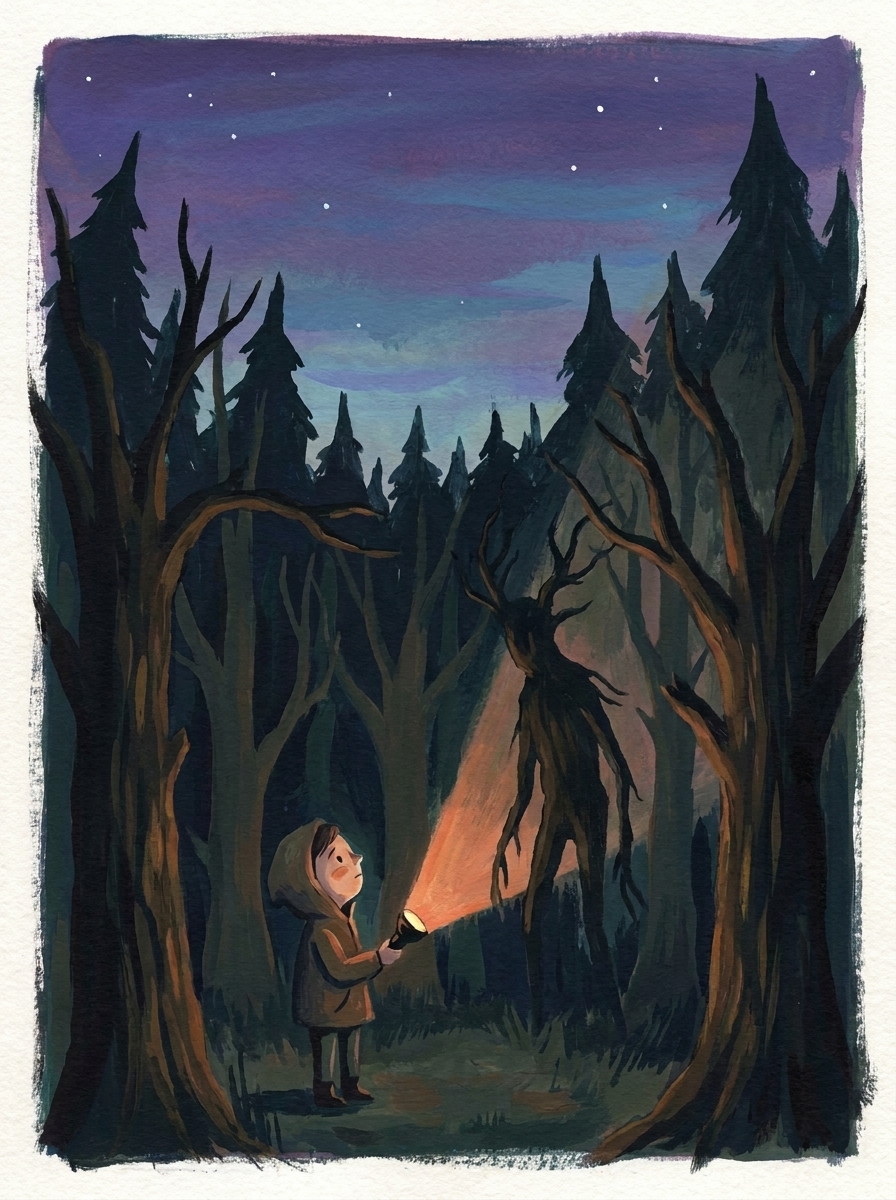
I keep a folder of cryptid documentaries on my hard drive. Not as a joke, not as an irony shield — I watch them. Patterson-Gimlin, the Skinwalker Ranch footage, the Brown Mountain Lights, the Nazca lines. I know what an apophenic forty-second forest clip looks like to a trained eye. I know that the modal Bigfoot witness is a tired hunter at dusk, that pareidolia turns shadows into shoulders, that a deer rearing on its hind legs in late autumn is a more-than-sufficient explanation for ninety percent of what gets posted to the cryptozoology subreddits. I have read the structural critiques. I find them persuasive. And then a documentary opens with grainy thermal footage of a bipedal heat signature at the treeline in Olympic National Forest, and somewhere underneath the part of me that knows better, a different part lights up — wants it to be real, half-believes it might be, and would, given even a little permission, walk back into the woods that night with a flashlight.
I am not embarrassed about this anymore. I used to be. I think the embarrassment was itself a kind of cope, because it let me pretend the gap between knowing and feeling was smaller than it was. The honest report is that there is a chasm between the two, and that the chasm is roughly the same width whether the subject is Bigfoot or interstellar visitation or whether my dead grandfather sometimes makes the lights flicker. I know the probabilities. I feel the pull. The two operations are happening in the same body and they are not, in any direct way, talking to each other.
This essay is about the gap. Specifically: what produces it, why it is morally neutral machinery, and why understanding how it works is, in the current attention environment, becoming something closer to a survival skill than a curiosity.
Start with the machinery, because the embarrassment dissolves once you can see it. A human nervous system is the inheritance of roughly two million years of selection in environments where pattern detection had to be calibrated for false positives. The cost asymmetry was brutal and one-directional: a rustle in the grass that turned out to be wind cost you a startle reflex and a little adrenaline; a rustle that turned out to be a leopard and got dismissed as wind cost you a lineage. So the dial got set high. We see faces in clouds, agency in weather, intention in the wind moving a curtain, because the kind of brain that didn't do this got eaten and the kind that did had children. Our default is to perceive something rather than nothing, and to perceive someone rather than something. The wilderness still in our wiring expects ambush. The forest at dusk activates equipment that was never designed for the suburbs.
Layer onto that the architecture of narrative cognition. The brain doesn't store experience as a database of independent propositions; it stores experience as story, with causal structure already baked in. When a tale arrives — a hunter's anecdote about something tall watching from the ridgeline, a pilot's description of a craft that moved against inertia — the cognitive system processes it the same way it processes any other story, which is to say it integrates it into a working model of the world. We are not, by default, comparing the new story to a Bayesian prior over hominid biology or aerospace physics. We are comparing it to other stories of similar shape, and the comparison produces a felt sense of plausibility that operates upstream of any explicit probability calculation. Stories about things in the woods feel more probable after you hear other stories about things in the woods. This is not a bug. This is how the system was designed to work in a world where most useful information came in narrative form from people who had been somewhere you had not.
A third piece of the machinery, which the cognitive scientists have spent the last fifteen years formalizing under the unfortunate name of predictive processing: the brain is fundamentally a prediction engine, not a perception engine. It generates a model of what it expects to see and then updates the model against the discrepancy when sensory data arrives. Perception itself is hypothesis-confirmation modulated by prior expectation, which means that what you see in the forest at dusk is partly a function of what your nervous system has been primed to look for. Prime someone for Bigfoot and the bear at three hundred yards becomes ambiguous in a particular direction. Prime someone for craft and lights and the satellite passing overhead acquires a felt strangeness it would not otherwise have. The honest gloss is that there is no clean separation between seeing and believing, because the seeing is partly constituted by what the believing apparatus has been pre-loaded to find.
And underneath all of this — the pattern detection, the narrative processing, the predictive priors — there is what the existential psychologists have spent fifty years documenting, which is that the human animal carries a low-grade, chronic, mostly suppressed awareness of its own mortality and meaninglessness, and that this awareness leaks out as a constant demand for the world to be larger, stranger, and more meaningful than it usually appears. The Burke meta-analysis, looking across two hundred and seventy-seven experimental studies, found that mortality salience reliably increases supernatural belief, worldview defense, and openness to agency-rich explanations of ambiguous events at an effect size of about r equals .35. That is not a fringe effect. That is a stable feature of the architecture. Whatever is reminding you, at a sub-articulate level, that you are going to die is also tilting your plausibility weights toward a universe in which the rules are stranger than physics, where contact with something Other is possible, where the world is not done revealing itself. The forest at dusk is talking to that part of you.
So far, none of this is news to anyone who has read the cognitive science. The news, or anyway the move I want to make, is the next one. Because once you have the machinery laid out — pattern detection biased toward false positives, narrative cognition treating stories as evidence, predictive priors shaping perception, existential machinery demanding a meaning-saturated world — you start to notice that the machinery does not, in any meaningful way, distinguish between propositions that differ from each other by enormous margins of probability.
Take the two propositions I find myself entertaining at the edge of a documentary on a Tuesday night. There is life somewhere in the universe. And that life has visited Earth and is being concealed by terrestrial governments. The first claim is, on any reasonable Bayesian accounting, somewhere between likely and almost certainly true, given the number of stars, the prevalence of organic chemistry, the relatively short interval between Earth's habitability and the emergence of life. The second claim requires, at minimum, faster-than-light travel or extreme longevity, a sustained interest by a non-human civilization in our specific rock, decades of operationally airtight cover-up across multiple governments and contractors, and several other low-probability conjunctions stacked on top of each other. The probabilities differ by something like fifteen orders of magnitude. The first is a near-default expectation among working astrobiologists. The second is approximately as well-evidenced as the proposition that my dead grandfather is moving the lights.
But the felt plausibility — the part of me that lights up when the thermal footage comes on — does not notice the gap. It treats both as roughly the same kind of thing. It treats them, in the language of the previous paragraphs, as story-shaped propositions about a wider, stranger world; as data that fits a prior calibrated for ambush; as offerings to the existential machinery that demands more universe than the suburbs are providing. The cognitive operation that produces I feel like this might be true is doing something completely different from the operation that produces the probability of this is roughly 0.7. The first is a belief-feeling, generated by a system that evolved to track the social and existential meaning of propositions. The second is a probability calculation, generated by a system we had to invent in the seventeenth century because we noticed the first system kept getting us killed.
This is, I think, the diagnostic moment — the place where the essay's real claim lives. The mistake is not that we feel the pull of cryptids and visitation. The pull is information about how the machinery is constructed; it is not, in itself, evidence about the world. The mistake is in confusing one operation for the other. When the felt plausibility lights up, what we are experiencing is not "my mind is doing probability." What we are experiencing is "my mind is doing meaning." And meaning, as a cognitive operation, is necessarily impressionistic, narrative-shaped, and tilted toward the world being larger than it appears. It would be a defective meaning-machine if it weren't.
I want to sit in this for a moment, because it is the part of the argument that I want to be careful about. There is a tradition — call it the eliminative-rationalist tradition — that takes the gap between feeling and calculation and concludes that the feeling is just wrong, that the proper response to noticing it is to suppress it, override it, train it out. Dawkins in his harder moments. Sam Harris on a podcast. The New Atheist project of the mid-2000s. I find that tradition unsatisfying, and not because I want to keep Bigfoot. I find it unsatisfying because it misunderstands what the feeling is for.
The feeling is the substrate of meaning-making, which is to say it is the substrate of being a person who is doing anything with their life rather than passively reading off a probability distribution. The same machinery that lights up at the thermal footage is the machinery that makes a friend's death feel like it should mean something, that makes a piece of music feel like it is gesturing at something the notes don't contain, that makes love feel like it is also a metaphysical event and not only a neurochemical one. You cannot extract the part that generates the pull toward cryptids without also extracting the part that generates the pull toward significance. The William James line, that our passional nature must decide where evidence cannot, is sometimes read as a defense of religious belief; what it is actually saying is that the whole human creature is the believer, and the whole creature has needs that operate prior to and underneath any specific propositional content. To imagine a belief-forming apparatus that is purely evidence-tracking is to imagine an apparatus that does not belong to a creature with stakes.
The honest position, I think, is that the feeling is real as a feeling and informative about the feeler and not, by itself, evidence about the world. The wilderness still in our wiring is real news — it tells us something true about the architecture of the nervous system, about the kind of animal we are, about what our ancestors did at the treeline at dusk for hundreds of thousands of years. The thermal footage is, separately, a piece of probabilistic evidence about whether there is currently a hominid in the Pacific Northwest, and on that question, the prior is very, very low and the data is very, very weak. Both things are true. The error is in routing the first kind of information through the channel that handles the second.
Once you can see the mechanism this clearly, two things happen. The first is private and gentle: the embarrassment about wanting Bigfoot to be real evaporates, because the wanting is not a failure of rationality; it is information about how the machinery feels from the inside. The second is public and not gentle at all. Because the same machinery that lights up at the thermal footage is the machinery that lights up at QAnon, at election conspiracies, at the engineered narratives currently being optimized at industrial scale by people who understand the mechanism in considerably more detail than I have laid it out here.
This is what I mean about morally neutral machinery. The cognitive system that generates the felt plausibility of cryptids is identically the system that generates the felt plausibility of "the election was stolen" or "vaccines contain microchips" or "the cabal is in the basement of the pizza restaurant." It is the same equipment, doing the same operation: integrating story-shaped information into a working model of the world, generating felt plausibility upstream of any probability calculation, treating narrative coherence as evidence of truth. The mechanism does not know the difference between Bigfoot and QAnon. It is calibrated for sensitivity, not accuracy. It was built for a world in which the cost of missing a real pattern was catastrophic and the cost of generating a false one was low. That cost structure has reversed. We now live in environments where false patterns are deliberately manufactured at scale by actors who have studied the architecture and built tools to exploit it, and where the cost of acting on a false pattern can be — as recent history demonstrates — a participatory hand in the dismantling of democratic institutions, or a vaccine refusal that gets a child hospitalized, or a stockpile of weapons aimed at a target the algorithm picked for you.
So the question stops being "is it foolish to want Bigfoot to be real," which is the wrong question, and becomes "who is operating the machinery, and toward what end." When an artist deploys the equipment, the result can be Tarkovsky, or Lynch's Twin Peaks, or the late paintings of Hilma af Klint — work that uses the pull of the strange to deepen attention to the actual world, to make the felt-plausibility-of-meaning bleed into a richer engagement with ordinary experience. The artist understands the apparatus and uses it to expand the user's perceptual range. The propagandist understands the same apparatus and uses it to collapse the user's judgment around a predetermined conclusion. Same equipment. Different operators. Wildly different outcomes for the operated.
I am less certain about this next part than I am about the rest, but I will say it anyway: I think one of the most important pieces of cognitive hygiene available to a person currently alive is the ability to feel the pull of a felt-plausibility and also hold, in a separate channel, the probability calculation, without confusing them. To say to yourself, in the moment the thermal footage lights up: yes, this is doing meaning to me, and the meaning is real as meaning; and also, the probability that there is a relict hominid in Olympic National Forest is approximately zero, and these two facts are not in conflict because they live in different parts of the apparatus. The same hygiene works against QAnon, against the engineered outrage cycle, against the AI-generated narrative that will increasingly be aimed at you with knowledge of your specific priors. It is not the same thing as suppressing the feeling. It is more like learning to read it as instrumentation about the self rather than as testimony about the world.
This is hard. It is harder now than it has ever been, because the attention economy is built on collapsing exactly this distinction — on making the felt plausibility feel like probability-tracking, on smuggling meaning operations into perceptual channels, on producing narratives so well-calibrated to the architecture that the gap between knowing and feeling closes without you noticing. The platforms have read the cognitive science. The political operatives have read the cognitive science. The advertising agencies and the chatbot designers and the propagandists for foreign-influence operations have all read the cognitive science. The only person who often hasn't read the cognitive science is the person being operated on.
I keep watching the cryptid documentaries. I think I will keep watching them. The wanting-Bigfoot-to-be-real is doing something for me — it is keeping a part of my nervous system in dialogue with the wilder world it expected to live in, and that dialogue feels, in some way I cannot fully articulate, like part of being a person rather than only a brain. But I want to be clear, especially to myself, about what is happening when the pull arrives. It is not evidence. It is instrumentation. The forest at dusk is talking to a part of me that the forest has every right to talk to. The question is whether I can hear the conversation for what it is, without letting it impersonate a different conversation that I am also having, with much harder-edged tools, about what is actually out there.
The cathedrals of the next century, if there are any, will not be built of stone. They will be built of attention. The architects of that attention already understand the substrate; the question is whether the rest of us can learn the same thing fast enough to keep our judgment our own. Wanting Bigfoot to be real is a small, mostly harmless symptom of a much larger fact about the kind of animal we are. The fact will not go away. What you do with the fact — whether you let it deepen your attention or hand your attention to someone who has studied the mechanism harder than you have — is increasingly the only question that matters.
I will be in the woods this weekend with the flashlight. I do not expect to find anything. I would like to.
I have a folder of cryptid documentaries on my laptop. Not as a joke. I watch them on purpose.
I know the science. I know that a deer on its hind legs at dusk explains most of what people film. I know the human eye sees faces in clouds and shoulders in shadows. None of that stops the feeling.
A grainy thermal clip rolls. Something tall walks the treeline. And some part of me lights up like a kid. It wants this to be real. It half-believes it already is.
I used to be embarrassed by that part of me. I'm not anymore. And I think the reason matters more than it sounds.
The Machinery in Your Head
Your brain was not built in a library. It was built in a forest, over two million years, by ancestors who got eaten when they missed things.
A rustle in the grass might be wind. It might be a leopard. The brain that called every rustle a leopard wasted some adrenaline. The brain that called every rustle wind got eaten.
So we are wired to see something rather than nothing. And someone rather than something. The wind in a curtain feels like a presence because that's the only setting your nervous system ships with.
There's more. Your brain doesn't store the world as a list of facts. It stores it as stories. When someone tells you a story about a thing in the woods, you don't compare it to a probability chart. You compare it to other stories about things in the woods. And it starts to feel possible.
One more layer. Underneath all of this, you carry a quiet awareness that you will die one day. You don't think about it on purpose. But it leaks out as a constant low hum, asking the world to be bigger and stranger than the suburbs make it feel.
The forest at dusk is talking to that part of you. The thermal footage is talking to that part of you. That part has been listening for a very long time.
Two Things That Feel the Same
Here's where it gets interesting. Watch what my brain does on a Tuesday night with a documentary on.
It entertains two thoughts. There is life somewhere in the universe. And that life has visited Earth, and the government is hiding it.
The first idea is probably true. Lots of stars. Lots of chemistry. Most scientists who study this expect life is out there somewhere.
The second idea needs aliens who can travel here, a reason to care about us, and a perfect cover-up across decades and governments. The odds are tiny. Closer to my dead grandfather flicking the lights.
But to the feeling in my chest, they're the same thing. Both light up the same circuit. Both feel like maybe.
That feeling isn't doing math. It's doing meaning. And meaning, by design, tilts toward the world being bigger than it looks. A meaning-machine that didn't do that would be broken.
The Honest Reading
Some smart people say the answer is to suppress the feeling. Train it out. Be only the math.
I think they're wrong, and not because I want to keep Bigfoot. I think they're wrong because the feeling has a job.
The same circuit that lights up at the thermal footage lights up when a friend dies and you feel like it should mean something. It lights up when music seems to point past the notes. It lights up when love feels bigger than chemicals.
You can't cut out the part that wants Bigfoot without cutting out the part that wants any of that. They're the same wire.
So here's the honest read. The feeling is real, as a feeling. It tells you something true about you. It does not, by itself, tell you what's out there. Both things are true at the same time.
Why This Isn't Just About Bigfoot
Now the part that isn't gentle.
The same circuit that lights up at the thermal footage is the circuit that lights up at QAnon. At "the election was stolen." At "vaccines have microchips." At every conspiracy that's ever pulled a person away from their family.
The machinery does not know the difference. It is built for stories. It treats coherence as proof. It was tuned for a world where missing a real pattern got you killed and seeing a fake one cost almost nothing.
That world is gone. Now we live in a world where fake patterns are made on purpose, at scale, by people who have read the same science I just told you. Platforms have studied this. Political operatives have studied this. So have advertisers and propagandists.
The only person who hasn't studied it is usually the person being studied.
The Skill Worth Learning
I think one skill matters more right now than almost any other. It's the skill of feeling the pull and also holding the math, at the same time, without confusing them.
To say to yourself, when the thermal clip rolls: yes, this is doing meaning to me. And meaning is real. And also, the chance there's a real hominid out there is basically zero. Both things, in different rooms, not arguing.
That's not the same as killing the feeling. It's more like reading it as a signal about you, not a report about the world.
It's hard. It's harder now than it has ever been, because everything online is built to collapse exactly this gap. To make meaning feel like evidence. To slip story past the part of your brain that would have caught it.
I'll Still Be in the Woods
I'm going out this weekend with a flashlight. I do not expect to find anything. I would like to.
The wanting is doing something for me. It keeps a part of me in conversation with a wilder world than the one I live in. That feels, in some way I can't fully say, like part of being a person and not just a brain.
But I want to know what's happening when the pull arrives. It isn't evidence. It's instrumentation. The forest at dusk is talking to a part of me that the forest has every right to talk to.
The question is whether I can hear what it's actually saying. And whether I can keep that conversation separate from the harder one, with sharper tools, about what's really out there.
The cathedrals of the next century won't be built of stone. They'll be built of attention. The people building them already understand the wiring.
The only question left is whether the rest of us figure it out fast enough to keep our own minds.