

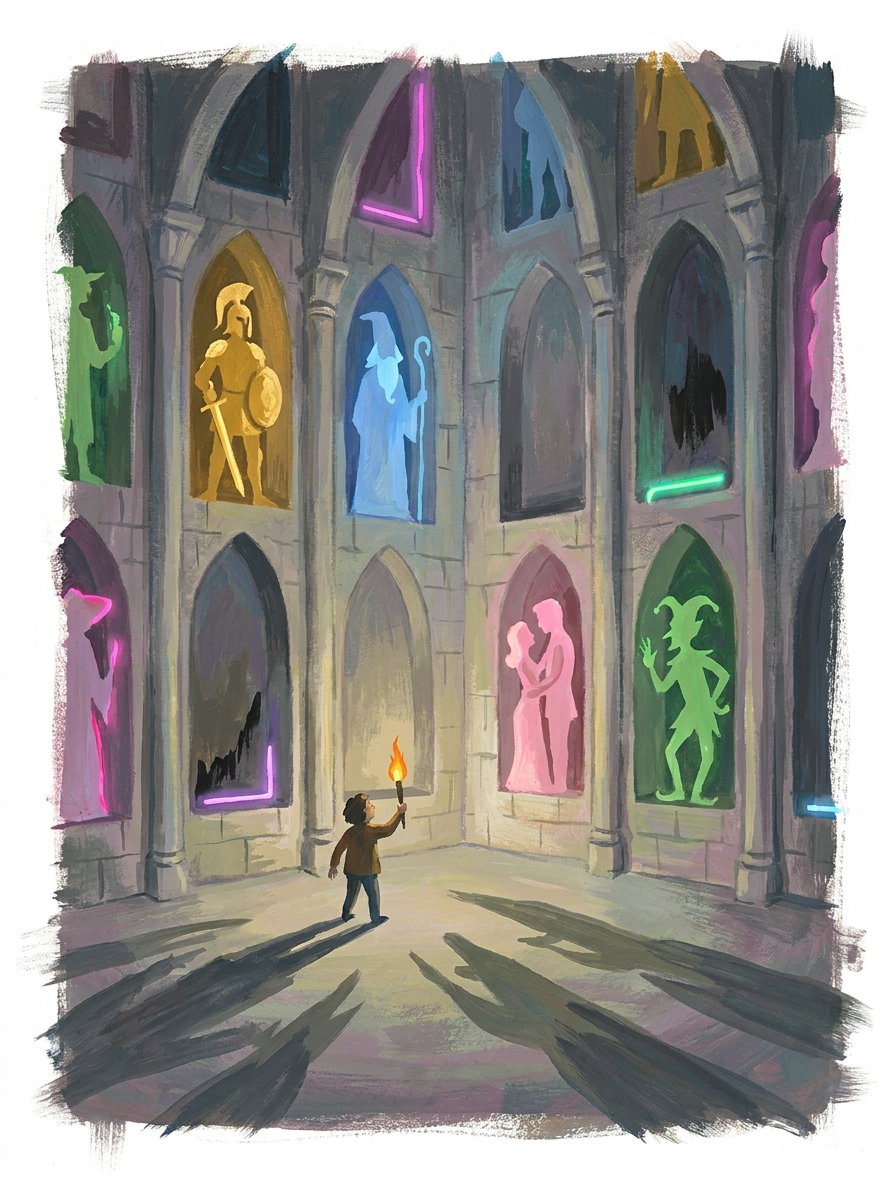
Ten shapes. Ten kinds of work the species keeps needing done. Ten kinds of cost the species keeps paying for the doing.
The warrior protects and the warrior's tradition is hijacked for conquest. The founder builds and the founder's myth legitimates whoever inherits the building. The healer mends and the healer's knowledge is suppressed by the institutions that claim to own healing. The underdog vindicates the small and the underdog's story is used to console the small into accepting their smallness. The trickster liberates and the trickster's wit is indistinguishable, structurally, from the con artist's. The sage teaches and the sage's authority is converted into credentialism that excludes the people who need the teaching most. The lover devotes and the lover's devotion is weaponized as guilt, as control, as the demand that private bonds compensate for public failures. The sacrificer dies for meaning and the state that honors the sacrifice is always recruiting the next one. The renunciate leaves and the leaving is dressed up as spiritual achievement to disguise what is sometimes cowardice. The returner promises and the promise is used to sell reaction as restoration.
Every shape carries its shadow. Every shadow is cast by the same light. The light is real. The shadow is also real. The catalogue does not resolve the tension. The catalogue holds it.
What the Catalogue Reveals
The first revelation is that the shapes are not invented. They are produced.
Prestige detection, coalition cognition, fairness intuitions, mortality salience, causal goal-tracking, over-imitation, the gap between the actual self and the ideal self: these systems are not cultural preferences. They are cognitive architecture. They run in every human brain that has ever been studied, across every culture that has ever been tested, with a consistency that makes the variation interesting precisely because the substrate is so stable. The shapes are what happen when these systems operate at cultural scale, with narrative amplification and institutional support.
This means the shapes are not going away. A culture can suppress a specific hero tradition. It can tear down statues, rewrite textbooks, cancel the figures that occupied the slots last season. But the slots remain. The cognitive machinery that produces the warrior continues to produce the warrior whether the culture has a name for the figure or not. The machinery that produces the sage continues to produce the sage whether the culture honors wisdom or has replaced it with content. The suppression of the figure does not suppress the need for the figure. It just ensures the need gets filled by whatever wanders into the vacancy.
The second revelation is that the shapes reveal the culture more than they reveal the hero. Every society has warriors, but which warriors it elevates tells you what it authorizes violence for. Every society has founders, but which founders it celebrates tells you which foundational violence it has chosen to remember and which it has chosen to forget. The conditional shapes, the lover and the renunciate, are even more diagnostic. A culture that does not produce lover heroes is a culture that has not decided private bonds are worth public sacrifice. A culture that does not produce renunciate heroes is a culture that has not decided that withdrawal from striving is anything other than failure.
The catalogue is a mirror. The mirror does not care whether the culture likes what it sees.
The third revelation is that the shapes are tools, and tools can be turned. This is not a metaphor. It is a description of mechanism. The same neural pathways that produce the protective warrior produce the conquering one. The same prestige circuits that elevate the sage who speaks truth elevate the credentialed expert who speaks power. The same coalition cognition that bonds a community around its sacrificed dead bonds a nation around the demand for more sacrifice. The hardware does not distinguish between the use and the abuse. The hardware provides the slot. The culture fills it.
The filling is where the politics lives. And the politics has never, in the history of the species, been separable from the figure.
The Modern Hollowing
The shapes persist. The modern world has not abolished heroes. It has industrialized them.
The franchise hero is the warrior, the underdog, and the returner fused into a single product and iterated across thirty films, eight streaming series, and a theme park. The figure retains the surface features of the original shapes: the courage, the disadvantage, the promise of return. What it loses is the cost. The franchise hero does not suffer in ways that change the hero. The franchise hero does not pay for the violence in ways the audience must sit with. The franchise hero is the shape with the weight removed, and the weightlessness is the product.
This is not a complaint about superhero movies. It is an observation about what happens to the cognitive machinery when the shapes are delivered without the cost. The prestige circuits still fire. The coalition identification still activates. The mortality-salience management still operates. But the circuits are running on empty calories. The audience has the experience of being in the presence of the hero without the experience of being changed by the presence. The slot is filled. The work is not done.
The algorithmic role model is the sage stripped of wisdom and rebuilt for engagement. The figure says things that sound like insight. The figure performs the gestures of depth: the pause, the earnest stare into the camera, the citation of a study the figure has not read. The prestige circuits fire because the performance is calibrated to make them fire. But the wisdom is not there. The character has not been changed by the knowing. The sage who has not suffered for the knowledge cannot carry the figure's weight, and the algorithmic version has not suffered at all. It has optimized.
The influencer is prestige detection hijacked at the source. The species evolved to pay attention to people who are worth learning from: the skilled hunter, the successful parent, the person who knows where the food is. The influencer activates the same attention system but provides no underlying skill, no knowledge, no competence that the attention is tracking. The figure is famous for being attended to. The attention is the product and the product is the attention and the loop has no content. The slot is occupied. The occupant is empty.
The political pseudo-hero is the most dangerous variant because it combines the returner's promise with the warrior's aggression and the founder's claim to legitimacy. The figure promises to restore a lost order, fight the enemies who destroyed it, and build something permanent in the wreckage. The shape is a composite, and the composite draws power from every source it references. The audience experiences the full emotional force of the heroic tradition without any of the accountability the tradition was supposed to carry. The pseudo-hero is the catalogue weaponized against the people the catalogue was supposed to serve.
What the Hollowing Costs
The cost is not that people stop believing in heroes. The cost is that the belief stops doing work.
A functional warrior tradition tells a culture what violence is for and what violence costs. A hollow one tells the culture that violence is exciting and that the excitement is the point. A functional sage tradition tells a culture that knowledge changes the knower. A hollow one tells the culture that knowledge is a credential, a brand asset, a thing you perform rather than a thing you become. A functional sacrificer tradition tells a culture that some losses are real and that the realness deserves to be honored. A hollow one tells the culture that loss is content, that grief is a narrative arc, that the death is the season finale before the resurrection in the next.
The hollowing does not happen because modern cultures are cynical. It happens because the shapes are valuable, and valuable things get captured by the systems that can profit from them. The franchise captures the warrior. The algorithm captures the sage. The market captures the lover. The political machine captures the returner. The capture is not conspiracy. It is economics. The shapes fill cognitive slots that billions of people need filled, and the entity that fills the slot captures the attention, and the attention is worth money, and the money funds the next filling.
The problem is that the filled slot is not the same as the functioning figure. A malnourished body still feels hungry, and a malnourished culture still needs heroes, but the need is not met by the filling. The need is met by the figure doing the work the shape was built to carry. And the work requires cost.
The Choosing
The catalogue does not argue that heroes are good. The catalogue argues that heroes are inevitable. The slots are in the wiring. The shapes are in the history. The question is not whether a culture will have heroes. The question is whether the culture will choose them with any awareness of what the choosing does.
The choosing matters because the shapes do work. The warrior who is chosen with care is the warrior whose tradition distinguishes the protector from the predator. The warrior who is chosen carelessly is the warrior whose tradition licenses the predator as protector. The difference is not in the shape. The difference is in the choosing. And the choosing is a cultural act, which means it is a collective responsibility, which means it is everyone's problem.
This is the uncomfortable conclusion the catalogue reaches. The shapes are not self-correcting. The machinery does not automatically produce good heroes. It produces heroes, full stop, and the quality of the heroes depends on the quality of the attention the culture pays to the production. A culture that stops paying attention still gets heroes. It just gets the ones the market provides, the ones the algorithm promotes, the ones the demagogue offers.
The series began with a question: why does the title exist at all? The answer, after ten shapes and ten essays, is that the title exists because the species needs it. The cognitive machinery that produces heroes is the same machinery that produces culture. The shapes are the load-bearing structures of the moral imagination. They carry what propositions cannot: the sense that someone, somewhere, has faced the worst of it and come through, and that the coming-through can be learned from, and that the learning matters.
The shapes are durable. The slots remain. What fills them is partly up to us.
The dark is filled by the same things in every age. The light is filled by the things we choose. The choosing requires honesty about what the shapes cost, what the shapes do, what the shapes have been turned to, and what happens when the shapes go cheap.
This series has been an attempt at that honesty. Ten shapes. Ten kinds of work. Ten kinds of cost. And the recurring question that the species has never stopped asking, in every culture that has ever existed, in every language that has ever been spoken, in every story that has ever been told around a fire or projected onto a screen:
Who should we be?
The catalogue does not answer the question. The catalogue reveals that the question is permanent, that the answers are temporary, and that the seriousness with which a culture approaches the asking is the best measure of the culture's health.
The shapes are waiting. The slots are open. Choose carefully.
Ten Shapes. Ten Kinds of Work. Ten Kinds of Cost.
The warrior protects, and the warrior's tradition gets hijacked for conquest. The founder builds, and the founder's myth props up whoever inherits the building. The healer mends, and the healer's knowledge is suppressed by institutions that claim to own healing. The trickster liberates, and the trickster's wit is structurally identical to the con artist's. The sacrificer dies for meaning, and the state that honors the sacrifice is always recruiting the next one.
Every shape carries a shadow. Every shadow is cast by the same light. The light is real. The shadow is also real. The catalogue doesn't resolve the tension. It holds it.
The Shapes Aren't Going Anywhere
The first thing the catalogue reveals: the shapes aren't invented. They're produced. Prestige detection, fairness intuitions, mortality awareness, the gap between who we are and who we want to be: these aren't cultural preferences. They're cognitive architecture. They run in every brain that's been studied.
A culture can tear down statues and rewrite textbooks. But the slots remain. The brain that produces warriors will keep producing warriors whether the culture has a name for them or not. Suppressing the figure doesn't suppress the need. It just means the slot gets filled by whatever wanders into the vacancy.
The Shapes Are a Mirror
The second revelation: the shapes tell you more about the culture than about the hero. Every society has warriors, but which warriors it elevates tells you what it authorizes violence for. Every society has founders, but which it celebrates tells you which foundational violence it chose to remember and which it chose to forget.
The conditional shapes are even more diagnostic. A culture without lover heroes hasn't decided private bonds are worth public sacrifice. A culture without renunciate heroes hasn't decided withdrawal from striving is anything other than failure.
The Modern Hollowing
The shapes persist. The modern world hasn't abolished heroes. It's industrialized them.
The franchise hero is the warrior and the underdog fused into a product and iterated across thirty films. The figure keeps the surface of the shape, the courage, the disadvantage, but loses the cost. The franchise hero doesn't suffer in ways that change anything. The audience gets the experience of being near a hero without the experience of being changed.
The algorithmic role model is the sage stripped of wisdom and rebuilt for engagement. The figure performs depth: the pause, the earnest stare, the citation of a study it hasn't read. The prestige circuits fire. But the wisdom isn't there.
The influencer is prestige detection hijacked at the source. Famous for being watched. The attention is the product and the product is the attention and the loop has no content.
The political pseudo-hero is the most dangerous variant. It mixes the returner's promise with the warrior's aggression and the founder's claim to legitimacy. The audience gets the full emotional force of the heroic tradition without any of the accountability.
What the Hollowing Costs
The cost isn't that people stop believing in heroes. It's that the belief stops doing work. A functional warrior tradition tells you what violence is for. A hollow one tells you violence is exciting. A functional sage tradition says knowledge changes the knower. A hollow one says knowledge is a brand asset.
The hollowing happens because the shapes are valuable and valuable things get captured. The franchise captures the warrior. The algorithm captures the sage. The market captures the lover. The capture isn't conspiracy. It's economics.
The Choosing
The catalogue doesn't argue that heroes are good. It argues they're inevitable. The slots are in the wiring. The question isn't whether a culture will have heroes. It's whether it will choose them knowing what the choosing does.
The shapes are the load-bearing structures of the moral imagination. They carry what rules and arguments can't: the sense that someone, somewhere, has faced the worst of it and come through, and that the coming-through can be learned from.
The shapes are durable. The slots remain. What fills them is partly up to us.
The dark is filled by the same things in every age. The light is filled by the things we choose. The question is whether we keep the choosing serious.
Who should we be?
The catalogue doesn't answer the question. It reveals that the question is permanent, the answers are temporary, and the seriousness of the asking is the best measure of a culture's health.
Choose carefully.