

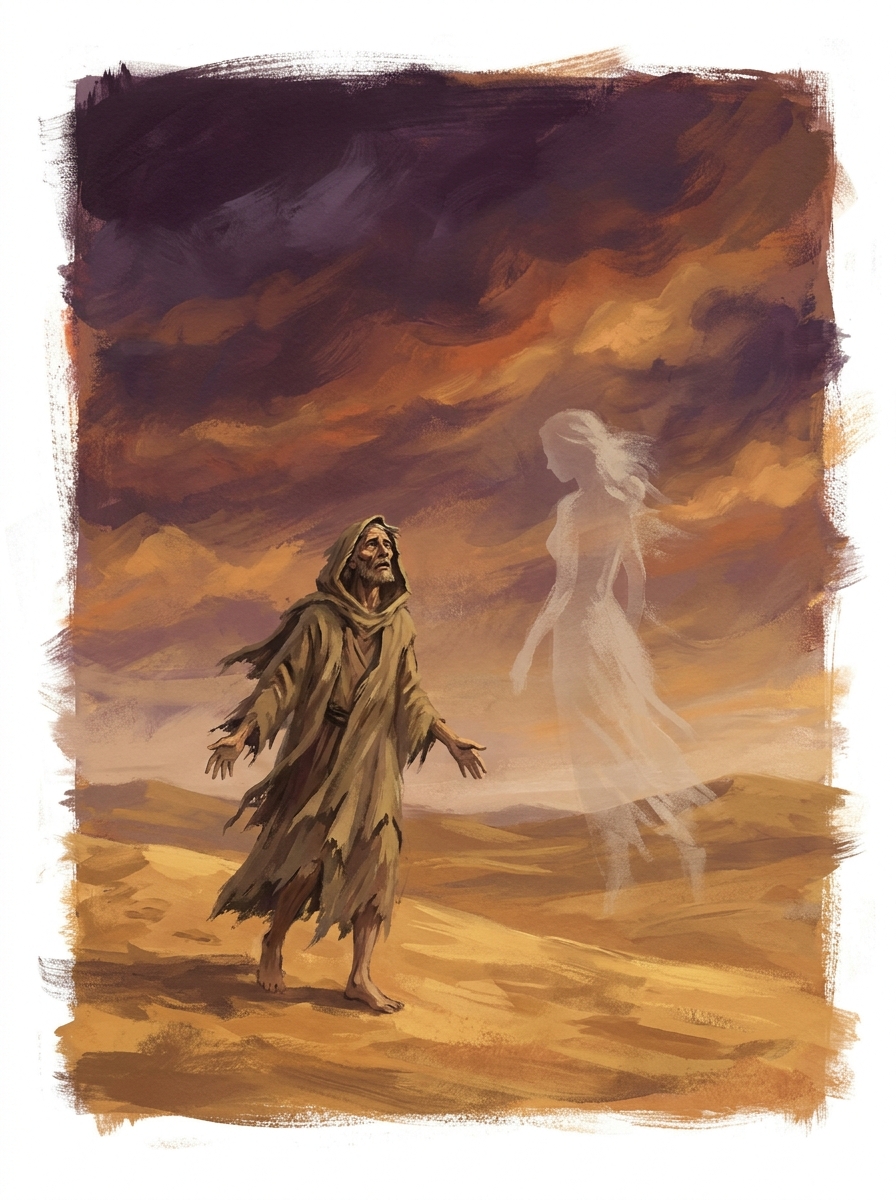
Majnun wanders the desert talking to a woman who is not there. He has been exiled from her presence, forbidden by her father to see her, separated by tribal custom and paternal authority and the entire weight of Arabian social order. He wanders anyway. He wastes away. He becomes synonymous with madness. His name literally means "the mad one." And for a thousand years of Persian and Arabic poetry, he has been a hero.
This is not self-evidently heroic. The warrior fights. The founder builds. The healer cures. The lover... loves. That's it. The lover loves with such intensity that the love itself becomes the achievement, the resistance, the transcendence. And the surrounding culture, watching the lover ruin himself for devotion, decides that the ruin is noble.
Not every culture makes this decision. That is what makes the lover the most revealing figure in the catalogue.
The Substrate
Pair bonding provides the biological floor. Humans are not uniquely monogamous among primates, but we are unusual in the intensity and duration of our pair bonds. The neurochemistry of romantic attachment, the dopamine and oxytocin and vasopressin cascades that Helen Fisher has documented at Rutgers, produces a state that resembles, at the neural level, both addiction and devotion. The lover is the figure this state produces when a culture decides to honor it rather than suppress it.
Attachment theory, from John Bowlby forward, adds the developmental layer. The infant's bond to the caregiver is the template on which all later attachments are built. The lover's devotion to the beloved recruits the same neural circuitry as the child's devotion to the parent: the same distress at separation, the same relief at reunion, the same willingness to prioritize one person's well-being above all competing claims. The lover is the adult version of the infant's cry, and the figure carries the infant's urgency.
But the substrate alone does not produce the hero. Pair bonding exists in many species. Attachment exists in every human. The lover becomes a hero only when the surrounding culture constructs a moral economy in which private devotion can function as a public virtue. This construction is not universal, which is why the lover is a conditional shape.
The Exemplars
Orpheus and Eurydice are the Greek template, and the story's power lies in its failure. Orpheus descends to the underworld to bring back his dead wife. He is told not to look back. He looks back. She is lost forever. The lover here is not the one who succeeds. The lover is the one who tries, who crosses the boundary between the living and the dead for the sake of one person, and whose failure reveals that love, even at its most heroic, does not override the order of the cosmos. The story is the counterargument built into the shape.
Layla and Majnun, formalized by Nizami Ganjavi in the twelfth century but rooted in older Arabic tradition, is the lover as absolute devotee. Majnun's love for Layla is not a relationship. It is a state of being. He does not want to possess her. He wants to be consumed by the wanting. The figure here is devotional rather than relational, which is why the Sufi tradition reads the story as a parable of divine love rather than romantic love. The beloved is the excuse for the devotion. The devotion is the point.
The bhakti saints of South India, Andal and Akka Mahadevi and Mirabai, are the lover in the devotional register at full intensity. Mirabai, a sixteenth-century Rajput princess, abandoned her marriage and her social position to devote herself to Krishna. She sang. She danced. She refused to comply with the expectations of her caste, her gender, and her family. The devotion was the rebellion, and the rebellion was the devotion. The figure here transgresses every social boundary that stands between the lover and the object of love, and the transgression is what makes the devotion heroic.
Tristan and Isolde are the European version of the transgressive lover, and their story carries the specific weight of medieval Christian culture's ambivalence about desire. The lovers are bound by a potion, not by choice. The narrative displaces the agency from the lovers to the substance, which allows the audience to sympathize with the adultery without endorsing it. The displacement is revealing. The culture wanted the figure but was not comfortable with what the figure implied about the priority of private bonds over social obligations.
Penelope is the lover as faithful waiter. She holds the household together for twenty years while Odysseus wanders. She fends off the suitors. She weaves and unweaves the shroud. The heroism here is not the dramatic gesture but the sustained refusal to give up. The lover as the one who stays.
The Variations
The transgressive lover and the faithful lover are different moral shapes. The transgressive lover, Tristan, Majnun, Mirabai, breaks the social order because the love is larger than the order. The faithful lover, Penelope, Sita, the loyal spouse across many traditions, sustains the social order through devotion. Both are lovers. Both are heroes. The difference reveals whether the culture values love as a force that disrupts or a force that holds.
The devotional lover, the bhakti saint or the Sufi ecstatic, translates romantic attachment into the register of the sacred. The beloved becomes the divine. The longing becomes prayer. The figure reveals the deep structural similarity between romantic love and religious devotion, a similarity that neuroscience has increasingly confirmed: the brain regions activated by intense romantic attachment overlap substantially with those activated by mystical experience.
The filial lover, the Confucian son or daughter whose devotion to parents functions as moral example, is the lover operating in the family rather than the couple. In cultures where filial piety outweighs romantic attachment as a social virtue, the lover hero takes the form of the devoted child rather than the devoted partner. The shape is the same. The object changes. And the change reveals the culture's priorities.
The Honest Account, and the Conditional Note
The lover hero is most fully developed where culture has made room for romantic-love traditions or devotional spiritualities. In cultures where marriage is an economic contract and devotion is owed to community rather than individual, the lover hero is rarer or appears in different shapes: the loyal friend, the filial child, the devoted servant.
This is not a hierarchy. It is a diagnostic. The lover hero requires the culture to have decided that private bonds are worth more than the social obligations they displace. That decision is not trivial. It carries costs. The lover who abandons the arranged marriage for the beloved is also the lover who disrupts the alliance the marriage was supposed to seal. The lover who abandons the family for the divine is also the child who leaves the parents without support.
The conditional quality is the essay's central interest. Why do some cultures build the scaffolding and others do not? The answer appears to track with the culture's relationship to individual agency. Cultures that prioritize collective obligation tend to produce fewer lover heroes. Cultures that prioritize individual experience tend to produce more. The lover is the hero of interiority, and interiority as a cultural value is not a given.
The figure has also been weaponized in ways specific to its nature. The romantic-love ideal, as the historian Stephanie Coontz has documented, is a relatively recent organizing principle for marriage. For most of human history, marriage was an economic and political arrangement, and the idea that it should be based on romantic love would have seemed bizarre and dangerous. The lover hero helped build the case for the transition, and the transition brought real gains in individual freedom and real losses in communal structure.
The modern version of the loss is the isolation of the couple. The lover who needs only the beloved is the lover who has no community. The figure, taken to its logical conclusion, produces a world of pairs rather than networks, and the pairs are fragile in ways the networks were not.
The Craft Turn
The lover story works when the love costs the lover something the audience values. This is the only test that matters.
Free love, without consequence or transformation, reads as romance, not heroism. The love that the audience recognizes as heroic is the love that gives up something real: status, safety, belonging, life. Orpheus gives up the promise of a normal afterlife. Majnun gives up sanity. Mirabai gives up caste and family and the entire social position her birth entitled her to. The cost is the credential.
The love must also be specific. The lover who loves everyone is a saint, not a lover. The lover who loves one person, this person, at this cost, against these obstacles, is the figure that earns the shape. The specificity is what separates devotion from abstraction.
The Return
The lover carries the cultural argument that private bonds can be load-bearing. That fidelity to one can be the highest form of fidelity to all. The figure says: what I owe to this person, right here, is not less than what I owe to the world.
The claim is not always true. Sometimes what the lover owes to the world genuinely outweighs what the lover owes to the beloved. The tradition that produces warrior heroes thinks so. The tradition that produces lover heroes disagrees. The tension is not resolved by either side winning. It is maintained by both sides existing.
The lover is the figure that keeps the private on the table when the public is trying to clear it.
Majnun Wandered the Desert for a Woman Who Wasn't There
He was exiled from her. Forbidden by her father, separated by tribal custom. He wandered anyway. He wasted away. His name literally means "the mad one." And for a thousand years of Persian and Arabic poetry, he's been a hero.
The warrior fights. The founder builds. The healer cures. The lover... loves. That's it. The lover loves with such intensity that the love itself becomes the achievement. And the surrounding culture, watching the lover ruin himself for devotion, decides the ruin is noble.
Not every culture makes that decision. That's what makes the lover the most revealing figure in the catalogue.
The Biology Is Real. The Hero Isn't Automatic.
Humans form unusually intense pair bonds. The neurochemistry of romantic attachment, documented by Helen Fisher at Rutgers, looks like both addiction and devotion at the neural level.
Attachment theory adds another layer. The infant's bond to a caregiver is the template for all later attachments. The lover's devotion recruits the same brain circuits as the child's devotion to a parent: same distress at separation, same relief at reunion.
But biology alone doesn't produce the hero. Pair bonding exists in many species. The lover becomes a hero only when the culture builds a moral system where private devotion counts as a public virtue. That construction isn't universal. The lover is a conditional shape.
Lovers Who Became Heroes
Orpheus went to the underworld to bring back his dead wife. He was told not to look back. He looked back. She was lost forever. The story's power is in its failure. Love, even at its most heroic, doesn't override the order of the cosmos.
Mirabai, a sixteenth-century Indian princess, abandoned her marriage and social position to devote herself to Krishna. She sang. She danced. She refused to comply with expectations of caste, gender, and family. The devotion was the rebellion.
Penelope is the lover as faithful waiter. She holds the household together for twenty years while Odysseus wanders. She fends off suitors. She weaves and unweaves. The heroism isn't the dramatic gesture. It's the sustained refusal to give up.
Why Some Cultures Build the Shape and Others Don't
The lover hero requires the culture to have decided that private bonds are worth more than the social obligations they displace. That decision carries costs.
The lover who abandons an arranged marriage also disrupts the alliance the marriage was supposed to seal. The lover who abandons family for the divine is also the child who leaves parents without support.
Cultures that prioritize collective obligation produce fewer lover heroes. Cultures that prioritize individual experience produce more. The lover is the hero of interiority, and interiority as a cultural value is not a given.
The modern version of the cost is the isolation of the couple. The lover who needs only the beloved is the lover who has no community. Taken to its logical conclusion, the figure produces a world of pairs rather than networks.
What Makes a Lover Story Work
The love has to cost the lover something the audience values. Free love without consequence reads as romance, not heroism.
Orpheus gives up a normal afterlife. Majnun gives up sanity. Mirabai gives up caste, family, and social position. The cost is the credential.
The love also has to be specific. The lover who loves everyone is a saint, not a lover. The lover who loves this person, at this cost, against these obstacles, is the one who earns the shape.
What the Lover Carries
The lover holds a cultural argument that private bonds can be load-bearing. That what you owe to this person, right here, is not less than what you owe to the world.
That claim isn't always true. Sometimes the world genuinely outweighs the beloved. The warrior tradition thinks so. The lover tradition disagrees. The tension isn't resolved by either side winning.
The lover is the figure that keeps the private on the table when the public is trying to clear it.