
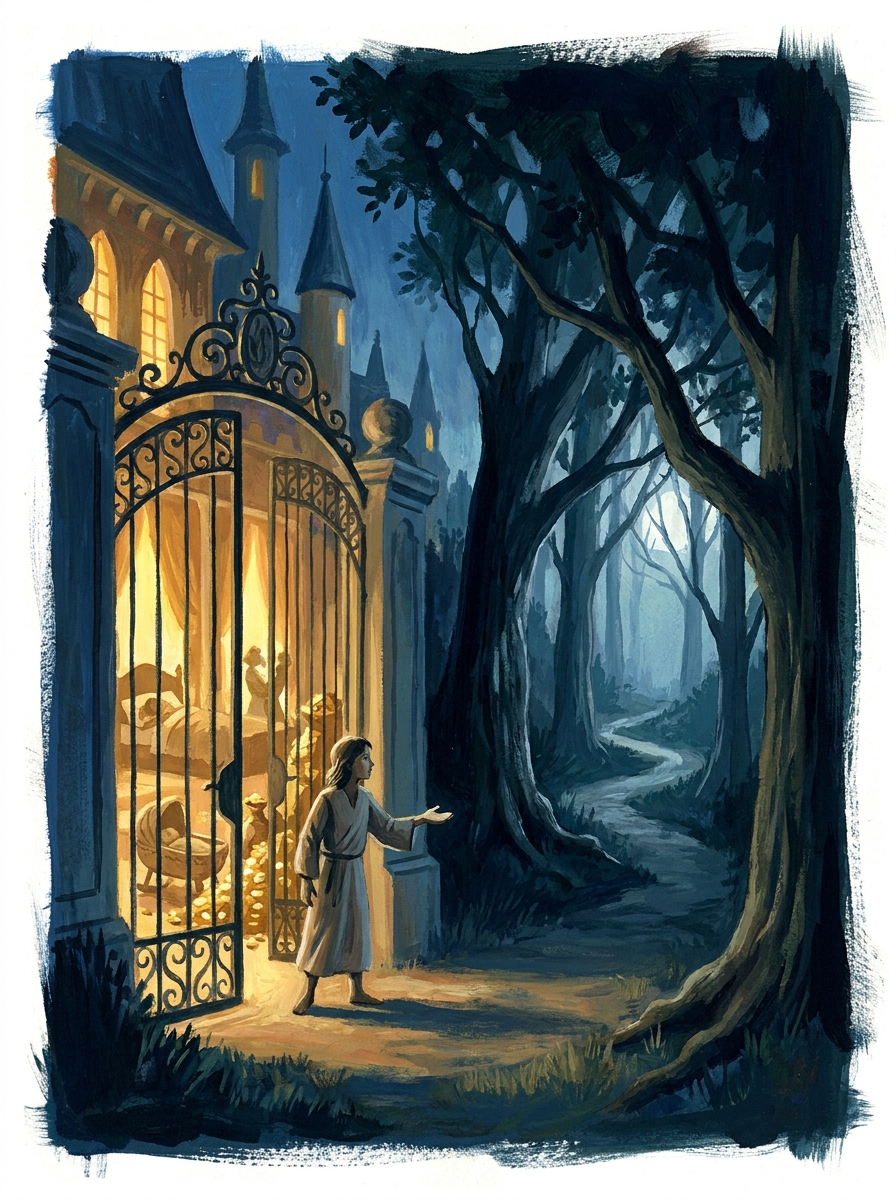
Siddhartha Gautama walked out of a palace. He left behind a wife, a newborn son, a kingdom he was born to inherit, and every material comfort the ancient world could concentrate in one person. He walked into the forest in the middle of the night. He did not come back for six years, and when he came back he was no longer the person who had left.
The story has been told for twenty-five centuries, and the part that fascinates is not the enlightenment. It is the leaving. The moment when a man who had everything looked at everything and decided it was not sufficient. Not that it was bad. Not that it was unjust. That it was not sufficient. The insufficiency is what drives the figure, and the figure is unlike any other in the catalogue.
The warrior fights. The founder builds. The healer cures. The trickster bends. The renunciate stops. The renunciate looks at the entire apparatus of human striving, the accumulation, the ambition, the status, the reproduction, the legacy, and walks away from it. And the culture that watches this walking away decides, against every material logic it possesses, that the walking away is heroic.
This decision is not universal. That is what makes the renunciate the most culturally contingent shape in the series, alongside the lover. Where the lover requires a moral economy that values private devotion, the renunciate requires a moral economy that values release. Not every culture builds that economy. The ones that do reveal something about themselves in the building.
The Substrate
Mortality salience provides the engine, but in a different register than it provides for the sacrificer. The sacrificer responds to the awareness of death by converting death into meaning: the body is given, and the giving is the point. The renunciate responds to the awareness of death by questioning whether the entire structure of meaning is itself the problem. The sacrificer redeems the game. The renunciate interrogates whether the game is worth playing.
The aspiration toward equanimity is the specific psychological substrate that distinguishes the renunciate from every other shape. William James identified the "twice-born" personality in The Varieties of Religious Experience: the person for whom ordinary happiness is not enough because they have seen through it, for whom the only peace available is the peace on the far side of disillusionment. The renunciate is the twice-born made heroic. The figure is attractive not because it promises pleasure but because it promises freedom from the tyranny of pleasure and pain alike.
Prestige detection operates here, but in its most paradoxical form. The renunciate gains prestige precisely by renouncing the things prestige is usually built from: wealth, power, sexual access, social standing. The paradox is structural, not accidental. The figure who has nothing commands attention because the having-nothing is interpreted as evidence of having found something better. The emptiness is read as fullness. The lack is read as abundance.
This reading requires cultural preparation. A society must have developed the conceptual framework within which renunciation makes sense as an achievement rather than a failure. Without that framework, the person who walks away from wealth is not a hero. They are a fool, or a coward, or someone who simply could not handle the demands of ordinary life.
The Exemplars
The Buddha is the exemplar who has shaped the figure most broadly. His renunciation is staged in four encounters that the tradition calls the Four Sights: an old man, a sick man, a corpse, and a wandering ascetic. The first three establish the problem. The fourth establishes the possibility of a response. The young prince sees that aging, sickness, and death are universal, and he sees a person who has responded to that universality by stepping outside the structures that pretend to protect against it. The response is not flight. It is recognition. The tradition insists on this distinction because the distinction is what separates the renunciate from the deserter.
The desert fathers and mothers of early Christianity represent the renunciate in the Western tradition at its most extreme. Anthony of Egypt, who went into the desert around 270 CE and stayed for decades, became the template for Christian monasticism. His renunciation was not philosophical. It was physical: he lived in a tomb, then in a ruined fort, then in a cave on a mountain. He ate bread and water. He fought demons. The struggle was literal in the tradition's own telling, and the literalness matters because it reveals what the culture believed the renunciate was actually doing. Anthony was not simply declining to participate. He was fighting a war on a front that no one else could reach.
The Hindu sannyasin occupies the fourth and final stage of the idealized life in classical Hindu thought: the stage where the householder, having raised children and fulfilled social obligations, leaves the household and wanders as a renunciant. The structure is revealing. The renunciation is not a rejection of the world. It is the world's own prescription, built into the life cycle, sanctioned and expected. The sannyasin does not defy society by leaving it. The sannyasin completes society's program by leaving it. The shape here is domesticated, which is both its strength and its limitation.
The Jain ascetic takes renunciation further than any other tradition. Mahavira, the tradition's great teacher, practiced a discipline so extreme that later Jain monasticism includes, in some lineages, the practice of sallekhana: the voluntary fast unto death. The figure here has moved beyond the renunciation of pleasure to the renunciation of the body itself. The Jain renunciate reveals the shape's logical terminus: if the world is the problem, then the most complete response is the complete withdrawal from the world, including withdrawal from the biological process that keeps you in it.
The Daoist hermit offers the counter-note. Where the Buddhist and Jain renunciates withdraw from the world because the world is suffering, the Daoist hermit withdraws because the world, specifically the social world of politics and ambition, is a distortion of something simpler and truer. The Tao Te Ching does not describe the world as suffering. It describes the social order as noise. The sage who retreats to the mountain is not escaping pain. The sage is returning to the signal that the noise has obscured. The renunciation is corrective rather than terminal.
The Variations
The total renunciate and the engaged renunciate represent the figure's fundamental fork. The total renunciate disappears: into the cave, the forest, the desert, the mountain. The engagement with the world is over. The figure's heroism is the completeness of the departure. The engaged renunciate departs and returns, or departs without entirely leaving. The Buddhist monk who teaches, the Christian monastic who runs a hospital, the Sufi who wanders from town to town offering counsel: these figures carry the renunciation back into the world as a lens through which the world can be seen differently.
The distinction is not merely practical. It is theological. The total renunciate implies that the world cannot be redeemed while you are in it. The engaged renunciate implies that the world can be changed by someone who has seen through it. The two positions produce different institutions, different ethical systems, and different relationships between the contemplative and the community that supports the contemplative.
The lay renunciate, the householder who practices renunciation without leaving the household, is the figure's most challenging variation. The Bhagavad Gita's central teaching to Arjuna is essentially a manual for lay renunciation: act, but without attachment to the fruits of action. The figure here has internalized the departure. The renunciation is not physical. It is psychological. The lay renunciate lives in the world but is not, in some essential interior sense, of the world. Whether this is achievable or simply a convenient fiction for people who want the prestige of renunciation without the cost is a question the traditions themselves have debated for millennia.
The gendered dimension is impossible to ignore. Male renunciation has been honored, institutionalized, funded, and celebrated across most traditions that produce the figure. Female renunciation has been treated with suspicion, containment, or outright suppression. The woman who walks away from family obligations is not a saint. She is a deserter, an unnatural mother, a threat to the social order that depends on her reproductive and domestic labor. The exceptions exist: the Buddhist bhikkhuni, the Christian nun, the Hindu female sannyasin. But the exceptions prove the rule. The figure is gendered in its reception even when the traditions claim it is not gendered in its possibility.
The Honest Account
The renunciate is the conditional shape, and the conditionality is the essay's central interest.
The figure appears in full force where contemplative traditions have built the scaffolding to support it: in South Asia, across the Buddhist world, in the Christian monastic traditions that drew on earlier Egyptian and Syrian asceticism, in the Sufi lineages of the Islamic world. It appears weakly or not at all in cultures that valorize productivity, lineage continuation, civic engagement, and political action as the highest goods. Classical Roman culture produced very few renunciate heroes. Traditional Chinese culture, for all its Buddhist influence, remained deeply ambivalent about the figure because the Confucian obligation to family and state pulled in the opposite direction. Modern Western culture, which has inherited the Protestant work ethic's suspicion of withdrawal, produces almost none.
The conditionality is diagnostic. A culture that produces renunciate heroes has decided, at some level, that the world as it is cannot provide what matters most. A culture that does not produce them has decided, at some level, that the world as it is is where the action is. Neither decision is self-evidently correct. Both carry costs. The culture that honors renunciation risks producing evasion, quietism, and the abandonment of social responsibility dressed in spiritual clothes. The culture that refuses renunciation risks producing a world where no one ever questions whether the race is worth running, where the only acceptable relationship to striving is more striving.
The figure has also been weaponized in ways specific to its nature. Hereditary monasticism, the system in which younger sons were deposited in monasteries not because of spiritual vocation but because of inheritance logistics, was widespread in medieval Europe and in parts of the Buddhist world. The institution of renunciation became, in practice, a mechanism for managing surplus aristocrats. The renunciate's prestige was borrowed to clothe what was essentially an economic arrangement.
The spiritual bypass is the modern version of the same corruption. The person who uses contemplative language to avoid confronting injustice, who retreats into mindfulness while the world burns, who converts the renunciate's discipline into a lifestyle brand: this is the figure stripped of its cost and sold as a consumer product. The renunciate who has not actually given anything up is not a renunciate. The figure requires the loss to be real.
Yet dismissing the renunciate entirely misses something the species has repeatedly insisted on. The recognition that some contests cannot be won by winning them, that some forms of striving produce only more striving, that the path through may sometimes be the path out: this recognition appears in too many cultures, across too many centuries, to be reducible to escapism. The renunciate is not always running away. Sometimes the renunciate is the only one who has stopped running.
The Craft Turn
The renunciate story works when the world the figure leaves is rendered with weight. This is the single most important structural principle, and it is the one most modern versions of the figure ignore.
Renunciation costs nothing if the world had nothing to offer. The Buddha's story works because the palace is real. The wealth is real. The wife is real. The newborn son is real. The audience must feel the gravity of what is being abandoned in order to feel the force of the abandoning. A character who renounces a world the audience would also happily leave has not made a sacrifice. They have made a sensible decision.
The cost must also be ongoing. The temptation narratives that appear across traditions, Anthony's demons in the desert, the Buddha's encounter with Mara under the Bodhi tree, the forty days of Christ's temptation, are not decoration. They are the narrative mechanism by which the renunciation is shown to be sustained rather than instantaneous. The renunciate who walks away once and never looks back is a simpler figure than the renunciate who walks away and keeps walking away, every day, against the pull of everything they left behind.
The cheap renunciate is the figure who was never really in the world to begin with. The character who has no attachments, no obligations, no pleasures, no skin in the game of ordinary human life, and who then "renounces" all of it. The audience recognizes the fraud even when the narrative does not. You cannot give up what you never held.
The Return
The renunciate carries the species's recognition that some games cannot be won, and that refusing to play is sometimes the highest form of play. The figure is the shape of that recognition.
The recognition is not comfortable. It implies that the ordinary structures of human meaning, the striving, the building, the accumulating, the competing, are insufficient. Not wrong. Insufficient. The renunciate does not condemn the world. The renunciate passes through it.
The figure is also the shape the species uses to ask whether there is anything beyond the game. The warrior says: fight. The founder says: build. The sage says: understand. The renunciate says: and then what? The question is not nihilistic. It is the question that every serious contemplative tradition begins with, and the traditions that begin with it have produced some of the most durable ethical systems the species has ever generated.
The empty hand is not empty because it failed to grasp. It is empty because it opened.
He Had Everything. He Walked Away.
Siddhartha Gautama walked out of a palace. He left a wife, a newborn son, a kingdom he was born to inherit, and every comfort the ancient world could concentrate in one person. He walked into the forest in the middle of the night. He didn't come back for six years.
The part that fascinates isn't the enlightenment. It's the leaving. A man who had everything looked at everything and decided it wasn't sufficient. Not bad. Not unjust. Not sufficient.
The renunciate is the figure who looks at the entire apparatus of human striving, the accumulation, the ambition, the status, and walks away. And the culture watching decides, against every material logic it has, that the walking away is heroic.
Why It Registers
The sacrificer responds to death by converting it into meaning. The renunciate responds by questioning whether the entire structure of meaning is the problem. The sacrificer redeems the game. The renunciate asks whether the game is worth playing.
The psychologist William James identified a personality type he called "twice-born": people for whom ordinary happiness isn't enough because they've seen through it. The renunciate is the twice-born made heroic. The figure attracts not by promising pleasure but by promising freedom from the whole cycle of pleasure and pain.
Here's the paradox: the renunciate gains prestige by giving up the things prestige is usually built from. Wealth, power, social standing, all gone. The emptiness is read as fullness. But this reading requires cultural preparation. Without the right framework, the person who walks away from wealth isn't a hero. They're a fool.
The Renunciate Around the World
The Buddha's Four Sights are the template: an old man, a sick man, a corpse, and a wandering ascetic. The first three establish the problem. The fourth shows there's a response. The tradition insists the response isn't flight. It's recognition.
Anthony of Egypt went into the desert around 270 CE and stayed decades. He lived in a tomb, then a ruined fort, then a cave. He fought demons. The culture believed he was fighting a war on a front nobody else could reach.
The Hindu sannyasin enters renunciation as the final stage of life, after raising children and fulfilling obligations. The renunciation isn't a rejection. It's the completion of society's own program. The shape is domesticated, which is both its strength and its limitation.
The Daoist hermit offers a different angle. The Daoist doesn't leave because the world is suffering. The Daoist leaves because the social world is noise obscuring something simpler and truer. The retreat is corrective, not terminal.
The Conditional Shape
The renunciate appears fully where contemplative traditions have built the scaffolding: South Asia, the Buddhist world, Christian monasticism, Sufi Islam. It barely appears in cultures that prize productivity, lineage, and civic engagement above all else. Classical Rome produced very few renunciate heroes. Modern Western culture, shaped by the Protestant work ethic, produces almost none.
This is diagnostic. A culture that produces renunciate heroes has decided that the world as it is can't provide what matters most. A culture that doesn't produce them has decided the world is where the action is. Neither is obviously right. Both carry costs.
The figure has also been corrupted. Hereditary monasticism in medieval Europe deposited younger sons in monasteries not for spiritual reasons but for inheritance logistics. The modern "spiritual bypass," using mindfulness language to avoid confronting injustice, is the same corruption in new clothes.
What Makes a Renunciate Story Work
The world the figure leaves has to matter. Renunciation costs nothing if the world had nothing to offer. The Buddha's story works because the palace is real. The wealth is real. The wife and son are real.
The temptation has to be ongoing. Anthony's demons, the Buddha's encounter with Mara, Christ's forty days: these show the renunciation is sustained, not instant. The figure keeps walking away, every day, against the pull.
The cheap renunciate is the character who was never in the world to begin with. No attachments, no pleasures, no skin in the game. You can't give up what you never held.
The Question
The renunciate carries the recognition that some games can't be won, and refusing to play is sometimes the highest form of play.
The warrior says: fight. The founder says: build. The sage says: understand. The renunciate says: and then what?
The question isn't nihilistic. It's the question every serious contemplative tradition begins with. And those traditions have produced some of the most durable ethical systems the species has ever generated.
The empty hand isn't empty because it failed to grasp. It's empty because it opened.