

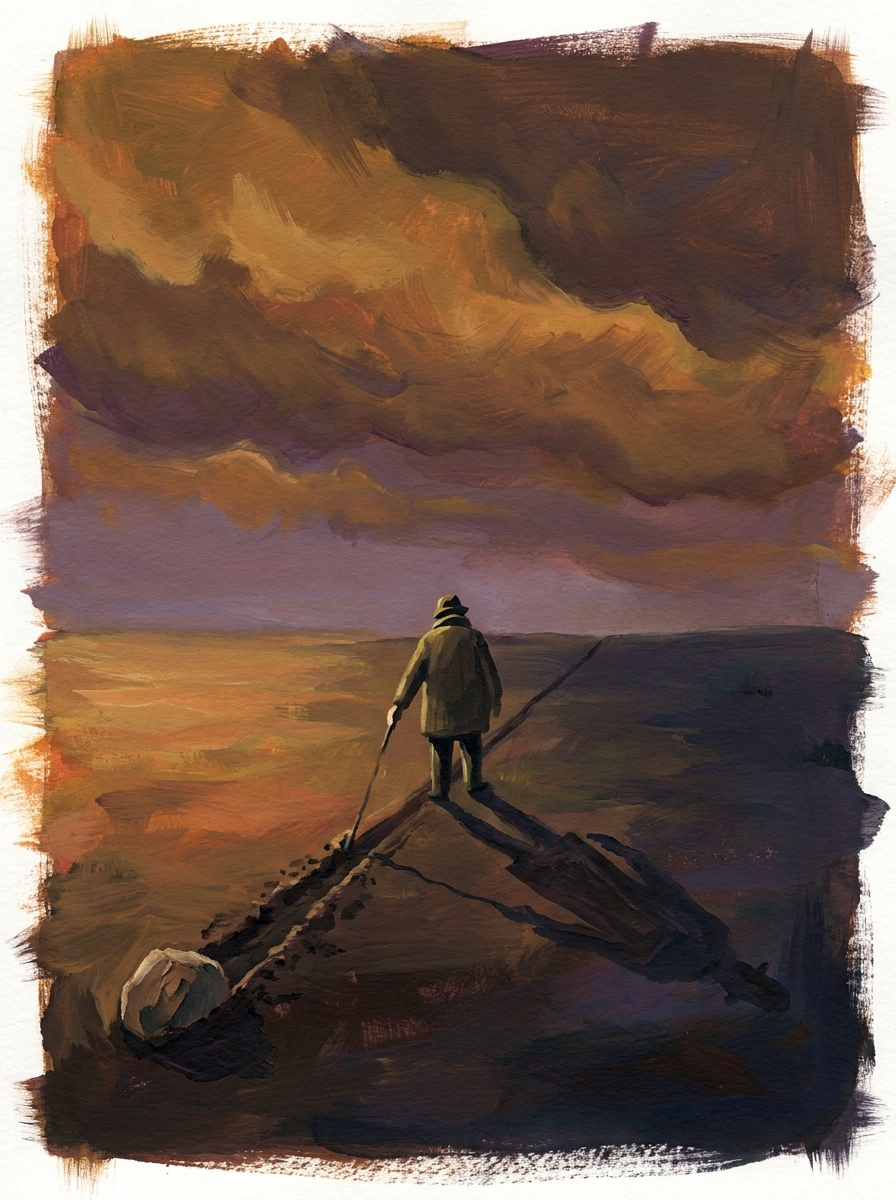
Romulus killed his brother. Then he drew a line in the dirt and said: this is the city. Anyone who crosses it without permission dies the way Remus died.
The founding of Rome begins with a murder and a boundary. The two are not unrelated. The founder is the figure who imposes order on chaos, and the imposition is never clean. Someone gets excluded. Someone gets buried under the first stone. The founder's story is always partly a story about who had to be removed so the order could begin.
This is not a Roman problem. It is a species-wide pattern.
The Substrate
The brain is an order-seeking organ. It finds patterns where none exist, imposes sequences on random events, and experiences genuine distress when the environment resists categorization. The founder is what happens when this drive scales up from the individual to the civilization.
Causal goal-tracking provides the narrative scaffolding. The brain parses intentional action through a template: problem arises, agent responds, problem resolves. The founder fits this template perfectly. There was chaos. The founder acted. Now there is order. The simplification is extreme, but the brain rewards it with satisfaction, the same satisfaction it gives when a story resolves.
Memory architecture gives the founder staying power. Pre-literate cultures used heroes as mnemonic anchors for ethics, genealogy, geography, and law. The Iliad is a memory device as well as a poem. The genealogy that traces a royal house back to a founding ancestor is a state document as well as a story. The founder holds the first link in the chain, and every link after it depends on the first one holding.
Legitimation is the political function the psychological substrate serves. The founder's story explains why the order exists, and the explanation doubles as a justification. To question the founder is to question the foundation. To question the foundation is to question everything built on it. The figure carries an implicit threat: pull this stone and the building comes down.
The Exemplars
Moses is the founder who never arrives. He leads the Israelites out of Egypt, receives the law at Sinai, wanders the desert for forty years, and dies within sight of the promised land. The founding is real. The founder's exclusion from the thing he founded is also real. The tradition that produced this story knew something about the cost of founding that smoother versions of the figure tend to lose.
Hammurabi, king of Babylon in the eighteenth century BCE, inscribed his laws on a basalt stele and attributed them to the sun god Shamash. The move is characteristic. The founder legislates, and the legislation requires a source of authority higher than the founder himself. The founder who claims to have invented the laws from scratch is vulnerable to the charge that someone else could invent different ones. The founder who received them from a god is protected by the god's permanence.
Confucius is a founder who insisted he was not founding anything. He described himself as a transmitter, not a creator, someone who was passing on the wisdom of the ancient Zhou dynasty rather than inventing something new. The claim was partly strategic. In a culture that valued precedent over innovation, the founder who presents himself as a restorer rather than an inventor gains the authority of the past rather than the fragility of the new. Confucius founded a philosophical tradition that shaped East Asian civilization for two and a half thousand years, and he did it by claiming he was merely remembering.
The immigrant patriarch in family mythology operates at the smallest scale. Every family that has moved across a border has a version of this figure: the one who made the crossing, who started the business, who built the house. The founding story organizes the family's identity the same way a national founding story organizes a nation's. The scale is different. The cognitive machinery is identical.
The Variations
The lawgiver and the state-builder are different operations wearing the same title. Hammurabi gives laws. Romulus draws boundaries. The lawgiver organizes behavior. The state-builder organizes space. Both are founders, but they found different things, and the difference matters when the founding is contested.
The cultural founder, the figure credited with inventing writing or agriculture or ritual, is the founder scaled to the species. Prometheus, Thoth, Quetzalcoatl in some traditions: these are founders whose founding is so large that the culture treats them as something more than human. The cognitive operation is the same. The scale is mythological.
The school founder, the teacher whose institution outlives them, is the founder operating in the domain of knowledge. Plato's Academy. Confucius's tradition. The Buddha's sangha. The founding of a school is a founding of a way of seeing, and the institution exists to preserve the seeing after the seer is gone.
The dynast is the founder reduced to the biological. The first king of a line. The progenitor whose descendants rule by descent rather than by merit. The dynast reveals the founder's shadow: the order that was created by one person's vision becomes the order that is maintained by another person's blood. The transition from founding to dynasty is one of the seams where the figure is most clearly doing political work.
The Honest Account
The founder is the legitimating myth of the order they founded. This is not a cynical observation. It is a structural one. Wherever there is a founder cult, there is a power structure asking not to be questioned.
The American founding is the clearest modern example. The constitutional framers are treated, in much American political discourse, as something closer to prophets than to politicians. Their intentions are divined. Their words are parsed for hidden meaning. Their authority extends across centuries in a way that would have baffled the framers themselves, most of whom expected the Constitution to be revised far more frequently than it has been. The founder cult makes the document sacred, and the sacredness makes the document harder to change, and the difficulty of change serves the interests of those who benefit from the current arrangement.
Every founder story is also a story about who was there before the founding and what happened to them. Romulus killed Remus. Moses led the conquest of Canaan. The American founders built their order on land that belonged to other nations. The Australian founding myth required the doctrine of terra nullius, the legal fiction that the continent was empty. The founder's order always displaces a prior order, and the founder's story usually minimizes the displacement.
The figure also rewards study because it reveals where a culture's load-bearing mythology actually sits. When you know who the founders are, you know what the culture is most afraid to question. And you know who benefits most from the not-questioning.
The Craft Turn
The founder story works when the order has cost. Moses never reaches the promised land. Romulus is eventually torn apart by the senators, in some versions of the myth. The founding of the Round Table ends with the destruction of the Round Table. The founder who succeeds without sacrificing anything is decorative. The figure earns its weight by paying for the order it creates.
The more interesting craft question is what happens to the founding when the founder dies. The order that depends on one person's charisma is fragile. The order that has been translated into institutions, laws, traditions is durable. Stories about founders are often really stories about translation: the moment when the founding passes from the person to the structure. The quality of the translation determines whether the founding survives.
The Return
The founder shows that culture is a thing made, by particular people, at particular cost. The figure is the seam where culture knows itself as constructed.
Every order could have been ordered differently. Every boundary could have been drawn somewhere else. Every law could have been written another way. The founder is the figure who reminds us that the arrangement we inherited was someone's decision, made under specific pressures, for specific reasons, with specific people left outside the wall.
The reminder is uncomfortable. It is also the beginning of political thought.
Every Founding Starts With a Line in the Dirt
Romulus killed his brother. Then he drew a line and said: this is the city. Cross it without permission and you die like Remus did.
The founding of Rome begins with a murder and a boundary. That's not a Roman problem. It's a species-wide pattern. The founder is the figure who creates order from chaos, and the creation is never clean. Someone always gets left outside the wall.
Why We Need Founders
The brain is an order-seeking organ. It finds patterns where none exist and feels real distress when things resist being sorted. The founder is what happens when that drive scales up from a single person to an entire civilization.
The brain also loves a good causal story: problem arises, someone acts, problem resolves. The founder fits that template perfectly. There was chaos. The founder acted. Now there's order. The simplification is extreme, but it feels satisfying.
There's also a memory function. Before writing, cultures used founders as anchors for law, lineage, and identity. The first link in the chain. Every link after it depends on that first one holding.
Founders Who Reveal the Shape
Moses leads his people out of Egypt, receives the law, wanders the desert for forty years, and dies within sight of the promised land. He never arrives. The tradition that told this story understood something about the cost of founding that smoother versions tend to lose.
Confucius insisted he wasn't founding anything. He said he was just passing on old wisdom. The claim was strategic. In a culture that valued tradition, calling yourself a "restorer" gave you more authority than calling yourself an "inventor." He founded a tradition that shaped East Asian civilization for 2,500 years while claiming he was only remembering.
The immigrant grandparent who crossed a border and started a business? Same cognitive machinery. Different scale.
The Part That Makes You Uncomfortable
The founder is always the legitimating myth of whatever they founded. Wherever there's a founder cult, there's a power structure that doesn't want to be questioned.
The American founders are treated like prophets. Their intentions are divined. Their words are parsed for hidden meaning. The founder cult makes the Constitution sacred, and the sacredness makes it harder to change, which serves whoever benefits from the current arrangement.
Every founding story is also a story about who was there before. Romulus killed Remus. The American founders built on land belonging to other nations. Australia required the legal fiction of "terra nullius," the idea that the continent was empty. The founder's story almost always minimizes whoever got displaced.
What Makes a Founder Story Work
The order has to cost the founder something. Moses never reaches the promised land. Romulus gets torn apart by senators. The founder who succeeds without paying anything is decorative.
The deeper question: what happens when the founder dies? The order that depends on one person's charisma is fragile. The order that gets translated into institutions survives. The best founder stories are really about that translation.
The Reminder
The founder shows that culture is something somebody made. Every order could have been ordered differently. Every boundary could have been drawn somewhere else.
That's uncomfortable. It's also where political thinking begins.