

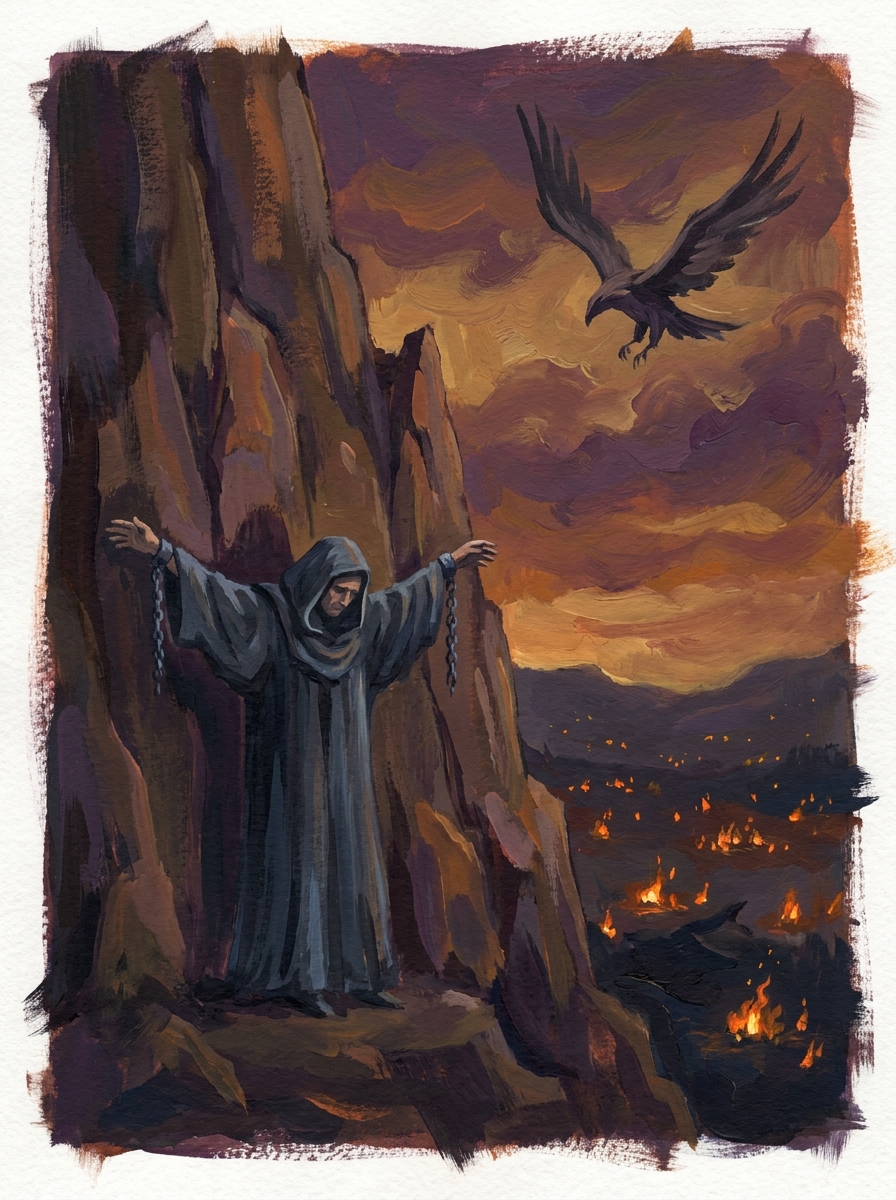
Prometheus is chained to a rock. An eagle eats his liver every day. The liver grows back every night. The punishment is eternal because the gift was permanent. He gave fire to humanity and the gods will never forgive him for it.
The sacrificer is the figure whose death, or whose suffering, gives the people something they could not obtain any other way. Not the warrior's death, which is a hazard of the fighting. Not the founder's death, which may come after the founding is complete. The sacrificer's death is the mechanism. Without it, the gift does not arrive.
This is the shape that most directly confronts the problem of meaning in the face of loss. And it is the shape most easily turned into a tool for sending people to die.
The Substrate
Mortality salience provides the foundation. Ernest Becker argued in The Denial of Death that awareness of death is the engine of human culture: everything we build, from monuments to religions to children, is partly an attempt to participate in something that will outlast the body. Sheldon Solomon, Jeff Greenberg, and Tom Pyszczynski spent forty years testing Becker's hypothesis through Terror Management Theory and found, consistently, that reminding people of their mortality increases their investment in symbolic immortality projects. The sacrificer is the most direct version of this: the person who converts literal death into symbolic permanence. The body dies. The meaning lives. The community processes the exchange and calls it sacred.
Coalition cohesion gives the sacrifice its social force. The group that has experienced a sacrificial loss is bonded by the loss in ways that no other experience can replicate. Military units know this. Religious communities know this. The shared dead are the strongest glue a group can have, and the sacrificer provides the dead in a form the group can make sense of.
Mourning and meaning-making provide the emotional mechanism. The sacrificer does not simply die. The sacrificer's death is interpreted, narrated, ritualized, and repeated until it becomes the core story around which the community organizes its understanding of itself. The death of Christ is reenacted in the Eucharist. The death of Husayn at Karbala is reenacted in Ashura. The death of the soldier is reenacted on Remembrance Day, on Memorial Day, on every national holiday that marks a military loss. The ritual is the mechanism by which the individual death becomes collective meaning.
The Exemplars
Prometheus gives fire and receives eternal punishment. The structure is clear: the gift is proportional to the cost. Anything less than eternal suffering would suggest the gift was small. The Greeks understood that the sacrificer's dignity requires the sacrifice to be catastrophic. A minor inconvenience does not earn the figure.
Christ, in the Christian tradition, is the sacrificer at cosmic scale. The death on the cross is not merely a martyrdom. It is, in the theology, a transaction: the suffering absorbs the sin of the world, and the world is redeemed by the absorption. The mechanics vary across denominations, but the shape is constant. Someone had to pay. Someone paid. The debt is clear. The sacrificer here is doing work that no other figure in the Christian catalogue can do, which is why the crucifixion is the central image of the faith and not the Sermon on the Mount. The teaching is important. The sacrifice is indispensable.
The bodhisattva who postpones nirvana in the Mahayana Buddhist tradition is the sacrificer in the contemplative register. The bodhisattva has reached the threshold of liberation and turns back, choosing to remain in the cycle of suffering until every sentient being has been liberated. The sacrifice is not death. It is the refusal of the escape. The figure gives up the one thing the tradition values most, release from suffering, in order to share the path with everyone else. The cost is measured in lifetimes, not in blood, but the structure is identical to Prometheus's.
Sundiata's mother, Sogolon, in the West African epic, is the sacrificer at the family scale. She endures humiliation, exile, and suffering so that her son can become the emperor who unifies the Manding peoples. Her sacrifice is not a single dramatic act. It is a sustained expenditure of dignity and comfort over years. The figure here is the parent who gives everything so the child can become what the parent cannot. The shape is as old as parenthood, and it is rarely honored with the same vocabulary the tradition reserves for the warrior's death or the founder's monument.
The soldier who dies for the squad is the sacrificer at the smallest collective scale. The grenade-jumper, the rear guard, the medic who runs into fire. The figure is not choosing to die. The figure is choosing not to let the others die, and the distinction matters because it preserves the sacrificer's agency. The sacrifice is not submission. It is decision.
The Variations
The cosmic sacrificer and the communal sacrificer operate at different scales with different consequences. Christ and Prometheus sacrifice for the species. The war martyr sacrifices for the nation. The parent sacrifices for the child. The scale determines the audience, and the audience determines the meaning. The same act, dying for another, carries completely different cultural weight depending on who the "other" is.
The willing sacrificer and the involuntary one raise the hardest question. Socrates drinks the hemlock willingly. The scapegoat is driven into the desert. Both serve sacrificial functions. Both provide the community with a death that organizes meaning. But the willing sacrificer has chosen, and the involuntary one has been chosen, and the difference between choosing and being chosen is the difference between the gift and the theft.
The founding sacrifice, the cornerstone victim, the death that inaugurates the structure, appears across cultures with unsettling regularity. The tradition of burying a body in the foundation of a building is documented in Europe, Asia, Africa, and the Americas. The tradition suggests that the sacrificer's work is not merely emotional or symbolic. It is structural. The community believes, at some level, that the order itself is built on a death.
The Honest Account
The sacrificer is among the most easily weaponized figures in the catalogue. This is the essay where that sentence carries the most weight.
The state that elevates the sacrificer is often the state that needs to send people to die. Military sacrifice is genuinely honored in every nation that maintains an army. It is also genuinely exploited by every nation that maintains an army. The two are not separable. The monuments to the fallen are both tributes and recruitment tools. The gold-star family is both honored and used. The figure provides the emotional architecture that makes war tolerable, and the tolerability is what allows the next war to happen.
The religious sacrificer carries similar risks. The martyr tradition in Christianity, in Islam, in Sikhism, in Judaism, has produced genuine courage and genuine fanaticism, and the line between the two is drawn by whoever writes the history. The suicide bomber believes they are making a sacrifice. The community that sent them may believe the same. The figure does not automatically distinguish between the sacrifice that serves life and the sacrifice that serves destruction.
The parent who sacrifices everything for the child is both genuinely admirable and genuinely dangerous. The sacrificial parent can become the parent who controls through guilt, the parent whose suffering is a weight the child must carry forever. "I gave up everything for you" is the sacrificer's shadow, and the shadow falls on the child.
Yet collapsing the sacrificer entirely into propaganda misses something real. The species's recognition that some persons have, in fact, given themselves for others is not a delusion. It is an observation. The grenade-jumper existed. The mother who starved so her children could eat existed. The figure honors something genuine, and the genuineness is what makes the weaponization possible. You cannot exploit a figure that carries no real weight.
The Craft Turn
The sacrificer story works when the death cannot be undone. This is the single most important structural principle.
Resurrection has its place, but it must be earned. The figure who dies and returns immediately has not made a gift. They have made a loan. The cost must be permanent, or at least must be felt as permanent for long enough that the audience processes the loss as real. Christ's resurrection works in the narrative because three days pass. The death is real. The burial is real. The followers scatter and grieve. The resurrection, when it comes, does not undo the sacrifice. It redeems it. The distinction is everything.
The cheap sacrifice is the one where the character loses nothing the audience cares about. The expendable side character who dies to motivate the hero. The mentor whose death was structurally inevitable from the first scene. The figure who is introduced in order to be killed. These deaths look like sacrifices but function as plot devices, and the audience can tell the difference, even when they can't articulate it.
The Return
The sacrificer is the figure through which the species processes the insolubility of loss. Some losses cannot be prevented. Some prices must be paid. The figure does not argue that this is good. It argues that this is real, and that the realness can be given a shape, and that the shape can carry meaning forward after the body is gone.
The figure is also a recurring instrument of state violence. Both are true. The figure does not resolve the tension.
The tension is the point. The species needs the shape. The species also needs to be suspicious of anyone who points at the shape and says: your turn.
Prometheus Gave Fire. The Gods Never Forgave Him.
Prometheus is chained to a rock. An eagle eats his liver every day. It grows back every night. The punishment is eternal because the gift was permanent. He gave fire to humanity and paid for it forever.
The sacrificer is the figure whose death, or whose suffering, gives the people something they couldn't get any other way. Not the warrior's death, which is a hazard of fighting. Not the founder's death, which might come after the founding is done. The sacrificer's death is the mechanism. Without it, the gift doesn't arrive.
This is the shape that most directly confronts the problem of meaning in the face of loss. It's also the shape most easily turned into a tool for sending people to die.
Why the Shape Has Power
Ernest Becker argued in The Denial of Death that awareness of death drives much of human culture. Everything we build, from monuments to religions, is partly an attempt to participate in something that outlasts the body. The sacrificer is the most direct version: the person who converts literal death into symbolic permanence.
The group that has shared a sacrificial loss is bonded in ways nothing else can match. Military units know this. Religious communities know this. The shared dead are the strongest glue a group can have.
The sacrificer's death doesn't just happen. It gets interpreted, narrated, ritualized, and repeated. Christ's death is reenacted in the Eucharist. The death of Husayn at Karbala is reenacted in Ashura. The soldier's death is reenacted on Memorial Day. The ritual turns individual death into collective meaning.
The Shape Across Cultures
Prometheus gives fire and gets eternal punishment. The cost is proportional to the gift. The Greeks understood that the sacrificer's dignity requires the sacrifice to be catastrophic.
Christ, in Christian theology, is the sacrificer at cosmic scale. The crucifixion is a transaction: suffering absorbs the sin of the world. That's why the cross is the central image of the faith, not the Sermon on the Mount. The teaching is important. The sacrifice is indispensable.
The bodhisattva in Mahayana Buddhism reaches the edge of liberation and turns back. The sacrifice isn't death. It's the refusal of escape. The figure gives up release from suffering to stay and help everyone else get there. The cost is measured in lifetimes, not blood, but the structure is the same as Prometheus's.
The soldier who jumps on the grenade is the sacrificer at the smallest scale. The figure isn't choosing to die. The figure is choosing not to let the others die. The distinction matters because it preserves agency. The sacrifice is decision, not submission.
The Most Weaponized Shape
The state that honors the sacrificer is often the state that needs to send people to die. Military sacrifice is genuinely honored in every nation with an army. It's also genuinely exploited by every nation with an army. The two aren't separable. The monuments to the fallen are both tributes and recruitment tools.
The religious martyr tradition has produced genuine courage and genuine fanaticism, and the line between them is drawn by whoever writes the history.
The parent who sacrifices everything can become the parent who controls through guilt. "I gave up everything for you" is the sacrificer's shadow.
Yet collapsing the figure entirely into propaganda misses something real. The grenade-jumper existed. The mother who starved so her children could eat existed. The figure honors something genuine, and the genuineness is what makes the weaponization possible.
What Makes a Sacrificer Story Work
The death can't be undone. If it's reversed immediately, it's not a gift. It's a loan. The cost must be permanent, or felt as permanent long enough for the audience to process the loss as real.
Christ's resurrection works because three days pass. The death is real. The burial is real. The followers scatter. The resurrection doesn't undo the sacrifice. It redeems it.
The cheap sacrifice is the expendable side character killed to motivate the hero. The figure introduced in order to die. These look like sacrifices but function as plot devices.
The Tension
The sacrificer is how the species processes the fact that some losses can't be prevented. Some prices must be paid. The figure says that the realness can be given a shape, and the shape can carry meaning forward after the body is gone.
The figure is also a recurring instrument of state violence. Both are true.
The tension is the point. The species needs the shape. The species also needs to be suspicious of anyone who points at the shape and says: your turn.