

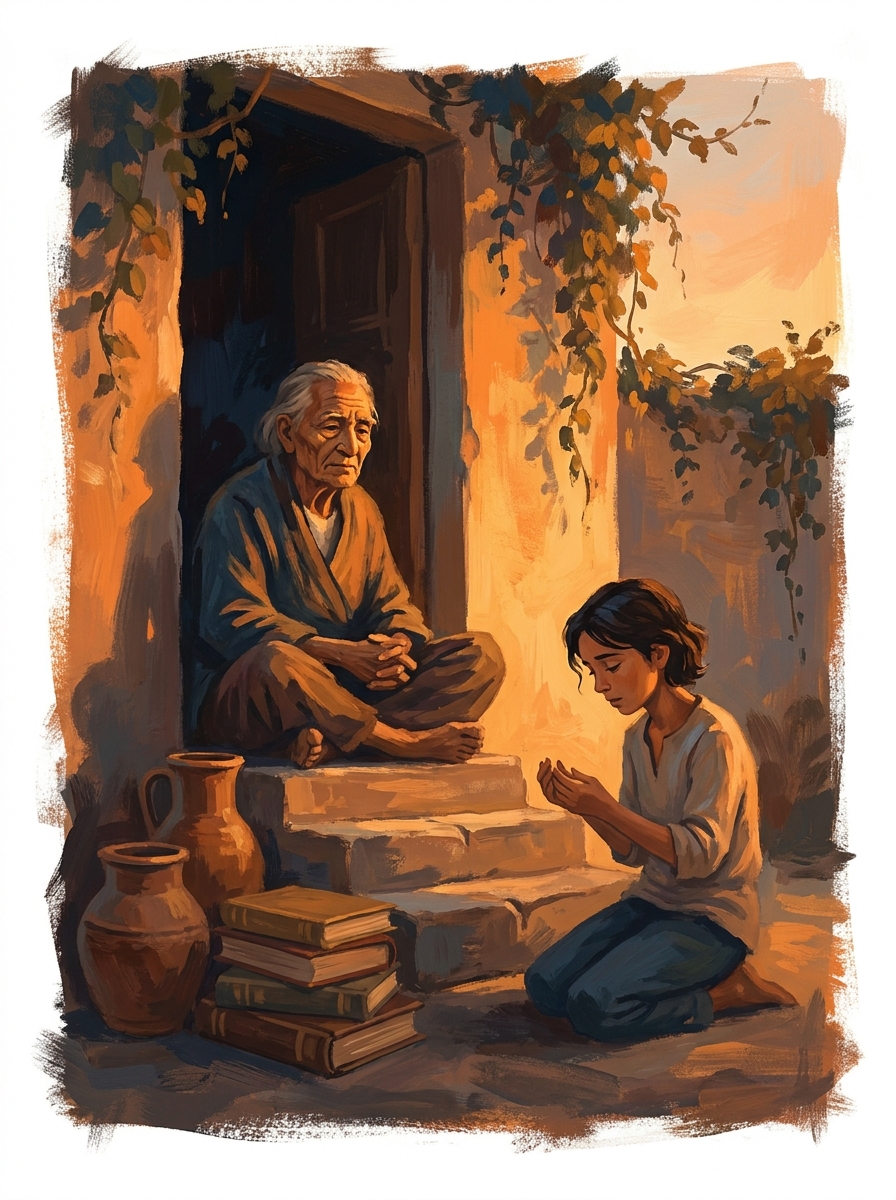
Socrates was not wise. He said so himself, repeatedly, to anyone who would listen, and some who wouldn't. What he claimed, in the Apology, was something narrower and stranger: that he was wiser than other men only because he knew he knew nothing, while they believed they knew something.
This is a peculiar foundation for a heroic figure. The warrior is strong. The founder is decisive. The sage is, by definition, someone who knows. But the sage who actually endures across cultures is not the one who has all the answers. It is the one whose knowing has changed the knower.
The distinction matters more than it sounds like it should. There are two kinds of knowledge. One is information: facts, techniques, procedures, things you can write down and hand to someone else. The other is character: the integration of what you know into how you live, the closing of the gap between understanding and action. The sage is the hero of the second kind, and the figure exists because the species has noticed, again and again, that the second kind is rarer and more valuable than the first.
The Substrate
Prestige detection is the engine. Joe Henrich's distinction between prestige and dominance reaches its purest expression in the sage. The warrior combines prestige with force. The founder combines prestige with institutional power. The sage is prestige stripped of every other component: the figure you defer to not because they can hurt you, not because they control resources, but because they see something you want to see.
Over-imitation amplifies the effect. Humans do not merely learn from sages. They copy them, down to the gestures, the mannerisms, the rhythms of speech. Confucius's followers imitated his posture. Socrates's students imitated his habit of questioning. The Buddha's disciples imitated his stillness. The imitation is not superficial. It is the means by which the character, not just the information, is transmitted. The student who copies the teacher's way of sitting is attempting to copy the teacher's way of being in the world.
The aspiration toward integration, the gap between the actual self and the ideal self, gives the sage its motivational force. The sage occupies the ideal-self slot at the cultural level: the figure who has closed the gap between knowing and being. The figure is attractive because the gap is felt by every human who has ever known the right thing to do and failed to do it.
The Exemplars
Confucius is the sage as ethical teacher. His project, in the Analerta, is the cultivation of ren, a term usually translated as "benevolence" or "humaneness" but better understood as the full realization of what it means to be human in relation to others. The teaching is relational rather than metaphysical. Confucius does not claim access to the divine. He claims attention to the human. The sage here is the person who has studied the ordinary transactions of life, parent and child, ruler and subject, friend and friend, with such care that the ordinary has become profound.
The Buddha as teacher is the sage in the contemplative register. Siddhartha Gautama's authority rests not on lineage, not on divine commission, but on the claim that he has seen the nature of suffering and found a way through it. The authority is experiential. The Four Noble Truths are not commandments delivered from a mountain. They are a diagnosis offered by someone who has been sick and recovered. The sage here is the doctor of the mind, and the prescription is a way of paying attention.
Solomon, in the biblical tradition, is the sage as judge. His wisdom is tested not through philosophical argument but through practical decision: the two women who both claim the same child, the judgment that reveals which mother is real. The wisdom here is not abstract. It is the ability to see through deception to the truth of a particular situation. Solomon's wisdom is contextual, relational, and demonstrated under pressure, which is why the story has survived three thousand years while most philosophical arguments from the same period have not.
The Daoist sage, Laozi or the composite tradition that bears his name, is the sage as paradox. The Tao Te Ching teaches by unsaying. The sage leads by following. The sage speaks by remaining silent. The sage acts by not-acting. The paradoxical structure is deliberate. The text is arguing that the deepest wisdom cannot be captured in propositions, that the moment you systematize it you have lost it. The sage here is the figure who holds knowledge that resists being held.
The grandmother in the kitchen is the sage at the smallest scale. She does not publish. She does not teach in institutions. She knows what she knows because she has lived long enough and paid enough attention to understand things that cannot be taught any other way. The figure appears in every culture and is almost never canonized, which tells you something about what cultures choose to honor and what they choose to rely on without honoring.
The Variations
The political sage advises kings. Confucius wandered from court to court seeking a ruler who would listen. Chanakya, the author of the Arthashastra, built the Maurya Empire by whispering in the right ears. Machiavelli wrote The Prince from exile, teaching rulers how to rule without being in a position to rule himself. The political sage is the figure whose knowledge is aimed at power without seeking power for itself, a position that is either the highest form of service or the most sophisticated form of cowardice, depending on who is telling the story.
The wandering sage teaches through encounter. Socrates in the Athenian agora. The Sufi masters on the road between cities. The Buddhist monks on their walking pilgrimages. The wandering sage has no institution, no endowment, no fixed address. The teaching happens in the meeting, and the meeting happens by chance, and the chance is the mechanism by which the teaching escapes institutional capture.
The mystic sage, whose knowledge cannot be transmitted in words, is the limiting case. The Zen master who answers a question with a slap. The Sufi whose teaching is a look. The desert father whose silence says more than a sermon. The mystic sage is the figure that reveals the boundary of the shape: the point where knowledge becomes something that can only be pointed at, never delivered.
The Honest Account
The sage tradition has been used to legitimate hereditary literate elites and to silence non-literate forms of knowledge. This is the figure's shadow, and it is long.
In Confucian China, the sage tradition became the foundation of the civil service examination system, which produced one of the most sophisticated meritocracies in human history and also one of the most effective mechanisms for reproducing class privilege. The examinations were theoretically open to anyone. In practice, the years of study required to pass them were available only to families that could afford to feed a student for decades. The sage tradition, theoretically egalitarian, became a gatekeeper.
The European university system followed a similar pattern. The medieval university was, in principle, open to anyone who could demonstrate intellectual capacity. In practice, it was open to men who could afford not to work, and it excluded women entirely until the nineteenth century. The sage tradition legitimated the exclusion by treating the knowledge the universities produced as the only knowledge that counted.
The figure is also disproportionately male in the canon despite an enormous female teaching tradition that goes mostly unrecorded. The grandmother in the kitchen knows things the professor does not. But the grandmother's knowledge is not called wisdom. It is called intuition, folk knowledge, common sense. The distinction is political, not epistemological.
The line between wisdom and credentialism is where the sage figure is most contested in the modern world. The expert who speaks from credentials is performing the sage role. Whether the credentials map onto the wisdom the figure is supposed to carry is the question the audience has increasingly stopped asking, which is partly why the figure has lost its cultural authority at the precise moment when it is most needed.
The Craft Turn
The sage story works when the wisdom is hard-won, demonstrated under pressure, and refuses easy systematization.
Hard-won means the sage has paid for the knowing. Socrates paid with his life. The Buddha paid with years of asceticism that nearly killed him. Confucius paid with exile and irrelevance during his lifetime. The sage who has not suffered for the knowledge cannot carry the figure's weight.
Demonstrated under pressure means the wisdom is shown in action, not in lecture. Solomon judges the case. Confucius answers the student's actual question rather than the question the student should have asked. The sage who only quotes is a librarian. The sage who acts on what they know, in the moment, under conditions that punish error, is the durable version of the figure.
Refuses easy systematization means the wisdom resists being turned into a manual. The moment the teaching becomes a twelve-step program, the figure has been converted from a sage into a brand. The teaching that survives is the teaching that remains, in some essential way, difficult.
The Return
The sage carries the species's bet that knowledge can become character. The figure is the form of that bet.
The bet is not always won. Most knowledge does not become character. Most information remains information. The sage is the exception, the figure who managed the translation, and the figure's rarity is part of what makes it worth honoring.
The species keeps making the bet because the alternative is worse. A world where knowledge never changes the knower is a world where learning is merely instrumental, where the point of knowing is always what you can do with the knowing rather than what the knowing does to you. That world is increasingly recognizable. The sage is the figure that stands against it.
Not by arguing. By being.
Socrates Said He Knew Nothing. That Was the Point.
Socrates claimed he was wiser than other men for one reason only: he knew he knew nothing, while they believed they knew something.
Strange foundation for a hero. The warrior is strong. The founder is decisive. The sage is supposed to know things. But the sages who actually last across cultures aren't the ones with all the answers. They're the ones whose knowing has changed who they are.
There are two kinds of knowledge. One is information: facts, techniques, things you can write down. The other is character: the integration of what you know into how you live. The sage is the hero of the second kind. The figure exists because the species has noticed that the second kind is rarer and more valuable than the first.
Why We Follow Sages
Joe Henrich's distinction between prestige and dominance reaches its purest form in the sage. The warrior mixes prestige with force. The founder mixes it with power. The sage is prestige stripped of everything else: the person you pay attention to because they see something you want to see.
Humans don't just learn from sages. They copy them, down to the gestures and speech patterns. Confucius's followers imitated his posture. Socrates's students imitated his questioning habit. The imitation isn't superficial. It's the method by which character, not just information, gets transmitted.
Sages Around the World
Confucius taught the cultivation of what it means to be fully human in relation to others. He didn't claim contact with the divine. He claimed close attention to the ordinary. Parent and child, ruler and subject, friend and friend, studied with such care that the ordinary became profound.
The Buddha's authority rests on experience: the claim that he saw the nature of suffering and found a way through it. The Four Noble Truths aren't commandments from a mountain. They're a diagnosis from someone who's been sick and recovered.
Solomon's wisdom is tested through practical decision, not philosophy. Two women both claim the same child. His judgment reveals which mother is real. The wisdom is specific, relational, and demonstrated under pressure.
The grandmother in the kitchen is the sage at the smallest scale. She doesn't publish. She knows what she knows because she's lived long enough and paid enough attention. The figure appears in every culture and is almost never honored with the same vocabulary as the philosopher.
The Shadow of the Shape
The sage tradition has been used to prop up literate elites and silence other forms of knowledge. In Confucian China, the civil service examination system was technically open to anyone but practically available only to families that could afford decades of study. The sage tradition, in principle egalitarian, became a gatekeeper.
The figure is disproportionately male in the canon despite an enormous female teaching tradition that goes unrecorded. The grandmother's knowledge isn't called wisdom. It's called intuition, common sense, folk knowledge. The distinction is political, not real.
Today, the line between wisdom and credentialism is where the sage is most contested. The expert who speaks from credentials is performing the sage role. Whether those credentials map onto actual wisdom is a question we've increasingly stopped asking.
What Makes a Sage Story Work
The wisdom has to be hard-won. Socrates paid with his life. The Buddha nearly died from asceticism. Confucius paid with exile and irrelevance during his lifetime.
The wisdom has to be demonstrated under pressure, not in a lecture. Solomon judges the case. The sage who only quotes is a librarian. The sage who acts on what they know, in the moment, is the one who lasts.
And the wisdom has to resist easy packaging. The moment the teaching becomes a twelve-step program, the figure has been converted from a sage into a brand.
The Bet
The sage carries the species's bet that knowledge can become character. Most knowledge doesn't. Most information stays information. The sage is the exception, and the rarity is part of what makes the figure worth honoring.
A world where knowledge never changes the knower is a world where learning is only useful for what you can do with it, never for what it does to you. That world is increasingly recognizable. The sage is the figure that stands against it.
Not by arguing. By being.