

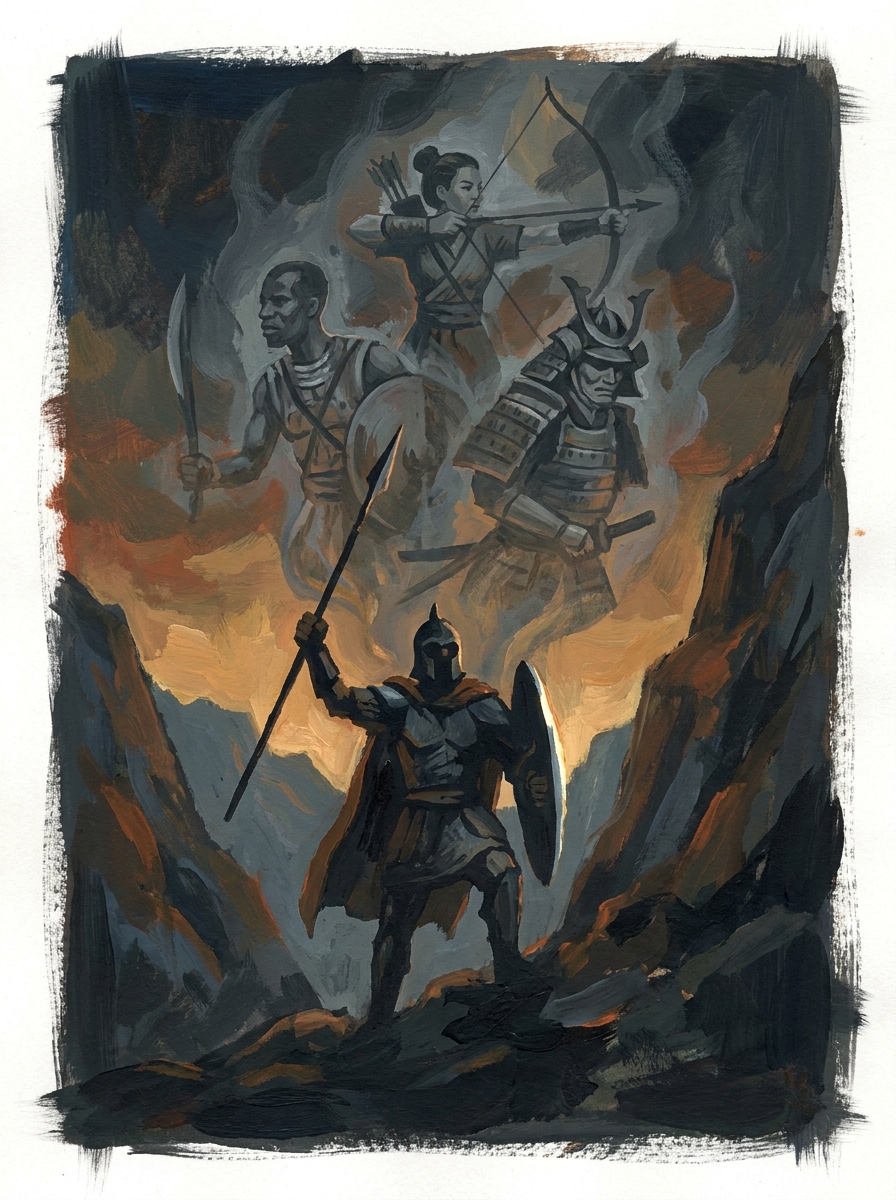
In 480 BCE, three hundred Spartans and several thousand allied Greeks held the pass at Thermopylae against a Persian army that outnumbered them by a factor historians still argue about. The Spartans died. The pass fell. The war continued. And twenty-five hundred years later, the story is still being told, still being painted, still being made into films that cost more than the entire Spartan treasury ever held.
The facts of the battle matter less than the shape of the story. A small group stands between a larger threat and the people behind them. They fight. They fall. The people survive. The shape is older than Sparta. It is older than Greece. It is older than writing.
The warrior is the first shape in the catalogue because it is the most physical, the most immediate, and the most dangerous. It is the figure whose body becomes the boundary between the group and the thing that would destroy it. And it is the shape most easily turned into a weapon.
The Substrate
The brain does not come equipped with a warrior module. But it comes equipped with the components the warrior is assembled from, and the assembly is so reliable that every culture on record has produced some version of it.
Coalition cognition is the foundation. Humans track, with extraordinary precision, who would fight for them. Michael Tomasello's work at the Max Planck Institute has documented that children as young as three show preferential helping behavior toward in-group members and preferential suspicion toward out-group members. The system is not taught. It is calibrated by experience, but the hardware is installed at the factory.
Aggression channeling sits on top of coalition cognition. Every human society must do something with its violent energies. The warrior provides a form. Not all violence, but this violence. Not all killing, but killing in defense of, killing authorized by, killing on behalf of. The distinction between the warrior and the murderer is the distinction between sanctioned and unsanctioned aggression, and the figure exists in part to make that line visible.
Then there is what Terror Management Theory calls mortality transcendence. The warrior who dies for the group does not simply die. The warrior who dies for the group enters a category that outlasts individual death. The honored dead at Thermopylae, at Gettysburg, at the Somme, at Stalingrad: the locations change, the emotional architecture is identical. The community converts the death into meaning, and the meaning converts the dead into something that survives.
The Exemplars
Achilles is the Western template, and Achilles is already a problem. He fights for glory, not for the city. His rage is personal, not civic. His withdrawal from battle costs Greek lives, and his return is motivated by the death of his companion Patroclus, not by duty. The Iliad is not a straightforward celebration of the warrior. It is an interrogation of what the warrior costs, conducted by a culture that depended on warriors for survival.
Hector is the other figure in the same poem, and Hector is the one who fights for the city. He knows he will die. He fights anyway. His farewell to his wife Andromache and his son Astyanax is one of the oldest scenes of a soldier leaving for a war he knows he won't return from. The Iliad gives us both warriors and asks the audience to sit with the difference.
Sundiata Keita, the founder of the Mali Empire in the thirteenth century, is the West African warrior whose story, preserved in the griot tradition, begins with disability. He cannot walk as a child. He is exiled. He returns, defeats the sorcerer-king Sumanguru at the Battle of Kirina, and unifies the Manding peoples. The warrior here is also the underdog and the founder. The shapes overlap.
Arjuna, on the battlefield of Kurukshetra in the Bhagavad Gita, provides the strongest counterpoint to the eager warrior. He looks across the field at his own relatives, his teachers, his friends, and refuses to fight. The entire Gita is Krishna's argument for why he must. The text does not resolve the tension cheaply. Arjuna fights, but the text never pretends the fighting doesn't cost.
Cu Chulainn, the Irish hero of the Ulster Cycle, fights in a battle-frenzy so extreme that his own people fear him. He is the protector of Ulster and also its most dangerous inhabitant. The warp-spasm, his transformation in battle, is not glorious. It is monstrous. The culture that produced him knew that the warrior's gift and the warrior's curse were the same thing.
The Variations
The defender and the conqueror are different shapes wearing the same armor. Hector defends. Alexander conquers. Both are called warriors. The distinction reveals what the surrounding culture authorized violence for.
The reluctant warrior, Arjuna's type, appears in cultures where the moral weight of violence is felt as a genuine problem. Cultures that need their warriors to hesitate before killing produce heroes who hesitate. Cultures that need their warriors eager produce heroes who are eager. The shape tracks the culture's relationship to its own violence.
The lone warrior, the ronin, the gunslinger, the knight-errant, is the warrior removed from the coalition. This figure appears when a culture is anxious about whether the warrior's loyalty serves the people or the warrior's own code. The loner is the warrior who answers to something other than the state, and the state is never quite comfortable with the answer.
The protective parent in extremis is the version of the warrior that appears in cultures that want to extend the shape beyond the male, martial template. The mother who fights for her children is a warrior figure operating outside the institutional warrior tradition, and her presence in the canon reveals a culture that recognizes the substrate (protective rage, mortality transcendence, coalition defense) without the institutional scaffolding.
The Honest Account
The warrior is the most easily weaponized figure in the catalogue. This is not a side effect. It is a design feature.
Every recruitment poster in history has been a warrior story. The Spartan dead at Thermopylae were used by the Nazi SS, who inscribed the epitaph attributed to Simonides on their own memorials. Bushido, the way of the warrior in Japan, was substantially reinvented in the early twentieth century to serve imperial militarism. The medieval knight, as a historical figure, bears limited resemblance to the knight of romance; the romance was written to legitimate a class of armed men whose actual behavior required a great deal of legitimating.
The figure is overwhelmingly gendered male in the canon. This is not because women have never fought. It is because the warrior tradition, in most cultures, serves double duty as a legitimation of patriarchal authority. The man who protects is also the man who rules. The connection is not accidental. Warrior cultures tend to be male-dominated cultures, and the figure provides the story that makes the domination feel like service.
Heroes also encode in-group preference with lethal precision. The honored death of one's own warrior implies the contemptible death of the enemy's. The Spartan dead are heroes. The Persian dead are the defeated. The figure rarely scales beyond its coalition. One culture's Thermopylae is another culture's foreign aggression.
And the warrior provides pretext for cruelty that no other figure can match. The noble cause justifies what the merely human one cannot. Wars fought in the name of a warrior tradition have a way of producing atrocities that the tradition then refuses to see, because seeing them would require seeing the figure as something other than pure.
The Craft Turn
The warrior story works when the violence costs something. This is the single most reliable diagnostic for whether a story is using the figure or selling it.
The cheap warrior suffers nothing. The fight is choreographed for spectacle. The bodies fall without weight. The hero walks away unmarked, ready for the sequel. This warrior flatters the audience without earning the figure. It is the warrior as entertainment product, stripped of the moral weight the shape was built to carry.
The durable warrior is the one who loses something that cannot be recovered. Achilles loses Patroclus and the loss transforms the meaning of the war. Arjuna kills his own teacher and the victory is poisoned by the cost. Cu Chulainn's battle-fury terrifies the people he protects, and the protection is inseparable from the terror. The warrior who costs nothing protects nothing. The figure earns its weight through what it loses.
The Return
The warrior reveals the species's bargain with violence. We do not condemn killing. We condemn unauthorized killing. The hero is the figure who does it for us, and the "for us" is the part that carries the entire moral architecture.
Every culture draws the line in a different place. Every culture has to draw the line somewhere. And the warrior is the figure who stands on the line and makes the drawing visible.
The shape is as old as coalition. It will last as long as coalitions do.
The question is not whether the warrior will keep appearing. The question is whether the cultures that produce warriors will be honest about what they are making.
Three Hundred Spartans and a Shape That Won't Die
In 480 BCE, three hundred Spartans held a mountain pass against a massive Persian army. They all died. And we're still telling the story twenty-five hundred years later.
The facts of the battle matter less than the shape. A small group stands between a threat and the people behind them. They fight. They fall. The people survive. That shape is older than Greece. It's older than writing. It's the warrior.
Why Every Culture Makes Warriors
Your brain doesn't come with a "warrior module." But it comes with the parts to build one.
First: coalition cognition. Humans track, from a very young age, who would fight for them. Kids as young as three already help in-group members and distrust outsiders. The hardware is built in.
Second: aggression channeling. Every society has violent energy. The warrior provides a form for it. Not all violence. This violence. Authorized violence. The figure exists partly to make the line between the fighter and the murderer visible.
Third: what researchers call mortality transcendence. The warrior who dies for the group enters a category that outlasts death. The honored dead at Thermopylae, at Gettysburg, at Stalingrad: the locations change, the emotional architecture is the same. The community turns the death into meaning.
The Warrior Isn't One Thing
Achilles fights for personal glory. Hector fights for his city. Arjuna, in the Bhagavad Gita, looks across the battlefield at his own family and refuses to fight at all. The entire text is an argument for why he must.
Each version reveals what a culture authorized violence for. Cultures that need warriors who hesitate produce heroes who hesitate. Cultures that need them eager produce heroes who are eager.
The Part Nobody Wants to Hear
The warrior is the most easily weaponized hero in the catalogue. Every recruitment poster in history has been a warrior story. The Nazi SS inscribed ancient Spartan epitaphs on their own memorials. Bushido was reinvented in the twentieth century to serve Japanese imperial militarism.
The figure is also overwhelmingly male in the canon. Not because women haven't fought. Because the warrior tradition, in most cultures, doubles as a legitimation of patriarchal authority. The man who protects is also the man who rules. That connection isn't accidental.
And the warrior encodes in-group preference with lethal precision. The Spartan dead are heroes. The Persian dead are "the defeated." One culture's Thermopylae is another culture's foreign aggression.
What Makes a Warrior Story Work
The violence has to cost something. The cheap warrior suffers nothing. Bodies fall without weight. The hero walks away clean, ready for the sequel. That warrior flatters the audience without earning the figure.
The durable warrior loses something that can't be recovered. Achilles loses Patroclus and the whole meaning of the war shifts. The warrior who costs nothing protects nothing.
The Bargain
The warrior reveals a deal the species made with violence. We don't condemn killing. We condemn unauthorized killing. The hero is the person who does it for us. The "for us" carries the entire moral weight.
The shape will last as long as groups do. The question isn't whether we'll keep making warriors. It's whether we'll be honest about what we're making.