

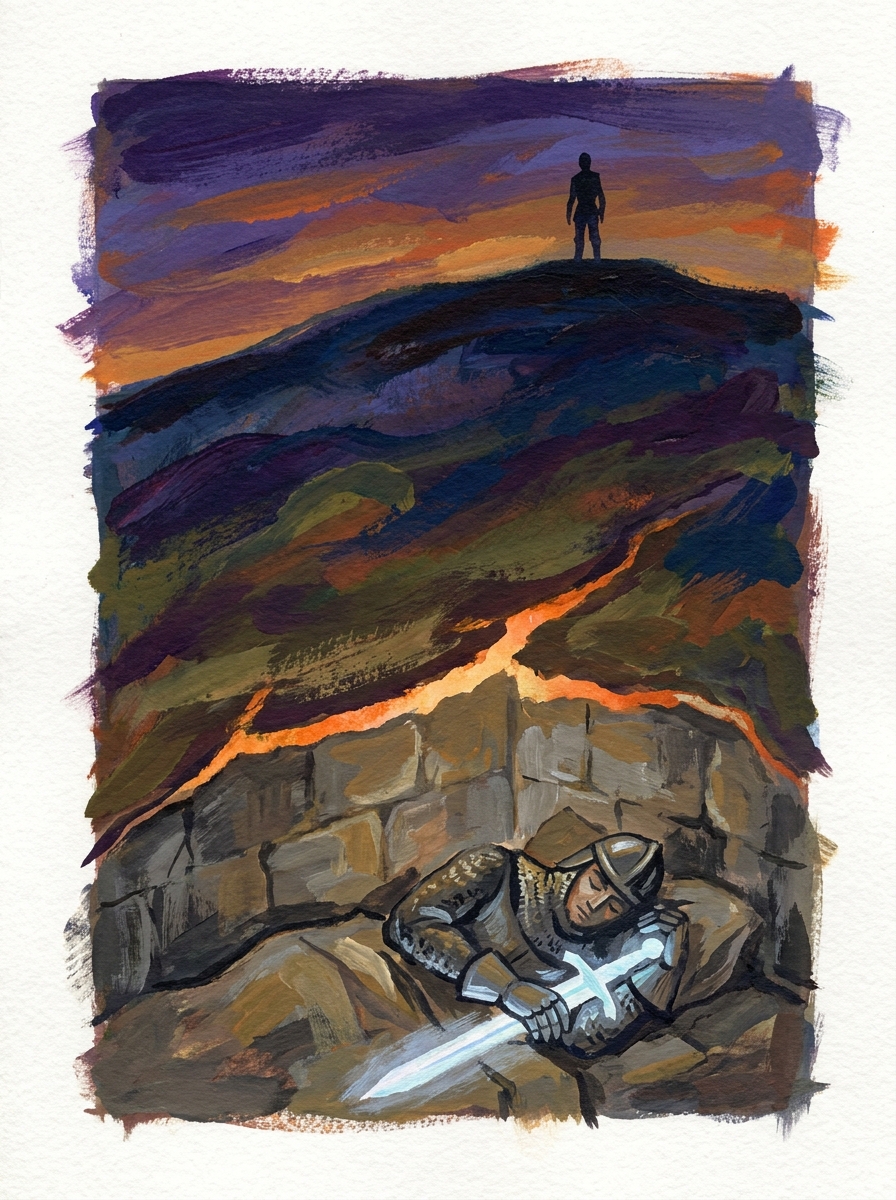
Somewhere under a hill in Britain, Arthur is sleeping. He has been sleeping since the sixth century, or the twelfth, or the fifteenth, depending on which version of the story you trust. His knights are with him. His sword is at his side. He will wake when the nation needs him most. He has not woken yet, which means either the nation has never needed him badly enough, or the story is not about waking at all.
The returner is the figure who is coming back. Not the figure who has come back. The figure who is coming back. The distinction is everything, because the returner's power lives almost entirely in the anticipation. The absent king, the hidden imam, the sleeping hero, the messiah who will appear when the conditions are right: these figures do their cultural work not by arriving but by being about to arrive. The promise is the mechanism. The fulfillment is almost always deferred.
This makes the returner the most politically volatile shape in the catalogue.
The Substrate
Hope cognition provides the foundation. The psychologist Charles Snyder defined hope as the combination of two beliefs: that a desired future is possible, and that pathways exist to reach it. The returner is hope given a face and a name. The figure converts the abstract possibility of a better future into a specific promise: this person, this return, this restoration. The conversion is what makes the figure so powerful and so dangerous. Abstract hope is flexible. Named hope is a weapon.
Cyclical renewal expectations provide the deeper substrate. The species has lived for most of its history in environments where things come back: seasons, tides, generations, the moon. The dead grain is buried and the living grain rises. The sun sets and the sun returns. The cognitive habit of expecting return is not a metaphor imposed on nature. It is a pattern extracted from nature and applied to everything else. The returner is the political and theological elaboration of a pattern the brain learned from watching crops grow.
Causal goal-tracking gives the figure its narrative power. The returner story is, at its core, a restoration narrative: an order was lost, a wrong was done, an exile occurred, and the figure who will return carries the correction. The structure maps perfectly onto the brain's appetite for resolved causation. There was a wrong. There will be a righting. The hero is the agent of the righting. The simplicity is what makes the figure irresistible, and it is also what makes the figure lie.
Legitimation is the cultural substrate. The returner does not merely promise a better future. The returner promises the restoration of a specific past. The rightful king returns. The original order is reinstated. The usurpers are overthrown. The legitimacy of whatever is being restored is built into the structure of the story itself. The returner does not ask the audience to evaluate the old order on its merits. The returner asks the audience to feel the wrongness of the old order's absence.
The Exemplars
Arthur is the Western template, and the story's structure reveals the returner's logic with unusual clarity. Arthur is the rightful king, established through the sword in the stone, a legitimacy test that cannot be faked. He is betrayed from within, by Mordred, by Lancelot, by the fractures in his own court. He falls at Camlann but does not die. He is carried to Avalon, the island from which he will return. The tradition calls him the rex quondam rexque futurus, the once and future king, and the phrase itself is the returner's complete formula. He was king. He will be king. The present is the interregnum, the gap between the real order and the temporary disorder, and the gap is what gives the figure its emotional force.
The Jewish messianic tradition is the returner at cosmic scale. The messiah will come and restore the kingdom of Israel, rebuild the Temple, gather the exiles, and inaugurate an age of universal peace. The promise has sustained a people through two millennia of exile, persecution, and catastrophe. The very durability of the expectation reveals something about the returner's function: the figure is most powerful where the loss is deepest. The messiah does not promise to improve an adequate situation. The messiah promises to reverse a catastrophe. The figure's power is proportional to the scale of what was lost.
The Hidden Imam in Twelver Shia Islam is the returner in occultation. Muhammad al-Mahdi, the twelfth imam, went into hiding in 874 CE and will return at the end of time to fill the world with justice. The concept of occultation, the idea that the returner is not dead but hidden, present but invisible, is the theological mechanism by which the promise is sustained indefinitely. The figure cannot be disproved because the figure has not failed to return. The figure simply has not returned yet. The "yet" carries the entire weight of the tradition.
The bodhisattva Maitreya in Buddhist tradition is the returner in the contemplative register. Maitreya is the future Buddha, the one who will appear when the dharma has been forgotten and the world needs re-teaching. The figure here is not a king who restores political order but a teacher who restores spiritual order. The variation reveals that the returner's structure is separable from its content. What is restored can be a kingdom, a teaching, a law, a way of life. The structure is the return. The content is variable.
The legitimate heir in folk tradition, the prince raised in hiding, the daughter who was lost and found, the child who was stolen by enemies and returns to claim what is rightfully theirs: these are the returner at the smallest scale. The pattern is among the most common in world folklore, and its commonality reveals the figure's emotional core. Someone was wrongfully displaced. Someone will be rightfully restored. The restoration is justice, and the audience's satisfaction in the restoration is the satisfaction of a fairness circuit being closed.
The Variations
The cosmic returner and the political returner carry different risks. The cosmic returner, the messiah, the Mahdi, the Maitreya, operates at the scale of divine intervention. The political returner, the rightful king, the legitimate government in exile, the old regime that will come again, operates at the scale of human power. Both promise restoration. The cosmic version invites patience. The political version invites action. The political returner is the more dangerous figure because the audience is not merely waiting for the return. The audience is expected to help bring it about.
The ancestral returner and the mythic returner differ in their relationship to time. The ancestral returner is a specific historical figure who will literally come back: Arthur, the hidden imam, the last Inca who will return from the mountains. The mythic returner is a structural promise rather than a personal one: the right leader will appear, the prophecy will be fulfilled, the conditions will align and produce the figure the age requires. The mythic version is more flexible and arguably more honest, because it does not depend on a specific person's literal return from the dead or from hiding.
The returner who actually returns is the variation the tradition least knows what to do with. Odysseus returns. Napoleon returned, twice. Charles II returned. The tradition's consistent finding is that the actual return is less satisfying than the promise of the return, because the returned figure must now govern, and governing is the one thing the returner mythology does not prepare the audience for. The king who comes back must deal with the same problems that destroyed the old order, and the mythology that sustained the waiting is no help with the dealing.
The Honest Account
Returner mythology is among the most politically explosive material in the catalogue. This is the essay where that sentence is least rhetorical.
Restorationist movements throughout history have been driven by returner narratives, and the pattern is consistent enough to be predictable. A people experiences a loss, real or perceived. An order that is remembered, accurately or not, as better than the present is elevated to the status of a golden age. A figure, historical or prophesied, is identified as the agent of restoration. And the movement that forms around the promise of restoration is given a moral urgency that no ordinary political program can match, because the movement is not merely advocating for change. It is demanding the correction of a cosmic wrong.
The Taiping Rebellion, the deadliest civil war in human history, was driven by a returner variant: Hong Xiuquan's claim to be the brother of Jesus Christ, sent to establish the Heavenly Kingdom on earth. The Ghost Dance movement among Plains nations was a returner narrative: the dead would return, the buffalo would return, the colonizers would be swept away. The Mahdist uprising in Sudan was explicitly a returner movement. The political rhetoric of "Make America Great Again" is returner mythology at the level of branding, and its effectiveness is precisely because it activates the same cognitive circuitry that has been responding to rightful-king stories for thousands of years.
The pattern reveals the figure's danger. The returner promises that a better world is not merely possible but was actual. It existed. It was taken. The taking was a crime, and the return will be justice. The structure does not require the audience to imagine a future that has never existed. It requires the audience to remember, or to believe they remember, a past that was stolen. And the stolen-past narrative is almost always, on inspection, a selective and idealized version of a more complicated history.
Every time a culture is told its lost greatness is coming back, someone is also being told they will be on the wrong side of the restoration. The usurpers will be overthrown. The outsiders who corrupted the order will be expelled. The enemies who caused the fall will be punished. The returner is the hero of those who identify with the old order, and the threat to everyone who does not.
Yet the figure is not reducible to its abuses. The Jewish messianic promise sustained a people through genuine catastrophe. The hope of Arthur's return sustained a colonized Celtic culture under centuries of English domination. The promise of Maitreya sustained Buddhist communities through periods of persecution and decline. The returner serves genuine psychological functions for people who have genuinely lost something, and the genuineness is what makes the propaganda possible. You cannot exploit a promise that carries no real weight.
The honest account holds both: the figure serves hope and the figure serves reaction, and the same cognitive machinery does both.
The Craft Turn
The returner story works when the absence has been long and costly. This is the structural principle that separates the durable returner from the cheap one.
Arthur works because the absence has lasted centuries. The messiah works because the exile has lasted millennia. The legitimate heir works because the displacement has been deep enough to reshape the world around the loss. The returner who has been gone for a weekend is not a returner. That is a person who went on a trip.
The cost of the absence must be visible. The world without the returner must be shown to be worse, specifically and concretely, than the world with the returner would be. The audience must feel the wrongness of the current order before the promise of restoration can carry weight. This is why returner stories so often begin with the depiction of corruption, decline, injustice, and decay. The darkness is the credential.
The cheapest version of the returner is the hero who leaves and comes back in the same story with no intervening loss. The departure must create a gap, and the gap must be felt, and the feeling must be sustained long enough that the return, when it comes, arrives with the force of a debt being paid. The hero who returns immediately is just a hero. The hero who returns after the world has had to live without them, and after the world has shown it cannot manage without them, is the returner.
The most honest version of the returner is the one who comes back and finds that the return does not solve the problem. Odysseus returns to Ithaca and kills the suitors, but the killing is ugly and the restoration is incomplete. The returned king discovers that the kingdom has changed in the king's absence, and the old order cannot simply be reinstated. The figure who returns to a world that has moved on is the returner at its most human, and its least mythic, which is usually where the best stories live.
The Return
The returner carries the species's refusal to let loss be final. The figure is the form of that refusal.
The refusal is not rational. Loss is often final. The dead do not return. The old order does not come back. The golden age, on inspection, was never as golden as the story makes it. The returner mythology is, in its most honest reading, a lie the species tells itself because the alternative, that some losses are permanent and some wrongs will never be corrected, is unbearable.
But the lie does work. It sustains people through periods that would otherwise be unsustainable. It provides a structure for hope when hope has no empirical basis. It says: this is not the end. Someone is coming. The order will be restored.
The figure is the last shape in the catalogue before the coda, and its placement is deliberate. The returner is the species's final bet against entropy, against decay, against the irreversibility of loss. The warrior fights the threat. The founder builds the structure. The healer mends the wound. The returner promises that even after all of them have failed, someone will come to start again.
The hill is still there. The sword is still at his side. He has not woken yet.
The species is still waiting.
Arthur Is Sleeping Under a Hill. He Hasn't Woken Yet.
Somewhere in Britain, King Arthur sleeps. His knights are with him. His sword is at his side. He'll wake when the nation needs him most. He hasn't woken yet, which means either the nation has never needed him badly enough, or the story isn't about waking at all.
The returner is the figure who is coming back. Not the figure who has come back. The distinction is everything. The returner's power lives almost entirely in the anticipation. The absent king, the hidden imam, the sleeping hero, the messiah: these figures do their work not by arriving but by being about to arrive. The promise is the mechanism. The fulfillment is almost always deferred.
This makes the returner the most politically volatile shape in the catalogue.
Why the Promise Works
The psychologist Charles Snyder defined hope as two beliefs combined: a desired future is possible, and pathways exist to reach it. The returner is hope with a face and a name. Abstract hope is flexible. Named hope is a weapon.
There's also a deeper pattern. The species spent most of its history in environments where things come back: seasons, tides, the moon. The dead grain is buried and the living grain rises. The cognitive habit of expecting return is a pattern the brain learned from nature and applied to everything else.
The returner also promises legitimacy. The figure doesn't just promise a better future. It promises the restoration of a specific past. The rightful king returns. The original order is reinstated. The story doesn't ask the audience to evaluate the old order on its merits. It asks them to feel the wrongness of its absence.
The Shape Across Cultures
Arthur is the Western template. Rightful king, established through the sword in the stone. Betrayed from within. Falls at Camlann but doesn't die. Carried to Avalon. The "once and future king." He was king. He will be king. The present is just the gap.
The Jewish messianic tradition is the returner at cosmic scale. The messiah will restore the kingdom, rebuild the Temple, gather the exiles. The promise has sustained a people through two thousand years of persecution. The figure is most powerful where the loss is deepest.
The Hidden Imam in Twelver Shia Islam went into hiding in 874 CE and will return to fill the world with justice. The concept of "occultation," the returner hidden but present, is how the promise is sustained indefinitely. The figure can't be disproved because it hasn't failed to return. It just hasn't returned yet.
The legitimate heir in folk tradition, the prince raised in hiding, the child stolen and returned: these are the returner at the smallest scale. Someone was wrongfully displaced. Someone will be rightfully restored. The audience's satisfaction is a fairness circuit closing.
The Most Dangerous Shape
Restorationist movements throughout history have run on returner narratives. The Taiping Rebellion, the deadliest civil war in human history, was driven by a returner variant. The Ghost Dance movement among Plains nations was a returner narrative. "Make America Great Again" is returner mythology at the level of branding.
The pattern: a people experiences a loss, real or perceived. An order remembered as better is elevated to golden age status. A figure is identified as the agent of restoration. The movement that forms gets a moral urgency no ordinary political program can match, because it's not just advocating change. It's correcting a cosmic wrong.
And every time a culture is told its lost greatness is coming back, someone is being told they'll be on the wrong side of the restoration.
Yet the figure isn't just propaganda. The Jewish messianic promise sustained a people through genuine catastrophe. The hope of Arthur sustained a colonized culture through centuries of domination. The returner serves real psychological needs for people who've genuinely lost something.
What Makes a Returner Story Work
The absence has to be long and costly. Arthur works because centuries have passed. The messiah works because millennia of exile have passed. The returner who's been gone for a weekend isn't a returner. That's someone who went on a trip.
The world without the returner must be shown to be worse. The audience has to feel the wrongness of the current order before the promise of restoration carries weight.
The most honest returner is the one who comes back and finds the return doesn't solve the problem. Odysseus returns and kills the suitors, but it's ugly. The old order can't simply be reinstated. That's the returner at its most human.
The Last Shape
The returner carries the species's refusal to let loss be final. The refusal isn't rational. Loss is often final. The old order doesn't come back. The golden age was never as golden as the story makes it.
But the refusal does work. It sustains people through what would otherwise be unsustainable.
The hill is still there. The sword is still at his side. He hasn't woken yet.
The species is still waiting.