

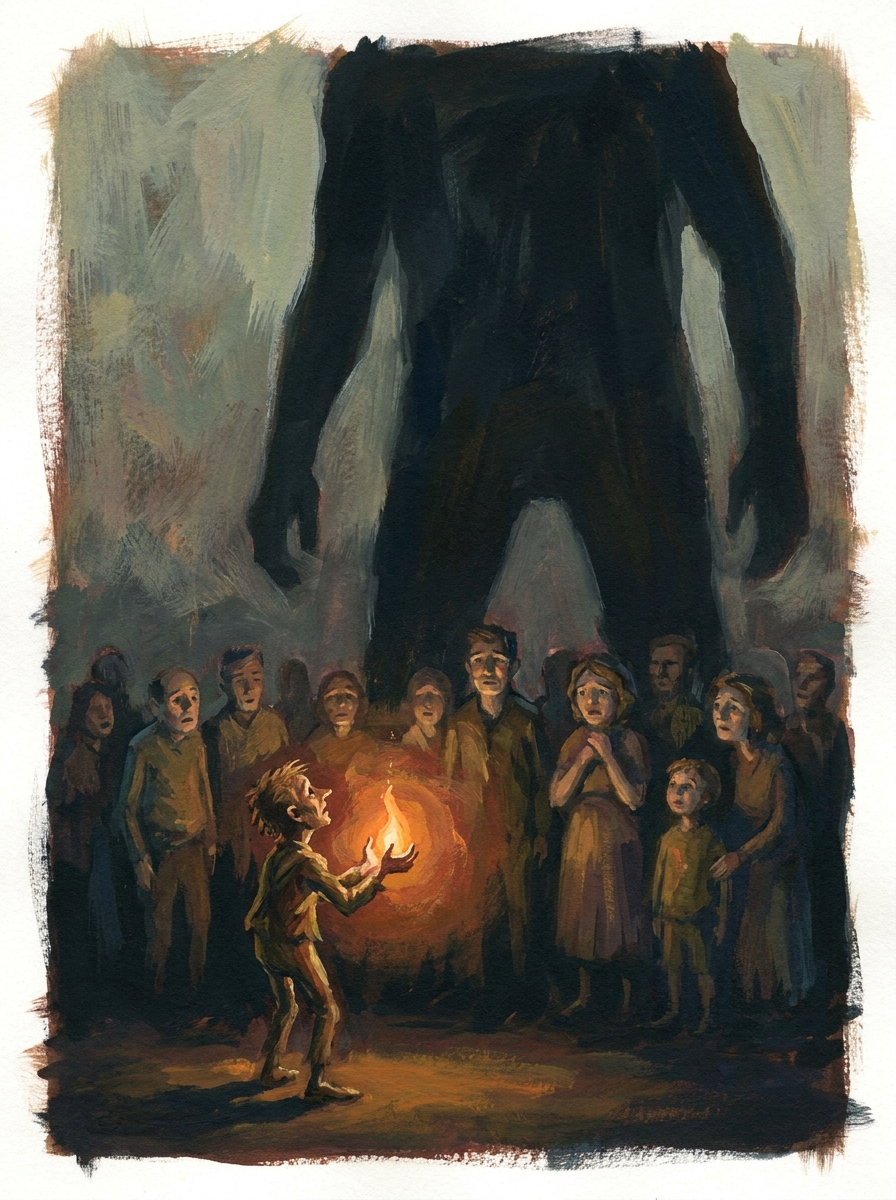
David picks up a stone. Goliath falls. Three thousand years later, every startup pitch deck in Silicon Valley is still telling the same story.
The underdog is the most emotionally reliable shape in the catalogue. You can run the experiment yourself. Tell someone a story about a powerful person who defeats a weaker one, and they will process it as information. Tell someone a story about a weaker person who defeats a more powerful one, and something happens in their chest. The response is not rational. It is not proportional. It is the activation of a system that is older than the cultures that learned to exploit it.
The Substrate
Frans de Waal's capuchin experiments at Emory demonstrated something that the field had long suspected but struggled to prove: fairness intuitions are not a human invention. Give two capuchins different rewards for the same task, and the one who receives the lesser reward will reject it entirely, sometimes throwing the food back at the researcher. The monkey would rather have nothing than tolerate an unfair distribution.
Humans have the same system, tuned higher and running constantly. We track fairness across relationships, institutions, and entire societies with an attention that borders on obsession. When the distribution is disrupted, when someone has too much and someone else has too little, the system produces discomfort. When the disruption is corrected, especially when it is corrected by the disadvantaged party, the system produces something that feels like justice.
The underdog is the cultural shape this system produces. The small defeating the large is not just a good story. It is a correction the brain has been waiting for.
The deep human attention to underdog narratives has been documented experimentally. Joseph Vandello and Nadav Goldschmied at the University of South Florida found that subjects consistently root for underdogs even when they have no stake in the outcome and even when rooting for the underdog is irrational by any strategic measure. The preference is not context-dependent. It is not culturally specific. It appears wherever researchers look for it.
The Exemplars
David and Goliath is the Western template, and it is worth noting how much the story has been simplified in the retelling. In the original text, David is not a random shepherd boy. He is already a musician in Saul's court, already anointed by Samuel, already singled out by the narrative as chosen. The "underdog" has been selected by God before the fight begins. The story is, on close reading, not a pure underdog narrative. It is a destined-king narrative wearing underdog clothes.
This complication matters because it reveals the first tension in the figure: the difference between the genuine underdog and the anointed one. The genuine underdog wins through effort, wit, or persistence against real odds. The anointed underdog was always going to win because the narrative has already decided the outcome. The second version is the cheaper one, and it dominates modern franchise storytelling.
The youngest son in folktales worldwide is perhaps the most reliably cross-cultural version of the figure. Folklorists have catalogued the pattern as a recognized tale type. In story after story, across cultures that had no contact with one another, the youngest of three brothers (or sisters) is dismissed by the family, given the worst tools, sent on the most dangerous errand, and succeeds where the older siblings fail. The youngest is the structural underdog: the one whose position in the birth order places them at the bottom of the hierarchy, and whose victory reorganizes the hierarchy around merit rather than precedence.
Sundiata Keita at his beginning is a different register of the same shape. The future emperor of Mali cannot walk as a child. He is mocked, exiled, treated as worthless by the court. His rise from disability and exile to the unification of the Manding peoples is an underdog story operating at the scale of empire. The disability is not incidental. It is the mechanism by which the narrative establishes the hero's credentials. The greater the initial disadvantage, the greater the vindication.
Cinderella crosses gender lines and cultural boundaries simultaneously. The Chinese version, Ye Xian, predates the European versions by centuries. The core is constant: a young woman of good character is reduced to servitude by the people who should protect her, and her restoration to status is accomplished through means that the powerful cannot control or prevent. The glass slipper, the pumpkin coach, the fairy godmother are surface details. The shape beneath them is the one that matters.
The Variations
The orphan, the slave, the disabled hero, and the foreign outsider are all versions of the underdog whose specific disadvantage defines the specific vindication. The orphan's triumph says: you do not need parents to be worthy. The slave's triumph says: the system that classified you was wrong. The disabled hero's triumph says: the body's limits are not the person's limits. Each variation carries a specific moral claim, and the claim reveals what the surrounding culture considers the most illegitimate form of disadvantage.
The poor scholar who beats the establishment in Chinese examination literature is the underdog operating in the domain of knowledge. The figure appears wherever a culture maintains both a meritocratic ideal and an entrenched elite. The story's popularity is diagnostic: the more the culture tells stories about poor scholars winning, the more anxious it is about whether its meritocracy actually works.
The Honest Account
The underdog narrative is also the story modern democracies tell themselves about inequality. This is where the figure becomes genuinely dangerous.
Anyone can make it. The system is fair. The cream rises to the top. If you haven't risen, the problem is effort, not structure. The underdog story, when deployed as ideology rather than narrative, becomes a mechanism for tolerating inequality. As long as there are enough visible underdogs winning, the system appears just. The exceptional success of a few becomes evidence that the failure of many is deserved.
The economist Robert Frank has written extensively about the "success and luck" problem: the tendency of successful people to attribute their outcomes to effort and talent while minimizing the role of circumstance, timing, and structural advantage. The underdog narrative reinforces this attribution. If David beat Goliath, why can't you beat yours? The answer, which the narrative systematically obscures, is that most Davids do not have a sling, do not have a God, and do not live in a story where the outcome has already been decided.
The cultural function is partly consolation. The underdog makes the hierarchy tolerable by allowing for occasional vindication. The vindication is real. The consolation is real. And the structure that produces the disparity is also real, and the narrative rarely touches it.
There is also the anointed-underdog problem. Harry Potter is the most commercially successful underdog in modern fiction, and Harry Potter is not actually an underdog. He is the chosen one, the boy-who-lived, the heir to a magical fortune, the descendant of greatness. His time under the stairs is a costume. The real underdog in the Harry Potter universe is Neville Longbottom, and the story gives him a supporting role.
The franchise consistently prefers the anointed underdog to the genuine one, because the anointed version is safer. The genuine underdog's victory questions the hierarchy. The anointed underdog's victory confirms it. The system was right all along. The cream rose. The prophecy was fulfilled. The audience goes home comforted rather than challenged.
The Craft Turn
The underdog story works when the disadvantage is real and the victory is costly. These are the two tests, and most modern versions of the figure fail one or both.
A real disadvantage means the character lacks something that cannot be willed away. Neville is clumsy and underestimated and has to earn every inch. That is a real disadvantage. Harry is temporarily inconvenienced by his aunt and uncle. That is a costume.
A costly victory means the character gives up something in the winning. The youngest son who defeats the dragon but cannot go home afterward. The slave who wins freedom but loses the community that sustained them in captivity. The cost is what separates the underdog story from the wish-fulfillment fantasy. Without cost, the vindication is hollow.
The Return
The underdog reveals the species's ambivalence toward hierarchy. We accept rank. We also cheer when rank breaks. The two impulses coexist in the same nervous system, and the figure carries both without resolving them.
The ambivalence is not a flaw. It is the engine of political life. Societies that feel no tension about their hierarchies are societies that have stopped questioning them. Societies that feel nothing but tension about their hierarchies are societies that cannot maintain them long enough to function.
The underdog holds the tension. The figure says: the small can beat the large. The figure does not say: the small always beat the large. The gap between the two sentences is where the politics lives.
David Picks Up a Stone. Three Thousand Years Later, We're Still Telling the Same Story.
The underdog is the most emotionally reliable shape in the catalogue. Tell someone a story about a powerful person beating a weaker one and they'll process it as information. Tell them a story about a weaker person beating a more powerful one and something happens in their chest.
That response isn't rational. It's the activation of a system older than any culture that learned to exploit it.
Your Brain Has a Fairness Module
Frans de Waal's experiments at Emory showed that capuchin monkeys will reject a reward entirely if the monkey next to them gets a better one for the same work. The monkey would rather have nothing than tolerate an unfair deal.
Humans have the same system, running constantly. We track fairness across relationships, institutions, and entire societies. When the distribution is disrupted and then corrected, especially by the disadvantaged party, we feel something that registers as justice.
The underdog is the cultural shape this system produces. The small defeating the large isn't just a good story. It's a correction the brain has been waiting for.
The Shape Shows Up Everywhere
David and Goliath is the Western template, but look closely: David is already anointed by God before the fight. He's a destined king wearing underdog clothes. The difference between the genuine underdog and the anointed one is the first tension in the figure.
The youngest son in folktales worldwide is more honestly cross-cultural. Folklorists have catalogued it as a recognized pattern. In story after story, across cultures with no contact, the youngest is dismissed, given the worst tools, sent on the hardest errand, and succeeds where older siblings fail.
Cinderella crosses gender lines and cultural boundaries. The Chinese version, Ye Xian, predates the European versions by centuries. The core is constant: someone of good character is reduced to nothing, and their restoration can't be controlled or prevented by the powerful.
The Dangerous Part
The underdog narrative is also the story modern democracies tell themselves about inequality. Anyone can make it. The system is fair. If you haven't risen, the problem is effort, not structure.
The economist Robert Frank has written about how successful people attribute their outcomes to effort while minimizing luck and structural advantage. The underdog narrative reinforces this. If David beat Goliath, why can't you? The answer the narrative hides: most Davids don't have a sling, don't have a God, and don't live in a story where the outcome was already decided.
Then there's the anointed-underdog problem. Harry Potter is the most successful underdog in modern fiction, and he's not actually an underdog. He's the chosen one, heir to a magical fortune. His time under the stairs is a costume. The real underdog is Neville Longbottom, and the story gives him a supporting role.
Franchises prefer the anointed underdog because it's safer. The genuine underdog's victory questions the hierarchy. The anointed one confirms it.
What Makes an Underdog Story Work
Two tests. The disadvantage must be real, not a temporary costume. And the victory must be costly, not a wish-fulfillment fantasy. The youngest son who defeats the dragon but can't go home afterward. The slave who wins freedom but loses the community that sustained them. Without cost, the vindication is hollow.
The Tension That Drives Everything
The underdog reveals something we carry in the same nervous system: we accept rank, and we cheer when rank breaks. Both impulses coexist.
That ambivalence isn't a flaw. It's the engine of political life. Societies that feel no tension about their hierarchies have stopped questioning them. Societies that feel nothing but tension can't maintain them long enough to function.
The underdog holds the tension. The small can beat the large. The small don't always beat the large. The gap between those two sentences is where the politics lives.