

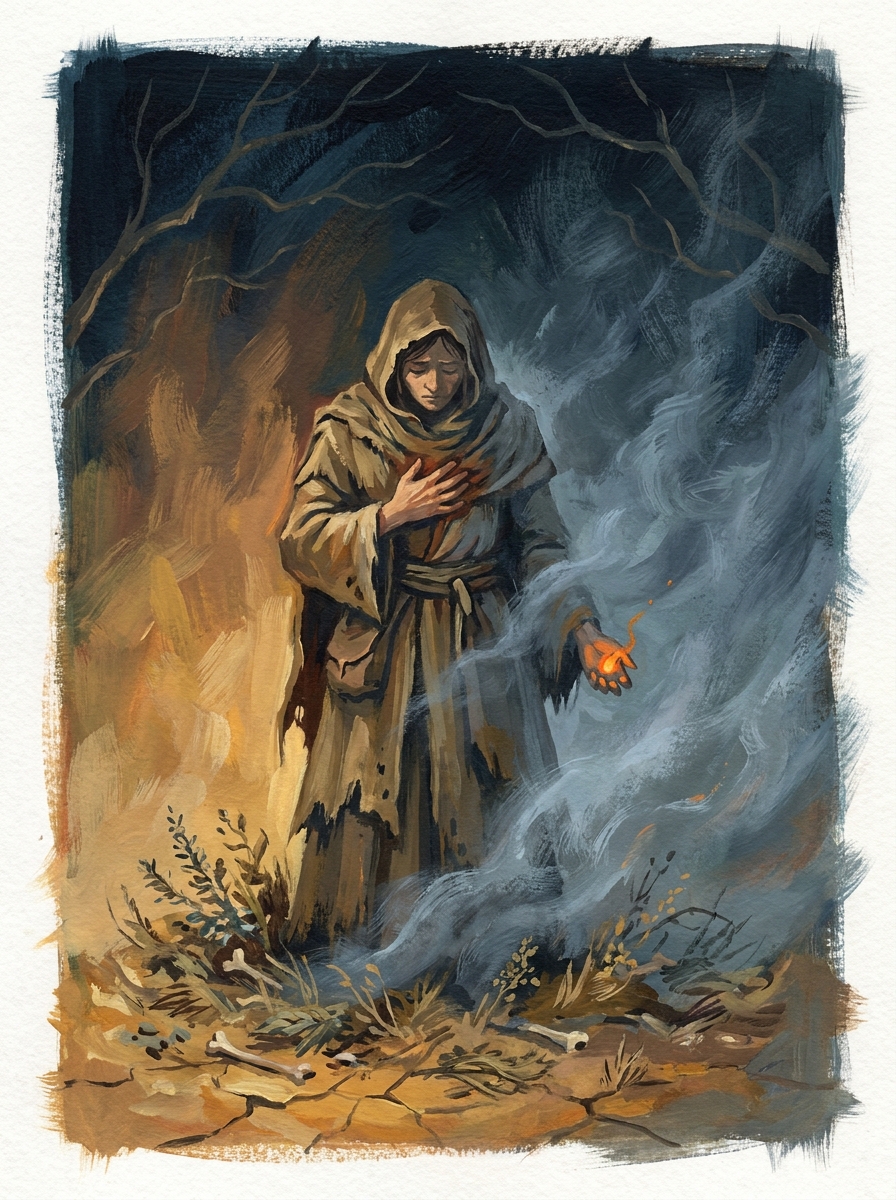
The shaman returns from the spirit world sick. This is the part that modern retellings consistently leave out. The journey is not a vacation. The boundary the healer crosses, between the world of the well and the world of the afflicted, is a real boundary, and crossing it costs something real. The healer who comes back unscathed has not been where the illness lives.
This pattern, the wounded healer, appears so consistently across cultures that the psychiatrist Carl Jung named it and the anthropologist Mircea Eliade documented it across five continents. The shaman's initiatory illness, the crisis that breaks the person and rebuilds them as someone who can see what others can't, is the origin story of the healing figure in nearly every pre-modern tradition.
The healer is the third shape in the catalogue, and it is the one most consistently undervalued. The warrior gets the monument. The founder gets the institution. The healer gets the back door and the middle of the night.
The Substrate
The neural substrate of care is among the oldest systems in the mammalian brain. Parental care behavior, mediated by oxytocin and vasopressin, is not a human invention. It predates primates. It predates mammals in some forms. The impulse to approach suffering rather than flee it, to tend to a distressed body rather than abandon it, is wired into the species at a level deeper than culture.
But the healer is not simply the caring person. The healer is the caring person who crosses a threshold.
Liminal cognition, the brain's heightened attention at boundaries, provides the structural element. The healer stands between the sick and the well, between the known and the unknown, between the ordinary world and whatever lies on the other side of the symptoms. The position is inherently unstable. The healer who is fully in the world of the well cannot see the illness. The healer who is fully in the world of the sick cannot bring anything back. The figure works because it occupies the line.
Threat resolution provides the social function. The community faces a problem it cannot solve through ordinary means. Someone must go where the problem lives, learn something about it, and return with the means to address it. This is the healer's narrative, and it maps onto the broader structure of all quest narratives. The healer's quest happens to be aimed at suffering rather than treasure, which is why the figure has lower cultural status than the warrior or the founder despite doing work that is equally old and arguably more necessary.
The Exemplars
Asclepius, the Greek god of medicine, was the son of Apollo and a mortal woman. He learned healing from the centaur Chiron, himself a wounded figure, an immortal who carried an incurable wound. The teaching lineage is instructive: the wounded teach the wounded to heal. Asclepius became so skilled that he could raise the dead, and Zeus killed him for it. The message is not subtle. The healer who crosses the final boundary, who reverses death itself, threatens the order of the cosmos. The figure is powerful precisely because it operates at a boundary that the gods themselves want policed.
The circumpolar shaman, documented across Siberian, Central Asian, and indigenous North American traditions, follows a pattern so consistent that it constitutes one of the strongest cross-cultural data points in the catalogue. The future shaman becomes ill. The illness is understood as a dismemberment, a death, a journey to the spirit world. The shaman returns with knowledge, specifically the knowledge of how to make the journey voluntarily and bring others back from it. The illness is the credential.
Imhotep, the Egyptian polymath of the twenty-seventh century BCE, was a historical person who was later deified as a god of healing. His trajectory, from practitioner to god, reveals the cultural mechanism by which the healer is elevated. The community needs the healing function so badly that it makes the healer sacred, and the sacredness protects the function from the ordinary political forces that would otherwise consume it.
The female herbalists of European peasant cultures operated without institutional backing, without titles, without the protection of sacredness. They knew plants. They knew bodies. They knew birth and death at close range. They were the first-line healers for the vast majority of the European population for centuries, and they were systematically displaced, first by the accusatory cultures of the witch-trial period, then by the professionalization of medicine in the modern era. The history of women healers is partly a history of erasure, and the erasure reveals how much the healer's status depends on institutional recognition rather than on the work itself.
The Variations
The technical healer and the intercessory healer represent two different theories of what illness is. The technical healer, the physician, treats illness as a mechanical problem. The intercessory healer, the saint who prays for the sick, treats illness as a relational problem between the sufferer and some larger order. Both are healers. Both are using the same cognitive shape. The difference lies in what the surrounding culture believes illness means.
The shamanic healer, the boundary-walker who travels to where the illness lives, is the most complete version of the figure because it preserves all the substrate elements: the threshold crossing, the cost, the return with knowledge. Modern medicine has stripped the threshold and the cost from the healer's role, which is partly why the figure has lost its narrative weight even as the technical capacity has increased beyond anything the shamans could have imagined.
The wounded healer is not a variation so much as a revelation of the figure's core logic. The healer who has not suffered cannot see the suffering clearly. The healer who has suffered and survived carries knowledge that cannot be taught, only lived through. Jung was drawing on a tradition far older than psychology when he observed that the doctor's own wound is the source of the doctor's healing power.
The Honest Account
The healer is the figure most often gendered female and least often canonized. This is not a coincidence. It is a record of how cultures distribute honor.
The healing tradition has been suppressed wherever it has been women's tradition. The European witch trials, between roughly 1450 and 1750, killed an estimated forty to sixty thousand people, the majority of them women, many of them local healers whose knowledge threatened the authority of emerging male-dominated medical institutions. The connection between the witch and the healer is not metaphorical. In many communities, the same woman was both, and the accusation was the mechanism by which the healing function was transferred from women's networks to institutional medicine.
The professionalization of healing in the modern era completed the transfer. The midwife was replaced by the obstetrician. The herbalist was replaced by the pharmacist. The village healer was replaced by the licensed physician. Each replacement brought real gains in technical capacity and real losses in relational knowledge. The modern doctor knows more about the body than any shaman who ever lived. The modern doctor also, in many cases, knows less about the patient.
The healer has also been used to legitimate hierarchies of knowledge. The sage and the healer overlap in cultures where healing is understood as a form of wisdom, and the overlap can produce gatekeeping. Who gets to heal, who gets to decide what counts as healing, and who gets to profit from the distinction are political questions that the figure's narrative tends to obscure.
The Craft Turn
The healer story works when the cure costs the healer. This is the diagnostic. The healer who fixes people painlessly, whose power operates like a technology rather than a sacrifice, has been flattened to a plot device. The figure earns its weight by paying for the healing.
The strongest healer stories are stories about the threshold. The healer goes where the patient cannot go, sees what the patient cannot see, and brings something back that makes the passage unnecessary for the patient. The cost is borne by the healer. The gift is given to the sick. The structure is sacrificial, which is why the healer and the sacrificer overlap at their deepest level.
Stories that use the healer as a vending machine, insert symptom and receive cure, are using the costume without the figure inside it.
The Return
The healer is the species's insistence that suffering is not the end of the story. The figure exists to keep that insistence on file.
The insistence is not always justified. Some suffering has no cure. Some crossings have no return. The healer cannot fix everything, and the culture that expects the healer to fix everything will break the healer trying.
But the insistence matters. The species has been walking the boundary between the sick and the well for as long as there have been species members who stopped running and turned back to help. The shape carries that turning back. It carries the cost of it. And it carries the refusal to let the cost be the last word.
The Healer Comes Back Sick
Here's the part modern stories leave out: the shaman returns from the spirit world sick. The journey isn't a vacation. The boundary the healer crosses, between the well and the afflicted, is real. Crossing it costs something real. The healer who comes back unscathed hasn't been where the illness lives.
This pattern, the wounded healer, appears so consistently across cultures that the psychiatrist Carl Jung named it and the anthropologist Mircea Eliade found it on five continents. The healer's initiatory illness, the crisis that breaks them and rebuilds them, is the origin story of healing in nearly every pre-modern tradition.
Why This Shape Exists
The impulse to approach suffering instead of running from it is wired deep. Parental care behavior, driven by oxytocin, predates primates. It predates mammals. The urge to tend to a distressed body is older than culture.
But the healer isn't just the caring person. The healer is the caring person who crosses a threshold.
The healer stands between the sick and the well, between the known and the unknown. The position is unstable by design. A healer fully in the world of the well can't see the illness. A healer fully in the world of the sick can't bring anything back. The figure works because it sits on the line.
Healers Across the World
Asclepius, the Greek god of medicine, learned healing from Chiron, a centaur who carried an incurable wound. The wounded teaching the wounded to heal. Asclepius got so good he could raise the dead, and Zeus killed him for it. The message: the healer who crosses the final boundary threatens the entire cosmic order.
The circumpolar shaman, documented across Siberia, Central Asia, and indigenous North America, follows the same pattern everywhere. The future shaman gets sick. The sickness is understood as a death and rebirth. The shaman comes back with knowledge. The illness is the credential.
The female herbalists of European peasant culture had no titles, no institutions, no protection. They knew plants and bodies and birth and death. They were the healers for most of the population for centuries. Then they were systematically displaced, first by witch trials, then by the professionalization of medicine.
The Shadow Side
The healer is the figure most often gendered female and least often honored. That's not coincidence. It's a record of how cultures distribute credit.
The European witch trials killed an estimated forty to sixty thousand people, mostly women, many of them local healers. The accusation was often the mechanism that transferred healing from women's networks to male-dominated medical institutions.
Modern medicine completed the transfer. The midwife became the obstetrician. The herbalist became the pharmacist. Each replacement brought real gains in technical knowledge and real losses in relational care. The modern doctor knows more about the body than any shaman who ever lived. The modern doctor also, often, knows less about the patient.
What Makes a Healer Story Work
The cure has to cost the healer. A healer who fixes people painlessly, whose power works like a vending machine, has been flattened to a plot device.
The strongest healer stories are about the threshold. The healer goes where the patient can't go, sees what the patient can't see, and brings something back. The cost is borne by the healer. The gift goes to the sick.
Still Turning Back
The healer is the species's insistence that suffering isn't the end of the story. Some suffering has no cure. Some crossings have no return. But the species has been walking the boundary between the sick and the well for as long as there have been people who stopped running and turned back to help.
The shape carries that turning back. And it carries the refusal to let the cost be the last word.